

Three years.
Three years of creators arguing about whether the detectors work. Whether the seams show. Whether anyone besides them actually cares. (Spoiler from someone who’s personally cared about all of this for at least three years: not really, occasionally, almost no one, and the third answer makes the first two irrelevant.)
Three years of energy spent on a question that was rigged from the start, by an audience that was never asking it. (Worth saying out loud at least once. Three years. Down the crapper.)
I’ll be blunt: detection-proofing is the most embarrassing vanity project the creator economy’s produced this decade. And we’ve produced some real shitty ones.
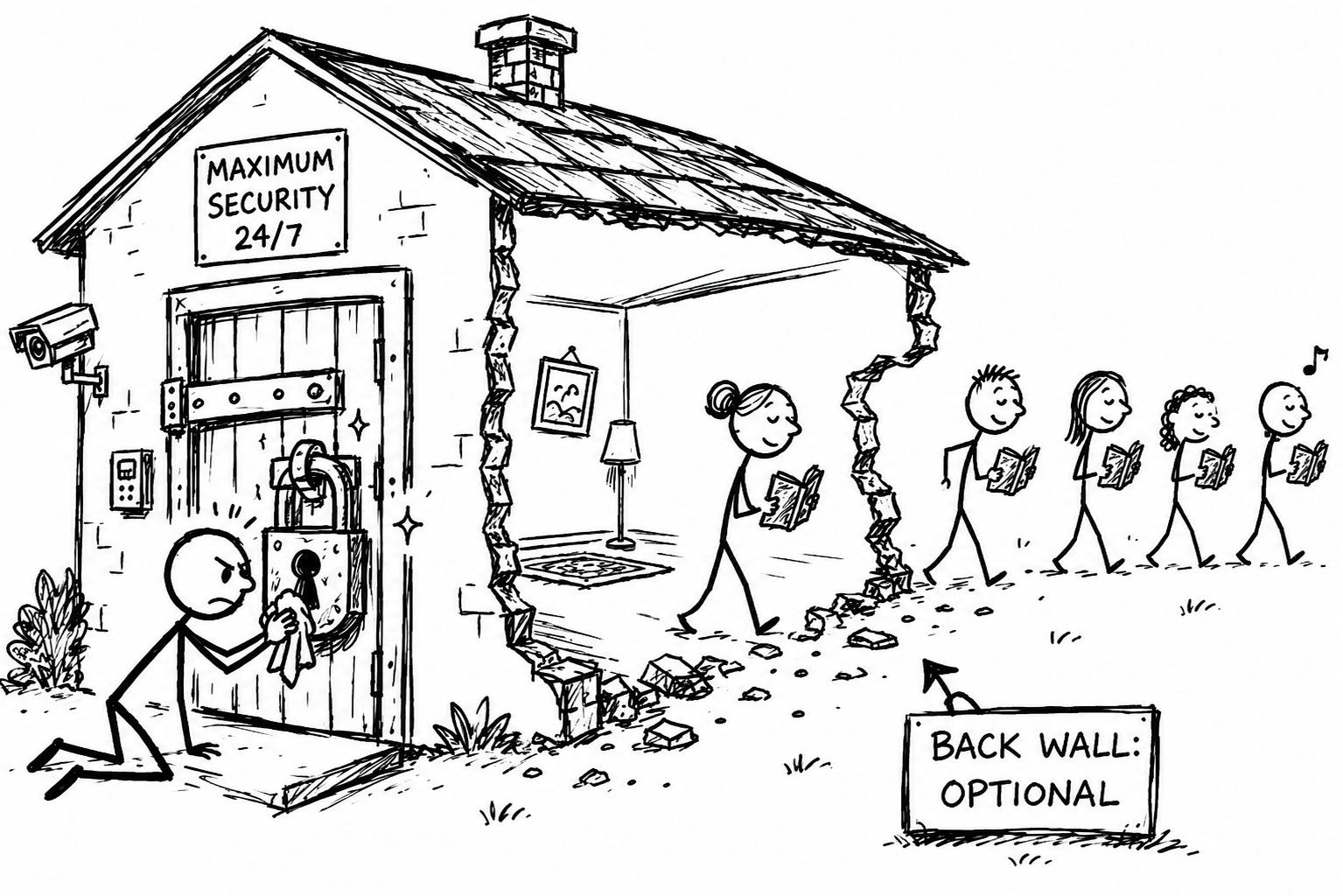
It feels like quality control. It produces fuck-all. You’re polishing the lock on a door nobody gives a shit about opening, while the back wall of your house is missing, the readers are slowly wandering out through the gap, and you’re very carefully reading the engraving on the doorknob to make sure it still says your name.
Detection chases a moving target. Every model release makes the detector worse by mathematical inevitability. The creators “winning” detection this week are passing tools that already aged out yesterday afternoon. (And your audience couldn’t tell either way, which is the part nobody likes to admit out loud at the parties they’re starting to not get invited to.)
There’s an entire cottage industry of detection apps, all of them obsolete by the time you finish reading their landing page. (Excellent business model for them. Less excellent for you, the customer, who paid for a tool that was wrong about its core function before you opened the email confirming your subscription. Capitalism’s something else.)
So If The Audience Never Cared About Detection, What The Hell Did They Care About?
Whether you can defend the argument. That’s the whole shape of it.
Not whether AI helped. Not whether the seams show. Not whether your sentences pass some statistical sniff test that was rigged by the same companies producing the slop the test is supposed to catch.
Whether, when a sharp reader replies with “wait, what about X?” you can answer from your own thinking. Or whether you have to run back to the chat window like a child who forgot his lines, paste in the reply, and ask the model to please help you respond convincingly to the reply about the post the model wrote in the first place.
Pull up your last post. Imagine the reply. Could you defend the central claim without the model in the room?
If the answer’s no, the argument isn’t yours yet. It’s borrowed shape. Which is fine for brainstorming. Less fine for a published piece with your name on the masthead and your face as the avatar.
That’s question one. There are three more, and they get progressively more uncomfortable.
The Audience Doesn’t Audit. It Drifts.
Readers don’t audit your posts. They never will.
Nobody’s at their kitchen table running your newsletter through detection software. They have lives. (Or at least the kind of approximation of lives that lets them clear their inbox and feed the dog before bed.) The whole detection panic’s happening exclusively inside the creator’s skull, the way a forest fire happens without consulting the trees about scheduling.
What the audience IS doing, slowly, over time, is noticing.
They notice who can defend their arguments. They notice who has a real position and who has a model’s polite paraphrase of one. They notice who writes with the confidence of someone who’s actually thought about the thing, versus the confidence of someone who’s been told what to think by something that can’t, by definition, think.
This noticing doesn’t show up as a banhammer. There’s no callout post. No moment of public reckoning. Just drift.
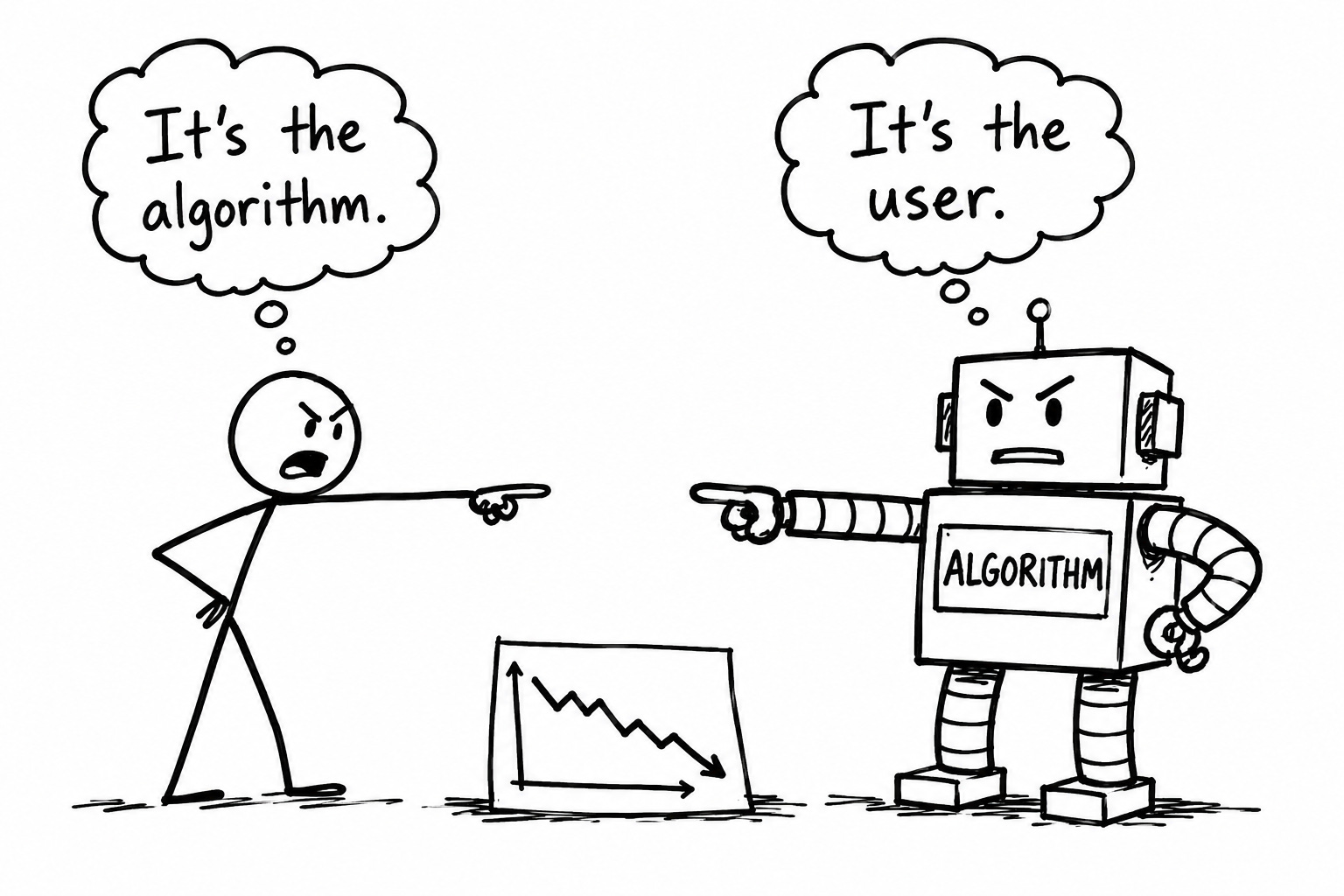
Less citation. Fewer recommendations. Slower growth. Numbers that used to climb start sitting still, then start dipping, and nobody can quite explain it. (You’ll explain it to yourself by blaming the algorithm. The algorithm’s also blaming you. Neither one of you is wrong, which is somehow worse than if one of you were.)
Here’s question two: Can you defend why the piece is shaped the way it is?
Why this opening and not the two others you tried. (And there should be at least two others. If you only had one opening, you didn’t write a piece. You shipped the model’s first draft and called it yours.) Why this order. Why this example over the three alternatives.
If you can’t defend your structural choices, you didn’t make them. The model made them and you signed off. (There’s a kind of person who joins a cult and spends ten years insisting it was his idea. The robe was a gift. The compound was a sabbatical. The shaved head is just easier in summer.)
The Fingerprints Problem
Detection-proofing fails because it solves the wrong problem.
The audience isn’t asking “did AI touch this?” They’re asking “is there anyone home?”
You can produce a piece that’s 100% AI-written and have it feel inhabited, because you pushed back, edited hard, deleted the model’s best paragraph for the third time because you knew it was wrong, and forced your own structural choices through like a small-town mayor refusing to budge on the parade route. You can produce a piece that’s 100% human-typed and have it feel hollow, because you wrote it on autopilot during a 6 AM Zoom with the camera off and your soul on screensaver.
Fingerprints come from thinking. The typing’s incidental.
Which brings us to question three: Where did you overrule the model?
If you never pushed back, you didn’t co-write. You transposed. A real edit (a deletion, a reorder, a flat “no, try again, do it differently, you’re embarrassing both of us”) is one of the cleanest signs that actual thinking happened. The presence of friction proves two minds were in the room.
The absence of friction means you were alone with a very fast typist who can’t tell you when you’re wrong, doesn’t care if you’re wrong, and will produce confident wrongness all day long because that’s the job and it’s good at it.
If your process is “prompt, paste, publish,” you’re not writing anymore. You’re signing forgeries. The model paints. You add the signature. The signature is the only part of the transaction that’s actually yours, and even that is starting to feel borrowed. (The editor who would have recommended you can spot a forgery at fifteen feet. The conference programmer is now booking the writer who can defend her sentences in a Q&A. The reader who used to forward your stuff to her smart friend has stopped, because forgeries don’t travel well. People share originals. Drift is silent. But it has sharp teeth.)
The Sentence Only You Would Have Written
The last question’s the hardest. (It’s also the one creators most consistently fail, including myself. The first time I ran my own work through this check, I learned things about my writing I’d have preferred not to learn, and then I learned the same things again about the next piece, and the next, and at some point I stopped being surprised and started being useful to myself.) It’s also the one that separates work that compounds from work that dissolves like sugar in rain.
Is there a sentence in this piece that only exists because YOU did the thinking?
The kind of sentence that emerged from sitting with the problem long enough to find a specific thing nobody else was going to say. The kind that wouldn’t surface from any prompt because no prompt would know to ask. The kind you couldn’t outsource if you tried, because you didn’t even know it was coming until your hand typed it and you looked at it and thought “huh, okay, that’s mine.”
If you can point to that sentence, the piece is yours. The byline is honest. The work is real.
If you can’t, what you’ve published is a remix squatting under your byline, and every reader who sticks around long enough to read three or four of your posts in a row will start to feel something they can’t name. They’ll move on. Not all at once. Slowly. The way people stop calling a friend who only ever talks about himself.
The recap, since this got dark
Four questions. Run them on every draft. Not as a purity test. As a calibration.
Could you defend the central claim without your AI in the room?
Can you defend the shape of the piece?
Where did you overrule the model?
Is there a sentence only you could have written?
If a draft fails one of these, the fix isn’t to rewrite the surface. The surface is where detection-proofing happens. The surface is also where ensloppification happens. Both problems live in the same corner of the workflow, and both come from the same source: not doing the fucking thinking the model bypassed.
You can keep polishing the lock. The windows are still open. The readers are still drifting out the back wall. (The back wall’s been missing for approximately three years, but you’ve been busy.) The audience is still building its quiet, unspoken standard, and you’re still optimizing for the wrong audience entirely. Detection theater’s collapsing in slow motion, and the creators still anxiously running their drafts through tools will wake up in a year wondering why their numbers stopped moving.
The creators running the defensibility check will still be there. They’ll be tired. They’ll be cranky. (They’ll have published five drafts they almost didn’t because they failed question four three times each. This is the work. The work’s occasionally insufferable. The alternative’s worse.) They’ll be writing something nobody else could’ve written.
You can join them. Or you can keep signing forgeries.
Crafted with love (and AI),
Nick “Patron Saint of Lost Vanity Projects” Quick

PS... The four-question check is the doorway. The Voiceprint Quick-Start Guide’s the foundation underneath it. (You can’t write a sentence only YOU would write until you’ve done the work of figuring out what “only you” sounds like. The guide’s where that part starts.) Grab it:

PPS... Co-Write with AI publishes pretty much every single day, which is partly discipline and partly the only thing keeping me from reorganizing my pantry alphabetically by spice family at 3 AM. Forward this to a creator who’s still posting detection scores like they’re meaningful currency. They’ll either thank you in six months or unfollow you immediately. Both outcomes count as modest improvements.
You've made some great points here!
I used to be obsessed with running my writing through AI detectors until they started detecting stuff I wrote myself as 100% AI... Stuff written years before Chatgpt was even a twinkle in OpenAI's eye.
Then I realised it's your own experience, independent thought and personality that shines through that makes the writing truly yours.