
Your Readers Know Something’s Wrong. Here’s What They’re Detecting.
A forensic guide to catching slop before your subscribers do it for you

They’ve stopped reading to the end.
You haven’t noticed because you’re too busy checking your analytics dashboard like it owes you money. But the evidence is everywhere. Fewer comments. Shorter time-on-page. That slow, quiet exodus of people who used to actually engage.
You’re still publishing. Still showing up. Still doing the thing.
So what changed?
Nothing you can see. And that’s the problem.
Your readers are detecting something you can’t anymore. Patterns that register as wrong in some primal part of their brain before conscious thought kicks in. Little signals firing that say this doesn’t feel like them even when they couldn’t explain why if you paid them.
I’ll spare you the suspense: you’re publishing slop. Regularly. Confidently. With the serene ignorance of someone who’s been drinking their own filthy bathwater so long they think it’s the finest French champagne.
(I would know. I was that person six months ago. I write about co-writing with AI for a living and I still fell for it. It’s like a sex therapist discovering they’ve been faking it. With themselves.)
Your ear is compromised. Your readers’ ears aren’t.
They’re catching what you’re missing. And they’re quietly unsubscribing without sending you the courtesy of a breakup text.
So why can’t you see it?
Your Eye Stopped Twitching. That's the Problem.
This isn’t me calling you stupid. (That would be rude and also hypocritical given my recent track record.)
Blame your brain. It adapted. That’s what brains do. (Annoying, but evolutionarily sound.)
You’re exposed to AI-generated text constantly now. Reading it. Editing it. Publishing versions of it. Breathing it in like secondhand smoke at a filthy Fremont Street casino. Your baseline for “normal” has shifted to accommodate patterns that used to make your eye twitch.
Six months ago, that helpful-professional tone would’ve registered as uncanny valley. Now it just sounds like... writing.
Six months ago, the LinkedIn-guru tone would make you want to throw your laptop into a woodchipper, then throw the woodchipper into another woodchipper. Now it feels... professional. Authoritative, even.
(Six months ago I had standards. Now I have a newsletter and a drinking problem. Only one of them pays.)
The drift happened so gradually you didn’t notice. That’s how drift works. That’s how all the worst things work. Nobody wakes up one day and decides to become boring. They just stop noticing when boring shows up and makes itself at home.
Your readers haven’t been marinating in AI output the same way. Their BS detector still works. They just don’t know what it’s detecting.
What your readers are catching—and you’re not—breaks down into twelve patterns. I’ve organized them into three tests you can run before your coffee gets cold.
If you have the stomach for it.
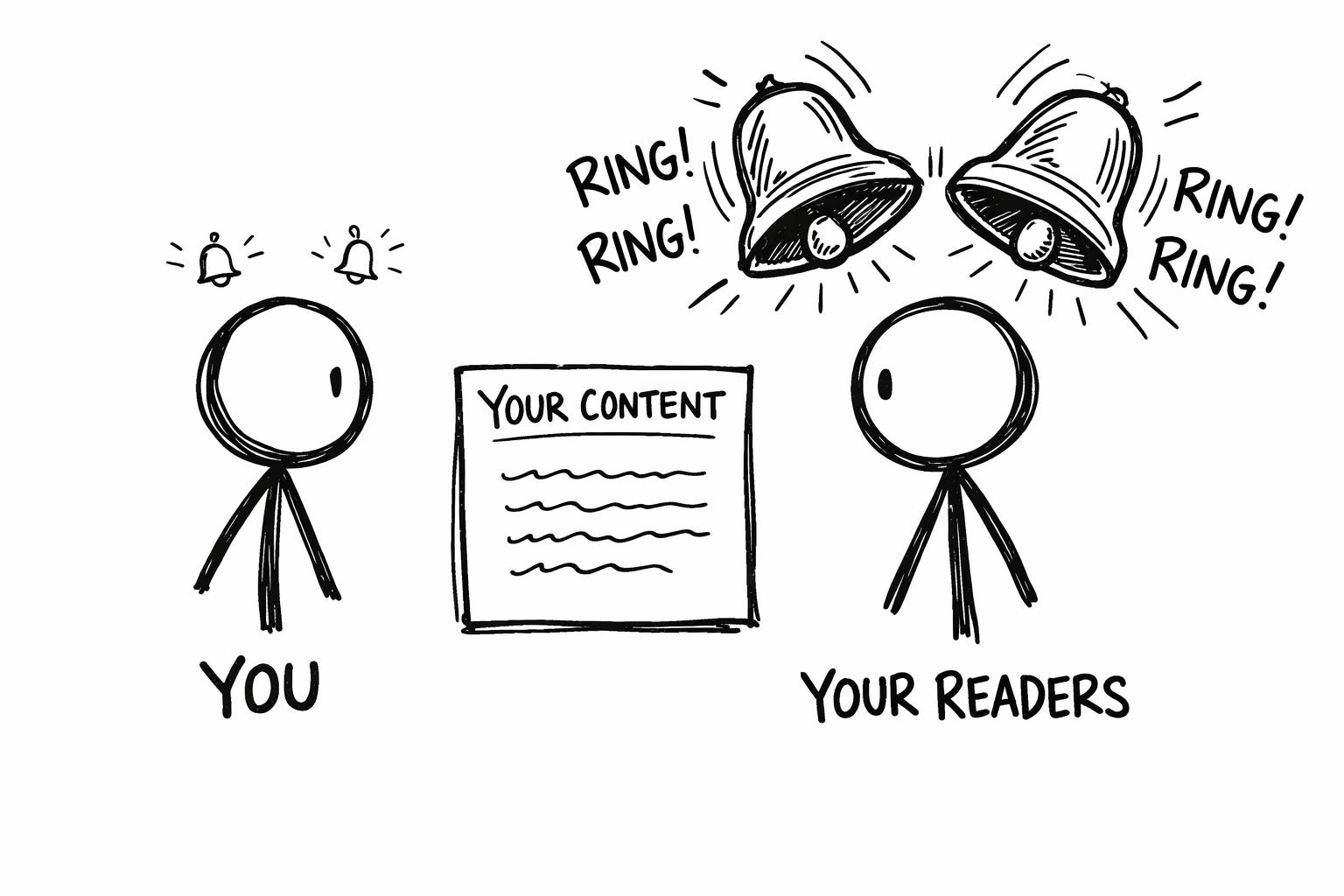
Test 1: Surface Detection (30 Seconds)
The obvious tells. What any casual observer catches in the first paragraph while they’re still deciding whether to keep reading or check their phone.
Pattern #1: The Vocabulary Fingerprints
AI shits word-prints everywhere. Distinctive vocabulary it reaches for when no human would.
The usual suspects:
Utilize. Leverage. Delve. Unpack. Robust. Ecosystem. Synergy.
Run the search. Ctrl+F each one.
One hit is a slip. Could happen to anyone. You were tired. Mercury was in retrograde. Whatever.
Three hits is a crime scene. Someone (something) was here, and it wasn’t you. The body’s still warm. The bloody fingerprints are all over the keyboard.
The evidence:
Contaminated: “With the right framework in place, you’ll be empowered to create content that truly connects with your audience on a deeper level...”
Clean: “Stop trying to connect. Say something true. Connection is a side effect.”
Same information. One sounds like a person had a thought. The other sounds like a hostage reading a ransom note written by McKinsey. (Nobody’s coming to rescue your content. The SWAT team took one look and said “not worth it.”)
Pattern #2: Your Fingerprints Are Missing
Your writing has verbal DNA. Phrases you repeat. Rhythms you default to. Tics you can’t shake no matter how many editors tell you to cut them.
(I use parenthetical asides like they’re going out of style. You probably noticed. My editor has given up fighting this particular war.)
Look at your last piece. Strip the byline. Would your mother know it was yours? Would your best friend? Would you?
If there’s nothing distinctly yours in it (your phrases, your weird tangents, your inability to make a point without at least one absurd comparison), you’re not publishing your work. You’re publishing slop wearing your byline like a stolen dinner jacket.
Pattern #3: The Formality Costume
AI has a default register: helpful professional. The voice of someone trying to sound trustworthy without saying anything that might get them fired from a job they don’t even have.
Too stiff. Too casual. Or that uncanny middle-ground where it’s technically conversational but somehow still feels like a press release written by someone who’s never had a conversation.
The evidence:
Wrong: “I hope this information proves valuable to your content creation journey!”
Right: “Do this. If it doesn’t work, reply and call me an idiot. I’ll either fix it or agree with you.”
Read one sentence out loud. Would you say this to a smart friend? Or does it sound like you’re addressing a conference room full of people who secretly hate being there?
(If your honest answer is “I’d say this to a smart friend,” you may need smarter friends. Or more honest self-assessment. Probably both.)
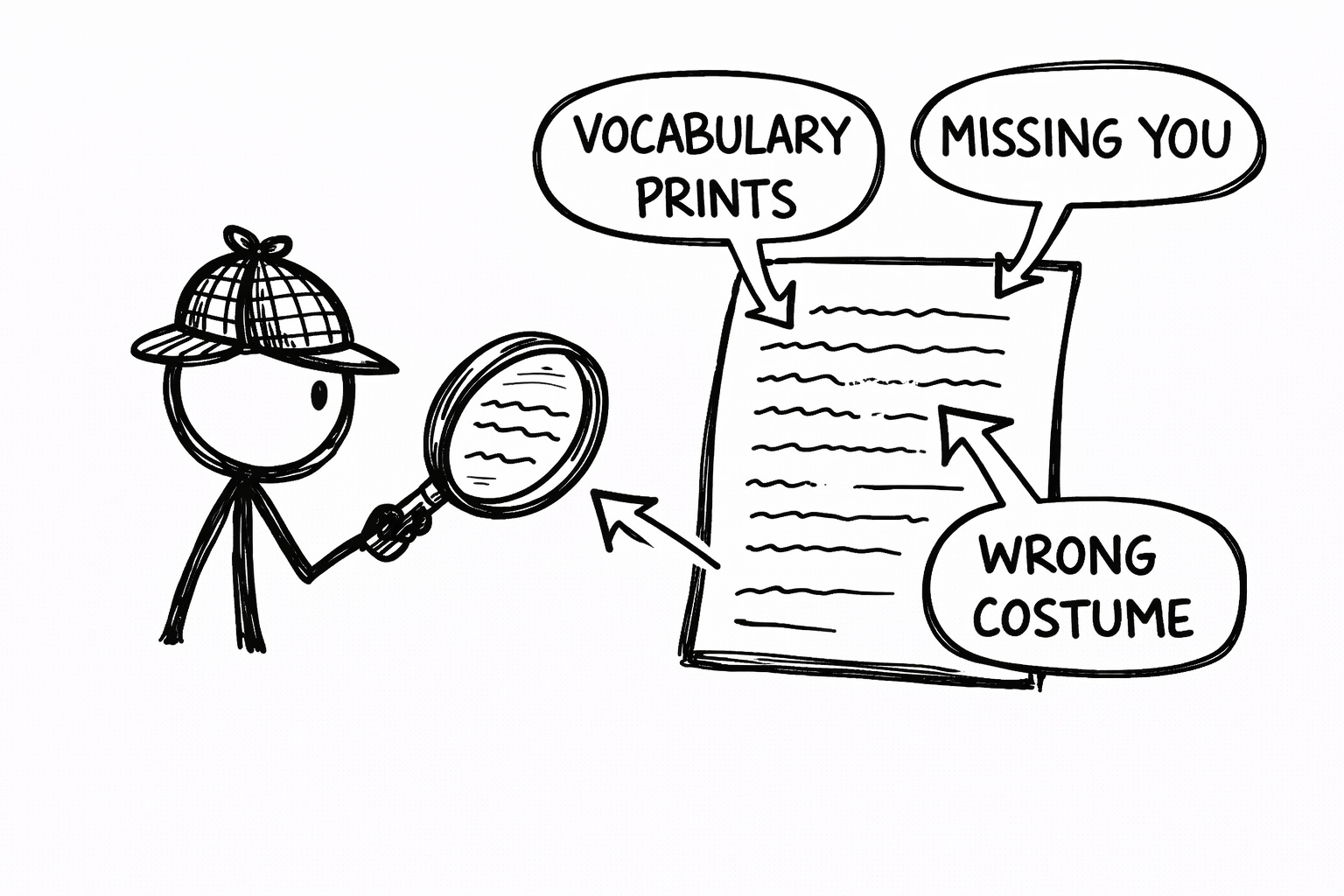
Test 2: Structural Detection (2 Minutes)
This is where contamination hides from casual inspection.
The content reads fine sentence by sentence. Grammar’s clean. Points are clear. Nothing obviously wrong.
But the construction betrays non-human assembly. It’s like a movie set… gorgeous from the front, plywood and scaffolding from behind. Walk through the door and you’re standing in a studio parking lot.
Pattern #4: Rhythm Flatline
Pull up any paragraph. Scan the sentence lengths.
AI defaults to medium. Every. Single. Sentence. Roughly the same word count. No variation. No dynamics. No pulse.
It’s like a heart monitor showing a steady line. Technically consistent. Functionally dead.
Flatline rhythm looks like this:
Medium sentence about fifteen words long. Another medium sentence roughly the same length. This pattern continues without variation throughout the piece. Eventually the reader falls asleep.
Healthy rhythm could be anything:
Staccato punches, rolling waves, whatever your weird brain does when it’s actually thinking. Some writers jab. Some unspool. Some argue with themselves mid-paragraph. The pattern doesn’t matter. The variation does.
One sounds like a human wrote it. One sounds like a human gave up.
Pattern #5: The Throat-Clearing Opener
Examine your first paragraph. What does it actually do?
AI opens with context. Background. Setup. Orientation. All the things teachers told you to include and nobody actually wants to read.
“Content marketing has evolved significantly over the past decade. As creators navigate an increasingly complex landscape of digital tools and platforms...”
You’ve already stopped reading, haven’t you? I don’t blame you. I wrote that example and I wanted to stop writing it halfway through. (In fact, that’s exactly what I did.)
The diagnostic: Does paragraph one hook or explain?
If it explains, your content is front-loaded with AI’s pathological need to establish context before saying anything interesting. It’s like someone clearing their throat for thirty seconds before speaking. By the time they get to the point, everyone’s already checked out.
Human writers start with the interesting thing. Then add context if absolutely necessary.
(Which it usually isn’t. Context is foreplay for people who are afraid to fuck. I’ve written ten thousand unnecessary setup paragraphs in my life. Some people smoke after. I wrote preambles before. Neither of us finished satisfied.)
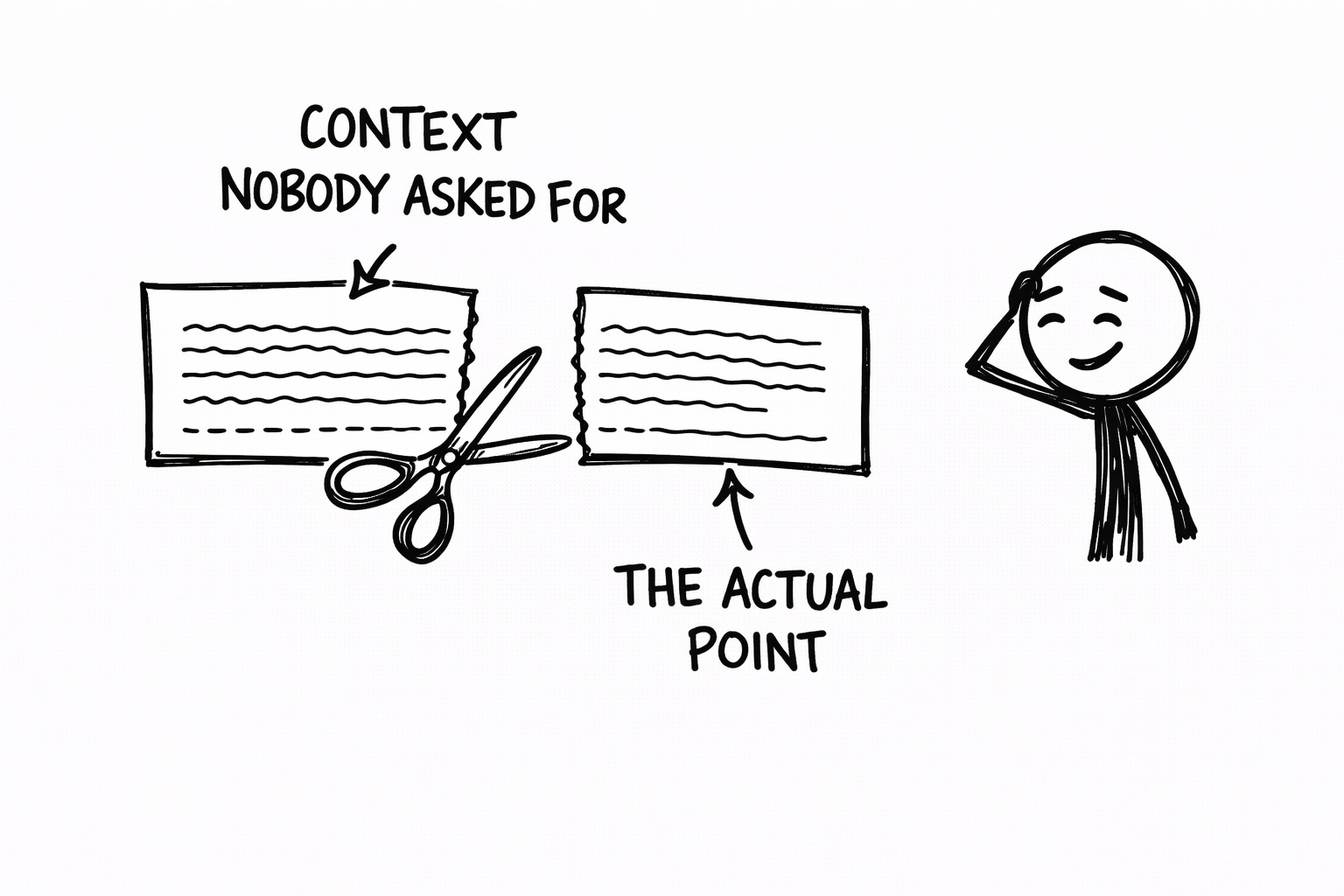
Pattern #6: Visible Transition Machinery
Furthermore. Additionally. Moreover. In addition. To that end.
These words are evidence. They’re AI admitting it doesn’t know how to connect thoughts naturally, so it’s bolting them together with visible hardware.
The test: Delete every transition word in a section. Read it again.
If it still flows? They were dead weight. Guardrails on a road with no cliff.
If the whole thing collapses? Congratulations. Your transitions were load-bearing. Which means your actual ideas weren’t.
Real transitions disappear. The second your reader notices one, they’ve stopped trusting you. They’re not following your argument anymore. They’re watching you try to make one. It’s like catching a magician palming the card. The trick’s over. So is the magic.
Pattern #7: Modular Construction
Can you rearrange your sections without anyone noticing?
Swap section two and section four. Move the conclusion to the middle. Shuffle the whole thing like a deck of cards.
If it still makes sense, you don’t have structure. You have a list pretending to be an argument.
AI builds modular content. Self-contained blocks that don’t depend on each other. Interchangeable parts. Assembly-line efficiency.
Real arguments have dependency. Section three builds on section two. The ending earns its emotional weight from everything before it. The middle collapses without the opening.
The diagnostic: Would anyone notice if you rearranged this?
If no, you have content assembly. Not construction. And your readers can feel the difference even when they can’t name it.
Test 3: Soul Detection (1 Minute)
The deepest contamination. The kind that passes every other test.
It sounds like you. Uses your words. Follows your structure.
But it’s a forgery. Convincing enough to fool casual inspection. Empty of actual you.
This is the one that draws blood. The one that catches slop so polished it fools everyone (including the person who published it) until readers quietly disengage without knowing why.
Pattern #8: Stance Drift
Your writing has a position. A relationship to the reader. A personality in how you deliver information.
AI drifts toward neutral professional. Helpful without opinion. Expertise without conviction. The voice of someone who desperately wants to be useful but has never had a controversial thought in their life.
Signs of drift:
Insights with all the specificity of a horoscope and twice the forgettability
Advice that cost you nothing to make and would cost you nothing to be wrong about
The tone of someone who wants to be helpful but doesn’t actually give a shit
The evidence:
Drifted: “By implementing these strategies, you’ll be well on your way to achieving content success!”
Authentic: “This works. The other stuff they’re selling you doesn’t. I’ve tried both.”
The first is what you write when you're scared of the comments. The second is what you write when you've stopped giving a fuck.
(The comments will come either way. Might as well earn them.)
Pattern #9: Hollow Core
The hardest contamination to detect. Because everything looks right.
Voice is right. Structure is right. Even the specific advice sounds reasonable.
But there’s no point. No actual insight. Just well-constructed nothing. Cotton candy disguised as protein.
The autopsy method: Strip away all style. Remove the personality. Delete every interesting turn of phrase.
What remains?
If you can't summarize the core insight in one sentence, there isn't one. Just vibes with a word count.
(I've published hollow content. Proudly. Confidently. Then three hours later I'm staring at it like a drunk text I can't unsend, wondering if anyone I respect saw it.)
Pattern #10: Wet Cardboard Humor
AI attempts humor. It consistently fails.
The punchline shows up before the setup like a flasher who forgot his trench coat. No buildup. No tension. Just the reveal, standing there, expecting applause. Nobody’s laughing. Somebody should be arrested.
Humor requires timing and surprise. AI has neither. It has pattern matching. Which is just a fancy way of saying it knows what funny looks like but will never understand that moment when laughter detonates in your belly and rearranges your whole day.
The test: Did you actually react? Smile, smirk, exhale amusement?
Or did you recognize the structure of a joke without feeling anything?
Delete failed humor entirely. Add yours during editing. Some things cannot be delegated. This is one of them.
(If you’re not funny, that’s fine. Not everyone needs to be. But unfunny-on-purpose is better than unfunny-by-committee. At least it’s honest.)
Pattern #11: You-Shaped Holes
Generic examples where your stories should be.
“Many people find...” where your experience belongs.
Abstract scenarios instead of the specific moment that made you understand this in the first place.
The test: Is there anything in this piece only you could have written?
Any detail, reference, or example that requires your specific life to produce?
You-shaped holes filled with filler. That’s the slop that passes every other test. Technically competent. Completely forgettable. Words that pass through your brain like a stranger passing through an airport… present, moving, gone. No reason to remember. Nothing left behind.
Find the holes. Fill them with your actual experience. Your data. Your embarrassing mistakes.
(The embarrassing mistakes are usually the most interesting part anyway. Readers don’t connect with competence. They connect with the spectacular failures that competence eventually emerged from.)
Pattern #12: The Verbal Rejection Test
Final test. The one that catches what everything else missed.
Read it aloud. Not performance reading. Not the voice you use when you’re trying to sound smart. Just talking through it like you’re explaining to someone sitting across from you who would absolutely call you out if you said something stupid.
Your body will tell you what’s wrong.
Every stumble is a flag.
Every wince is a flag.
Every moment of “I would never actually say that” is a flag.
Your mouth rejects forgeries your eyes accept.
Rewrite what your mouth rejected.
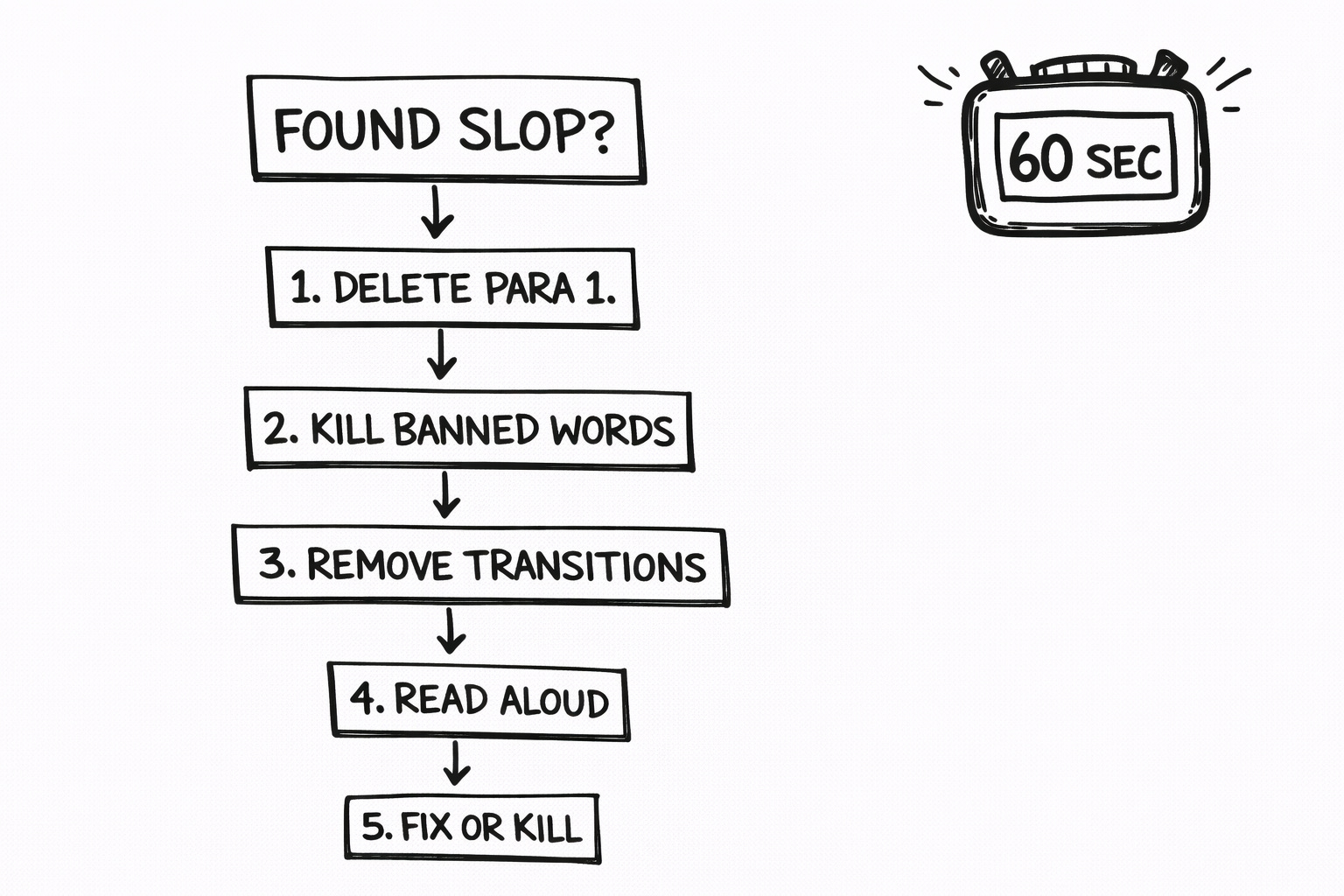
The Fix Protocol
Evidence collected. Contamination confirmed.
Now: surgery.
The 60-Second Triage (when you don’t have time to fix everything):
Delete the first paragraph. (Probably throat-clearing. Possibly salvageable but not worth the triage time.)
Ctrl+F and kill every banned word. No mercy. No exceptions. No “but it works in context.”
Remove all transition words. See what survives the purge.
Read aloud. Mark the top three moments your mouth rejected.
Fix those three or kill the piece entirely.
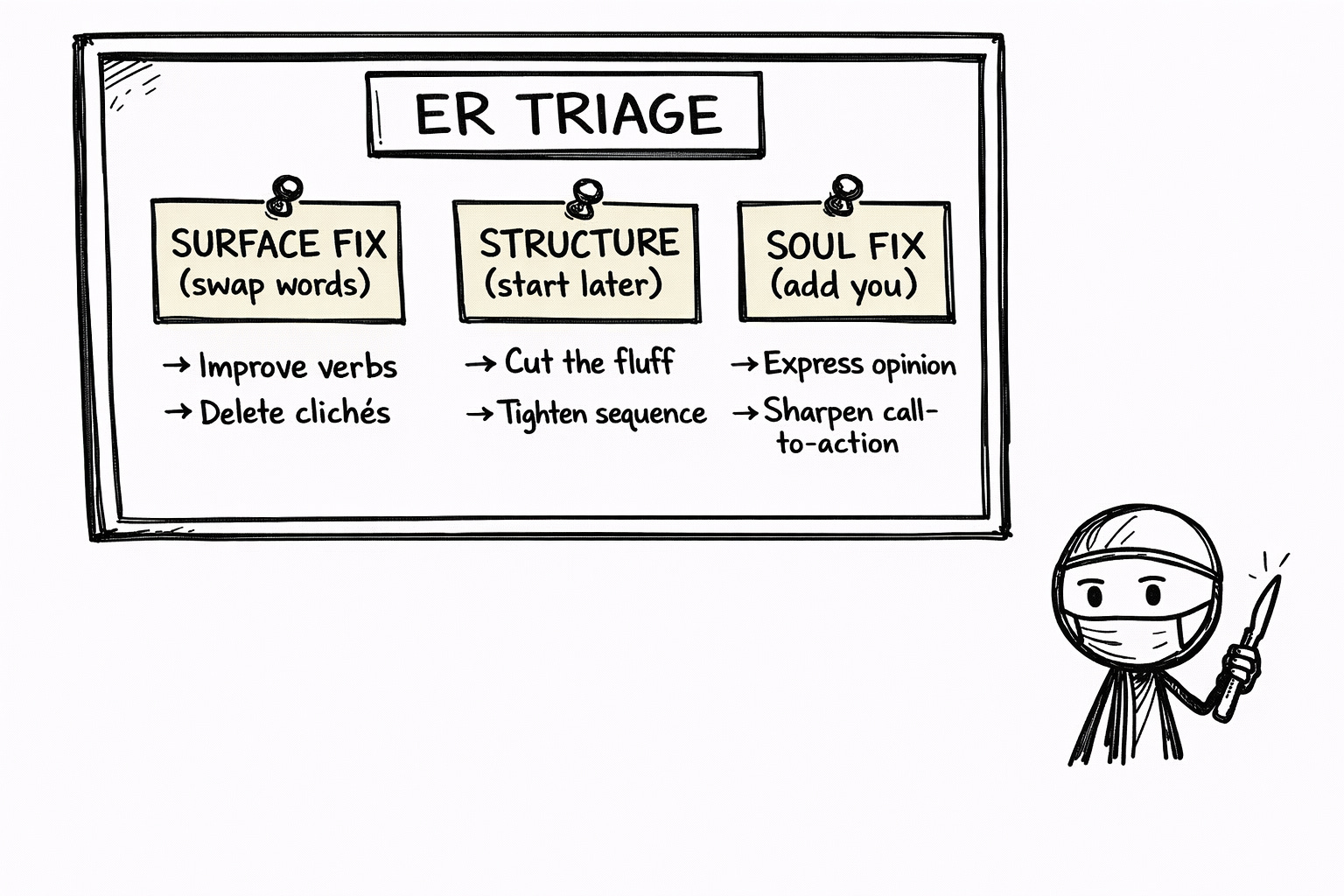
Systematic Cleanup:
Surface contamination: Replace AI vocabulary with yours. Add your signature phrases. Adjust formality until it sounds like you talking, not you performing.
Structural contamination: Start later. (Probably paragraph three.) Remove transition machinery. Create dependency between sections so they can’t be rearranged.
Soul contamination: Inject actual opinion. Fill identity gaps with real experience. Delete every attempted joke and add your own. Or leave humor out entirely. Both are valid. Wet cardboard is not.
My Insurance Policy Against Myself
I run this on everything I publish now.
Not because I’m paranoid. (Okay, partly because I’m paranoid.) But mostly because I know how easily contamination happens. How gradually standards erode. How confidently you can publish garbage when you’ve been swimming in garbage so long you can’t smell it anymore.
Last Tuesday’s newsletter draft had four banned words, stance drifting toward LinkedIn motivational speaker, and an opening paragraph that felt like being gently smothered by a throw pillow that wanted you to have a blessed day.
I caught it. Five minutes before publish.
That’s the point. The checklist catches what your compromised judgment doesn’t.
Twelve patterns. Three tests. Under five minutes.
The alternative is publishing forgeries of yourself and wondering why your audience quietly disappears without explanation.
Your readers know something’s wrong.
Now you know what they’re detecting.
The only question is whether you’ll catch it before they stop giving you chances.
🧉 What’s your tell? The one that slips through no matter how many times you catch it? Mine’s stance drift. I start sounding like the voiceover in a pharmaceutical ad right before they list the side effects.
Crafted with love (and AI).
Nick “Bathwater Sommelier” Quick

PS… I write daily. As in every day. As in I have sent emails on Christmas morning because slop never sleeps and apparently neither do my neuroses. Subscribe if you want a daily voice preservation dispatch from someone who cares way too much about this. Unsubscribe whenever you want. I’ll notice. I’ll wonder what I did wrong. I’ll write a newsletter about it. The cycle continues.
Nick, no idea how you manage to write posts like this every single day!
Seeing words that carry no weight in a sentence is a "stop reading" for me. AI adds a lot of words, unnecessary ones that are just filler and I'm guessing because many of us are so far removed from our schooling years, and teachers struggled to make grammar fun, no one is questioning if every second sentence needs to start with "And" or "But" or noticing that they have sliced a sentence in half, creating a meaningless sentence fragment that doesn't carry the clever punch they thought it did... Light and shade disappears when AI touches too much.
Okay vent over, lol. Editing with AI is incredible and it makes me paranoid in equal measure.
All great advice, most of which applies to my pre AI offerings, which is why I appointed it to be my editor in the first place. It’s an improvement, if you ask me. Also, Mercury retrograde references now? I’m impressed.