
You Can’t Sharpen a Knife Against Air
Your content isn't boring because it's bad. It's boring because it's not fighting anything.

For over a decade, I produced content that technically qualified as sentences arranged in a row.
Useful? Presumably. Informative? According to everyone who never mentioned it again. Remembered by a single human being after they closed the browser tab?
I’d sooner believe trickle-down economics is about to dribble into my checking account.
My prose had all the staying power of a campaign promise in November. People consumed it the way they consume gas station sushi: quickly, without pleasure, and with vague regret they can’t quite name. I was producing. I was shipping. I was doing all the sacred rituals the productivity cult demands of its acolytes.
(I also had recurring dreams about my laptop falling off a cliff that felt suspiciously like wishes. But that’s a different newsletter.)
Here’s what took me an embarrassing amount of time to figure out:
Some writing crackles. You feel it in the first sentence. Someone’s got their hands on the wheel. Someone means this. You lean forward before you’ve decided to.
Most writing just... occupies space. Technically present. Spiritually filing for unemployment. The literary equivalent of a coworker who’s been “quietly quitting” since 2019.
The difference isn’t talent. I’ve met talented writers who produce forgettable work with the regularity of a Swiss train schedule. (Efficient, punctual, and you still couldn’t pick their last piece out of a police lineup.)
The difference isn’t clarity. Plenty of clear writing evaporates on contact. You can see right through it to the nothing underneath.
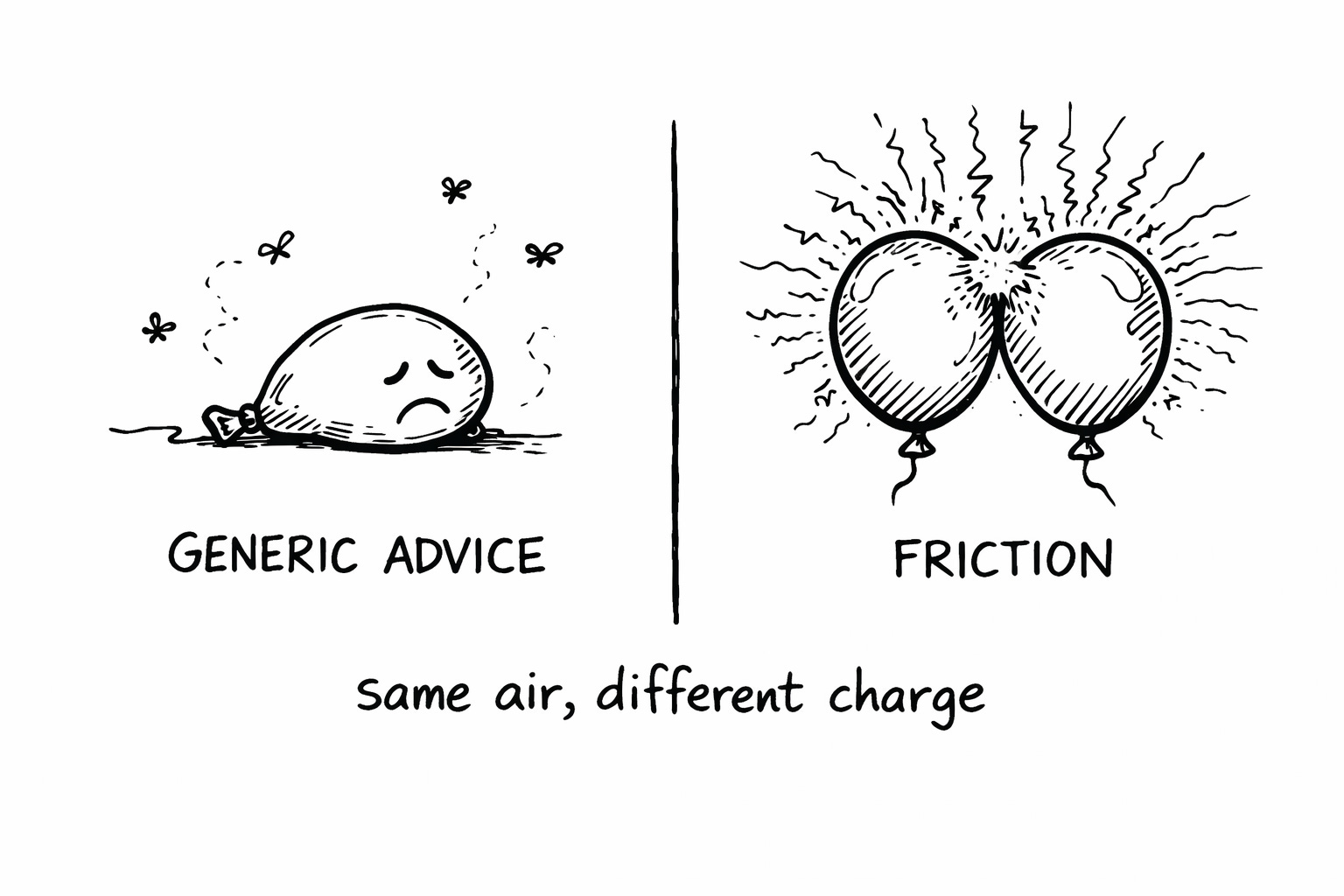
The difference is friction.
The Variable Missing From Every Piece of Forgettable Content
Friction is what makes prose feel like someone’s actually in the room. It’s the thing readers sense before they can articulate it. The feeling that something’s being contested. That the writer showed up with an actual position instead of a clipboard full of helpful tips and a smile borrowed from customer service training.
Most content has no friction because it’s not pushing against anything.
No resistance. No opposition. Just a voice echoing in an empty auditorium, explaining things to a crowd that never showed up, hoping someone wanders in and finds it sufficiently useful to not actively regret the experience.
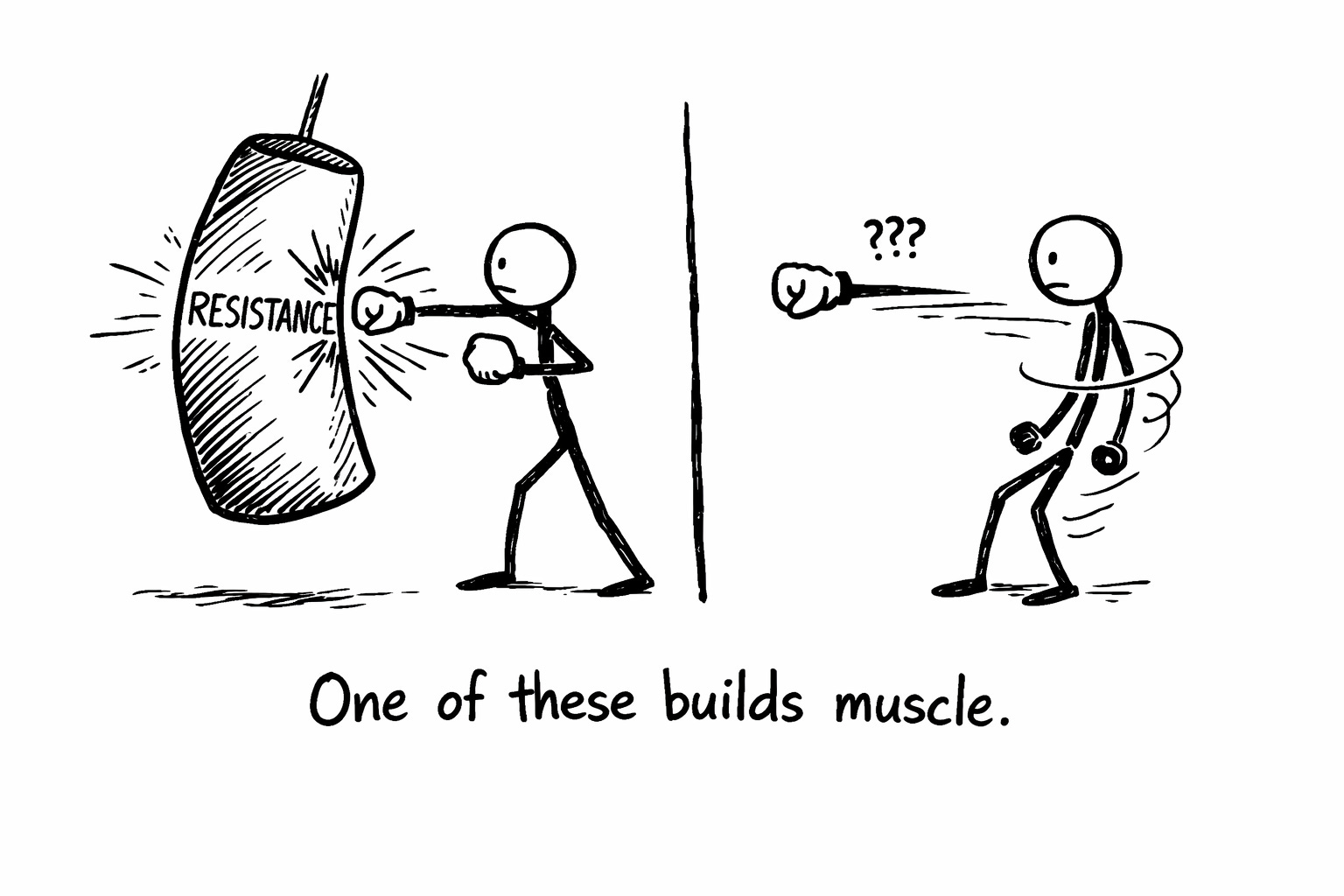
It’s throwing punches in zero gravity. Technically you’re making the motion. Nothing’s landing. Your fist just keeps going forever into the void while you spin slowly backward wondering where your life went wrong.
You can’t sharpen a knife against air. And you can’t sharpen your writing without something to push against.
(This took me a decade to figure out. Ten f’en years. I have a degree in this. I teach this for a living. I am a cautionary tale wearing business casual and Crocs, for some reason.)
What Friction Actually Does (Mechanically Speaking, Because I Don’t Trust Vibes-Based Advice From Newsletter Writers)
It makes hedging feel like bleeding.
When you’re pushing against something, you can’t sand down every edge until your point dissolves into oatmeal. Opposition forces commitment. You actually have to say the thing instead of gesturing vaguely in its direction like a museum docent describing modern art.
(Ever notice how your opinions crystallize the moment someone disagrees with you? That’s not coincidence. That’s your brain finally waking up because suddenly there are stakes. Same principle, applied to prose.)
It conjures stakes from the ether.
Stakes aren’t manufactured through dramatic language and strategic italics. Stakes emerge when something’s contested. When you’re pushing against a belief, readers feel the tension in their chest before their conscious mind registers conflict. Something’s being fought for. Their nervous system knows this is a fight, even if their brain thinks they’re just reading tips.
This is why political commentary gets more engagement than career advice, even when the career advice is objectively more useful. Conflict is interesting. Agreement is furniture. Nobody notices furniture until the bathroom stall door goes missing.
It gives you a vector instead of a vague direction.
Friction creates forward momentum. Every paragraph has the same job: push through the resistance. You don’t wander because you can’t wander. There’s only one way to go. Through.
I used to outline like a man possessed. Color-coded. Sub-points nested within sub-points like Russian dolls designed by an anxious accountant. The whole elaborate ritual. Now I just identify what I’m pushing against and let the friction drag me forward. Turns out argument has its own architecture. Who knew.
(Everyone who’s ever had a real fight with their significant other, probably. But I had to learn it the hard way, through spreadsheets and suffering. My origin story is extremely boring.)
Your Writing Needs an Enemy
The friction source is what I’ve started calling the enemy.
(Yes, I named it. I name things now. It’s either a coping mechanism or a personality disorder, depending on which therapist you ask.)
Not a person. Not some villain you can feel morally superior to. A position. A specific belief you’re pushing against like a fullback hitting the defensive line.
Something reasonable people actually think. Something that sounds smart until you hold it up to light. Something your reader might have believed before they started reading.
(Something you might have believed, before you knew better. Those enemies are particularly nutritious.)
What “The Enemy” Looks Like In The Wild
Generic take without an enemy:
“Consistency is important for building an audience. When you show up regularly, readers learn to expect you, and that expectation creates trust over time.”
That’s not wrong. It’s just forgettable. It’s linoleum. It’s the content equivalent of a Marriott mattress. Clean. Inoffensive. You never think about it until Gordon Ramsay brings a blacklight and suddenly everyone’s checking out early.
Same idea, but picking a fight:
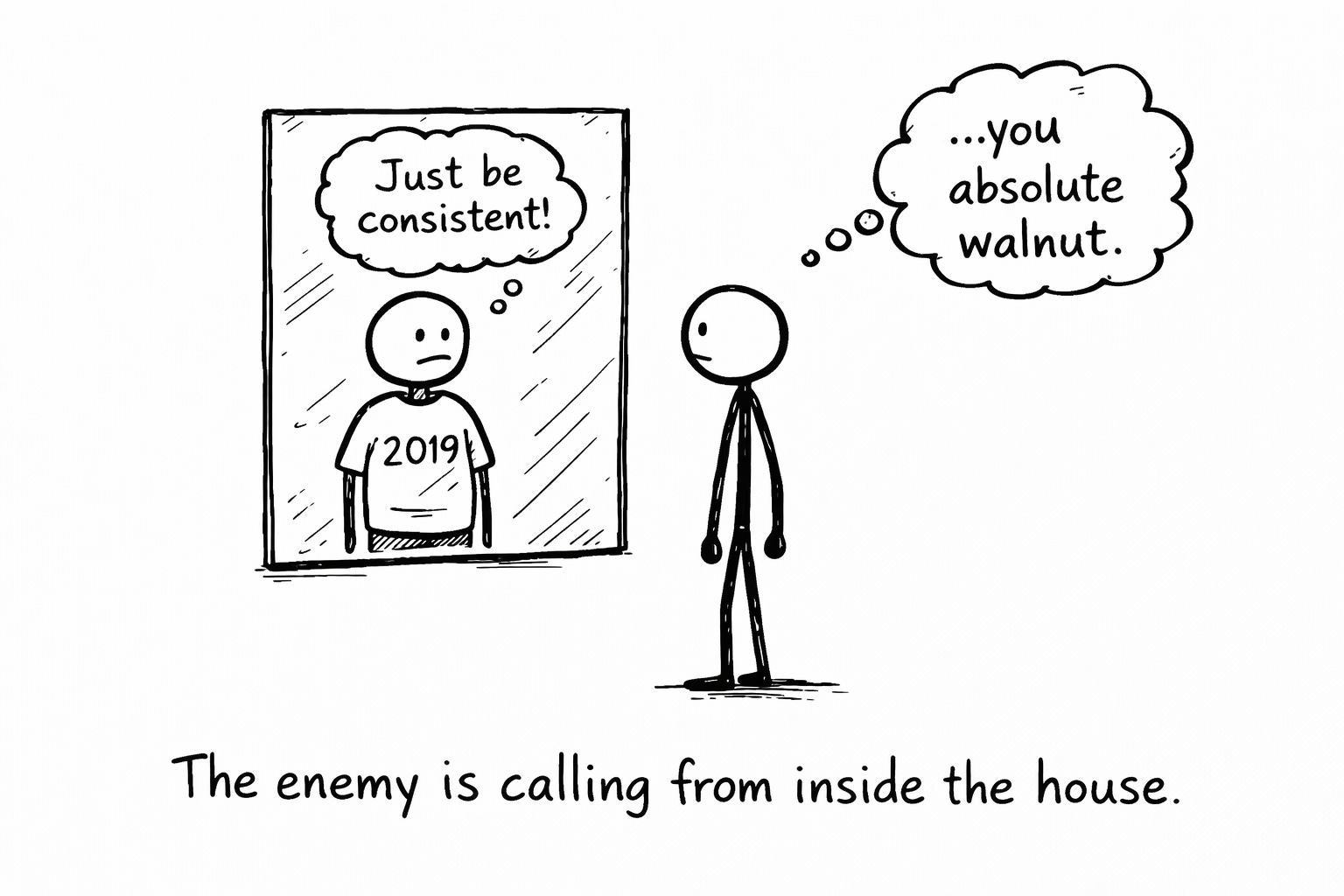
“Consistency is the most overrated advice in content strategy. You know what beats showing up every day? Showing up with something worth reading. I’d rather wait two weeks for something that actually says something than get a daily reminder that someone’s calendar has more discipline than their ideas.”
Feel the difference? The first one is explaining. The second one is contesting. It has something to lose. Someone could push back. Someone probably will. (Hi, future comment section. I see you sharpening your keyboard.)
The first is a pamphlet. The second is a position.
More examples, because I believe in evidence the way some people believe in horoscopes (but with better predictive accuracy):
Without friction:
“Understanding your audience is essential for creating content that resonates. Take time to research their needs, preferences, and pain points.”
With friction:
“Know your audience” is the advice people give when they don’t have better advice. Knowing your audience doesn’t write the piece. It just makes you more anxious about whether they’ll like it. I’ve written my best work when I forgot about my audience completely and wrote for the version of me who needed to hear this three years ago.
Without friction:
“Providing value is the foundation of good content marketing. When you consistently deliver value, your audience grows organically.”
With friction:
“Provide value” is how we talk about content when we’ve stopped believing it can actually change anyone. Value is table stakes. Value gets you in the door. Friction is what makes anyone remember you were there.
(That last one’s a little meta, given that this newsletter is about being memorable. But I’ve decided examined meta is a higher form of pretension, and I’ve made my peace with it.)
How to Find Your Enemy (Since They’re Rarely Just Loitering Where You Can See Them)
What advice makes you want to commit petty crimes?
The platitudes people repeat like morning affirmations without ever examining whether they’re true.
“Be yourself.”
“Start with why.”
“Content is king.”
(”Content is king.” Sure. And I’ve been a loyal subject for over a decade. Still waiting on that trickle-down royalty check.)
Somewhere in that visceral eye-roll is an enemy waiting to be exhumed. The specific belief that makes the advice irritating is your friction source. Follow the annoyance.
What do people in your space get catastrophically wrong?
Not tactical errors. Those are boring. Tactical errors are typos in the grand scheme of things. I’m talking about foundational beliefs. The assumptions that lead people down paths you’ve already walked, the ones that end at a cliff decorated with motivational quotes and good intentions.
My space is infested with “just use AI to write faster” evangelists. They’re not malicious. They’re just wrong. That wrongness gives me something to push against every single day. It’s like a gym membership, except instead of getting physically stronger I get more insufferably opinionated. Similar energy expenditure. Worse for my relationships.
What did YOU believe that turned out to be spectacular bullshit?
Past-you is the perfect enemy. You can go absolutely scorched-earth because you’re attacking yourself. No moral hazard. No punching down. Just honest archaeology of how magnificently wrong you used to be about something that mattered.
Some of my best pieces are cage matches with 2019 Nick. That guy thought “finding your voice” required introspection and journaling. That guy thought consistency would save him. That guy thought AI would only be a problem for other people in other industries.
That guy was an idiot. Well-meaning. Enthusiastic. Still a damned idiot.
Who would actively disagree with your main point?
If nobody would disagree, you’re not making a point. You’re making a statement shaped like a point. A point-shaped object. Those are different things. One generates heat. The other just waits for applause that never arrives.
The Permission Slip Nobody’s Going to Give You
I get it. Writing against something feels like you’re picking a fight you didn’t sign up for.
It feels like someone’s going to materialize in your comments section with citations and barely concealed contempt, explaining in detail why you’re wrong and also probably morally compromised.
(They might. People are resourceful when it comes to being unpleasant.)
But writing that offends nobody moves nobody.
I know this because I spent years manufacturing the safe stuff. It paid fine. The engagement was fine. The comments were polite when they existed at all. Everything was fine.
Fine is a specific kind of purgatory. Not the dramatic flames. The waiting room version. Where everything’s adequate and nothing matters and you slowly realize this might be the whole thing.
Here’s the absurd part: writing with friction often expands your audience.
Yes, some people will disagree with you. Good. Those people were going to skim, nod politely, and evaporate anyway. They were never going to remember your name.
The people who agree? They’ll feel like you wrote it specifically for them. Because you did. You wrote it for everyone who secretly held that position but never heard someone say it out loud.
That’s the trade. Lose the lukewarm. Gain the invested.
(The invested share things. The lukewarm don’t. This is also a math problem, for those of you who think in spreadsheets.)
Your Move
Take something you’re working on right now. Could be a newsletter draft. Could be a social post. Could be that blog piece that’s been decomposing in your drafts folder since last May, waiting for you like an ex you never officially broke up with.
Ask one question: What’s the enemy?
Not “who’s my audience.” Not “what value am I providing.” What belief am I pushing against? What would someone have to think in order to find my main point objectionable?
Name it. Write it down. Be specific. “People who believe dumb things” is not an enemy. That’s everyone, including us. “People who believe posting every day matters more than having something to say” is an enemy.
Then rewrite your opening paragraph with that enemy in your peripheral vision. Write like you’re trying to change one specific mind, not inform a theoretical “reader” who may or may not exist outside marketing personas.
See what happens to your voice.
(It’s going to get sharper. More direct. More you. Because you’ll stop trying to please a crowd of hypothetical people and start trying to win an argument you actually care about winning.)
Every knife needs a whetstone. Every piece of writing needs resistance. The physics don’t care whether you believe in them. Friction works regardless.
🧉 What enemy’s been lurking in your drafts? What belief have you been too diplomatic to name? Tell me in the comments. I want to see what you’re grinding yourself against.
Crafted with love (and AI),
Nick “Formerly Frictionless” Quick

PS… Identifying your enemy is significantly easier when you can articulate what your voice actually sounds like in the first place. Hard to sharpen something you can’t see. The Voiceprint Quick-Start Guide walks you through the VAST framework (Vocabulary, Architecture, Stance, Tempo) so you know what you’re working with before you start grinding against anything. Grab it here:
PPS… You just read 2,000+ words about making your writing sharp enough to draw blood. On whatever day this found you. (Time is a construct we maintain for calendar apps.) That means you’re not casually browsing. You’re invested. If this newsletter isn’t arriving in your inbox regularly, that’s a logistical error you can fix with whatever button is closest to these words.
And if you know a writer whose content has all the edge of a damp washcloth? Forward this. Tell them some Walnut in Paraguay says their work needs enemies. Either they’ll understand immediately or they’ll have concerns. Both outcomes serve the mission.
I have to say – even your captions are gold! "Hot air is not the same as heat." 🙏😆
If I look back in my writing, I doubt there's much friction in there. I think this relates back to being trolled on LinkedIn for an AI-related promotion - called an "AI art theif", "wreaking ecological damage". I like to pretend it didn't impact me but I'd be lying. It made me question everything I was doing! Time for that to change - thank you for this post, it really helps.
Nick, I love your writing. That title is everything.
This is my favourite sentence: Those enemies are particularly nutritious.
Your lines get me 😂 I used to put a few like this into a lot of notes but they never seemed to land with the crowd (possibly cultural humour differences?) so I now usually edit them out when one creeps in again. I'm gonna find a way to be brave and try again...