
The Job You Already Have (And Are Probably Botching)
Every AI workflow needs a guardian of taste. Solo creators already have one. The trick is doing the job on purpose.

Renaissance workshops had a master and a baker’s dozen apprentices. The master rarely touched the canvas. He made one decision: which paintings were finished and which weren’t.
That decision was the entire reason his name went on the work.
AI didn’t invent the studio model. It just made it cheaper to staff.
And it created a small problem nobody’s caught yet. AI handles the apprentice work cheaply, easily, at any scale. The master’s role is the other half of the operation, and somewhere in the rush to ship faster, most publishers quietly stopped doing it. The job didn’t get cut. It got forgotten.
Which means in a solo operation, you’re the master now. Whether you’ve claimed the role or not.
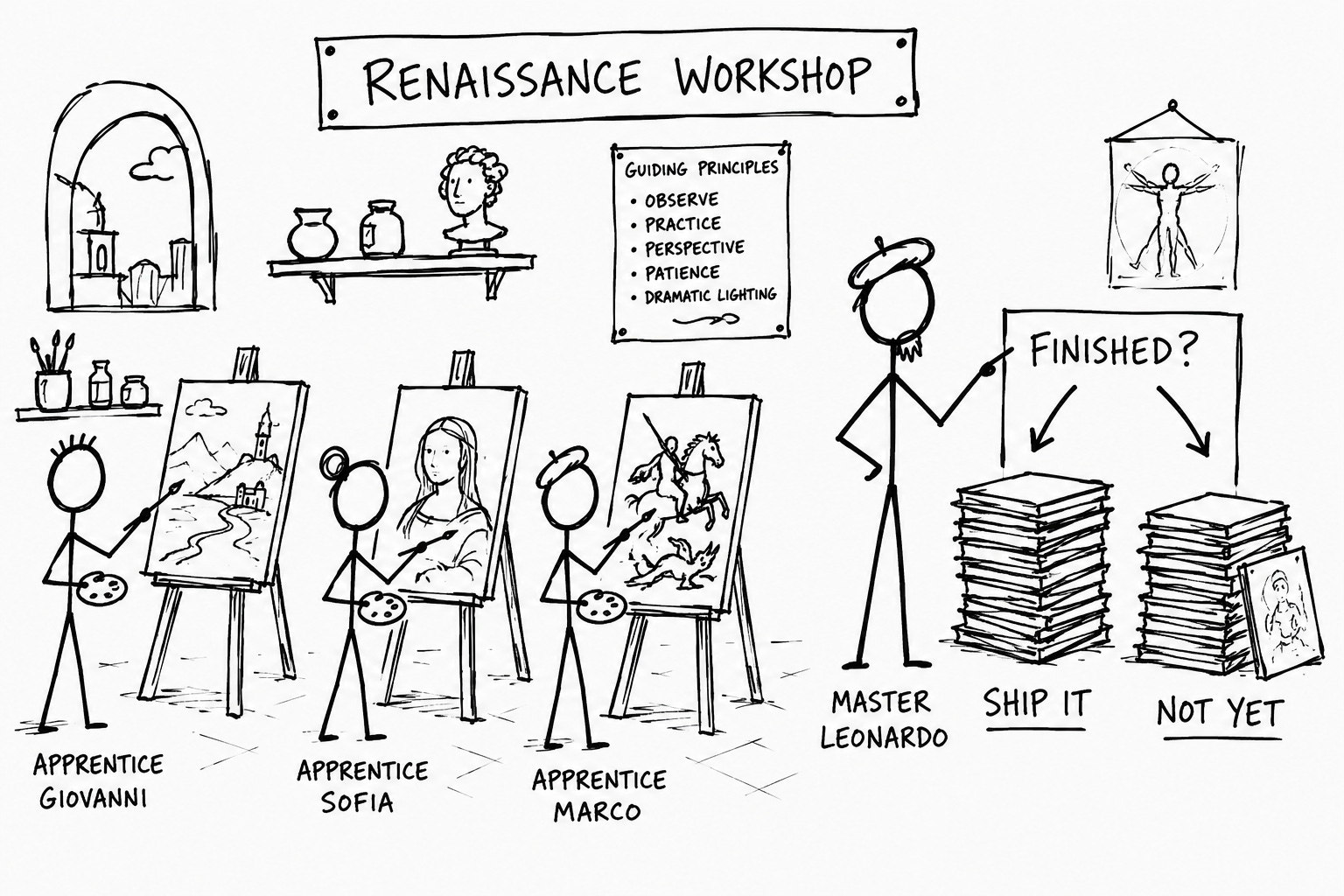
You also didn’t paint most of what’s about to leave your studio. AI did. And you’re still the one whose name goes on it.
You're already doing this job. Mostly without realizing it's your job. Mostly without the patience the work asks for. Mostly without the spine to delete what the clankers spent an hour writing for you.
Let’s fix that.
Why The Job Stays Invisible
Because speed is measurable and taste isn’t.
You can track drafts produced, posts published, words written, platforms hit. These numbers go on dashboards. They get screenshotted into build-in-public threads. They feel like motion, which they sometimes are. (I’ve been refreshing my own dashboard while writing this paragraph. The dashboard does not care about the irony.)
Taste doesn’t have a metric. There’s no KPI for “this paragraph is technically true and I don’t believe a word of it.” No dashboard widget for “this transition is so smooth I no longer trust this writer.” So in any system that rewards what’s measurable, the master’s job gets cut first. Every single time.
This is the trap. You build an AI-assisted workflow that produces more, faster, with fewer rough edges, then wonder why everything you publish reads like wallpaper. (Sometimes you blame the model. Sometimes you buy a new prompt database. Sometimes you just sit there frustrated and mildly betrayed by your own efficiency.) The answer is never the prompt. The answer is that the part of the process that protected specificity got run over by the production schedule.
The apprentices are doing fine. Nobody’s running the studio.
The Three Moves
Three moves. None of them complicated. All of them get skipped under deadline pressure.
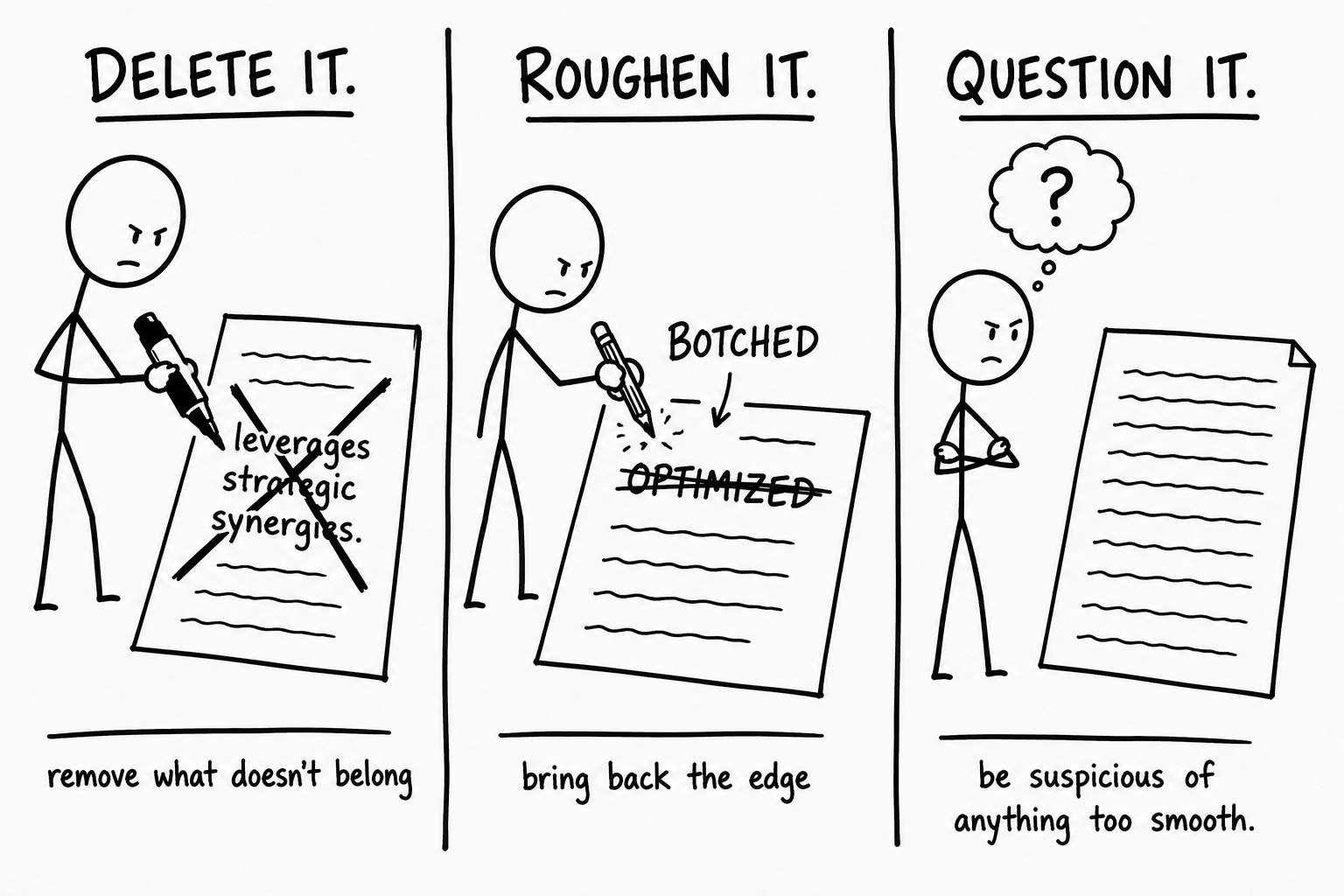
The veto
Sometimes AI writes a sentence that’s grammatically clean, factually accurate, and contextually on-topic, and it still has no business being in your piece. Maybe it’s too generic. Maybe it sounds like advice anyone in your niche could’ve written. Maybe it’s true but it’s not what you came here to say.
You delete it.
Not rework it. Not soften it. Not “leave it for now and come back later.” Delete it. Even when the rest of the paragraph has to be rebuilt around the loss. (Especially then.)
The rougher version
AI smooths language by default. Hedges your strong claim into a moderate observation. Changes your unusual word into a more familiar one. Adds connective tissue between sentences that didn’t need any, because the silence was the point.
Sometimes that’s right. Sometimes the smoothing actually helps. But often (and this is the move most people don’t make) the smoothing makes the writing weaker. Your job is to recognize that and put the rough version back. The unhedged claim. The unusual word. The abrupt cut between two sentences that creates the right kind of friction.
I keep a list of words AI smooths out of my drafts. (Yes, this is a thing I do. Yes, I’m aware it’s a deeply specific way to spend my afternoons.) “Ass-munch.” “Rawdog.” “Crappy.” Words that sit slightly rougher than the model’s default vocabulary. Every one of them, AI replaces with something cleaner. And every time, putting the rough word back makes the sentence sound more like me.
The “too smooth” call
This one’s the hardest. Because it requires you to override the part of your brain that thinks polished equals finished.
You read a draft. The sentences flow. The structure holds. Nothing is technically broken. And yet something is wrong. Every sentence works. None of them have bite. It’s competent in a way that’s almost worse than bad, because competent is harder to argue with.
Your job is to name that feeling and act on it. Before publishing. Before the schedule wins. (Most weeks, this is where I lose.)
The Polish Pass And The Taste Pass
Most editing workflows have one editing pass. That pass usually does what AI is genuinely good at: smooth the language, fix the grammar, tighten the structure, make sure the formatting is consistent. Call this the polish pass.
The polish pass is necessary.
It is not sufficient.
What’s missing in most workflows is a separate, deliberate taste pass. The two passes ask different questions. The polish pass asks is this clean? The taste pass asks is this mine?
A taste pass looks like this:
Does this sentence have to exist, or could the piece survive without it?
Where am I making a generic claim where I could make a specific one?
What’s the riskiest sentence in the piece? (If the answer is “nothing,” that’s the problem.)
Am I saying what I actually think or what sounds defensible?
Is there a stronger word here that I’m avoiding because it feels too sharp?
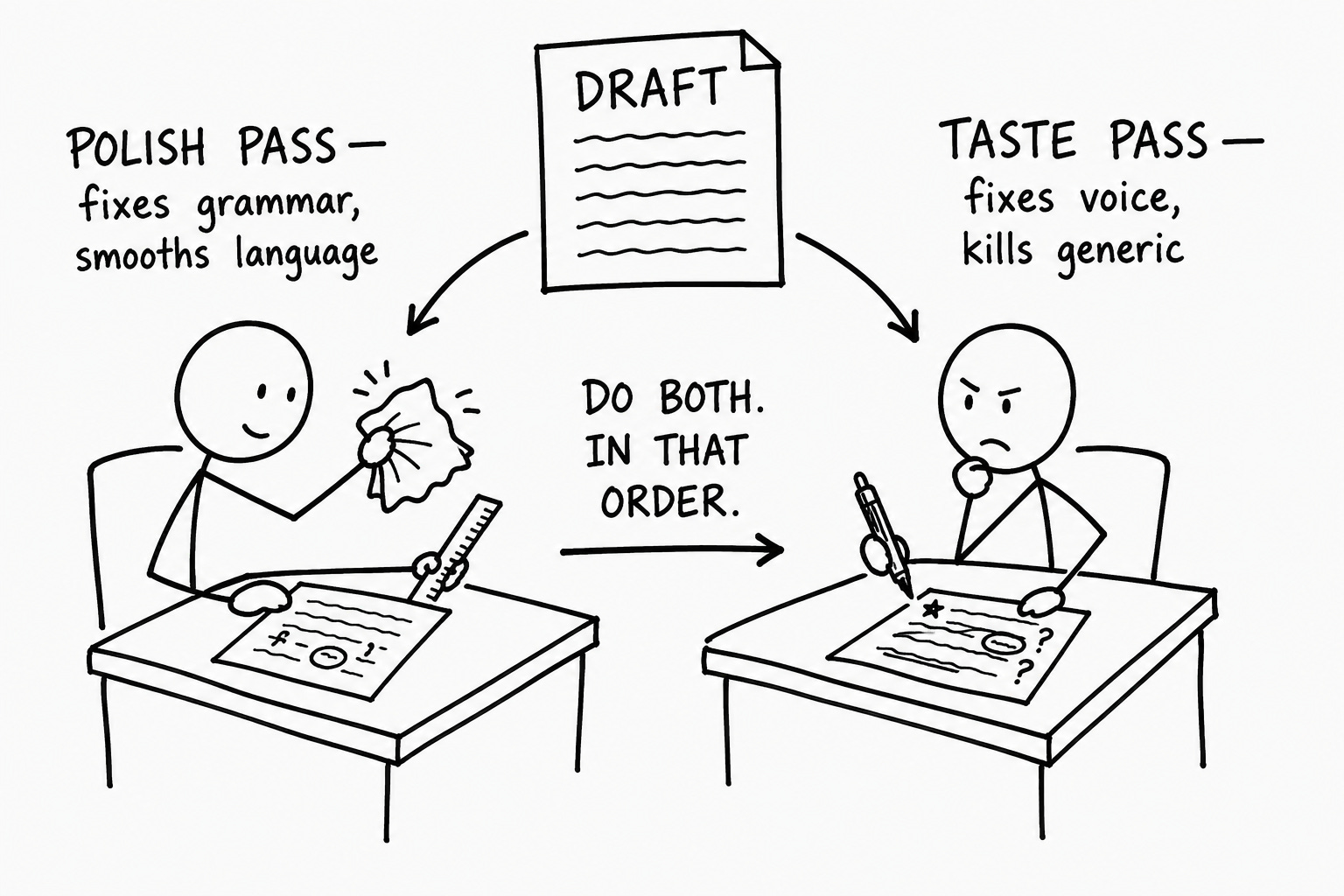
The polish pass makes the writing cleaner. The taste pass makes the writing more yours.
If you only have time to do one, go with the taste pass. (Sorry. I know nobody wants to hear that. Do it anyway.) Clean writing without specificity is bleh. Specific writing where you can almost hear the writer pacing the kitchen at two in the morning gets remembered.
You Already Have An Advantage You’re Sleeping On
In big content operations, the master’s job gets diluted into near nothingness. By the time a piece moves through five reviewers, three brand checks, and a legal pass, the rough edges that made it interesting have been negotiated into oblivion. Everyone signed off on smooth. Nobody signed off on alive.
You don’t have this problem. (You have other ones. I’ve been holding the same piss for ninety minutes because the Taste Pass on this article isn’t done.) You’re the writer and the master, both. AI just lets you staff the apprentice work without paying anyone in lodging or oil paint.
This is a structural advantage and most of us are sleeping on it. Big operations have more resources, more distribution, more production capacity. They don’t have your editorial coherence. The slop factories can’t have it. Their whole model is built on the idea that taste can be templated, automated, and handed off to AI agents at scale, which is fine for output volume and disastrous for everything else.
How To Actually Do This
A few things that have worked for me, in rough order of usefulness:
Separate the passes by time. Polish when you finish the draft. Walk away. (Feed the dog. Touch grass. Do a shitload of burpees. Whatever your equivalent is.) Come back at least an hour later, ideally the next morning, and run the taste pass with fresh eyes. The distance is doing real work. You can’t notice what’s too smooth while you’re still inside the smoothness.
Read it out loud. Not skimmed. Read. Out loud, in a normal voice, like a human animal making sounds with their mouth. The places you stumble are usually places where the writing got clumsy and your mouth knows before your brain does.
Mark every sentence you don’t quite believe. Not the ones that are factually wrong. The ones that are technically true but feel like filler. Then commit: rewrite, sharpen, or cut. No fourth option. (The fourth option seems to always be “leave it.” This is how every cringe sentence I’ve ever published snuck in.)
Hunt the missing specific. AI defaults to general because general is statistically safer. Find at least one place in every piece where you can swap a general claim for a specific number, a specific moment, a specific name. The piece gets better immediately. (Side effect: No copycat can lift your specifics without sounding like a cover band in a Fremont Street casino lounge.)
Trust the discomfort. If a sentence makes you slightly uncomfortable to publish, that’s usually the sentence worth keeping. Not always. More often than you’d think. The discomfort means you’re saying something you actually mean, which is exactly what readers respond to. (And, less romantically, what makes your work a pain in the ass to imitate.)
What Changes
Two things, mostly.
Your work starts sounding more like you and less like everyone else yammering about the same topics. That’s the obvious one.
The second is less obvious and matters more: you start trusting your own judgment. When you systematically protect the specific and the slightly rough parts of your posts, you build evidence that your instincts are worth listening to. (This is the part most workflow advice skips, because it’s hard to sell.) The evidence compounds. You get faster. More confident. Harder to override under deadline pressure.
This is what people mean when they talk about voice. Voice isn’t something mystical you were born with. It’s the accumulated record of decisions you made on your own behalf, hundreds of times, until they showed up as a pattern on the page. The Renaissance master’s signature meant something for the same reason. Every painting that left his studio with his name on it had passed through the same set of refusals.
Your byline works the same way. Or at least it should.
Slop factories can’t do this. They’re built to produce smooth output at scale, which is the opposite of editorial coherence. The clankers crap out the content people consume. You drop the bars people quote.
Crafted with love (and AI),
Nick “Mostly Subtraction” Quick

PS… Running a taste pass on lousy AI output is a punishment only handed down in North Korean prison camps. Nothing can teach AI taste. But the Ink Sync system can get it pretty darned close. Get the workshop for free here:

PPS… The slop factories own distribution. We've got each other. Subscribe, restack the line that hit, forward this to someone who needs it. Three small acts of defiance. Or don't, and we both pretend you always skip the post-scripts.