
Your AI Writing Doesn’t Suck Because It’s AI. It Sucks Because It’s Almost You.
Why being 90% yourself is worse than being 0% yourself (and what to do about it)

The worst AI content isn’t the stuff that screams “ChatGPT wrote this.”
It’s the stuff that’s 95% you.
And here’s the part that’s going to piss some people off: most of you are living in that zone right now. Writing content that’s almost authentic. Almost you. Almost good enough.
Which is worse than being obviously garbage.
When AI content is obviously AI—robotic, corporate, generic as hell—readers know what they’re dealing with. They scroll past. Delete the email. Close the tab. The trash took itself out.
When AI content is authentically you—systematically trained on your voice, refined through actual collaboration—readers engage. They trust it. They share it. They can’t tell and that’s the point.
But that middle zone? That 85-95% authentic range?
That’s where trust goes to die.
Because content that’s almost-but-not-quite you creates cognitive dissonance. It sounds like you enough to create expectations. Your readers lean in. They recognize something.
Then that remaining 10-15%—the slight vocabulary drift, the generic transitions, the one sentence that could be in literally any article about this topic—that’s what they remember.
Not because it’s AI. Because it’s almost you.
And almost doesn’t fucking count.
Think about deepfakes. The creepy ones aren’t the cartoonish CGI from 2015. (Remember when everyone thought that was scary? Cute.) The creepy ones are where something feels off but you can’t quite place it. The eyes track 97% correctly. The mouth movements are 92% synced.
Close enough to make your brain malfunction.
Same thing happens with AI writing.
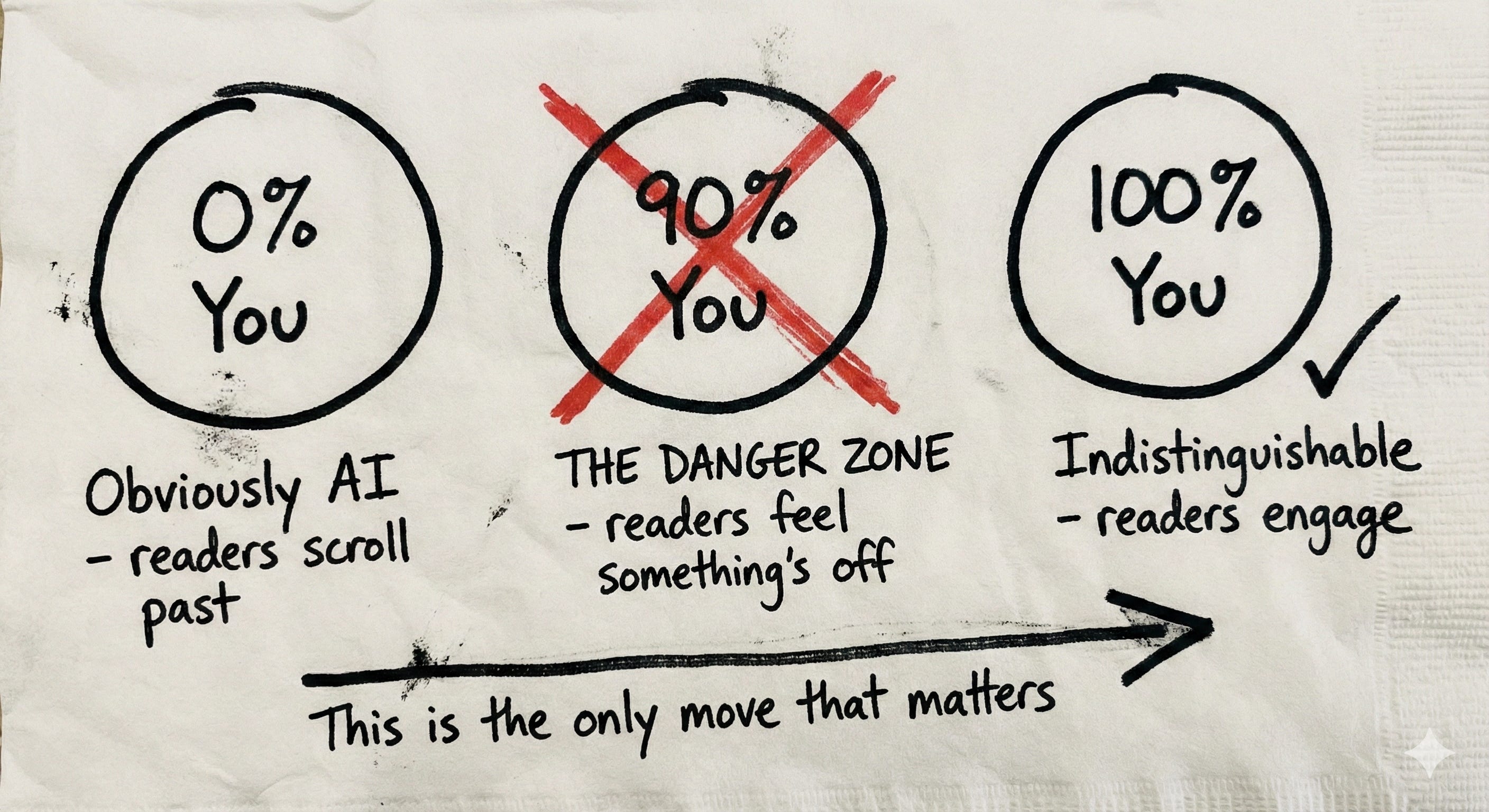
Your readers might not consciously think “this was written by AI.” But they’ll feel something’s wrong. The voice isn’t quite right. The personality is diluted by 8%.
It reads like you had a minor stroke but showed up to write anyway.
(And yes, I’m aware that’s dark. It’s also accurate. Your readers aren’t getting 100% of you and they can tell. That’s the betrayal.)
This is exactly where most creators live.
They use AI to expand ideas—turning bullet points into paragraphs. They use it to vary sentence structure. They use it to “polish” their drafts.
All noble goals. All pushing you toward the uncanny valley.
Because they’re using AI as a fancy thesaurus instead of a collaborative partner who actually knows how they think. They want the efficiency without doing the work.
And the 85-95% zone feels good to produce.
You read it back and think, “Yeah, this sounds pretty close to me.” Close enough. Good enough.
Your readers feel the 10% gap and ghost you. Slowly. Quietly. They don’t unsubscribe—that would require effort. They just... stop caring. Stop opening. Stop engaging.
And you have no idea why because the content seems fine.
Welcome to the uncanny valley. Population: everyone using AI “a little bit” without actually teaching it their voice.
The solution isn’t to make AI sound “more natural.”
The solution is to go all the way or go home. Either:
Use AI obviously and transparently (fine for certain contexts—summaries, transcripts, research)
Teach it your voice systematically so the output is indistinguishable (the Voiceprint approach, which requires actual work)
Everything in between is a trap door with a welcome mat on top.
This is why prompt libraries are bullshit. (Sorry to everyone selling them. Actually no I’m not.)
They optimize for that dangerous middle zone. “Make this sound more conversational.” “Add personality.” “Write like a human.”
You know what happens when you tell AI to “add personality” without defining whose?
It adds the averaged-out, statistically-most-common-personality-traits it’s learned from its training data. You get the personality equivalent of a guy named Brad who does well in meetings but nobody remembers five minutes after he leaves the room.
(Brad if you’re reading this: this isn’t personal. You’re just tragically forgettable.)
Your readers don’t need your AI writing to sound “more like you.”
They need it to sound exactly like you, or be obviously something else entirely.
Most people teaching AI writing won’t tell you this. Because it means there’s no shortcut. No magic prompt. No one-click solution to buy for $27.
You either do the actual work to systematically document your voice, or you accept that your AI-assisted content will always feel slightly off.
And here’s the part that’s going to make half of you leave: I think that’s exactly what most creators deserve.
Not because they’re bad people. Because they want the results without earning them. They treat AI like a drive-through window—place order, grab output, complain about the taste.
Then they wonder why their stuff sounds generic. Why engagement is dropping. Why nobody shares their work.
The AI didn’t betray you. You betrayed you by not teaching it who you actually are.
(And yes, I’m painfully aware of the irony—this piece was written collaboratively with AI. Because I spent weeks documenting my voice, testing outputs, refining the system. This is what happens when you go all the way instead of stopping at 87%.)
So here’s my actual question for you: What percentage of your current AI-assisted content lives in the uncanny valley?
Not “do you use AI” or “is it good enough.”
How much of it sounds 90% like you—and are your readers quietly noticing the missing 10%?
Because here’s what nobody’s saying in your replies: they can feel it. They just scroll past instead.
That 10% gap. That slight wrongness. That sense that you’re not fully there in your own writing.
And eventually, they’ll stop showing up too.
You can’t half-ass being unmistakably you and expect full-ass results.
Either teach AI your actual voice, or stop pretending you’re collaborating when you’re really just automating with extra steps.
Everything else is the uncanny valley. And nobody wants to live there.
How much of your AI-generated content would pass the “indistinguishable from you” test? Reply and be honest. Or lie. I’m not your supervisor. But your readers already know the answer.
Crafted with love (and AI),
Nick “100% Or Nothing” Quick

P.S. — Want the full secrets to creating a Voiceprint that actually teaches AI to write like you (not like Brad from the meeting)? It’s all in Co-Write OS—my course on systematic voice preservation. It’s free right now in my fledgling Skool community, but I’m building a real membership site like a grown-up. Once that launches, there’ll be a fancy-pants price tag on it. Grab it while it’s still free: