
Write From Your Throat, Not Your Head
What three days of fever taught me about the writing advantage AI can’t touch

The fever Hit Monday.
Not dramatically. Not a sweat-soaked awakening at 3am with sudden clarity. Just a slow recession, like a tide going out. One hour I was underwater, the next I was merely damp. Still exhausted. Still wrong. But measurably less wrong than six hours before.
My throat felt like I'd gargled aquarium gravel. Every swallow was a small act of violence against myself. I’d developed an intimate relationship with the specific temperature of my bedroom. Too hot under covers, too cold without, a narrow band of acceptable that kept shifting like it was personally offended by my comfort.
(Three days of this. Three days of my body staging a coup against basic functions like “drinking water without wincing.”)
I couldn’t write. Could barely think. But I could feel with excruciating precision. Every sensation amplified. Every physical state impossible to ignore.
And somewhere around day three, delirious and annoyed and very aware of my own mucus production, I realized something:
This is what’s missing from most writing.
Not the sickness. The embodiment. The physical texture. The sensation of existing in a body that won't STFU.
AI doesn’t have this. AI will never have this.
(No amount of training data fixes the fundamental problem of not having a throat that can hurt.)
And most writers (even healthy ones with functioning lungs) aren’t using it either.
Your Unfair Advantage
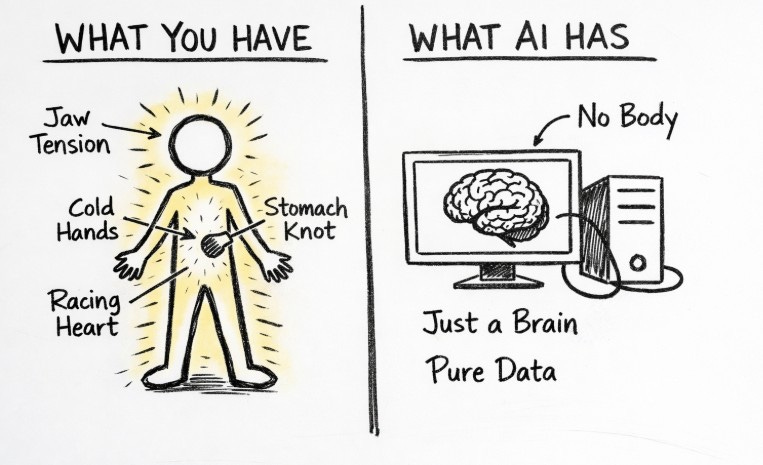
AI has no body. This seems obvious. It’s also the most underutilized competitive advantage writers have.
AI doesn’t know what water tastes like when you’re sick. (It tastes different. Metallic and too cold and somehow not wet enough.) It doesn’t know the specific quality of silence in a room when you’ve been alone with illness for three days. It doesn’t know how time moves differently when you’re watching the ceiling, waiting to feel human again.
AI can write ABOUT embodied experience.
AI cannot write FROM embodied experience.
That gap is the texture that makes writing feel like it was produced by someone who actually exists. Most writers don’t use it. They write from their heads, same as the machine does. Same as something that has never felt a damn thing.
They produce content that readers scroll past without knowing why.
Then they wonder why their work doesn’t land.
(It’s landing exactly where it should. Six feet under the algorithm.)
“Write What You Know” (You’ve Been Doing It Wrong)
Everyone’s heard it. Everyone’s misunderstood it.
Most writers interpret this as: write about your industry. Your expertise. Your domain knowledge. As if “what you know” means “what you could put on a resume.”
Resumes are lies we tell strangers. Your body doesn’t lie.
Write what you know means: write from your physical and emotional knowledge. The knowledge that lives in your body, not your brain. The knowledge that can’t be Googled or extracted from a training dataset.
You don’t know illness because you’ve read WebMD. You know illness because your throat did something particular. (Not “sore.” What KIND of sore? Sharp? Raw? Burning? The specificity is the point.) Your temperature fluctuated in a specific pattern. Your sense of time distorted in a particular way.
AI can describe illness.
You can make someone’s throat ache while reading.
If you’re writing from your head, you’re just another description. Another competent piece. The algorithm thanks you for your sacrifice.
The Embodied Swipe File
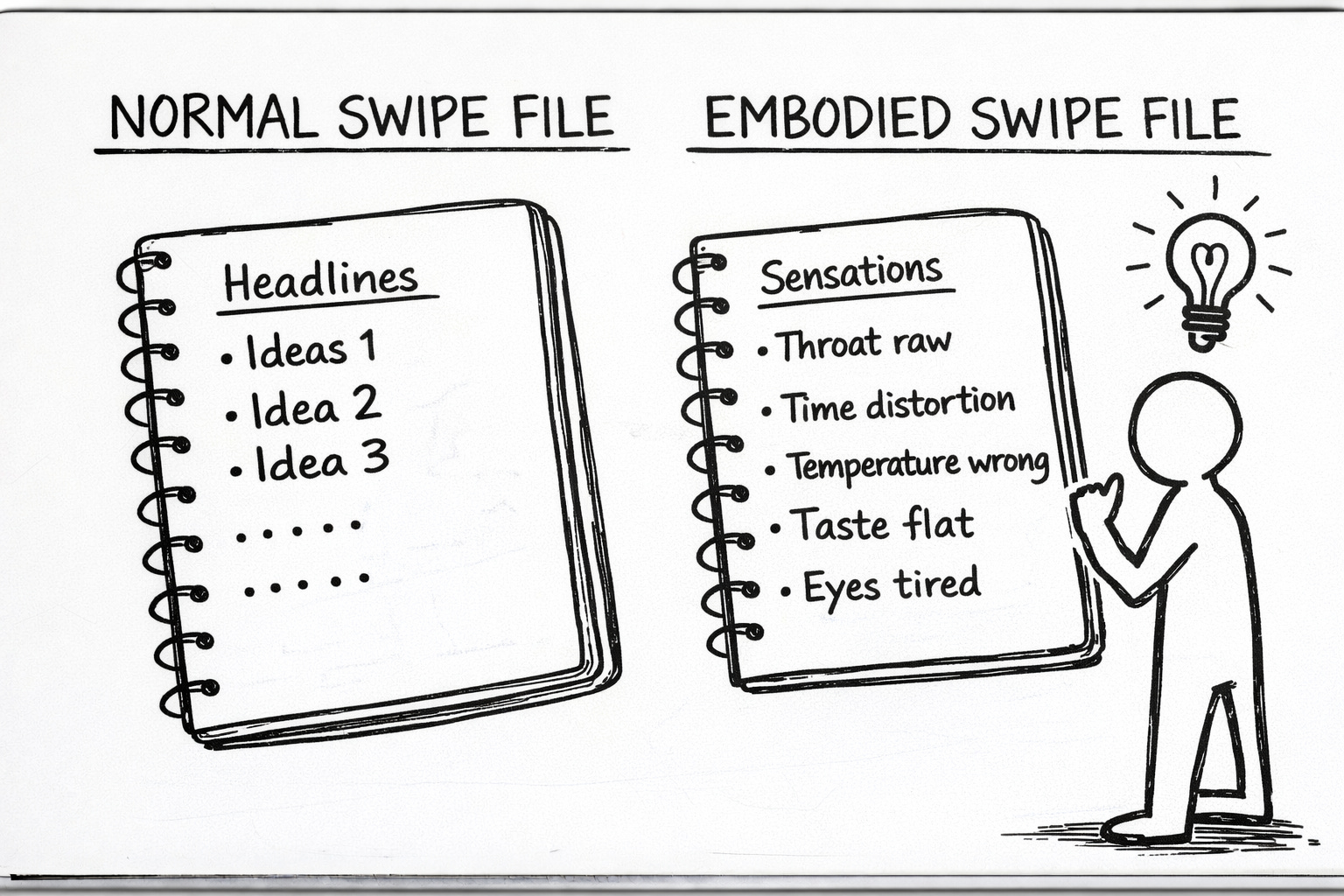
Writers keep swipe files. Ideas. Headlines. Structures.
Most swipe files are conceptual. Brain stuff.
You need a different kind. An embodied swipe file captures sensations. Physical states. The stuff your body knows that your brain forgets to record.
What goes in it:
The exact feeling of your apartment at 6am when you’re the only one awake. (Temperature. Light quality. What the air feels like on your face.)
What your hands feel like after typing for three hours. (The specific fatigue. Which fingers. The weird almost-numbness in the webbing between thumb and index finger.)
What being sick actually feels like. Not the diagnosis, the sensation.
The physical difference between good news and bad news. (Where do you feel it first? Chest? Stomach? Does your posture change?)
How to capture it:
Voice memo. Phone notes. Whatever’s fastest.
The moment you notice your body doing something in response to your life, capture it. Don’t edit. Just record the raw sensation before your brain converts it into a concept.
“Day three of fever. Time has stopped meaning anything. Slept for what felt like thirty minutes, was actually four hours.”
“First morning feeling human. Coffee tastes like coffee again instead of like hot bitter sludge.”
This is your swipe file. Not ideas. Textures.
Five Senses, One Actually Used
Most writers only use one sense: visual.
They describe what things look like. The appearance of the room, the person, the scene.
Visual is the most generic sense. It’s also what AI is most trained on. “The room was dimly lit.” “Her face showed concern.” “The sunset painted the sky in shades of orange.” AI can produce this infinitely. It all means nothing.
(I wrote an entire 3,500-word piece last month with zero non-visual sensory information. Not one sound. Not one smell. I caught it in editing and wanted to delete my entire writing career.)
Visual has a line around the block. The other four? Open bar, no wait.
Sound: Not music. The ambient texture. The specific quality of silence when you’ve been alone for days. The way your own breathing sounds different when your chest is congested.
Smell: The sense most directly connected to memory. Your olfactory bulb connects directly to your limbic system. Smell bypasses the thinking brain entirely. What does your apartment smell like after three days of being sick in it? Stale sheets. Cold medicine. Air that hasn’t moved enough.
Taste: Most underused. Most powerful. Being sick obliterates taste. Food becomes obligation. And then it comes back. That first meal that actually tastes like something is a homecoming.
Touch: Not touching things. What things feel like touching you. The specific wrongness of your own skin when you have a fever. Too sensitive, every contact amplified. Temperature. Always temperature.
The exercise: Take your last piece. How much visual? (Probably lots.) How much everything else? (Probably nothing.) Rewrite one section with zero visual and at least two other senses.
From Sensation to Insight
Here’s where most writers fail. They start including sensory details and it reads like a grocery list of body parts.
“My throat hurt. My head ached. I was cold.”
That’s description. Not insight.
Physical sensation contains knowledge. Your body knows things before your brain does. When you’re sick for three days and your sense of time dissolves, your body is teaching you something about how consciousness works. About how fragile the structures are that you take for granted.
The sensation is data. The insight is what that data means.
Example:
Sensation: “The fever made time meaningless. I’d wake up not knowing if it was morning or afternoon.”
Translation: “Time isn’t something I perceive. It’s something my body constructs. Fever broke the construction equipment.”
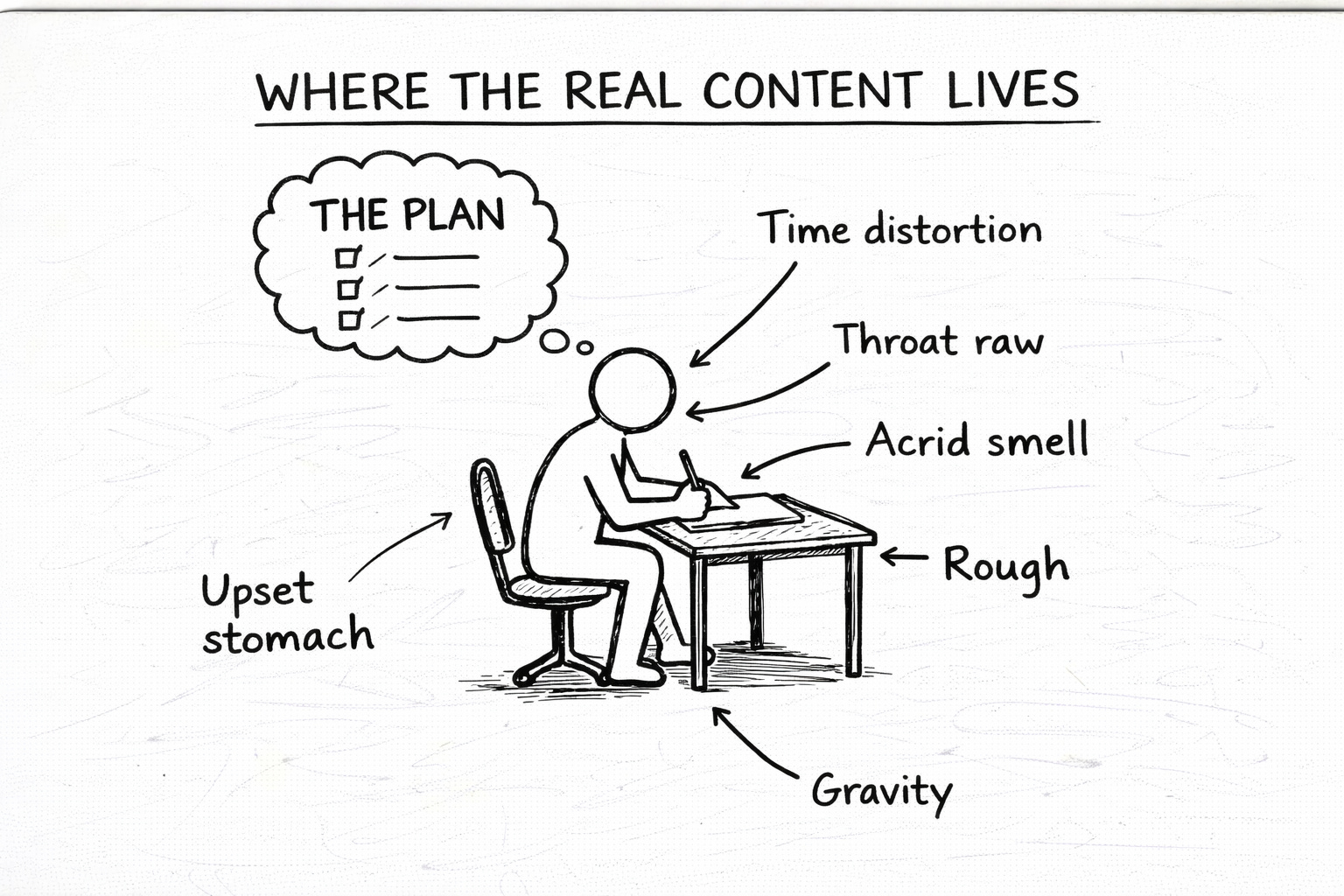
Insight: “AI experiences no time because AI has no body. This is why AI-written content feels weightless. It exists outside of time, outside of bodies, outside of the physical experience that gives writing gravity.”
The sensation alone is a detail. The translation is content.
The Body Start Protocol
Your brain lies to you. It tells you what you’re supposed to think. What the smart take is. Your brain has absorbed too many other people’s conclusions.
Your body doesn’t lie.
Before you write, stop. Set a timer for five minutes.
Close your eyes. Or don’t. But stop looking at the screen.
Notice:
What is your body doing right now? Not what you think it should be doing. What is actually happening. Is your jaw tight? Are your shoulders raised? Where is there tension? What’s your breathing doing?
What’s the temperature of the room? Of your body?
What do you hear? Not the obvious sounds. The ambient texture.
What do you smell? There’s always something.
Now ask:
What does my body want to write about?
Not what your brain planned. Not the content calendar item.
What is your body already processing through its tension, its temperature, its sensory state?
Often there’s a connection. The physical state relates to the topic you’re avoiding. Sometimes there’s no connection. That’s fine. You’ve spent five minutes actually inhabiting your body instead of treating it like an inconvenient flesh taxi for your opinions.
Your writing will be different.
The Unfair Advantage (Reclaimed)
AI is getting better at everything. Structure. Argument. Mimicking tone and voice.
AI is not getting better at having a body.
AI will never know the temperature of dread. Will never know what your shoulders do when you're avoiding something. Will never know the particular quiet of a house after everyone's gone to bed.
That gap doesn’t close. That gap is yours.
Your nervous system. Your sensory experience. Your physical knowledge of what it feels like to be alive, in a body. Even when that body isn’t cooperating. Especially when it’s not.
Whether you use it is another question.
Most won’t. Bodies are inconvenient. Sensations are messy. It’s easier to stay in your head, where everything’s neat and conceptual and indistinguishable from what a machine produces.
(Don't say I didn't warn you.)
Before your next piece, spend five minutes in your body instead of your brain. Notice what’s happening. The sensations, the temperature, the sounds, the tension. Then start writing from that place. Not about it. FROM it.
The difference is everything. Or nothing. Depending on whether you actually do it.
🧉 Body part check: where are you holding tension right now? Reply with one word. (Mine’s throat. Not accepting apologies at this time.)
Crafted with love (and AI),
Nick “Body Won't Shut Up” Quick

PS… I write daily. If 'competent but forgettable' describes your content and that pisses you off, you're in the right place. Subscribe.
Nick, I read this while actively noticing I've been holding my breath on and off for probably two hours now LOL. So thanks for that awareness I didn't ask for 😅
But seriously, I struggle so much with "write from embodied experience not about it". I tend to do the grocery list version ("my throat hurt" "my head ached") despite being a storyteller at hear.
I guess I'm just trying to mix the social media-style content with how you actually are supposed to write.
Amazing piece! And hope you're feeling better :)