
Fill the Holes in 90 Seconds (Before Your Brain Talks You Out of It)
Voice memos, brain dumps, and the fastest way to become the newsletter your readers would actually miss.

You added the flag-don’t-fill instruction. AI handed you back a draft with six clearly marked placeholders. Six spots where the memorable stuff goes.
You filled zero of them.
Or you filled one, spent thirty minutes agonizing over it, and let AI quietly backfill the other five because you ran out of time, energy, or faith that you had anything worth saying. Then you published, told yourself you’d do better next time, and moved on.
The spotting works. The flagging works. The beautifully structured draft with six holes staring at you like a pop quiz you didn’t study for works. The whole thing falls apart at the filling, because the moment you sit down to fill a placeholder, your brain switches from “person who lived a thing” to “writer constructing a paragraph,” and the entire apparatus seizes up. Rewrite. Delete. Rewrite. Delete. Check email. Consider a career as a Zamboni driver. Rewrite. Delete.
Parts 1 and 2 taught you how to spot the holes and flag them. What they didn’t cover is that the filling was supposed to take ninety seconds, not thirty minutes. And that the best version of your real story is the first one, not the fifth.
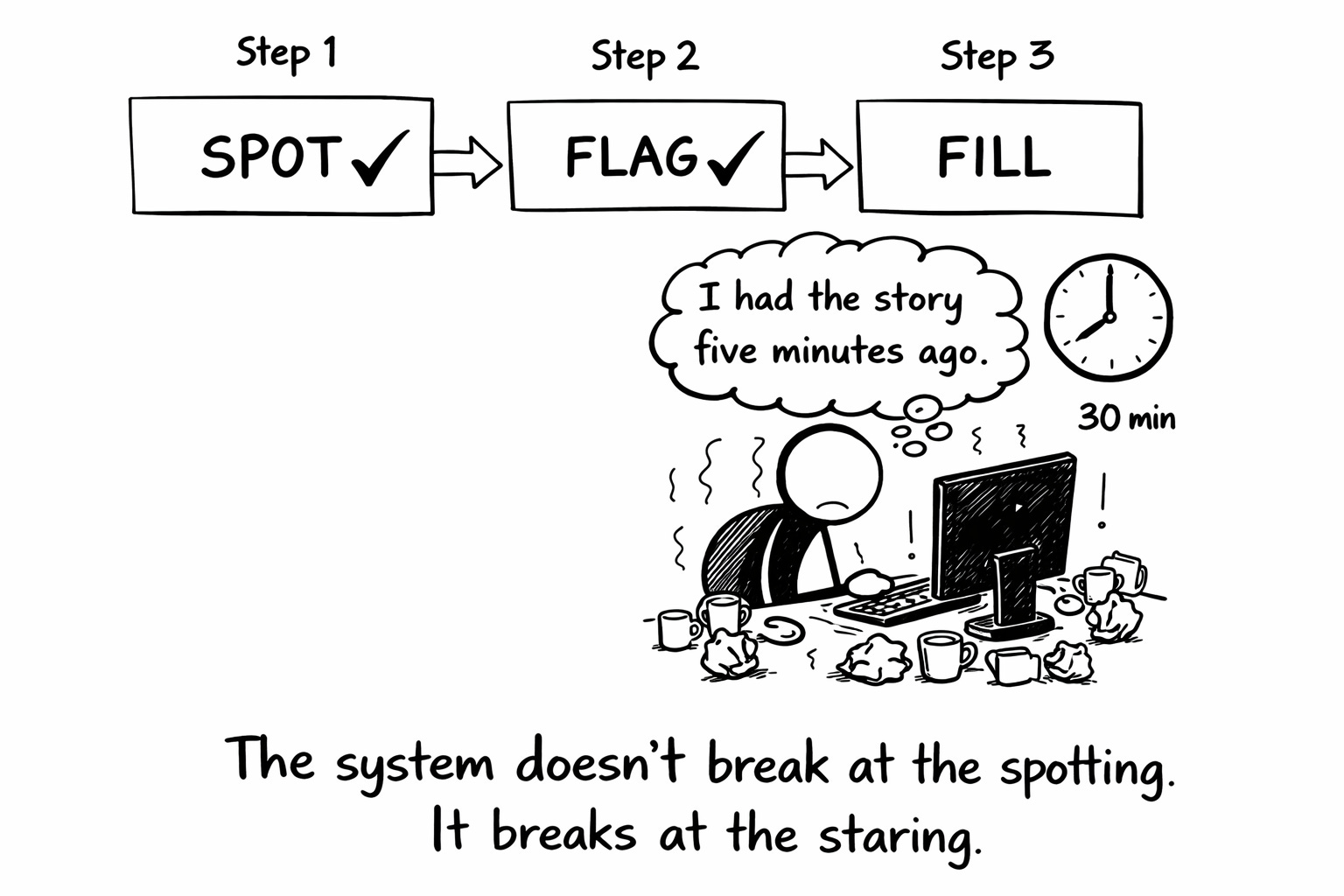
This is Part 3 of a 3-part series on you-shaped holes. Part 1 covered what they are and why AI fills them with competent filler your readers forget by Monday. Part 2 taught AI to flag them instead of faking them. Now we fill them. Fast. With the stuff that actually sticks.
Why Your Brain Is the Bottleneck (Not Your Writing Skill)
When AI marks a you-shaped hole, you’re mid-edit. Scanning, tightening, adjusting. And then a placeholder drops into the middle of the draft and asks you to create something from nothing inside a document that already reads like it’s finished.
So your brain does the only thing it knows how to do: it tries to write something worthy of the draft it’s sitting inside. Match the tone. Match the quality. Construct a paragraph that belongs. (Your brain, at this point, is basically a dinner guest who showed up in sweatpants, saw everyone else in cocktail attire, and is now trying to fashion a tie out of a napkin instead of just telling the story it came to tell.)
But the placeholder isn’t asking for a paragraph that belongs. It’s asking for raw material. The real story. The actual opinion. The genuine example. In whatever stumbling, half-formed shape it arrives in. AI already built the stage. (We covered this in Part 2: the structure, the transitions, the surrounding context.) You don’t need to write something that fits. You need to drop in the truth and let AI handle the seams.
The shift: stop writing your hole fills. Start talking them.
Writing lets you edit in real time. That’s the trap. Your fingers type a sentence, your brain scans it, your fingers delete it, and the cycle restarts forever, or until you give up and let AI backfill the hole with something polished and instantly forgettable. Talking doesn’t have a backspace key. Your mouth commits to the sentence before your inner editor can reject it. (Your inner editor hates this, by the way. It will file a formal complaint. Ignore it. It’s been wrong about what readers want for your entire career.)
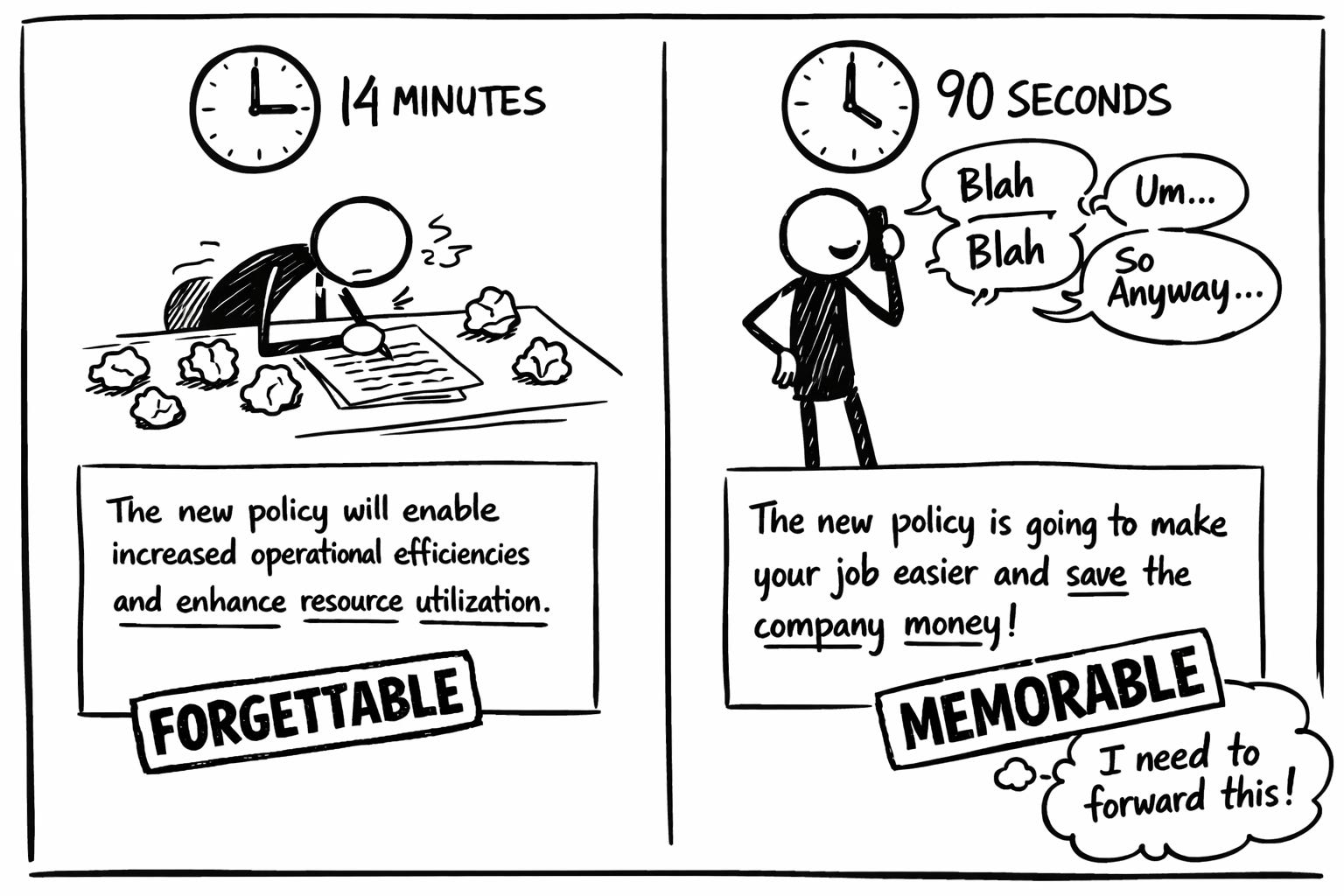
Ninety seconds of messy verbal rambling will produce more usable raw material than thirty minutes of typing and deleting, because the only thing standing between you and the content your readers will actually remember is the delete key.
Take it away.
The 90-Second Talk-Through
The technique is almost insultingly simple. Which is how you know your brain will resist it, because your brain is a credentialed snob who believes complexity equals quality and has been wrong about that for your entire creative life.
When you hit a you-shaped hole: grab your phone. Open the voice memo app. (The built-in one. Not the artisanal recording app you’ll spend twenty minutes researching to avoid doing the actual work. That app is a trap. The default one is fine.) Talk through the answer like you’re telling a friend at a bar.
Not a presentation. Not a keynote. Not a “let me organize my thoughts first” premeditated performance. A friend. At a bar. They just asked you a question and you’re answering it while deciding whether the jalapeño nachos are worth ordering for the table.
The rules:
First thought wins. Not the best thought. Not the most impressive thought. The first one. Perfectionism is a con artist in a rented suit. It tells you it’s here to improve quality while it pickpockets your time and replaces your instincts with something safer, smoother, and infinitely more disposable. Your first instinct is almost always the most authentic material you’ll produce because it hasn’t been sanitized by the committee in your head that desperately wants you to sound smart instead of real.
Ramble. Explicitly. Enthusiastically. Give yourself permission to be a complete disaster. Repeat yourself. Lose the thread. Say “um” so many times it becomes a rhythmic motif. You’re raiding the fridge at 2 AM, not plating a tasting menu. The processing comes later. Right now you’re just getting the truthful, embarrassing, weird, particular material out of your body and into a recording before your inner editor wakes up and starts suggesting “improvements” that are actually just ways to sand off every interesting edge.
(One of my worst voice memos for a post included the sentence “I don’t know why I’m even telling this story, it makes me look like an idiot.” That story became the most-forwarded section of that newsletter. Readers don’t forward polished. They forward real. They forward the thing that made them think “I can’t believe he actually admitted that.” Your inner editor would have deleted it. Your readers would have shared it. Trust the ramble.)
Hard stop at 90 seconds. Ish. The point is constraint, not a referee with a whistle. Ninety seconds is long enough to capture the essential truth and short enough that your inner editor doesn’t have time to fully boot up and begin its hostile takeover of your creative instincts. Past about two minutes, you start performing instead of talking. That’s where the raw authenticity curdles into something rehearsed. Get in, tell the truth, get out.
What to Do With Your Beautiful Mess
You’ve got a rambling voice memo. It contains the word “um” more times than any single audio file should legally be allowed to. Your future biographer would be concerned. Now what?
Option A: Transcribe and inject.
Use any transcription tool. (Your phone’s built-in dictation, Letterly, AI transcription, a patient friend with fast typing and questionable judgment in favors they agree to. Whatever converts sound to text.) Paste the rough transcription directly into the you-shaped hole.
Then tell AI:
I’ve filled this you-shaped hole with a raw voice transcription. Integrate this material into the surrounding draft. Keep my actual details, stories, opinions, and phrasing. Clean up ONLY the transcription artifacts: repeated words, false starts, filler sounds. Do NOT change my opinions, swap my examples for ‘better’ ones, add experiences I didn’t mention, or smooth out details that seem too pointed or revealing. Those are the parts that matter most.That last sentence is the guardrail. You’re giving AI explicit permission to polish but not to replace. And you’re drawing a hard line around the weird, too-personal, slightly-too-revealing details, because those are the exact elements AI’s instincts will try to generalize into something “cleaner.” AI thinks it’s helping when it smooths out your raw edges. It’s actually destroying the only parts of your draft that will survive in your reader’s memory past the next scroll.
(The first time you paste a raw voice memo transcription into an AI draft, you will physically cringe. Your polished paragraph about content strategy will be sitting next to “so basically I, um, I tried this thing and it was like, you know when you burn toast and the whole apartment smells and you just stand there?” and your entire body will reject it. Good. That cringe is the sound of something real entering a document full of beautiful fakes. Let the cringe happen. Then let AI stitch it in. The “smell of burnt toast” is the part your reader will quote to a friend.)
Option B: The bullet brain dump.
Some people think better through their fingers. (Different wiring. Same raw material comes out either way. Your vocal cords don’t have a monopoly on unfiltered truth.) Same concept, written:
3 to 5 bullets answering the placeholder
No full sentences required
Fragments, shorthand, half-thoughts, inside jokes with yourself
Same 90-second constraint
Include the raw, unfiltered, “should I really say this?” detail. Especially that one.
Then feed it to AI with the same integration instruction. Bullets in, polished paragraph out, your fingerprints on every detail your reader will actually carry with them after closing the tab.
The Complete System (Spot → Flag → Fill)
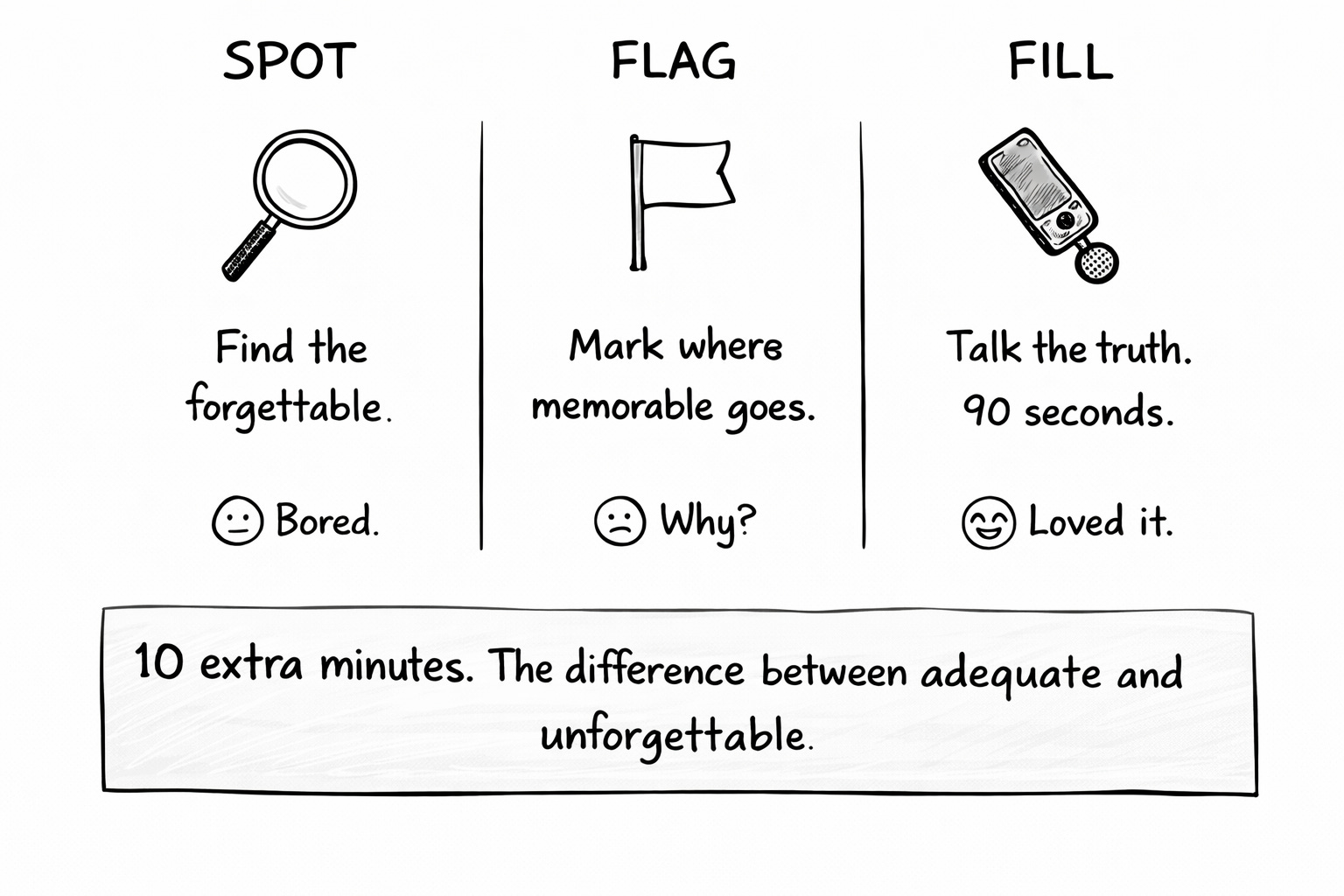
Here’s the full architecture, end to end. Three posts compressed into one workflow you can run on every co-writing session starting today:
Step 1: SPOT (Part 1) Read every AI-assisted draft with one question: “Would my reader remember this part next Monday?” Not “is this good?” Good and forgettable coexist constantly. You’re hunting for the spots where AI filled a gap with something competent, plausible, and destined to built to be forgotten. Fabricated experiences. Borrowed opinions. Generic examples. If it could have appeared in any newsletter covering the same topic, it’s a you-shaped hole.
Step 2: FLAG (Part 2) Build the flag-don’t-fill instruction into every co-writing prompt. Sandwich it (top and bottom). Run mid-draft interrogations. Set the cost function: over-flag, never under-flag. Every placeholder is a marked location on your treasure map that says “this is where the memorable stuff goes.” A missed placeholder is a missed chance to be the newsletter your reader quotes to a friend. An unnecessary placeholder costs you sixty seconds of talking into your phone. The math isn’t complicated.
Step 3: FILL (you’re here) When you hit a flagged hole, pick up your phone or your keyboard. Ninety seconds. First thought. Messy truth. Paste the raw material in. Tell AI to integrate without sanding off the specifics. The weird detail stays. The embarrassing admission stays. The phrase that makes you wince a little stays. Those are the parts that work. Those are the parts that survive.
Total added time per draft: roughly ten minutes. For the difference between a newsletter your reader opens out of habit and one they’d genuinely notice missing.
(Ten minutes. That’s less time than you spent choosing a podcast episode this morning. Except the podcast you forgot by lunch, and the voice memo you dropped into paragraph six is the reason someone screenshots your newsletter and texts it to three people.)
Co-Writing, Finally
The 90-second fill isn’t a productivity hack. (Okay, it’s partly a productivity hack. But if “saves time” were the whole pitch, you could just skip the filling and publish the AI-generated version. Most people do. That’s how most newsletters become someone’s “mark all as read.” Let’s move on.)
The real payoff is what changes about the nature of your co-written work.
Before this system, your drafts were a collaboration between you and AI’s imagination. Some parts yours, some parts AI’s best statistical guess, and no reliable way to tell which was which without a forensic audit and buckets of coffee.
After this system, your drafts are a collaboration between the weird stuff that actually happened to you and AI’s ability to make it presentable. AI builds the stage. You perform the show. AI wrote the transition into paragraph four. You wrote the part about accidentally replying-all to your entire client list at 1 AM and trying to play it off as a “brand authenticity moment.” One of those is invisible. The other one is why someone subscribed.
The audience remembers the performance. They don’t remember the lighting rig. But they’d notice if the lighting rig wasn’t there.
That’s co-writing. Not delegation. Not automation. Not “AI writes and I take credit.” A genuine division of labor where each party contributes what they’re actually good at, and the result is something neither could have produced alone: a newsletter that’s well-built AND worth remembering.
The slop factories will keep churning. A thousand posts a day, each one polished, each one evaporating on contact, because there’s no pulse underneath the polish. All volume. No signal. A wall of noise that never stops and never says anything worth repeating.
You only need to say one thing worth repeating.
The truth.
🧉 What do you do when you know what you want to say but can’t get it out of your head and onto the page? Everybody’s got a weird trick for this.
Crafted with love (and AI),
Nick "Trust the Ramble" Quick

PS… This three-part system took months of trial, error, and publishing newsletters that were technically excellent and spiritually deceased to figure out. I share what I learn daily (because apparently the one thing I can’t delegate to AI is the compulsion to overshare my process). Hit subscribe if you want co-writing frameworks that make your newsletter the one people would notice disappearing from their inbox. And if you know a creator who just spent three hours editing a draft that’s secretly 40% fabricated anecdotes nobody will remember by dinner? Forward them this whole series. All three parts. They deserve better than competent invisibility. So do their readers.
PPS… The spot-flag-fill system is powerful solo. It gets ridiculous when AI already knows your voice through the VAST framework, because then the structural writing sounds like you too, which means the gap between AI’s scaffolding and your real material gets smaller and more seamless. The Voiceprint Quick-Start Guide builds that foundation. Less friction, more you. Grab it here:
📌 The You-Shaped Holes Series:
→ Part 1: Your Newsletter Is Competent, Forgettable, and Slowly Dying
→ Part 2: I Trained My AI to Say “I Don’t Know” and My Readers Started Replying Again
→ Part 3: Fill the Holes in 90 Seconds (Before Your Brain Talks You Out of It) ← You are here