
Nobody Gets Replaced for Having Impeccable Taste
How to stay irreplaceable when AI can write faster than you.

The sommelier doesn’t grow the grapes.
Doesn’t tend the vines. Doesn’t crush the harvest or wait out the fermentation in some cold stone room, hoping the year was good enough. None of that. She walks into the cellar with a glass, takes one measured sip, and tells you which hillside it came from, why the soil did something interesting that year, and whether the bottle in your hand is worth opening or worth waiting on.
That’s not a small job.
That’s the job.
I’ve been thinking about this a lot since AI made it trivially easy to flood the cellar. Anyone with an internet connection and a long-tail keyword can produce content now. Volume is no longer a differentiator. The vineyard is infinite and the grapes are free.
Which means the only thing that matters is who’s doing the tasting.
Slop Is a Human Problem. Always Was.
Before we get into AI, we need to establish something.
Slop is not new.
The recycled LinkedIn wisdom repackaged with a new hook. The hollow how-to thread that taught nobody anything but got three hundred likes from people who bookmarked it and never came back. The fortune cookie take dressed up as insight. The motivational caption that said nothing with tremendous confidence. The blog post that existed purely to appease a content calendar nobody asked for.
That was all slop. Human slop. We produced it at an impressive scale for years before AI showed up, and we did it completely voluntarily, which is somehow worse. (Nobody was holding a gun to anyone’s head demanding a fifth consecutive post about morning routines. We just kept writing them. The market for mediocrity has always been robust.)
AI didn’t create the slop problem. It inherited it.
What AI did was remove the friction. The three hours of staring at a blank document, the mental effort, the small daily tax of actually having to sit down and produce something. That friction wasn’t making the content better. It was just making it slower. Take it away and the slop keeps flowing. Faster, cheaper, with considerably less suffering on the part of the person producing it.
All slop is human slop. The only question is whether a human typed it manually or had the good sense to outsource the typing.
The content that was always hollow is still hollow. The content that was always worth reading is still worth reading. The tool changed. The underlying dynamic did not.
Which brings us to the doomsday crowd, and why they’re measuring the wrong thing.
Production Got Easy. Developing a Palate Didn’t.
The doomsday crowd measured the wrong thing.
They looked at speed. Consistency. Cost per word. AI wins all three and it isn’t close. Fine.
Nobody’s arguing that.
What they missed is that churning out content was never the job. It just felt like it was, because it used to be hard. Take away the friction and you take away the illusion that the friction was the point.
It wasn’t.
The job was always deciding what’s worth saying. Whether the draft in front of you is telling the truth. What’s missing that only you would know to put there.
That job didn’t get automated. It got more important.
And the people who built the thing that does that job (not through a course, not through a framework, not through a prompt library, but through years of reading good things and publishing bad things and slowly developing the gut instinct that knows the difference) are sitting on an advantage that compounds every single day the vineyard gets bigger.
That thing is a palate.
Not a tool. Not a methodology. Not a downloadable template. (I say this as someone who has, technically, made downloadable templates. The irony is not lost on me. The audacity is entirely intentional.)
A palate. Built from everything you’ve read that stopped you cold. Every piece you published and immediately regretted. Every draft you killed at the last minute because something was off and you couldn’t name it and you were tired and you killed it anyway. Every time you read something genuinely good and felt the specific, slightly annoying feeling of I wish I’d written that.
That accumulation is not decorative. It’s structural. It’s the thing that knows before you do whether a draft is ready.
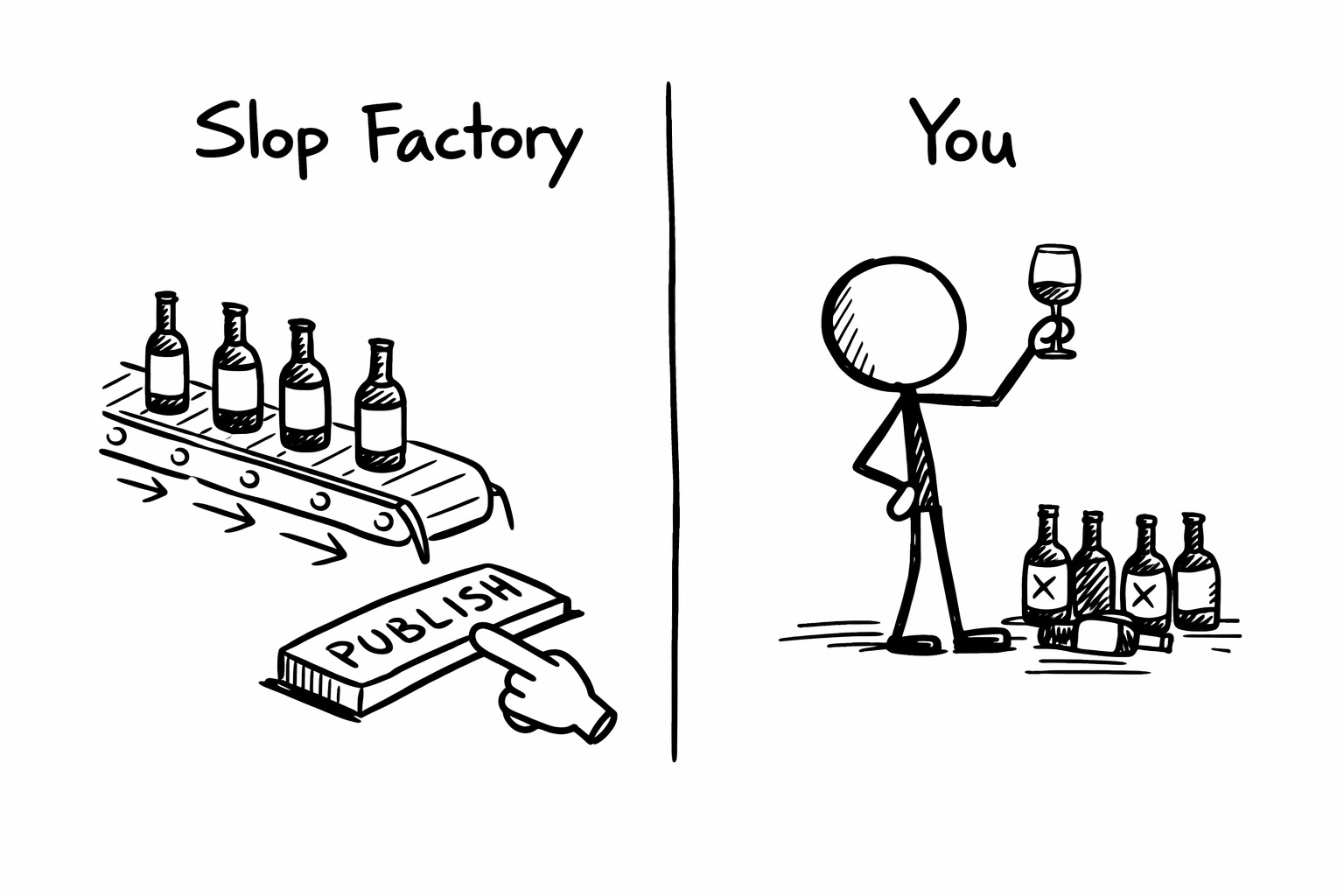
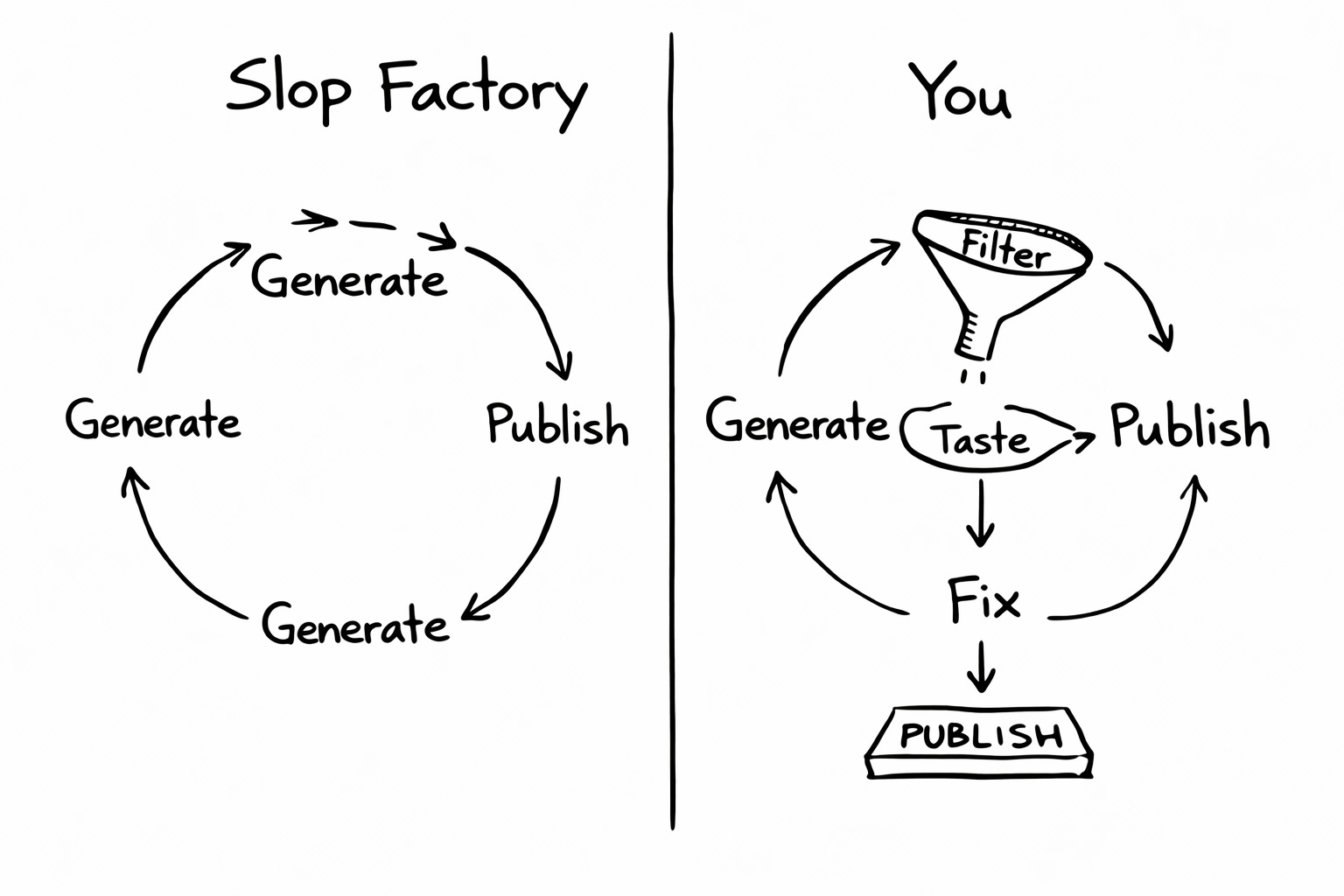
The slop factories have no palate. They generate and publish in a loop with no feedback mechanism, no moment of hesitation, nothing held up to the light. Volume is the strategy. Dilution is the inevitable result. The internet fills up with content that shuffles in, stands awkwardly in the corner, and shuffles back out. Nobody remembers it. Nobody was supposed to.
You can tell the difference. That’s not nothing.
That’s your whole competitive advantage, actually.
What a Developed Palate Actually Does
Not vibes. Not mystical creative instinct that you either have or were tragically born without. Specific, repeatable acts of judgment that you’ve already been performing without a name for them.
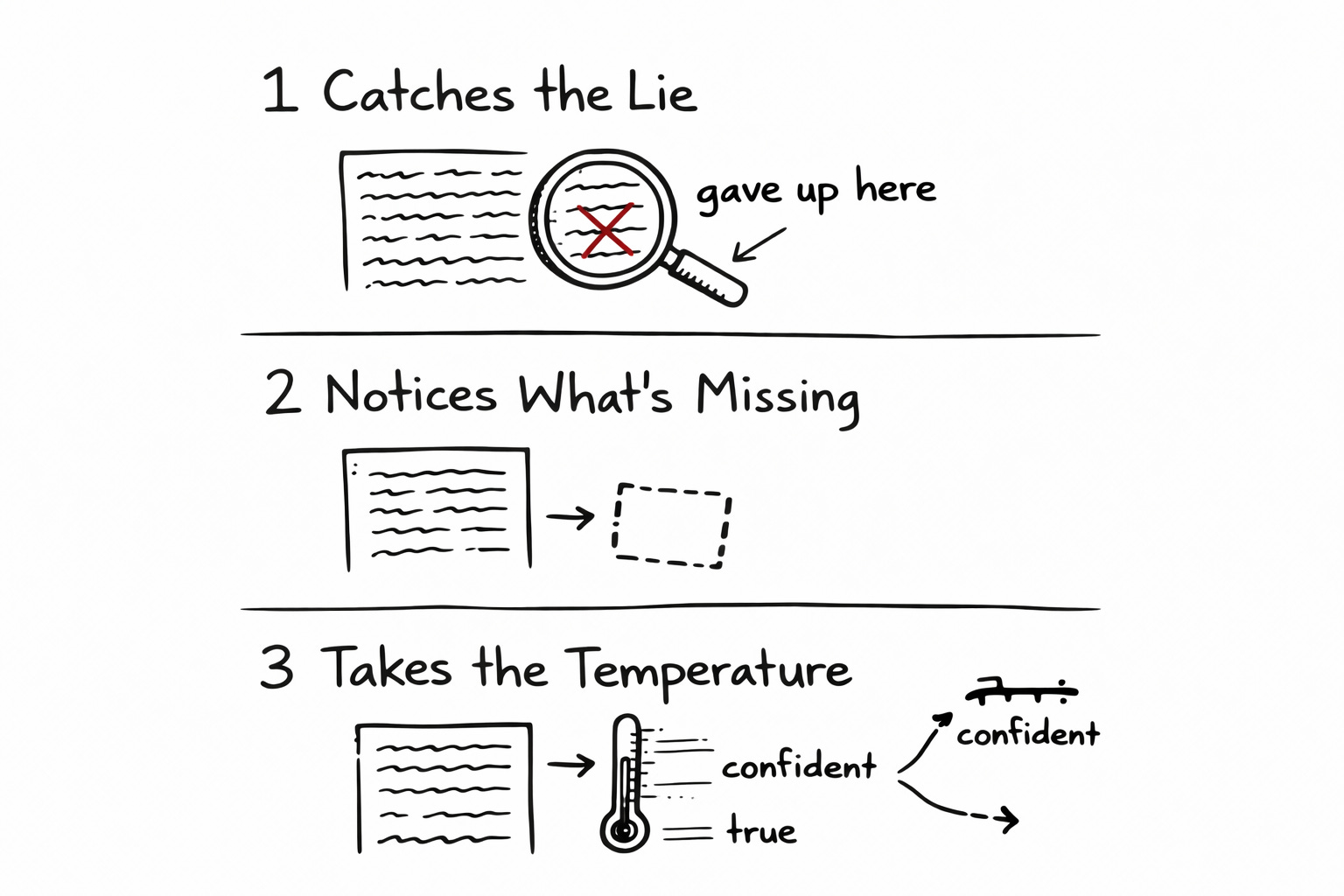
It calls the bluff in the second paragraph.
AI constructs arguments the way anxious students construct essays. Introduce the claim. Support the claim. Restate the claim. The structure is sound. The logic appears to connect. The conclusion arrives on schedule, confident and slightly smug, like it paid for business class and wants you to know.
Except sometimes the support doesn’t support anything. It nods in the direction of the claim and coasts on the structural confidence of the form. The argument gives up somewhere around sentence four and hopes you don’t look too closely.
Your palate tastes this. Before you can name it, before you’ve articulated what’s wrong, there’s a response. A flatness. The particular hollowness of something technically correct with no conviction underneath it.
Chase that flatness. Name it. Fix it specifically. “This paragraph isn’t working” is a feeling. “This paragraph claims to support point A but just restates it in different words” is a diagnosis. One gets you nowhere. The other gets you a better piece.
It notices what’s missing.
AI knows what everyone knows. The aggregated, averaged, publicly available version of knowledge on any topic, synthesized with a patience that borders on the inhuman. Which, again, appropriate.
What it doesn’t have is your specific, inconvenient, hard-won thing. The pattern you’ve been quietly watching for years that doesn’t have a name yet. The counterexample that dismantles the conventional wisdom while everyone else is still nodding along to it in webinars. The failure that taught you something embarrassing and specific and true that didn’t make it into anyone’s blog post because admitting it would have been uncomfortable.
Your palate notices the absence. Something that should be here isn’t. And only you know what belongs there, because only you lived the thing that would know to put it there.
It takes the temperature.
Does this feel true?
Not accurate. Not well-structured. True. The specific texture of something actually worked out, versus something performing the working-out with great confidence and nothing underneath.
AI produces confidence as a default setting. It’s extraordinarily good at confident. Confidence is a tone and tones are learnable patterns and AI is a pattern machine of the highest order.
Conviction is different. It requires having thought about something long enough to form a real opinion. The kind that survives contact with someone who disagrees at the wrong moment. (The kind you’d defend four Natty Lights in when someone challenges it at a party and you realize you’re not just performing an argument. You actually believe it.)
Your palate knows which one it’s drinking. Every time. Even when it can’t explain why yet. Especially then.
The Slop Is Calling From Inside the House
The creators in full panic mode are not in trouble because AI is better than them.
They’re in trouble because they were doing a slower, more exhausting, more human version of what AI does. Generating without judgment. Publishing without tasting. Moving volume and hoping the algorithm couldn’t tell the difference between content that exists and content that matters.
Some of them were producing human slop for years before AI showed up. The friction of doing it manually was the only thing making it feel like craft.
AI didn’t disrupt those creators. It just made the disruption legible. Removed the manual labor that was accidentally laundering mediocrity as effort.
(There is something almost elegant about this. Years of “I worked really hard on this” now indistinguishable from “I clicked a button.” The hard work was always supposed to be in the thinking. We just forgot that somewhere between the content calendar and the posting schedule and the relentless optimization of things that probably didn’t need optimizing.)
The replacement story is only bad news if the thing being replaced was actually yours.
If you’ve been building a palate (if you’ve sat with enough drafts to know when something is lying, developed the gut that catches what’s missing, built the instinct that takes the temperature before you publish) you’re not in the replacement story.
You’re in a completely different one.
The vineyard is infinite. You have more raw material than any creator in history has ever had access to. The cellar fills itself now.
Your job is to walk in, pick up the glass, and decide what’s worth opening.
That job has never mattered more than it does right now.
And the slop factories will never, through any update or improvement or model release, develop the thing that tells you to put the glass down and go back. The specific, irrational, occasionally infuriating certainty that this one isn’t ready yet.
That’s yours. Developed over years. Non-transferable. Completely immune to automation.
Nobody gets replaced for having impeccable taste.
They get replaced for never building one, and hoping volume would cover the gap.
Pick the very best of it.
🧉 What does your palate catch that nobody talks about? That feeling before you can name it. Drop it in the thread. Not the tidy answers. The real ones.
Crafted with love (and AI),
Nick "Palate Over Publish” Quick

PS… Without documented patterns to follow, AI doesn’t write like you. It writes like Chad. LinkedIn Chad. Newly-discovered-stoicism Chad. Three-bullet-point-morning-routine Chad. The Voiceprint Quick-Start Guide is how that stops. Grab it here:
PPS… New pieces drop here whenever they’re ready, which is often, which is your problem now. Because taste develops through consistent exposure and so does this newsletter.
And if you know a creator quietly suspecting their content calendar has been doing more work than their brain… Send them this! They’ll either thank you or never speak to you again. Both are valid.
In a world obsessed with speed, having good taste and quality is what'll set you apart. Our insights and experience are something that AI can't ever match. At the end of the day, AI is a tool, and it all depends on who is in control of it. - And there's no prompt for quality or taste : )