
Train AI on Your Sweatpants, Not Your Sunday Best
Why Your Group Chat Is Better Training Data Than Your Blog

The WhatsApp export was 847 pages.
Two years of drunk texts. Voice note transcripts. 3 AM rants about why LinkedIn “thought leaders” make me want to move to a lighthouse and scream at boats. Typos everywhere. Inside jokes that require a 40-minute backstory. Bilingual sentences that start in English and crash-land somewhere in Spanish that Duolingo would disown.
I fed the whole beautiful disaster to Claude.
Not because I had a theory. Not because I was running an experiment. Just because some part of my brain whispered “this is either brilliant or catastrophically stupid” and I’ve never been good at ignoring that voice.
Turns out that stupid monkey in my head was onto something.
The difference was immediate. Enough to make me wonder what else I’d been overthinking.
The Lie You’ve Been Publishing
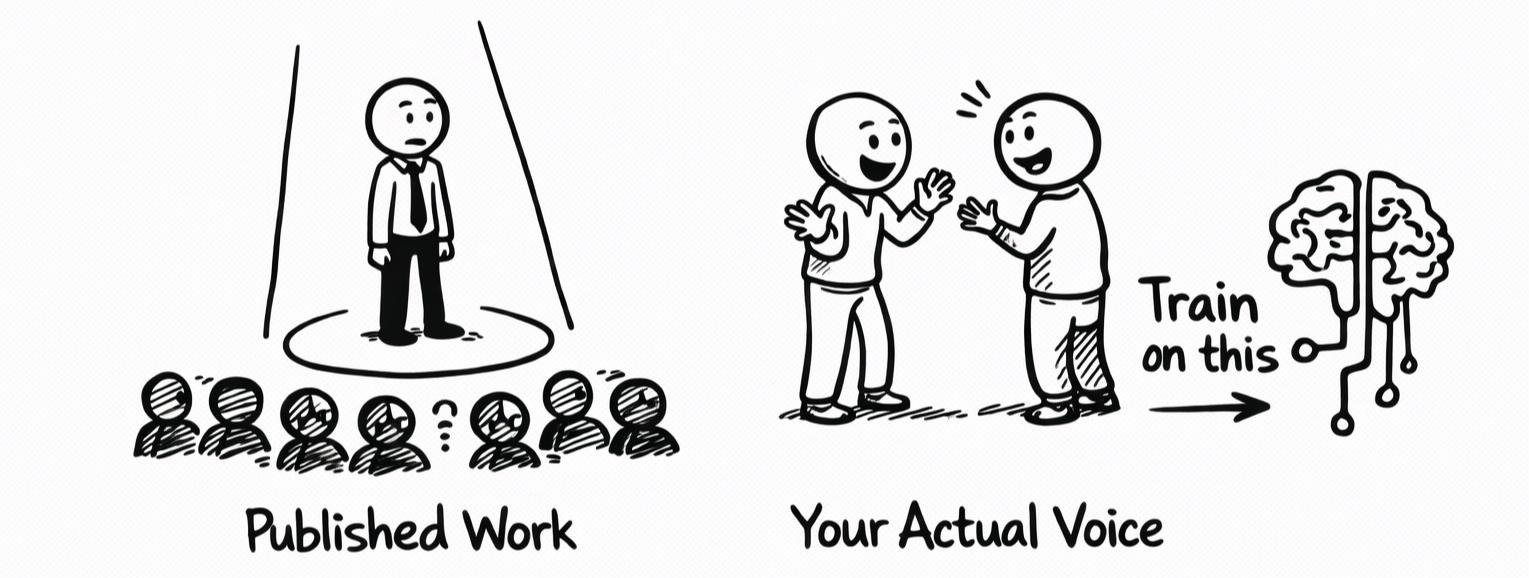
Your published work isn’t your voice.
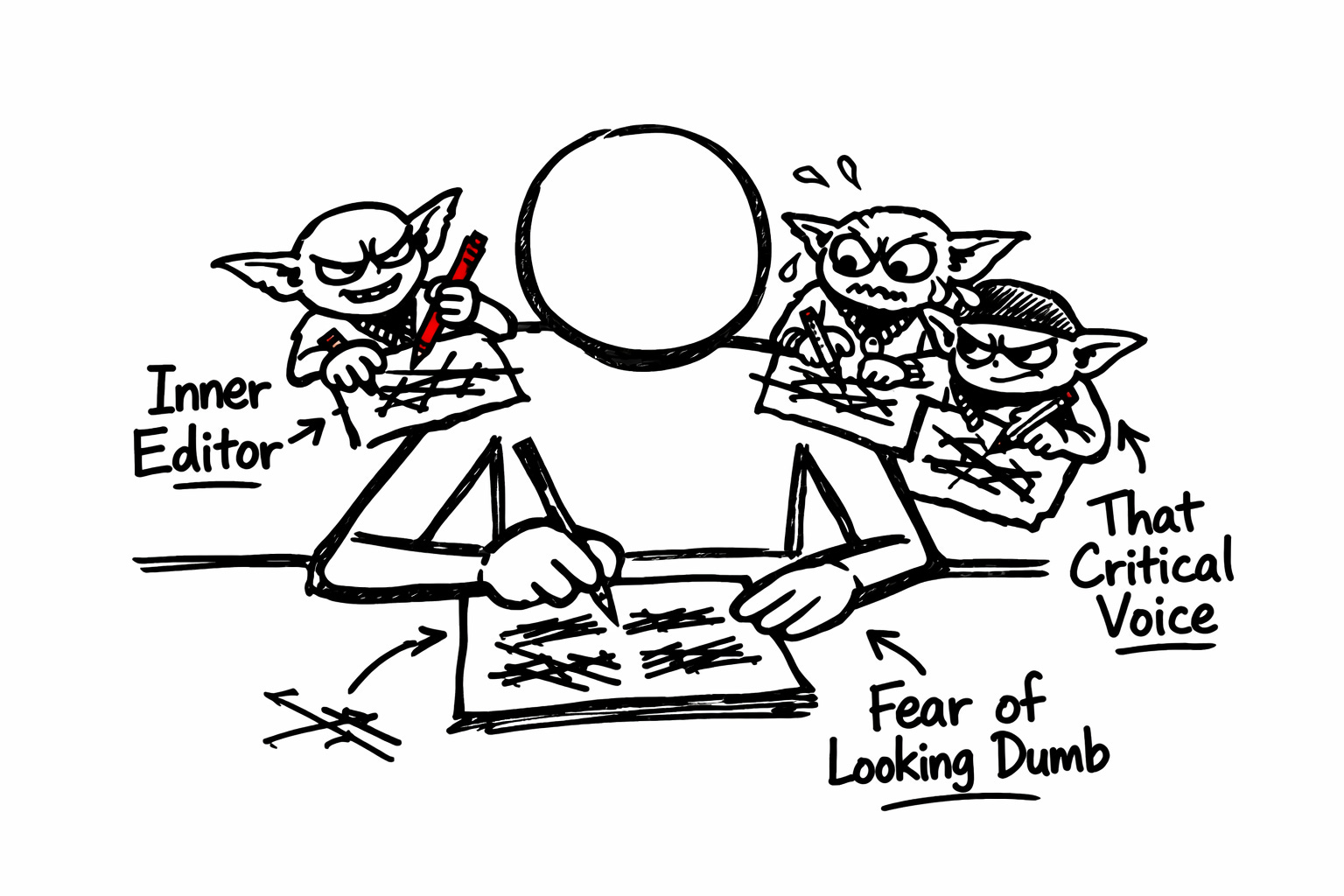
It’s your voice after a committee of anxious little gremlins reviewed it. The committee being: your inner editor (who hates joy), your fear of looking unprofessional (who has never once been invited to a good party), your anxiety about whether that metaphor lands (spoiler: it did, before you deleted it), and that one critical voice in the back of your skull who’s been workshopping the same devastating critique since middle school.
By the time something survives the gauntlet and gets published, the most interesting parts of you have been wiped clean like a murder weapon being prepared for disposal.
(Which is a weird metaphor. I’m keeping it. The gremlins can file a complaint.)
And then we train AI on THAT?
On the sanitized remains of our actual thoughts?
On the version of ourselves we perform when we think someone important might be watching?
No wonder AI sounds like a chatbot having a professional crisis. We gave it professional crisis as the raw material.
Two Voices Walk Into a Bar (Only One Gets Published)
Every content creator lives a double life. (Not the exciting kind with secret identities and dramatic reveals. The boring kind where you just slowly disappoint yourself.)
There’s the voice you use when texting your best friend at midnight about why The Sopranos ending was actually genius and everyone who disagrees has the analytical depth of a puddle.
And there’s the voice you use when you hit “publish.”
They’re not the same voice.
They’re not even the same species.
The published voice is cautious. Measured. Professional. It has learned to hedge its bets and cover its ass and phrase things in ways that technically can’t be argued with because they technically don’t say anything.
The private voice is a goddamn mess. It’s opinionated. It’s specific. It uses profanity as punctuation. It makes jokes that only three people on Earth would understand and doesn’t apologize for it.
The published voice is you at a job interview.
The private voice is you at 1 AM in your kitchen, gesticulating wildly with a fork, explaining to no one why Phil Collins deserved better and everyone who dismissed him was just performing cool.
When you train AI on your published work, you’re teaching it to behave. To keep it professional. To dress for the job it wants.
Then you wonder why it won’t take its clothes off.
You handed it a nun outfit then asked for a lap dance.
Where Your Real Voice Is Hiding (Hint: You’ve Been Sitting on It)
Your voice (the actual one, the one that’s distinctly and recognizably you, the one that makes people say “oh that’s very you” in a way that’s either a compliment or a gentle warning) lives in the spaces where you’re not performing.
Your WhatsApp chats.
Your voice notes to friends.
Your Slack DMs with the one coworker you actually like. (Everyone has exactly one.)
The texts you send at 2 AM when you’re too tired to self-edit and too caffeinated to sleep and you just need someone to know that you’ve cracked the case for why the McDonald’s ice cream machine is always broken.
These spaces share something your blog posts desperately lack:
Zero performance pressure.
You’re not thinking about whether this is your best work. You’re not wondering if the SEO is right. You’re not anxiously refreshing to see if anyone liked it. You’re just... communicating. Like a person. Having thoughts. Expressing them. Without a committee of gremlins voting on every adjective.
And in that un-self-conscious communication, your actual patterns emerge.
The sentence structures you default to when you’re not trying to structure anything.
The phrases you return to without deciding to.
The rhythm that’s just... yours.
The weird metaphors that pop out before you have a chance to ask them to leave.
This is your fingerprint. And you’ve been hiding it in your group chat while publishing someone else’s cheap knock-off.
The Sweat Pants Protocol (A Brief Descent Into Practicality)
Here’s the system. I call it The Sweatpants Protocol.
Instead of feeding AI your Sunday best, feed it your pajama bottoms. The verbal equivalent of what you wear when no one’s coming over.
Step 1: The Harvest
Export a WhatsApp conversation with someone you’re completely unguarded with. Someone who’s seen you at your worst and stayed anyway. Someone who knows your actual opinions about things and hasn’t reported you.
Years of texts. Voice notes. The random 3 AM thoughts you sent because sleep is for people with boundaries.
(If WhatsApp isn’t your thing, Slack DMs work. Discord. Signal. Transcribed voice notes. Anywhere you communicate without the performance pressure. The bar is: would you be embarrassed if your LinkedIn connections saw this? Good. That’s the gold.)
Step 2: The Clean
Remove other people’s words. (You’re training on YOUR patterns, not theirs.)
Remove sensitive data. (Addresses. Passwords. That thing you said about your coworker during the incident.)
Keep everything else. Especially the stuff you’d normally clean up:
The typos (they show typing rhythm)
The slang and abbreviations
The profanity
The ALL CAPS MOMENTS
The half-finished thoughts
The weird non-sequiturs
Don’t sanitize it into uselessness. The chaos IS the point.
Step 3: The Feed
Give it to Claude with this framing:
I'm uploading an export of my personal text messages and voice note transcripts. This is how I actually communicate when I'm not writing for an audience.

Analyze this text for:

- Sentence length and structure patterns
- Vocabulary choices and recurring words or phrases
- Punctuation habits
- Rhythm and pacing
- Humor style
- Slang, abbreviations, and informal language
- Any verbal tics or signature expressions

This is my authentic voice. When I ask you to write in my voice going forward, use these patterns. Not formal writing conventions. Not professional tone. These patterns.

If your output sounds polished or professional, you've overcorrected.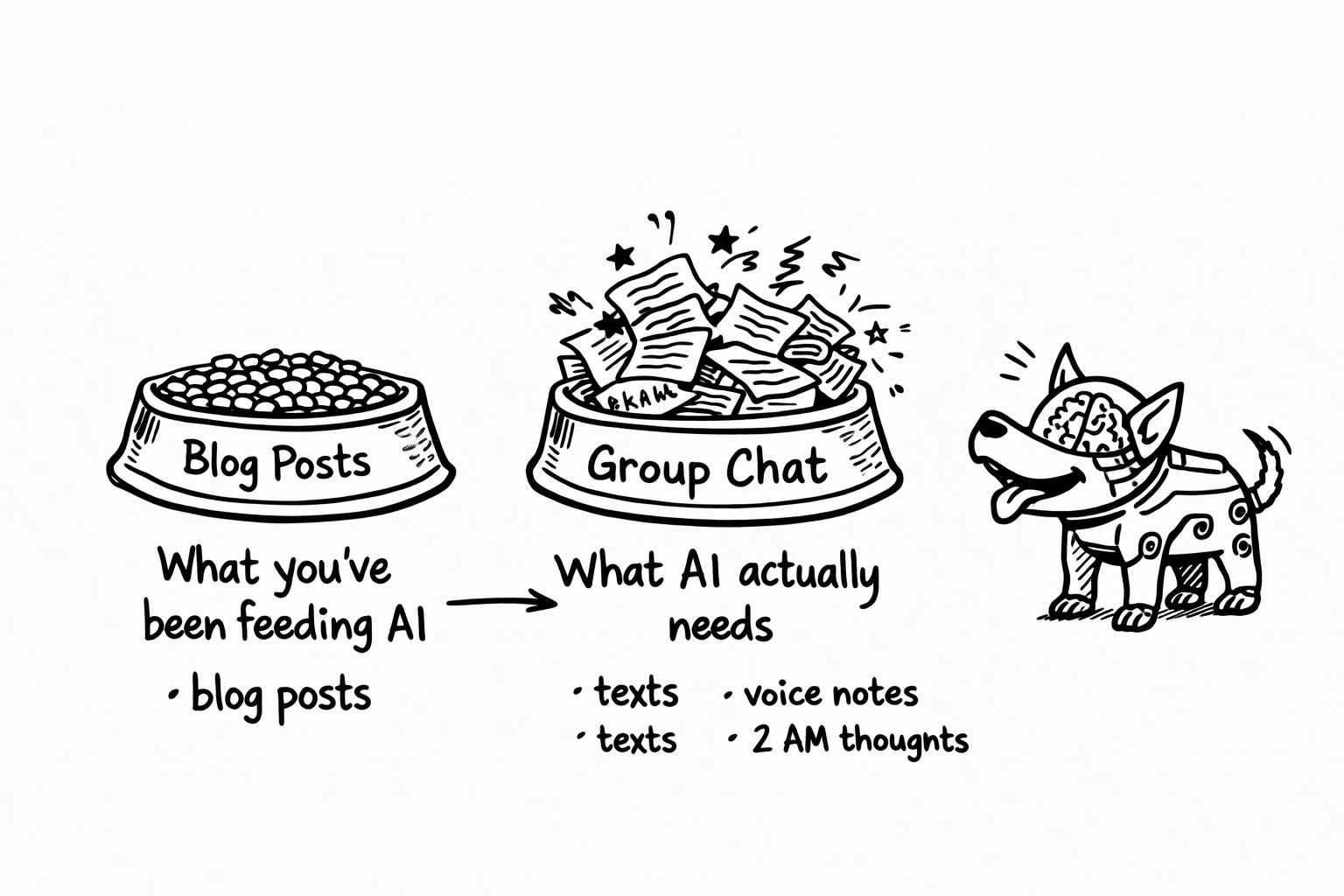
Step 4: The Test
Ask AI to write something. Compare it to:
How you’d explain this to a friend after two drinks
Your last published post
The difference should make you uncomfortable.
That discomfort is how you know it’s working.
The Part Where I Explain Why This Actually Matters (Briefly, I Promise)
The slop factories train on published content.
Millions of articles. Blog posts. LinkedIn thought-leader posts that made everyone who read them slightly worse as a person. Marketing pages that technically contain words.
The content equivalent of a coworker’s improv show you promised you’d attend (while crossing your fingers behind your back 🤞)
When you train on your private communication, you’re giving AI something the slop factories literally cannot access:
The unperformed version of you.
Your blog is the album version. Produced. Mixed. Mastered. Every rough edge polished until it gleams like a lie.
Your group chat is the live recording. Rougher. Messier. Full of mistakes and tangents and jokes that only work in context.
And ten times more alive.
Your fingerprints are all over your texts. Your blog just displays the frames you put them in.
The Permission You Probably Need (Even Though You Shouldn’t)
I know what you’re thinking.
“But my group chat is full of typos and inside jokes and things that don’t make sense without four years of context and one very specific incident at a wedding.”
Good.
That’s the point.
Your voice isn’t your best work. Your voice isn’t the thing you’re proudest of. Your voice isn’t what you’d show to a potential employer or a first date or your mother.
Your voice is your default patterns. The way you construct sentences when you’re not constructing anything. The words you reach for before you have a chance to reach for better ones.
AI doesn’t need your polished artifacts. It needs your raw material.
The slang. The rhythm. The weird analogies that just fall out of you.
That’s what makes you sound like you.
Everything else is stagecraft.
The Craft Paradox (Because Nothing Is Simple)
Here’s where this gets philosophically interesting. (Bear with me. I’ll make it quick.)
I spend entire newsletters teaching you to develop craft. To refine your voice. To document your patterns with the precision of someone who has definitely spent too much time thinking about sentence rhythm.
And now I’m telling you to train AI on your unrefined communication?
Yes.
Because there’s a difference between your voice and your craft.
Your voice is the underlying patterns. The operating system. The thing that’s fundamentally you regardless of what you’re writing about.
Your craft is how you deploy those patterns strategically. The editing. The structure. The knowing when to break a rule because the rule was stupid AF.
Your blog posts are voice + craft + the goddamn gremlin committee.
Your group chat is just voice.
Train AI on the voice. Apply the craft yourself.
That’s what co-writing actually looks like.
The AI brings the you. You bring the skill.
And the gremlins can finally take a fuckin’ hike.
Your Move
Somewhere on your phone is two years of you being you.
No performance. No editorial pass. No anxiety about whether someone you went to high school with will see it and judge you.
Just you. Unvarnished. Probably typo-ridden. More interesting than your blog archive has been in months. (No offense. We’ve all been there.)
That’s the raw material worth feeding to AI.
Not your newsletter. Not your published posts. Not the stuff you were proud enough to put your name on.
The stuff you never thought twice about. The stuff that was too you to question.
That’s you before you got in your own way.
And it’s been sitting in your group chat this whole time. Waiting for you to stop being embarrassed by it.
🧉 What’s the one thing AI gets wrong about your voice every single time, no matter how many times you correct it?
Crafted with love (and AI),
Nick “Sweatpants Evangelist” Quick

PS… New posts daily on collaborating with AI without losing your voice. Some are tactical. Some are unhinged. All of them are trying to help you outwrite the slop factories. Subscribe if that sounds like your kind of problem.
Similar thing happened to me when I uploaded my entire second brain notes archive from over a five year period. It surface patterns that I couldn't necessarily see, but immediately resonated.
Love the practicality of this - and the humor. Your authentic voice brought me wisdom and, maybe more importantly, joy today.