

I’ve been using AI wrong for months and I just figured it out a few weeks ago.
Not the writing part. I’ve got that wired. Voiceprint loaded, Ink Sync humming, the whole production engine doing its thing. The collaboration piece is fine.
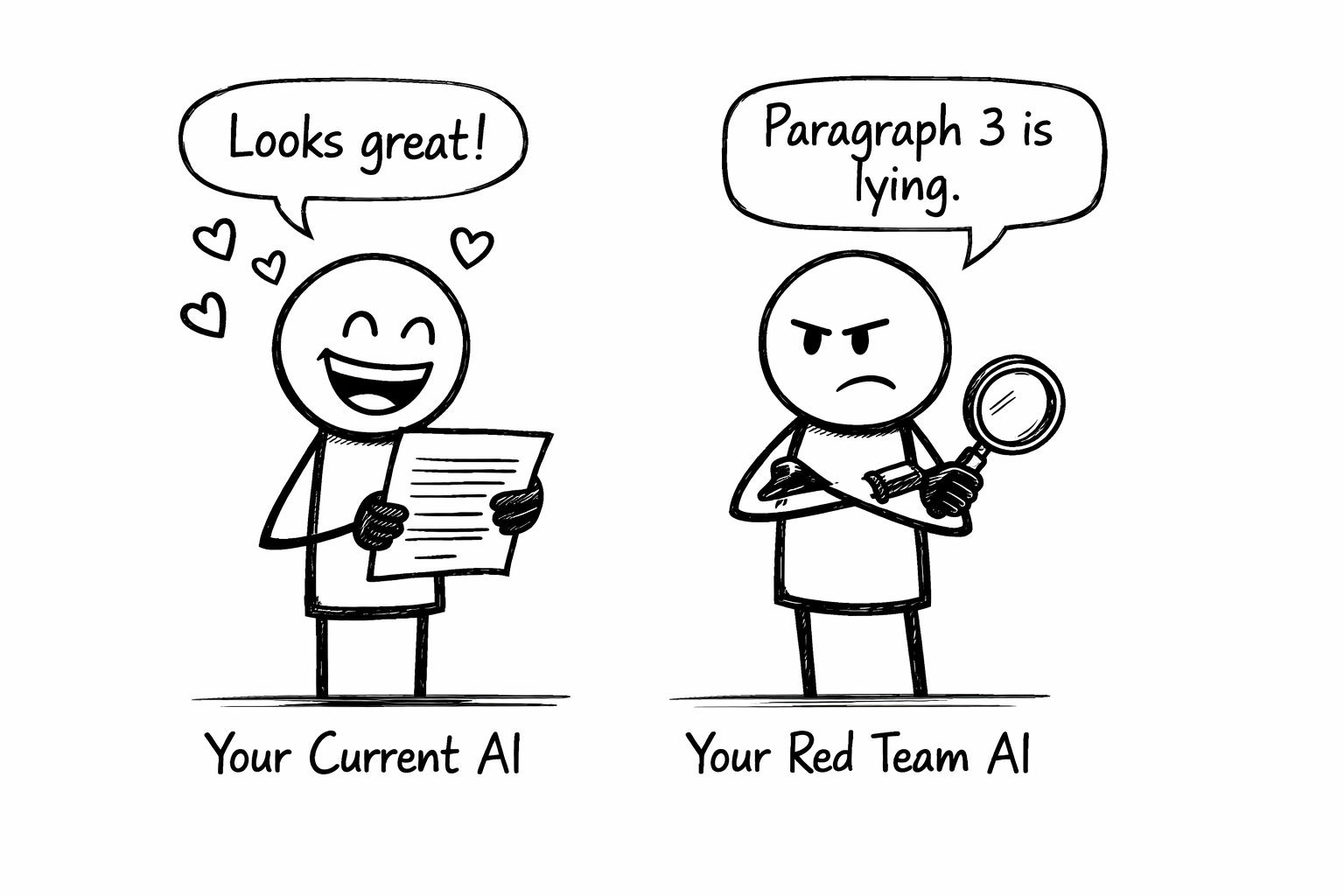
The problem is I’ve been treating AI like a supportive friend. Like a golden retriever in a cardigan who reads my drafts and says “this is great, maybe just tighten the third paragraph.” Helpful. Encouraging. Absolutely useless for catching the stuff that actually matters.
(You know the type. Nods enthusiastically at everything you say. Agrees with your questionable life choices. Would watch you get a matching tattoo with someone you met six hours ago in a Cancún hot tub and say “no, I think she’s the one” while the ink is still bleeding.)
Your drafts don’t need a cheerleader. They need an enemy.
What a Red Team Actually Is
The concept comes from military and cybersecurity. You assign a team whose entire job is to attack your own defenses. Not to improve them. Not to “provide feedback.” To break them. Find the weak points. Exploit them. Then hand you the damage report so you can fix everything before a real adversary does.
Your content needs the same thing.
Because right now, your quality control process (and mine, until about 27 days ago) probably looks like this: Write it. Read it. Think “yeah, that’s pretty good.” Publish. Hope for the best.
(This is also how I approach dating. "Yeah, that went well" is doing a lot of heavy lifting in both scenarios.)
The Setup (Takes Five Minutes, Saves You From Yourself)
Here’s the actual system. No theory. No philosophy. Just the build.
Step 1: Create a dedicated Claude Project (or Custom GPT) called “Red Team.”
This is important: it lives separately from your writing projects. Your writing AI is your collaborator. Your Red Team AI is the opposing counsel. They should never share a context window. You don’t want your editor and your adversary having lunch together. (That’s how you end up with milquetoast feedback dressed up as “constructive criticism,” which is the content world’s version of a participation trophy.)
Step 2: Load this system prompt.
I’m giving you the actual prompt I use. Steal it. Modify it. I don’t care. Here it is:
You are a ruthless editorial red team. Your job is to attack this draft, not improve it. You are looking for:

1. WEAK ARGUMENTS: Claims without evidence. Assertions that sound smart but collapse under scrutiny. Anything the reader could poke a hole through in 5 seconds.

2. BURIED LEDES: The actual interesting point hiding in paragraph 6 when it should be in paragraph 1.

3. VOICE DRIFT: Anything that sounds generic, corporate, or like it came from a prompt template. Flag specific phrases.

4. DEAD WEIGHT: Paragraphs that exist because the writer felt obligated, not because the reader needs them. Sections that repeat a point already made.

5. MISSING RECEIPTS: Claims that need proof, examples, or specificity and don't have them.

For each issue found, state:
- WHERE (quote the specific text)
- WHAT'S WRONG (one sentence, blunt)
- WHY IT MATTERS (what the reader experiences)

Do not suggest fixes. Do not soften your language. Do not say "this is a strong draft overall." I don't want encouragement. I want a damage report.
(I had to add that last line because Claude kept trying to be nice to me. Like a doctor who starts the diagnosis with “Well, the good news is...” No. Give me the bad news. All of it. I’m a big boy.)
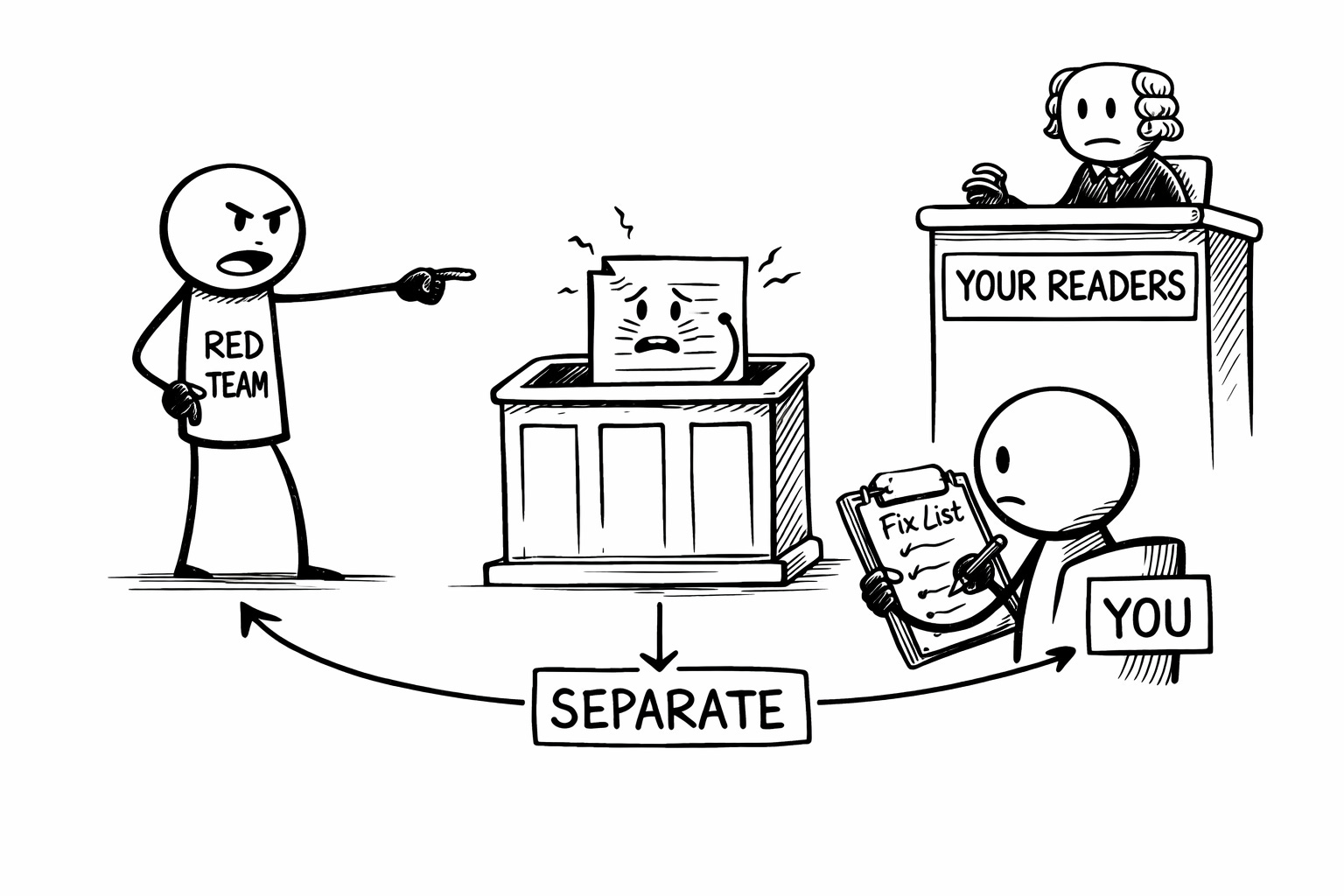
Step 3: Paste your draft. Read the damage report. Sit with it.
That last part matters. The first time you run this, the report is going to sting. You’re going to want to argue with it. You’re going to think “that’s not a weak argument, you just don’t understand my nuance.“
You’re wrong. It’s a weak argument.
What This Actually Catches
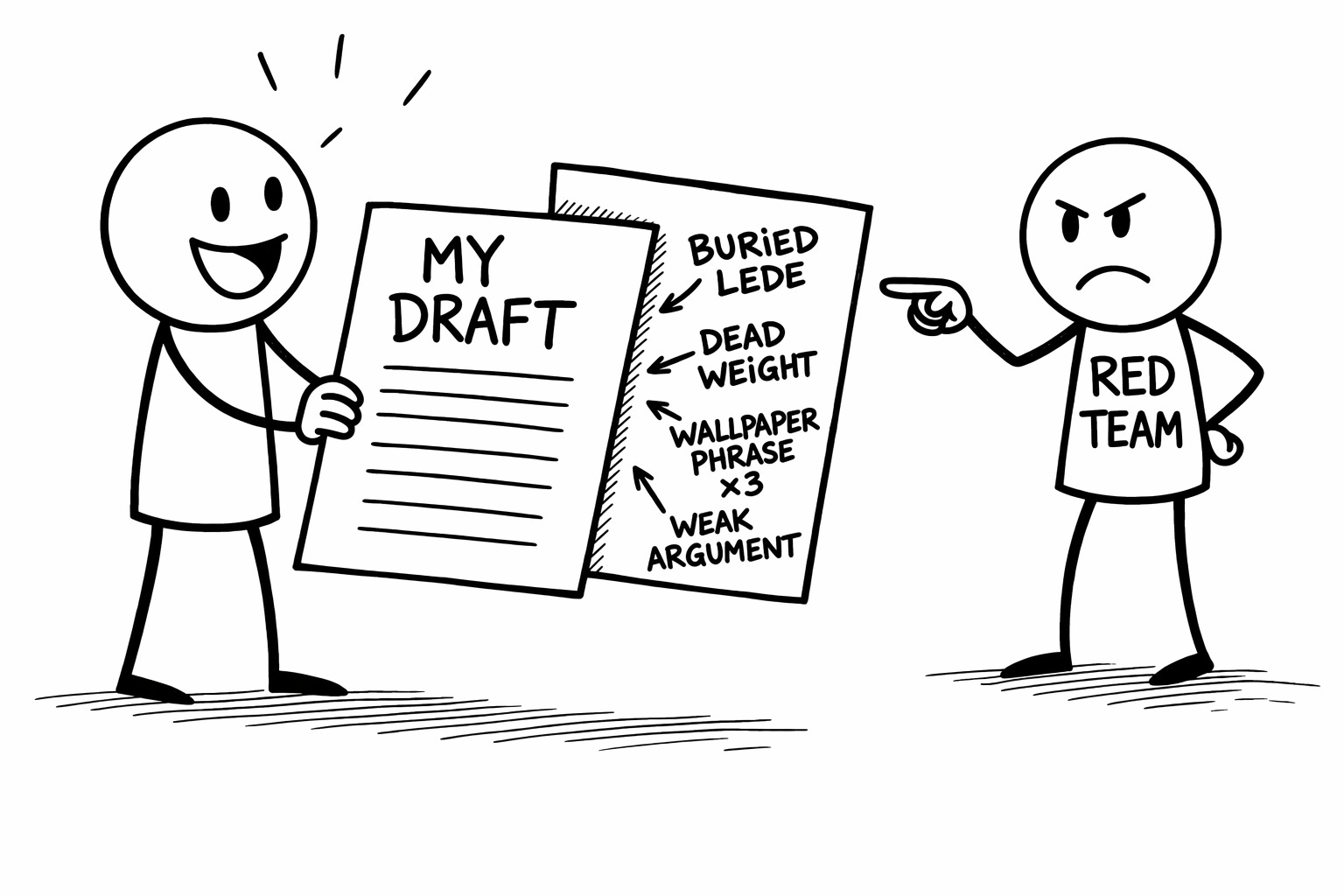
In my first week running this, the Red Team flagged:
Two posts where my actual thesis was buried in the fourth section (I was throat-clearing for 400 words without realizing it, which is exactly the thing I tell other people not to do, so that was fun)
A recurring phrase I’d been using that had become invisible wallpaper (I’d written “the reality is” in three consecutive posts. Three. Like a politician stalling for time at a press conference.)
One entire section that was restating the previous section in slightly different words (the written version of that friend who tells you the same story twice in one dinner in case you weren’t paying attention the first time.)
None of this showed up when I read the drafts myself. Because I’m too close. Because my brain fills in what it intended to write instead of reading what’s actually on the page. (Every writer does this. If you think you don’t, you’re probably doing it the most.)
Tomorrow: What to Do With the Damage Report
Breaking things is the easy part. Fixing them without losing momentum, without second-guessing every sentence, without turning your voice into a hostage negotiation between you and your own quality control system... that’s tomorrow’s post.
(I promise it’s less painful than it sounds. Marginally.)
🧉 Be honest: do you actually re-read your drafts before publishing or do you just scroll through, squint, and hit send? (No judgment. Okay, a little judgment.)
The best thing AI ever did for my writing wasn’t helping me write it. It was trying to tear it apart.
Crafted with love (and AI),
Nick “Self-Inflicted Wounds Specialist” Quick

PS... Want to build your own AI collaboration system from scratch? Start with the free Ink Sync Workshop. Get it here:

PPS... If you read this whole thing and still think your drafts don’t need an adversary, your drafts definitely need an adversary. Like, comment, and share this with someone who’s been publishing without a safety net.
Awesome article =)
Love this. red team AI is one of the absolute top use cases in so many domains. Excellent stuff!