
Subscribers Opted In Once. Readers Keep Coming Back.
The difference compounds over months into something the dashboard will never measure.

I used to obsess over subject lines.
Not like a normal person. Like someone who’d been told by every email marketing course, growth hack subreddit, and cold email playbook that the subject line is everything. A/B testing. Midnight rewrites. Triangulating between curiosity gap and emotional hook and the six magic words that stop the scroll.
(This is either highly relatable or deeply pathetic. Possibly both. Moving on.)
Turns out I had the wrong obsession.
Part 1 made the case that hooks aren’t the point. Part 2 is what the point actually looks like inside a specific human being. Not a subscriber count ticking upward. Something smaller. Something that changes a person’s behavior across months, permanently, in a way the dashboard will never report.
Most People Have Subscribers. Very Few Have Readers.
The difference sounds semantic. It isn’t.
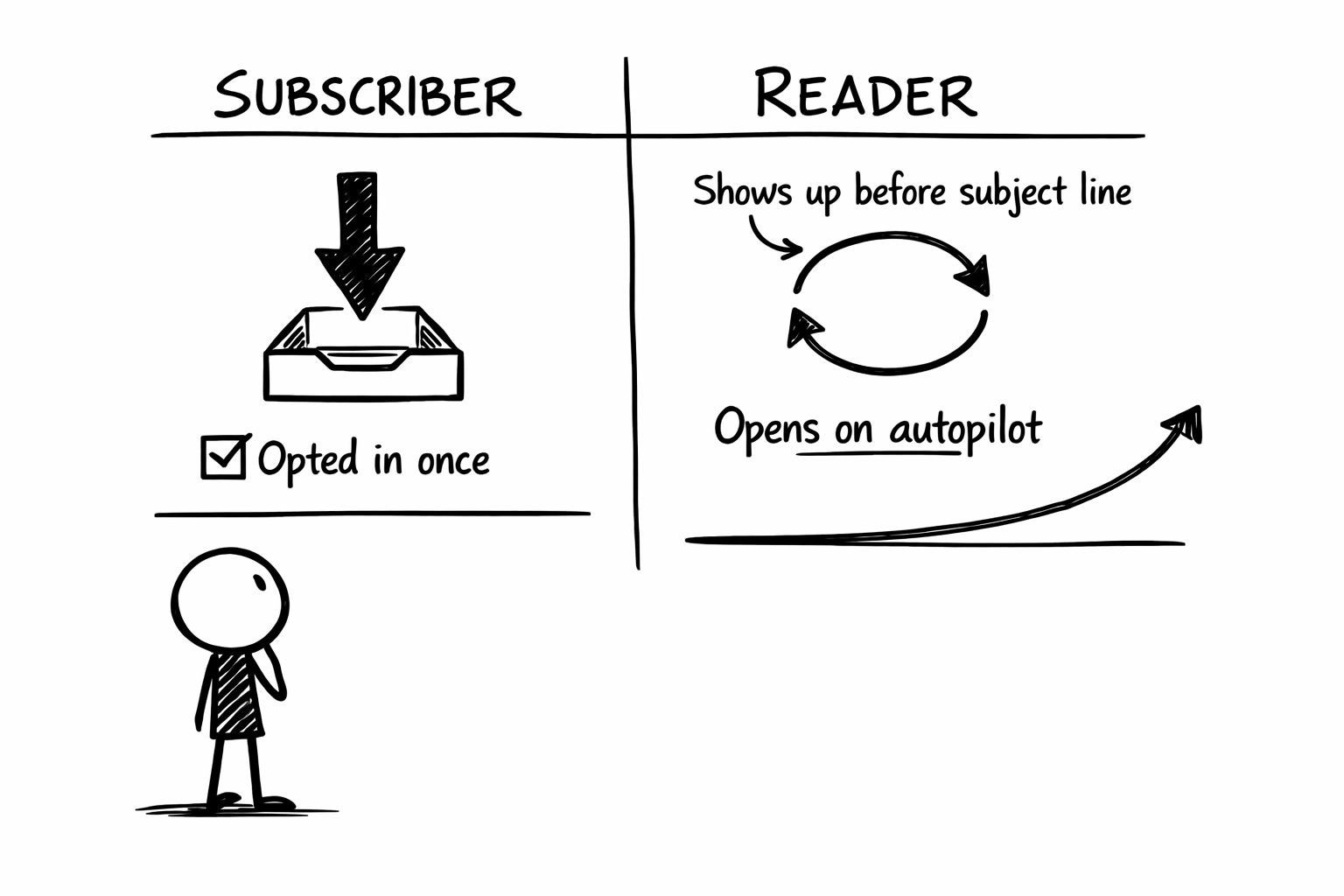
A subscriber made a decision once. They saw a hook, a landing page, a restack from someone they follow. They clicked. They opted in. That decision now lives in the past tense. The platform counts it permanently and calls it an audience.
A reader is someone whose behavior has changed.
(Let me slow down here because that’s easy to skim past. Not “someone who merely reads your stuff.” Someone who shows up enough times, finds enough of value, and builds enough of a relationship with your work that they arrive before you’ve sold them anything, before the subject line has registered, before they’ve made a conscious decision at all. A subscriber clicked once and moved on with their life. A reader keeps coming back until coming back becomes the default. The platform counts them the same way. They are not the same thing.)
You can have fifty thousand subscribers and four readers. You can have eight hundred subscribers and two hundred readers. The dashboard reports the first number with great confidence and says nothing about the second.
The second number is the only one that compounds.
And the thing that turns subscribers into readers, what makes a post actually deliver after the hook earns the open, is what the rest of this series is about.
The Running Tab You Never Opened
Here’s the mechanism.
Every post has a hook.. and everything after the hook. Call that everything the “throughline.” The part the platform doesn’t measure. When it delivers, it makes a deposit in a relationship that’s quietly accumulating whether you’re tracking it or not. When it coasts, it makes a withdrawal. Your reader doesn’t consciously track this. They’re not scoring your paragraphs on a rubric. They're not sending you internal memos about the quality of the part they stayed for.
They just gradually feel more or less inclined to open the next one.
(The best analogy I’ve found isn’t a bank account. It’s your relationship with a restaurant. You don’t tally the meals. You don’t consciously review whether Tuesday’s dinner maintained your positive priors about the establishment. You just find yourself calling to book again, or you don’t. The feeling accumulates without the accounting. After enough good meals, you stop reading the menu. You already know. That’s not apathy. That’s trust that built up quietly. And the second the kitchen has one obviously careless night (not unlucky, but phoned in) something shifts in a way that takes much longer to repair than the one bad night deserved.)
That’s the ledger. The reader doesn’t know it exists. You don’t get to see the balance. You only find out it’s there when it’s high enough to change their behavior, or when you’ve made enough withdrawals that the behavior changes back.
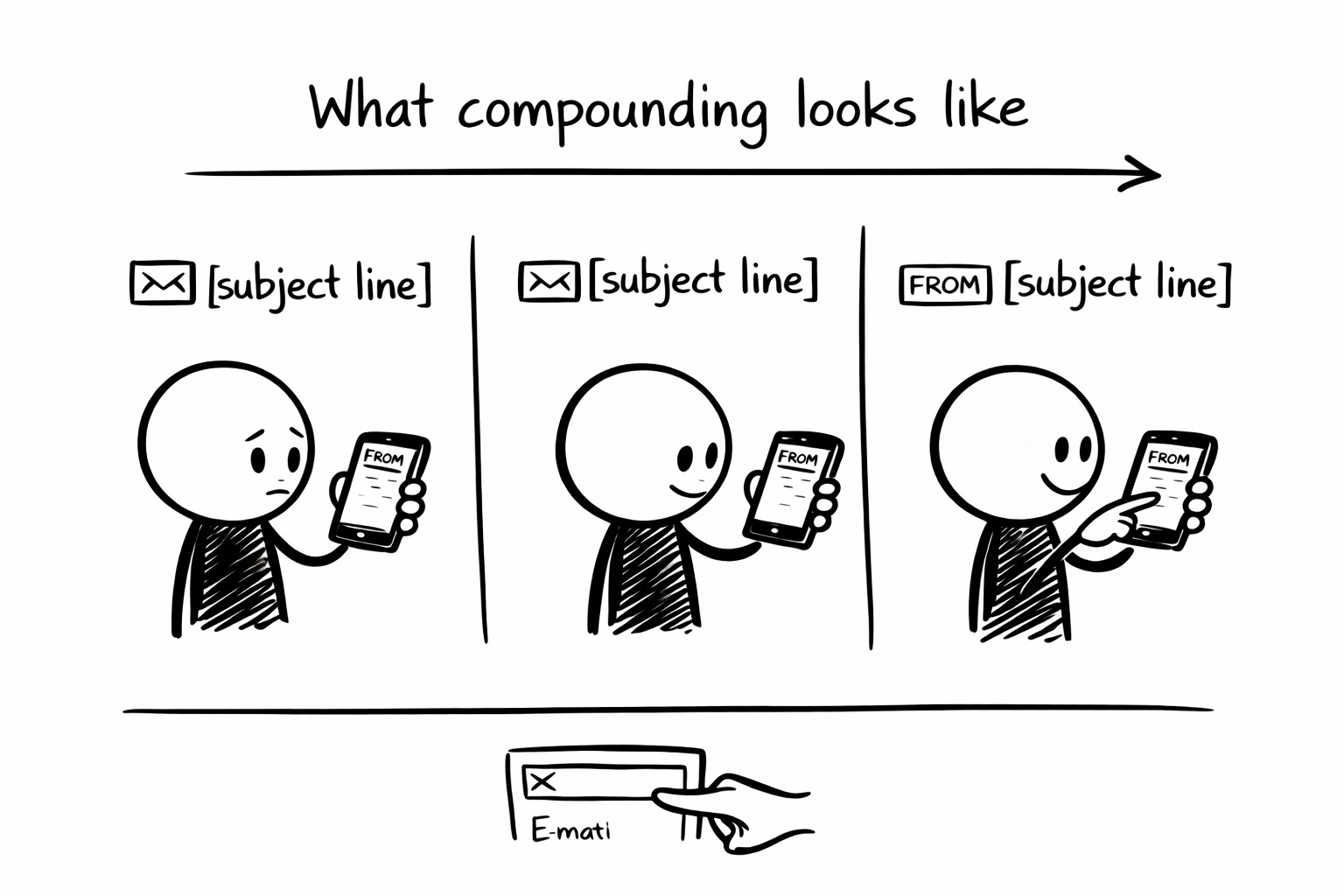
After enough deposits, the from field becomes the permission. Your name in their inbox stops being a question mark and starts being a signal. The decision to open got automated. They outsourced it to their memory of every time you showed up and delivered.
What the From Field Actually Means
When a reader stops evaluating your subject line, that’s the milestone.
Not because they’re lazy. Not because they’re apathetic. Because you’ve made enough deposits that the evaluation stopped being necessary. They know. Or more precisely, their behavior knows, even if they’d never articulate it that way.
The subject line used to be a proposal. Now it’s a formality.
(This is where I want to be specific, because it’s easy to read “they stop evaluating the subject line” as something passive, like interest accruing in an account you opened and forgot. It’s not passive. You earned it. You earned it in paragraph eight of a post last October that you almost cut because it felt too raw. You earned it in the ending that didn’t wrap up neatly and left something unresolved that buzzed around in the reader’s head for two days. You earned it in the post where you published something embarrassing and true instead of something safe and presentable. Each of those was a deposit the reader doesn’t remember making, and the balance is now high enough that your name in the from field is the whole pitch.)
You’ve automated a behavior in a specific human being. Their morning inbox routine now has a slot you didn’t engineer, don’t control, and will lose if you stop making deposits. The platform doesn’t report this slot. There’s no metric for it. It just exists, silently, in the routine of someone who has been reading you long enough to stop thinking about it.
The Forward-Lean Feeling
There’s an emotional experience at the end of a post that delivered.
It’s not satisfaction. Satisfaction is what you feel when something closes. This doesn’t close. It leans forward.
The want for the next one before it exists. Before you’ve announced it. Before the subject line has been written or the concept has been named. The reader has finished, they’re off the page, and somewhere underneath the surface there’s a low-frequency itch for the next thing you’re going to say.
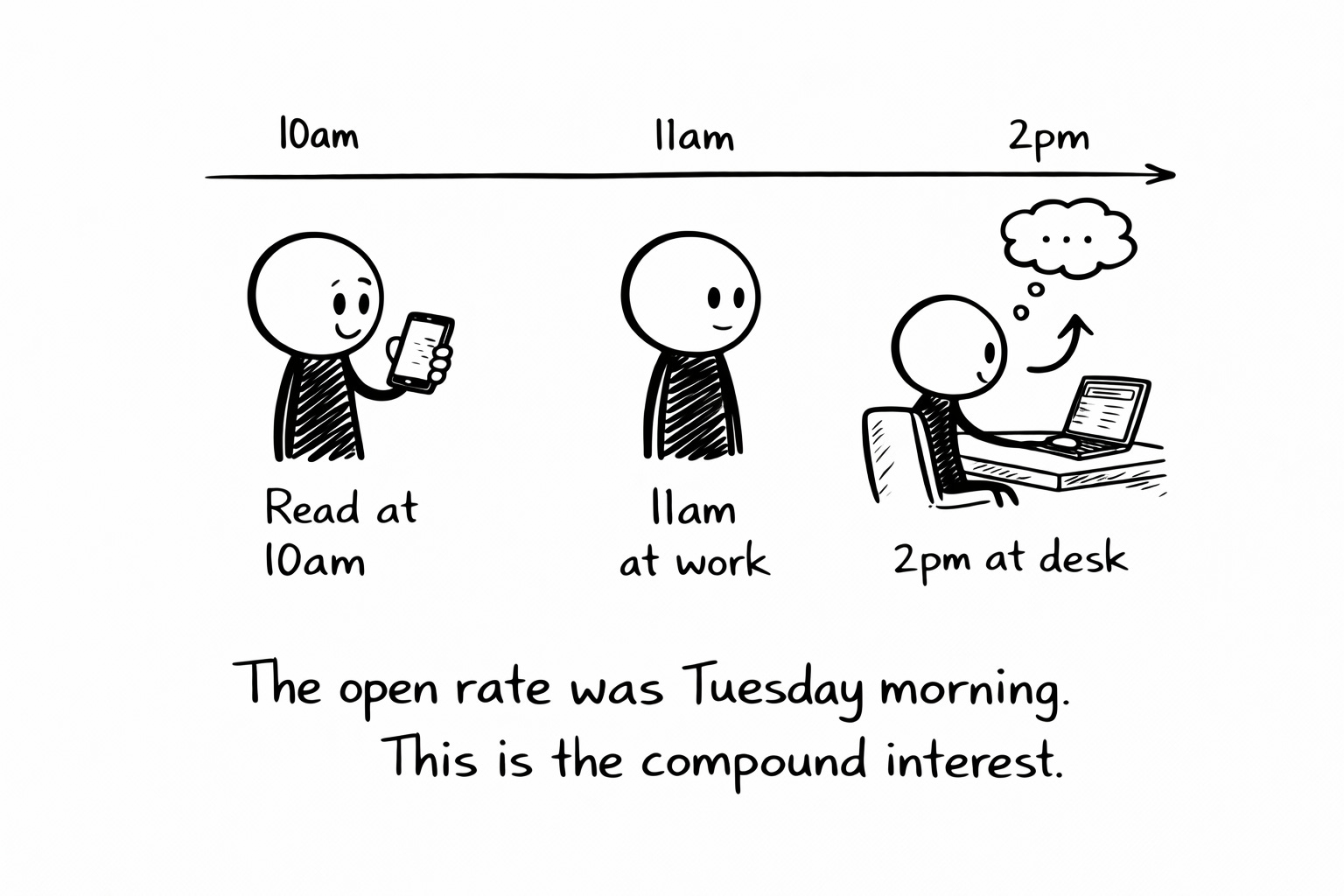
(I want to get specific here because “they want more content” is not it. It’s two in the afternoon on a Wednesday. The reader is back at their desk after lunch. They finished your post during a coffee break twenty minutes ago. They’re not thinking about it consciously. They’re answering a Slack message. But there’s a particular residue from a post that did something, like the way a song stays in your head without you trying to remember it, not an earworm but a feeling, a texture that keeps returning for reasons you can’t locate. That’s it. That’s what you’re building toward. Not the open. The residue that shows up uninvited at 2pm on a Wednesday three hours after the open.)
Liking a post is not the same as this. Thinking a post was good is not the same. Those are conscious evaluations that close. This is appetite. It accumulates invisibly, the way all the useful things do, and it’s distinct from engagement in every metric your dashboard can name.
What It Costs to Breach the Ledger
Inconsistency hurts more than absence.
A post that visibly coasted is a louder signal than a missed day. Readers forgive gaps. Life happens, everyone knows it, missing a Tuesday is forgivable without explanation. But a post that was clearly phoned in? A throughline that started with a decent hook, wandered through two paragraphs of filler, and landed with a conclusion that could have come from a LinkedIn carousel?
The subject line starts mattering again.
The evaluation comes back. The reader isn’t conscious of this. They won’t tell you. They’ll just open the next one a little more slowly. Check the preview text first. The decision that was automated quietly un-automates, without fanfare, without a DM, without any signal that would show up anywhere you can look.
Readers forgive absence. They notice withdrawal.
(This is the thing I wish someone had been blunt about earlier. The gap doesn’t kill you. The warm-body post does. The one where you clearly needed to publish something and published a warm body. That post is expensive. The receipt doesn’t arrive until three weeks later when your open rate has done something that makes no goddamned sense on a per-post basis and makes complete sense when you remember what you shipped in September.)
Keep making withdrawals and eventually they’re treating you like a stranger. The from field is irrelevant. The subject line is the whole pitch again. You built that relationship one deposit at a time and you lost it the same way, just faster, because trust erodes quicker than it builds.
One More Thing
The throughline you build over months isn’t one piece of writing. It’s the accumulated texture of every piece. The voice that sounds like you before the reader consciously registers your name. The rhythm they recognize in the first two sentences of the preview text. The specific way you handle endings that leaves them slightly unsatisfied in exactly the right way.
That’s where your Voiceprint matters. A throughline built on a distinctive, irreducibly-you voice compounds faster than one that could have come from anyone. The voice is what makes the texture yours. Without it, you can nail every mechanic in the next post in this series and still produce something someone could get from a stranger.
🧉 Think about the last newsletter you opened without reading the subject line. What did that sender do to earn that? I wanna know their secrets. Could you be a peach and share them with me in the comments?
The throughline isn’t about keeping readers on the page. It’s about what they feel when they’re away from it.
Crafted with love (and AI),
Nick "Still Waiting for the Dashboard to Catch Up" Quick

PS... The voice you’re depositing matters as much as the structure. If yours isn’t documented yet, here’s where to start.
PPS... Like it. Comment. Restack it. Subscribe. Send it to a friend. Send it to an enemy. Send it to your mother and finally give her something useful to forward to her book club. You have nothing to lose.