
The Most Expensive Word in Your Writing Is "I"
It's the most expensive habit in your writing. Here's the audit, the four conversion moves, and the one time the tax is worth paying.

Two openings. Same piece. Same writer.
“I’ve spent three years figuring out how to publish every day without becoming a hostage to my own content calendar.”
“You can publish every day without becoming a hostage to your own content calendar. I spent three years proving it.”
Same three years. Same content calendar. Same guy.
Read the first one again and watch what your brain does. There’s a stall. A little hitch where you stop absorbing the idea and start running a background check on the author instead. Who’s this guy? Am I enough like him for his three years to apply to my life? Do I care yet?
That stall costs you readers. And you keep installing it in the first sentence, which is the one piece of real estate where you genuinely cannot afford the rent.
I do it too. Not in the openings, usually (I’ve stewed on this principle long enough that the ledes mostly behave themselves now). It’s the other surfaces that catch me. The cold DM that opens with three “I”s like a man introducing himself at gunpoint. The reply that’s secretly about me wearing a question mark as a disguise. The Note that starts “I’ve been thinking.” The tax never disappears. It just relocates to wherever you stopped looking.
Welcome to the first-person tax.
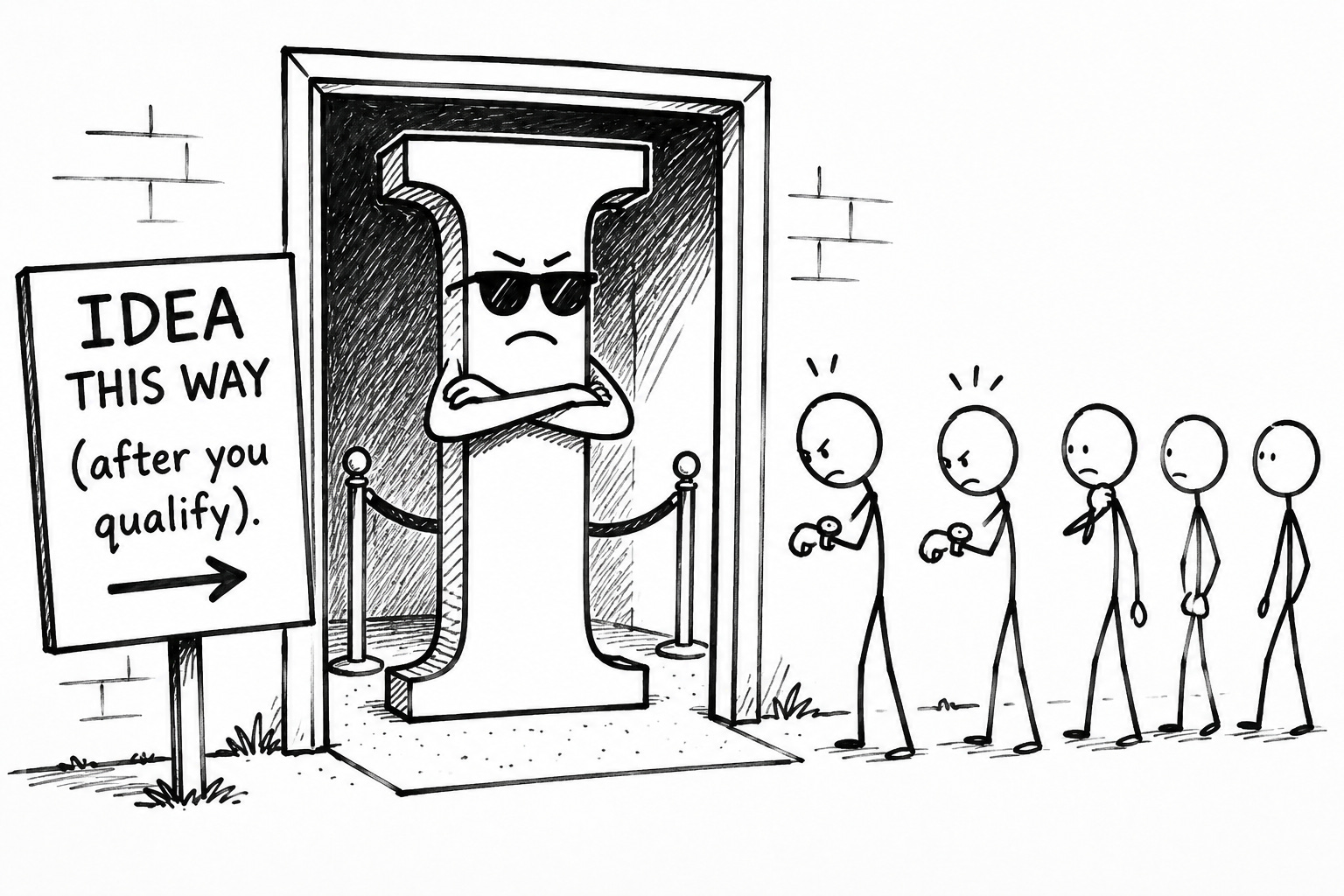
The Toll Booth You Welded Into Your Own Front Door
Every sentence asks the reader to do something. The good ones ask for almost nothing. They hand over an idea and step out of the way.
A first-person sentence at the top of a piece asks for something first. Before anyone can care about your point, they have to settle a question you quietly dropped in their lap: is this person enough like me that their experience transfers to mine?
You turned the first sentence into a cover charge before the reader could tell whether there was a party inside or six people networking under fluorescent lights.
This isn’t about whether “I” is tacky or self-indulgent or whatever the writing-advice people are wringing their hands about this week. (They’ll tell you first person is “brave” and “vulnerable,” usually in a newsletter that opens with a three-paragraph account of their morning pour-over. Let them.) It’s mechanical. You bolted a toll booth into your own doorway and now you’re confused about the foot traffic.
And the cruelest part? The better your idea, the worse it stings. You wrote something genuinely useful, then guarded the entrance with a pop quiz.
The Camera Is Pointed At Your Own Face
You write from inside your own skull. That’s the entire trap.
You’re standing inside the experience, marinating in it, narrating live. The reader is out on the sidewalk in the cold, deciding whether to come in. “I” is the natural word for the person inside the house. It’s the wrong word for the person you’re trying to coax through the door.
Nobody chooses the first-person tax. You inherit it. It’s the default camera angle, the one aimed back at your own face, and no one ever passes you a note that says turn the damn thing around.
So. Consider this your note.
You probably know a Trevor. Trevor publishes a newsletter called Trevor’s Take (the name is always the first warning shot). Every issue opens with Trevor. Every Note opens with “I’ve been thinking a lot lately about...” Trevor’s About page starts at his birth and proceeds chronologically, like a deposition. We’ll keep an eye on Trevor.
Thirty Seconds And A Highlighter
Here’s the check. You run it on anything before it ships, and it takes about as long as a drunk man needs to decide karaoke was always his destiny.
One. Isolate your first three sentences. Just those. The opening is where the tax incurs the most damage, so that’s where you audit first. (For a Note, a subject line, a DM, the “first three sentences” might be the entire thing. Even better. Less to miss.)
Two. Highlight every I, me, my, we, our. Look at the density. If your opening is wearing first-person pronouns like a band tee at a reunion show, that’s your signal.
Three. Ask one question of each highlight: is this pronoun making the reader recognize themselves, or making them recognize me?
That third question is the whole tool. Recognizing themselves is free. Recognizing you is the tax.
Most of your highlights will fail the question. Good. Failing is the point. Now you know exactly where the leak is, and you can patch it with one of four moves.
Four Ways To Stop Charging Admission
Move one: “I” becomes “you.”
Before: I think most people overcomplicate their publishing setup.
After: You’re overcomplicating your publishing setup.
Shorter, ruder, lands on impact. The reader doesn’t have to wonder whether your opinion applies to them. You aimed it at them on contact.
Move two: “I” becomes implied “you” (drop the pronoun entirely).
Before: I’ve found that batching a month of content kills the part worth reading.
After: Batching a month of content kills the part worth reading.
You’re not always trying to point at the reader. Sometimes you just need to get your own face out of the frame so the idea can stand on its own two legs. Cut the pronoun. Keep the truth.
Move three: “I” becomes “we.”
Before: I keep falling for the same bright-shiny-tool trap.
After: We keep falling for the same bright-shiny-tool trap.
This one’s a scalpel, not a butter knife. Used once, “we” pulls the reader into the same boat as you, and the boat feels cozy. Used in every sentence, it starts to sound like a wellness brand that just discovered the word “community” and won’t shut up about it. Ration it.
Move four: keep the “I,” but make it earn the seat.
Before: I spent three years figuring out how to run a daily publication without a team.
After: You can run a daily publication without a team. I spent three years and one minor mental breakdown proving it.
Watch the order. The “you” sentence pulled them in. Now the “I” shows up as a credential, not a customs form. It’s carrying proof the reader actually wanted. That’s a paid-up “I.” Worth every letter, sitting exactly where it belongs (second, after you’ve earned the right to talk about yourself).
When The Toll Is Worth Paying
Here’s where the lazy version of this advice faceplants.
If the rule were just “never start with I,” you’d be deleting some of the best openings ever written. Plenty of pieces open in the first person and detonate anyway. The pronoun was never the villain. The relationship between your “I” and the reader’s “me” is the villain.
So the real rule is the mirror test.
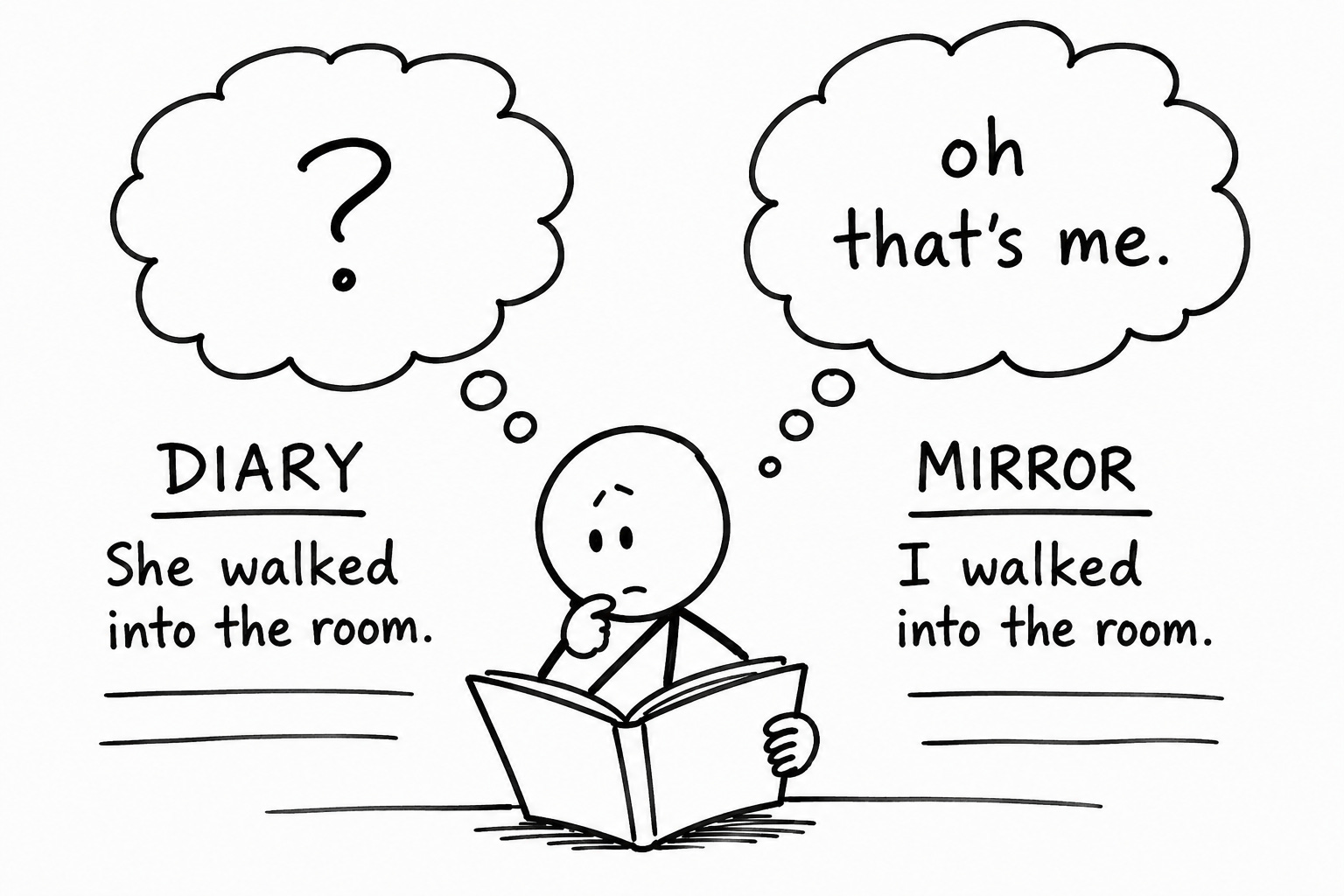
Your “I” earns its seat when the thing right behind it is something the reader has also lived, named so precisely that “I” stops being a window into your life and becomes a mirror they catch themselves in.
Mirror (works): I argue with people in the shower who aren’t there, and I usually win.
The reader finishes that one for you, silently, three words: ...so do I. You said “I.” They heard “us.”
Diary (doesn’t): I switched to a new note-taking app last week.
Nobody finishes that. They just watch you. You’re up on the little stage, they’re in the folding chairs, and the lights are getting awkward for everybody.
Same pronoun. Opposite result. The difference is whether the reader can stand inside the sentence with you, or has to sit there watching you stand in it alone.
One Tax Collector, Eight Door
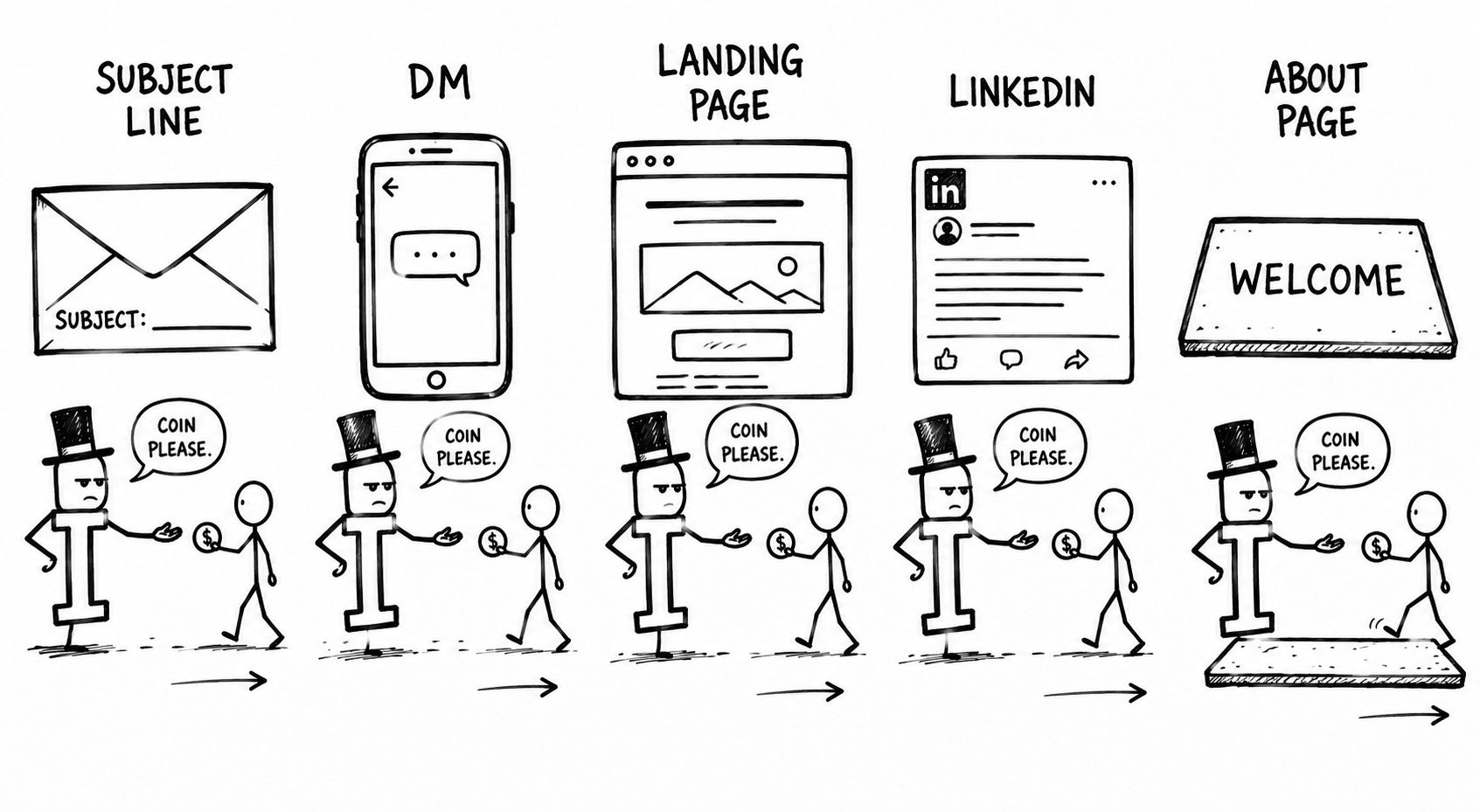
You don’t open in one place. A full-stack writer has a dozen front doors, and the tax collector is leaning on every single one of them with his arms crossed.
Post and essay openings. The classic. First sentence stuffed with “I,” reader gone before the piece earns a downward scroll.
Substack Notes and short-form social. Brutal, because there’s no second chance. The “I” Note demands the recognition check inside a feed that’s already deciding whether you exist at all. Lead with their problem, not the weather report inside your skull.
LinkedIn hooks. “I’m humbled and proud to announce that I...” has ended more reach in the feed than any algorithm change. Trevor posts these. Trevor is always humbled and proud. Trevor’s engagement is twelve likes, eight of them from other Trevors who didn’t read the post.
Landing and sales pages. The page is about what they get. Open with “I built this because I was tired of...” and the reader has to translate your problem into theirs before they care. Most won’t run the conversion. They’ll just leave the math undone and the tab closed.
The About page. The worst offender, every time, no exceptions. People write it as an autobiography when the reader is asking exactly one question: is this for me? Answer that first. Your origin story can wait three sentences. (Trevor’s About page is still going. We’re up to his gap year.)
Cold DMs. “I came across your work and I wanted to reach out because I...” Three I’s before you’ve handed over one reason to keep reading. They’ve already started typing “no thanks” and deleting the “thanks.”
Subject lines. The most valuable real estate you own, and “I” torches it instantly. The subject line’s whole job is making them feel the email is about them. “I” makes it about you, unopened, forever.
CTAs. Even the ask. “I’d love it if you subscribed” centers your feelings. “You’ll get [the specific thing]” centers their payoff. One begs. One offers. Guess which converts.
The Sixty-Second Shakedown Before You Publish
You don’t need to rewire how you write. You need one pass, every time, before anything goes out the door. Sixty seconds, maybe less once it’s a habit.
One. Find your first point of contact. Opening sentences, headline, subject line, hook, the first line of the DM. Whatever the reader hits first.
Two. Count the first-person pronouns. Out loud is better. Hearing yourself say “I” four times in one paragraph does something a silent read politely refuses to.
Three. Run the question on each. Mirror, or window? Recognizing themselves, or recognizing you?
Four. Convert the windows. You. Implied you. Earned I. Pick the move that fits.
Five. Leave the mirrors alone. If the “I” makes them mutter “me too,” it’s pulling its weight. Stop fiddling with it.
Six. Ship it.
Run this for two weeks and the checklist dissolves into instinct. You start hearing the tax in your head as you write, the way a guitarist hears a bad note a half-second before their finger lands on it. That’s the actual goal. Not a rule you obey forever. An ear you grow.
Trevor never grew the ear. Trevor refreshes his dashboard. Twelve opens. He blames the algorithm, then the niche, then Mercury being in retrograde. Then he opens a new post, types “I,” and leans back like he’s said something. The cursor blinks. It always blinks.
Your reader showed up willing to care. The least you can do is not charge them at the door before you’ve said one thing worth the toll.
Crafted with love (and AI),
Nick “Recovering First-Person Addict” Quick

PS... Your AI collaborator will reinstall the first-person tax every chance it gets (the statistical average is hopelessly in love with the word “I”). The free Ink Sync Workshop walks through teaching it what to do instead:

PPS... If this earned it: subscribe so the next one finds you, restack it so it finds someone else, and send it to the one writer in your life who opens every single thing with themselves. (You already know who.)
Once again Nick, F'awesome job on this post friend!