

You are not a writer with a newsletter, a podcast, a channel, or a feed.
You are a full-stack writer whose work has to travel.
That sentence either lands or you’re already mentally shopping for someone gentler to subscribe to. (Both responses are valid. One of them tells me more.)
A writer obsesses over sentences. A full-stack writer obsesses over the entire chain of events between the sentence and the human who reads it (and the eight or nine surfaces that human might be standing on when they first encounter your name, none of which you control, all of which you have to show up on anyway).
Not a small difference. It is the difference between a writer who grows and a writer who holds a quiet pity party for themselves every Sunday evening in front of a laptop that smells faintly of regret.
A writer asks: was today’s work any good?
A full-stack writer asks: did today’s work move through the machine? (Did it spawn fragments worth carrying elsewhere? Did it land in front of strangers who weren’t already in the room? Did anyone forward it, screenshot it, quote it back at me, or perform a single voluntary act they wouldn’t have performed otherwise?)
A writer measures themselves on the words.
A full-stack writer measures themselves on what the words do after they leave the building.
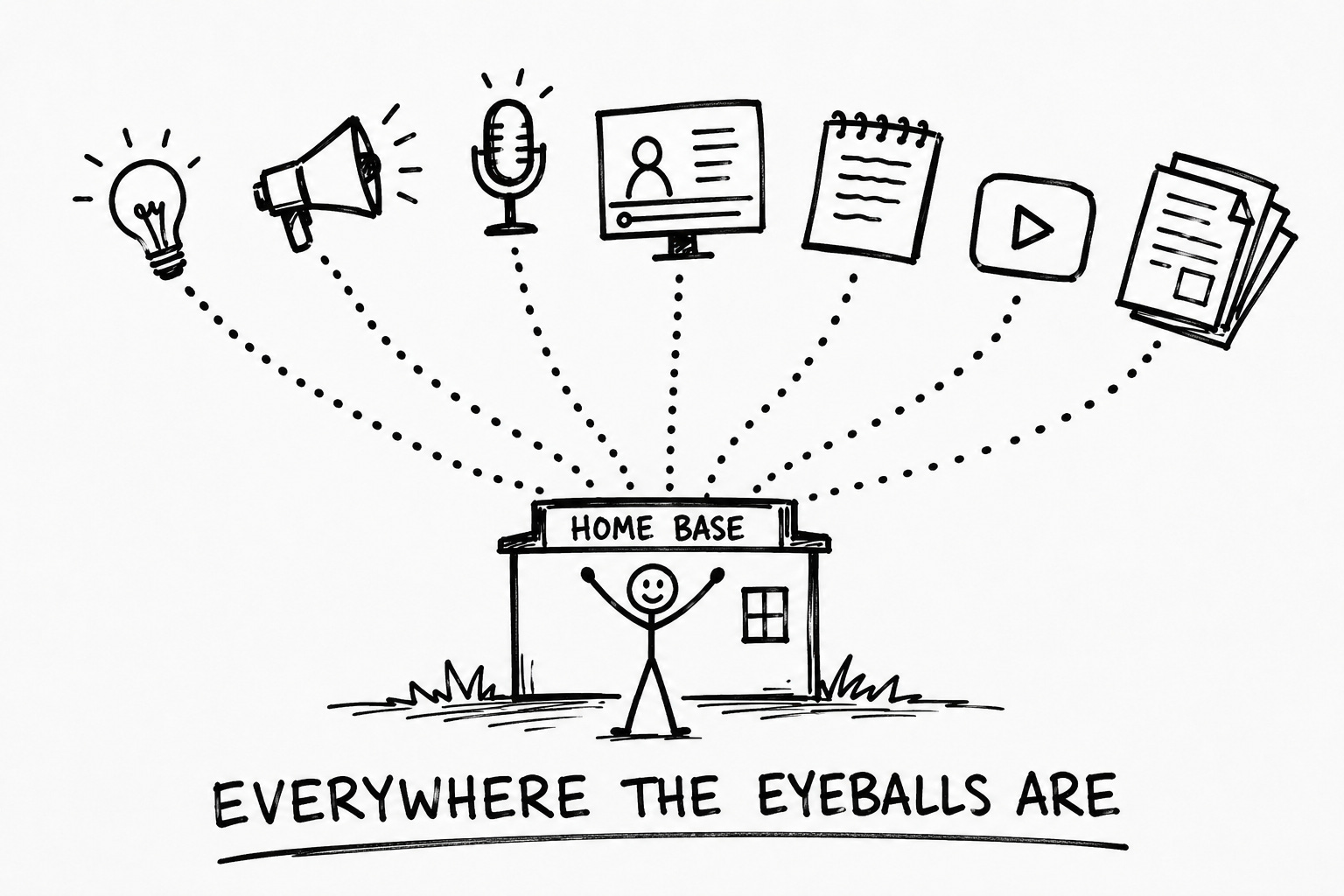
There’s a home base somewhere in your full-stack reality. The one place you actually own. Newsletter, podcast, channel, RSS feed, self-hosted site, whichever flavor of sovereignty you’ve picked. (Mine is settled here on Substack. Yours is your call. I am not going to pretend otherwise.) Everywhere else is fishing. Everywhere else is making eye contact across a crowded bar on the off chance someone interesting holds your gaze in return. (You’re not lonely. You’re sourcing.)
(Yes, you still have to write something worth noticing. I am not handing you a permission slip to ship slop with better logistics. Saying something worth a damn is still the entire point. The system exists to protect your message from the unique cruelty of being invisible.)
The Work Is Already Done. You Just Keep Publishing It Once.
Here is the most expensive habit in the entire writing economy. A writer spends three or four days on a piece, hits publish, and then closes the laptop with the satisfied conviction of a person who has just sent a drunk text. The send button was the entire experience. The reply, if any, is a problem for future them. The piece is now in somebody else’s hands or, more likely, in nobody’s hands at all. Then they wonder why the universe didn’t message back.
Most published work fails for one reason. It got published once and shown once and pointed at once, then quietly abandoned, like a houseplant left with a roommate who promised to water it. (The roommate is the algorithm. The roommate has never watered anything in its life.)
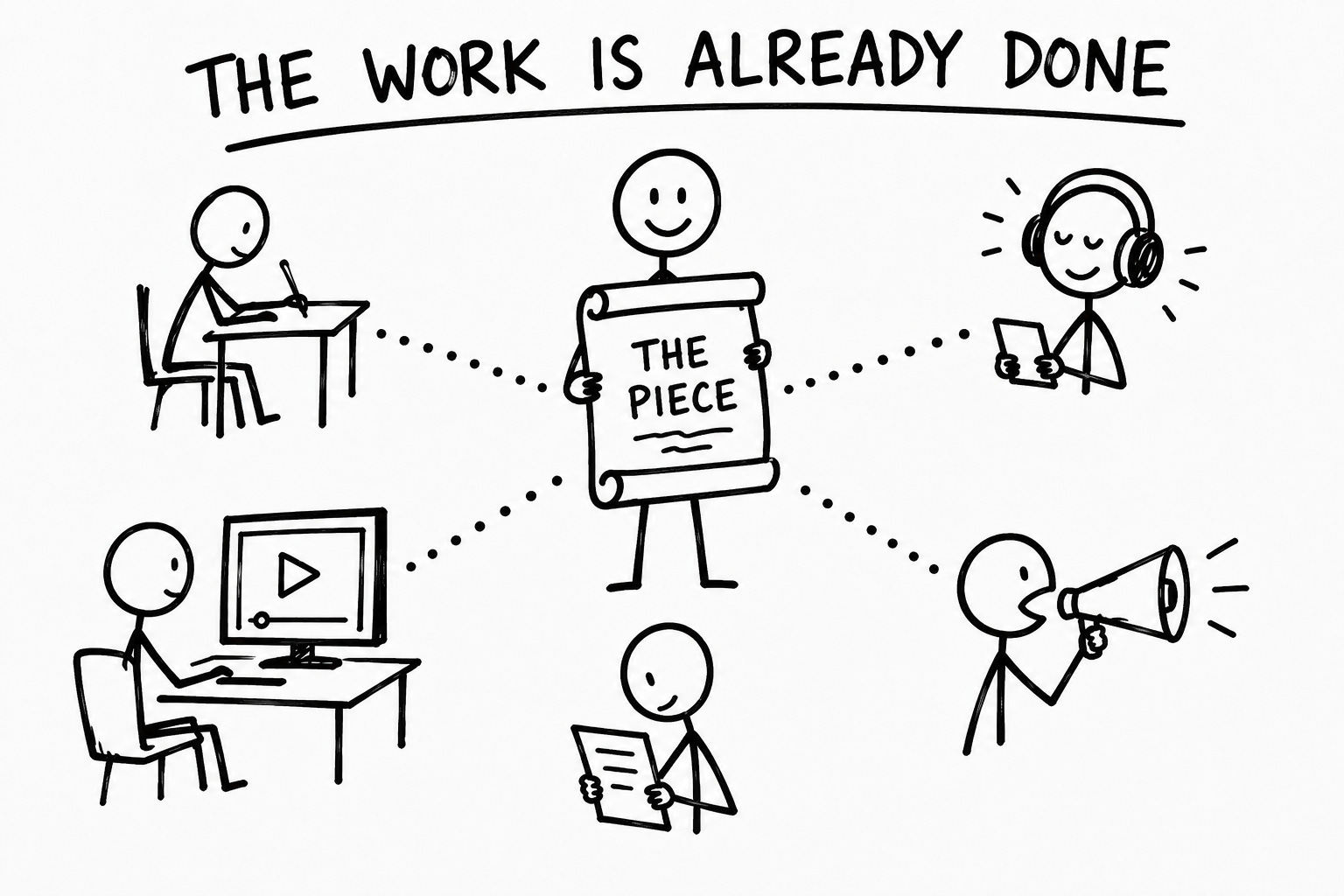
A full-stack writer treats every published piece as raw material for the next two weeks of presence everywhere else strangers might be standing. Same idea, restaged. Same argument, reshaped. Same voice, repointed at a room that wasn’t in attendance the first time.
So. Pull up your last published piece. Right now if you want, or as soon as you finish this. Three questions, and these ones are useful.
1. Where else could this piece live, more or less as is, with maybe twenty minutes of reformatting?
There is almost always one surface (sometimes three) where the existing piece would slot in cleanly with minor edits. You haven’t put it there because nobody specifically asked, and you were already mentally onto the next thing. The next thing can wait. This thing earned more reach than you gave it.
2. What is the single sharpest fragment buried inside this piece that could stand on its own somewhere else?
Most pieces contain at least one line, one paragraph, one observation, or one image that would survive being yoinked out of its context and dropped into a different one. The piece doesn’t need to be reread for this. Your gut knows. Whatever flashed in your head when you read that question is probably the right answer.
3. What format does this idea want to be in that you haven’t tried yet?
Audio. Visual. Conversational. Compressed. Expanded. A fragment used to start a discussion. A frame turned into a thread. A core argument restaged as a recommendation, a teardown, a confession, a list, a single image with twelve words of text. The format is the easy variable. The idea is the hard one, and you’ve already done the heavy lifting.
Tonight, this week, before you start the next piece.
Pick one answer. Just one. Spend forty-five minutes acting on it. Put the existing work in front of one new set of eyeballs.
That is the entire move. It is not a strategy. It is the operating habit of every writer who appears to be everywhere at once. They are not everywhere at once. They are systematically refusing to abandon work they already paid for.
The pivot you might have noticed on this newsletter? This is it. We’re going deeper into the full-stack writer lane (out loud, in public, with receipts). The voice work still matters. We’ll still publish it. Divergent writing is the precondition for any of this being worth distributing in the first place. Most of you aren’t bleeding on voice. You’re bleeding on everything that happens after. We’re going to fix that, one screw at a time, with a small army of AI agents handling the parts that aren’t supposed to feel like writing in the first place, so the parts that are can finally get the attention they deserve.
The writer disappears between pieces. The full-stack writer keeps showing up while others sleep.
Crafted with love (and AI),
Nick “Showing Up While You Sleep” Quick

PS... If you publish exactly one more piece this week and send it to exactly one place, you have just sent another drunk text. The Ink Sync Workshop is the part where you sober up enough to actually point the work at the right rooms. (Don’t worry; it’s totally free.)
PPS... The buttons. Push them. Like the post. Comment something. Restack it. Share with the one friend who needs this. Subscribe. Each one helps. Each one matters. Each one is technically a small commitment, and small commitments are how full-stack writers build careers, so this is also a free demonstration of the entire thesis. Look at us, putting theory into practice already.