

I’ve been lying to eight platforms simultaneously for the last three weeks.
Every morning, Twitter gets the combative version of me. LinkedIn gets the professional one. Threads gets the casual one. Bluesky gets the thoughtful one. Mastodon gets the one who pretends he doesn’t give a f#ck about metrics.
None of them are getting a copy of my newsletter. All of them are getting something that sounds like I wrote it specifically for them.
I didn’t.
I wrote one article. Then I ran it through a repurposing engine I built inside Claude Code (one layer of a larger AI content operating system that’s still under construction) and it produced platform-native outputs for eight channels in about four minutes. Notes, threads, standalone posts, carousel copy, a Medium republish. I spent another fourteen minutes reviewing, editing, and killing the ones that drifted. Total repurposing time: eighteen minutes. Total pieces of content from a single creative effort: north of twenty.
The outputs weren’t copies. They were extractions (different threads pulled from the same source, reformatted for how each platform’s audience actually reads). And that distinction matters more than anything else I’m going to say today.
The Two Ways Most Creators Screw This Up
There’s a spectrum, and almost everyone is camped at one of two terrible ends.
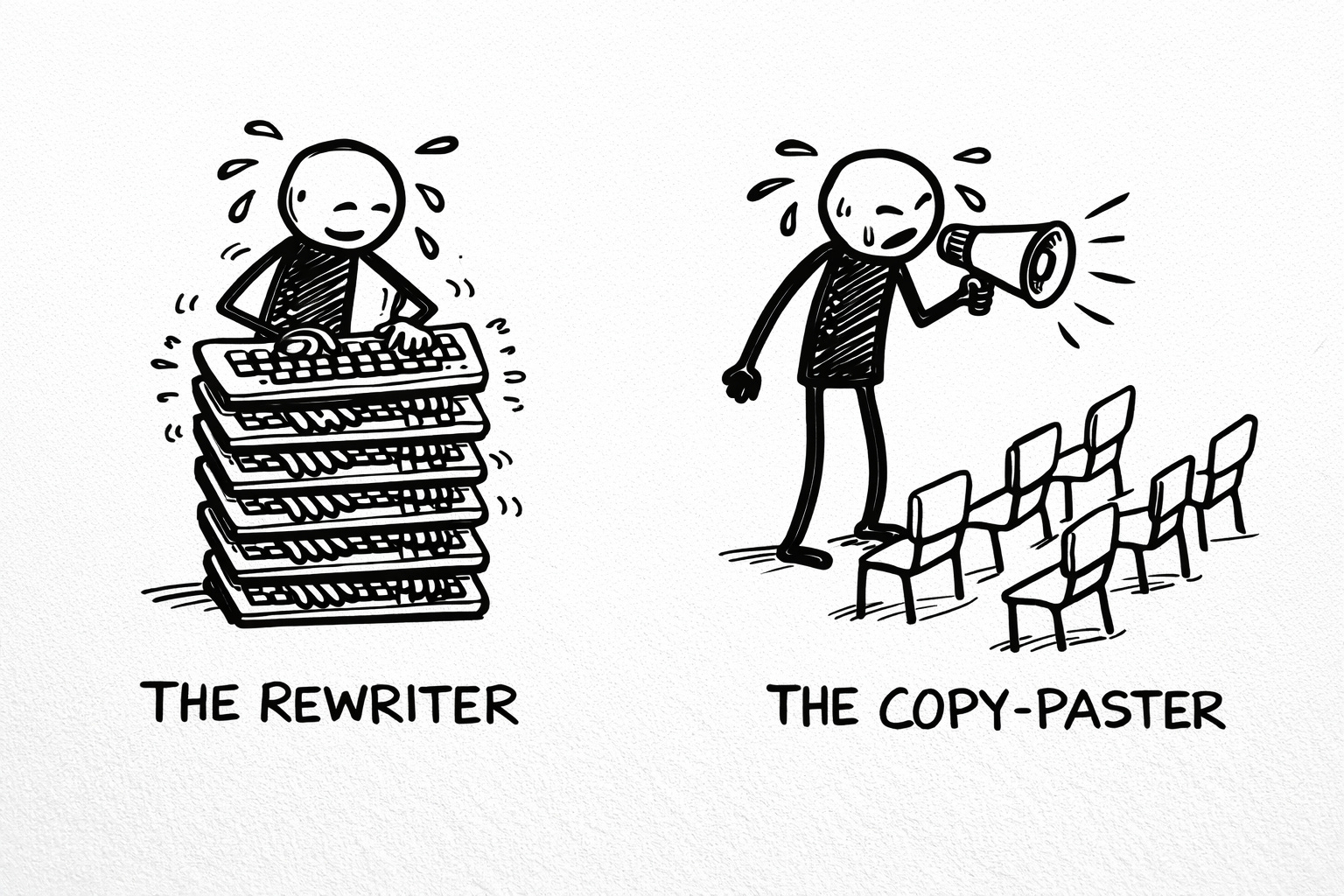
Camp One: The Manual Rewriters. These people finish a newsletter and then spend the next two hours painstakingly rewriting it for LinkedIn, then Twitter, then Threads, then whatever else they’ve committed to. They’re doing great work. They’re also doing it at a pace that will destroy them by month three. (I know because I was in this camp. The burnout doesn’t announce itself. One Tuesday you’re scrubbing the crapper and it hits you: this is the most creative you’ve felt all week.)
Camp Two: The Copy-Pasters. These people finish a newsletter, copy the link, and post “New article! Check it out” on every platform simultaneously. The engagement is what you’d expect, which is to say: you’re talking to yourself in a crowded room while everyone politely pretends you’re not there.
Both approaches suck, but they suck for different reasons. The rewriters burn out. The copy-pasters get ignored. And the vast, silent majority of creators look at both options and just... don’t distribute at all. They publish the newsletter. They close the laptop. The article gets one impression spike on one day and then quietly dies.
(I’ve seen the analytics of creators with genuinely excellent writing who are getting 30% of the reach they should be getting, purely because they treat distribution like an afterthought. It’s like writing a love letter and then DMing it to someone who left you on “Read” the last four times.)
What the Repurposing Engine Actually Produces
The insight that changed everything for me was embarrassingly simple: each platform output isn’t a copy of your article. It’s an extraction. You’re pulling different threads from the same source and reformatting them for how each platform’s audience actually consumes content.
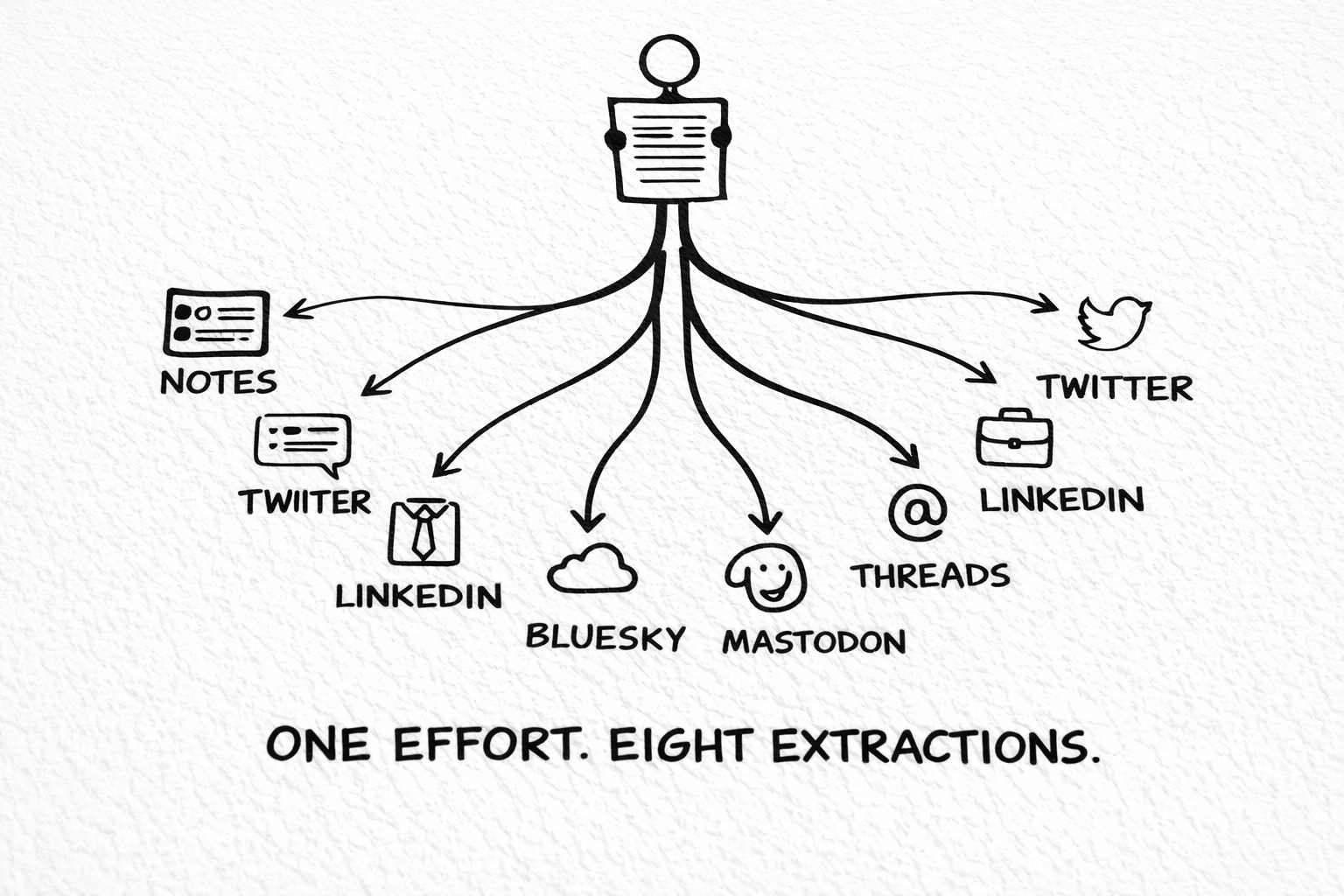
One Substack article goes in. Eight platforms get fed. The total output is north of twenty individual pieces. Here’s the full map.
1. Substack Notes (3-5 Notes) A mix of micro-insights that link back to the full post, spicy standalone takes that work without context, and engagement questions designed to generate replies. Notes generation was one of the first things I automated (originally with OpenClaw, now absorbed into Claude Code). Getting them to not sound like press releases was the easy part. Getting them to generate replies took six weeks of killing bad drafts.
2. Twitter/X (2-4 pieces) Standalone hot takes at 280 characters each (slightly combative, slightly unhinged, opinion-forward), sometimes a full thread that walks through the argument. The system generates variety and I pick what fits the week’s queue.
3. LinkedIn One tightly compressed post. Hook in the first line before “see more” (that first line is everything on LinkedIn). Compressed to 150-300 words. Link quarantined in the first comment because algorithms treat outbound links like a communicable disease on basically every platform now. The post itself is pure text, pure hook, pure value.
4. Threads (2-3 posts) Casual, internet-native versions. Under 500 characters each. The voice register drops. More conversational. Less structured. The system pulls different angles so I can stagger them across the week.
5. Bluesky (2-3 posts) Under 300 characters each. Same source material as Twitter but completely different energy (more thoughtful, less combative, because Bluesky rewards nuance over dunking).
6. Mastodon (2-3 posts) Under 500 characters each. Anti-corporate tone. No marketing speak. No CTAs. Just the ideas, presented honestly. (Posting a LinkedIn CTA on Mastodon is like wearing a 3-piece suit to a punk rock show. You'll leave with fewer friends than you came with. Possibly fewer teeth.)
7. Medium This one’s almost cheating. Medium has a built-in import tool that pulls from Substack and automatically sets canonical URLs (which means Google credits the original Substack post, preventing SEO cannibalization). I import, make minor formatting tweaks, select tags, and publish. Three minutes. But those three minutes buy me Medium’s domain authority pushing my content into Google results my Substack alone would never reach.
8. Carousel Copy Extract the core framework or process into slide-by-slide format. Hook slide (one provocative line). Five to seven content slides (one idea per slide, punchy). CTA slide. This feeds into Canva templates I’ve already built, so the design part is just swapping text. The extraction part (figuring out which ideas deserve slides and how to compress them) is what the system handles.
Same source material. Different cultures. Different formats. Different quantities. One article feeds eight platforms for days.
What This Looks Like on a Real Day
I’m going to walk you through exactly what happened last Thursday, because the theory is nice but the operational reality is what matters.
6:45 AM: I publish that morning’s article on Substack. Took about 75 minutes to write the day before (using Claude with my Voiceprint loaded, running the Ink Sync calibration loop until it sounded like me, not like a polite stranger pretending to be me).
7:00 AM: The repurposing engine triggers automatically. It monitors my Substack feed, detects the new post, pulls the full text, and runs all eight extraction workflows. No paste. No prompt. No manual anything. The system already has my Voiceprint, already knows each platform’s culture and constraints, and already has the extraction prompts loaded. By the time I pour my second cup of coffee, the drafts are waiting.
7:04 AM: I have drafts for all eight outputs sitting in front of me. The entire generation took about four minutes.
7:04-7:22 AM: I review everything. This is the part that takes the actual time, and it should. I scan each output, check that it sounds like something I’d post on that specific platform, fix anything that drifted, kill anything that feels forced. The LinkedIn draft needed a stronger opening hook. Two of the five Substack Notes were trying too hard to be clever. (One tried to use the word "pivotal." At gunpoint, maybe. "Take my right kneecap. Leave the vocabulary.") A few of the Twitter variations were redundant, so I picked the sharpest two and killed the rest. The carousel copy needed one slide cut because eight content slides is too many for the framework I was extracting.
7:22 AM: Everything is reviewed. I import the Medium version (three minutes). I queue the social posts in Nuelink for staggered distribution across the week. I schedule the Substack Notes throughout the day. (Substack now lets you schedule Notes, which means someone on their product team finally used their own platform.)
75 minutes of creative work (writing the article) generated 18 minutes of distribution work. Enough content to feed eight platforms for days.
(Before I built this system, distribution was a 90-minute chore I almost never did. The Substack article lived its life. My Twitter, LinkedIn, Threads, and Bluesky just... didn't. Eight platforms with my name on them and the last post on most of them was from a version of me who still had follow-through.)
The Bigger Machine This Lives Inside
The repurposing engine is one layer. Just one.
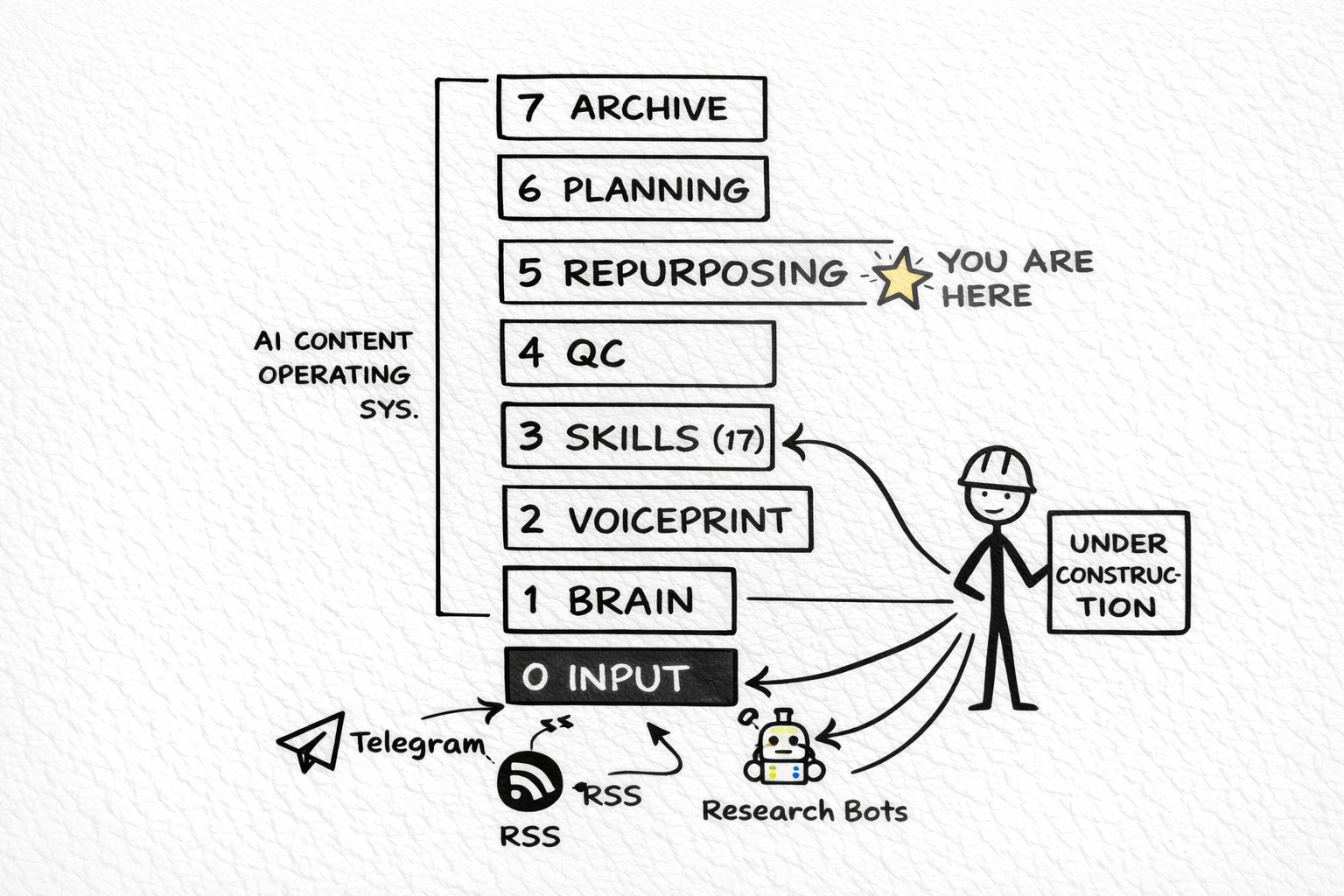
I’m building a full AI content operating system in Claude Code, and documenting the entire construction in public. Because if I’m going to tell creators to build systems, I should probably show mine while it’s still got the scaffolding up. (Competitors teach from slides. I teach from the construction site. Sometimes the construction site is on fire. That’s part of the charm.)
Here’s what the full system looks like right now. Seven layers, plus a Layer 0 that feeds everything:
Layer 0: Input Capture. Ideas flow in from Telegram (quick voice memos and links I send myself throughout the day), RSS feeds (curated industry sources), and research bots (including Momo, my AI news scanner that produces daily scored briefs). This is the raw material pipeline. Nothing gets created from nothing.
Layer 1: The Brain. A master CLAUDE.md file that acts as the system’s operating manual. It knows what I’m building, who I’m building it for, what stage the business is in, and what the strategic priorities are. Every other layer references this file.
Layer 2: The Voiceprint. The VAST framework documentation (Vocabulary, Architecture, Stance, Tempo) that tells the AI exactly how I write. This is the document I’ve been teaching people to build for months. It touches everything downstream. Without it, every output sounds like competent, generic, forgettable wallpaper.
Layer 3: Content Production Skills. Seventeen specialized skills (and counting) that handle different content types. Newsletter drafting. Notes generation. Comment crafting. Each skill has its own instructions, its own quality checks, its own awareness of platform constraints.
Layer 4: Quality Control. Five modules that catch drift, check for banned words, verify voice consistency, and run the Anti-Slop Checklist. The system polices itself before I ever see the output. (Not perfectly. Sometimes the quality control module lets something through that I would have caught. But it catches about 80% of the drift, which means I’m editing from a much better starting position.)
Layer 5: The Repurposing Engine. What you just read about. Eight extraction workflows. This is where one piece of creative work becomes a week of multi-platform distribution.
Layer 6: Content Planning. Calendar awareness, pillar tracking, topic rotation. The system knows what I published last week, what’s scheduled for this week, and which content pillars are overdue for attention.
Layer 7: Archive and Memory. The system remembers what it’s published, what performed well, what internal links exist, and what topics have been covered. This prevents accidental duplication and enables intelligent internal linking.
Seven layers. One operating system. Built by one person. (That person is me. And my AI collaborator. And my chihuahua Butters, who contributes nothing to the operation except warmth and moral support, which is honestly more than most advisory boards provide.)
Why I’m Showing You the Blueprints
I’m building this system for myself first. I’ve refined the extraction prompts eleven times in three weeks. The first version produced LinkedIn posts that sounded like a TED talk reject and Twitter posts that sounded like a motivational poster having a nervous breakdown. (Mastodon was accidentally perfect on day one. Turns out “slightly annoyed but still showing up” is their whole culture.)
Some layers are solid. Some are still duct tape and optimism. I’m packaging it so other creators can install it. Not today. But very soon.
🧉 Which platform have you been ghosting the longest? No judgment. We’ve all got one. (Mine was LinkedIn. Three months of silence. It got so bad I think my profile photo started aging without me.)
Crafted with love (and AI),
Nick “Professional Content Sprinkler” Quick

PS... The repurposing engine runs on a Voiceprint. Without one, the extractions sound generic on every platform, which is worse than not distributing at all. If you haven’t built yours yet, the Voiceprint Quick-Start Guide walks you through it.
PPS... If this post helped you rethink how you distribute your work, the like button is right there. The subscribe button is somewhere nearby too. They’re both free and they both make me disproportionately happy. (Butters celebrates every new subscriber with the same full-body vibration he uses for everything else. He has no idea what a subscriber is. The enthusiasm is unconditional.)