
I Posted a Crappy Instagram Reel. It Outperformed Everything I've Published This Month.
My publishing system works perfectly. A low-effort video still beat it.

I posted an Instagram Reel last week.
I never post Instagram Reels. I barely use Instagram at all. The app exists on my phone primarily as a mechanism for doom-scrolling Reels at 1 AM while telling myself I'm “researching content formats.” (I'm actually watching a guy teach you how to tell if you're being followed, which is a skill I’ll never need and have watched eleven times anyway.)
But I’d been meaning to experiment with video for months (it’s been sitting on my content calendar since January, radiating judgment every Sunday during batch sessions), and I figured the lowest-friction way to start was the dumbest possible version. No production. No script. No ring light. Just a screen recording of me building a newsletter post, chopped into a few clips, with some text clumsily slapped over it.
The whole thing took maybe twenty minutes to cut together. It looked like it was edited by someone who’d just learned what CapCut was. Because it was.
(I want to be clear about the quality level here. This was not a “raw but charming” video. This was not “lo-fi aesthetic.” This was a screen recording with text on it that I posted mostly so I could stop feeling guilty about the video line item on my content calendar. The bar was on the floor. I barely cleared it.)
The Reel showed different phases of creating a post. The outline. The Claude conversation. The draft. The edits. The voice pass. The final version. Nothing revolutionary. Just me doing the thing I do every day, captured on camera for the first time.
It got more engagement than the post it documented.
More views. More shares. More comments. More profile visits. More everything.
The post I spent hours writing, editing, polishing, running through my entire co-writing workflow? The one where every sentence was calibrated, every parenthetical was placed, every transition was earned?
It performed like it always performs. Fine. Solid. Respectable.
The garbage Reel I almost didn’t shitpost performed better.
I need you to understand how much this pisses me off.
The Part Where I Try Not to Launch My Laptop Into A Volcano
I’ve spent the better part of a year engineering a publishing operation specifically designed to produce the best possible finished product, every single day, without exception. It is meticulous. It is documented. It is the professional accomplishment I’m most proud of this year.
And some crappy screen recording with text on it just walked in, sat down at the table, and outperformed everything the system produced this month.
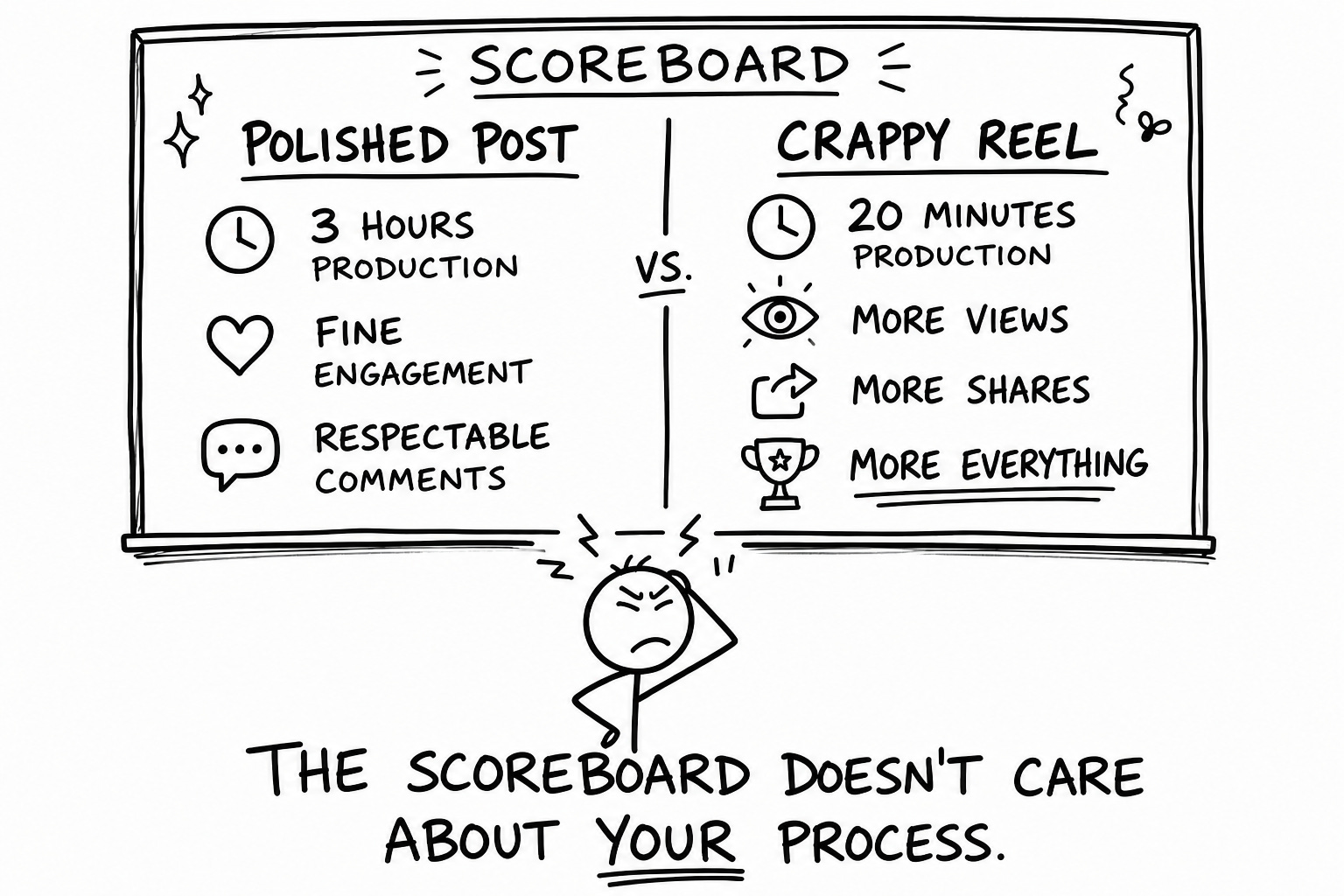
(I literally write a newsletter called “Co-Write with AI” about producing quality content. My whole thesis is that the work matters. That giving a shit about what you publish is the differentiator. And right now the data is telling me that twenty minutes of screen recording with the production value of a security camera did more than my entire publishing methodology. The irony doesn’t taste great.)
But once I got past my little tantrum phase (approximately 39 hours, during which Butters watched me pace around the apartment with the loving concern of a four-pound therapist who can’t prescribe medication), I started thinking about why.
And the why is actually interesting.
Why the Mess Won
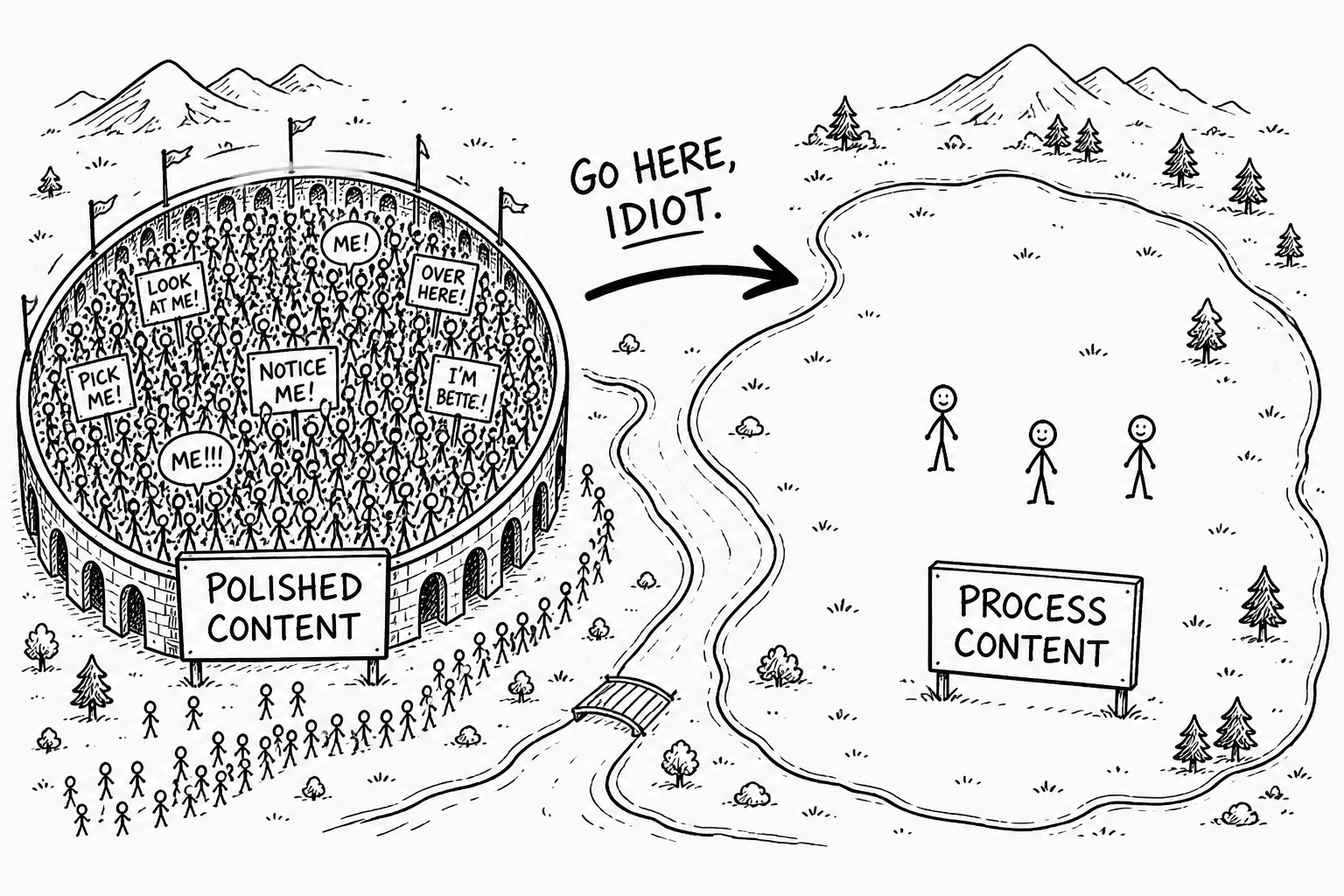
When I post a polished newsletter, I’m competing with every other polished newsletter in the feed. My carefully structured argument against nine hundred other carefully structured arguments, all smoothed to the same finish, all indistinguishable at scroll speed.
The polished content space is a bloodbath. Everyone’s in it. Everyone’s good at it. And the audience has been swimming in polished content for so long that their eyes slide right over it like a philosophy degree at a job fair. (I would know.)
When I posted myself making the newsletter, I was competing with almost nobody.
Because almost nobody shows the work happening. They show the work that happened. Past tense. Cleaned up. Narrative arc intact. Lesson extracted. All the mess composted into something presentable.
The Reel worked because it showed something people rarely see: the actual, unglamorous, occasionally unsightly reality of dragging a newsletter post out of the void by its ankles while it screams.
The outline that looked like a conspiracy theorist’s bedroom wall. The Claude conversation where I rejected the same sentence four times and couldn’t explain why. The draft where I typed “SOMETHING GOOD GOES HERE” in three separate places and meant it every time. The voice pass where I’m reading paragraphs out loud to a dog who is absolutely not listening but whose presence I find editorially necessary.
That’s interesting. Not because I’m interesting. But because the process is relatable in a way the product never is.
The Mechanism (Once I Stopped Being Mad Long Enough to See It)
Here’s what I think is actually happening.
Polished content demonstrates competence. Process content demonstrates humanity.
Competence is impressive. Humanity is connective.
And connection is what drives the subscribe button, the restack, the DM to a friend saying “you need to follow this person.”
Great work gets shared for what it says. Process gets shared for who it reveals. You need both. I’ve been all proof and no pulse.
When someone watches me wrestle with a paragraph in real time, something shifts. I stop being a newsletter in their inbox and start being a person at the same desk. The hierarchy collapses. The “creator up here, audience down there” dynamic flattens into “we’re both doing this, I’m just doing it on camera.”
(This is, annoyingly, the same thing I teach about AI collaboration. The whole Voiceprint methodology exists because AI erases the human fingerprints. Turns out I’ve been erasing my own fingerprints by only showing the finished product. The irony is starting to develop layers.)
The Reel didn’t outperform my post because it was better content. It outperformed my post because it let people see a real person doing real work. Poorly. On camera. Without the safety net of a polished narrative.
And that, apparently, is worth more than three hours of editorial precision.
So Now What, Genius?
I’m not abandoning polished posts. I’m not an arsonist. The newsletter isn’t going anywhere. The Voiceprint methodology still matters. The finished product is still the product.
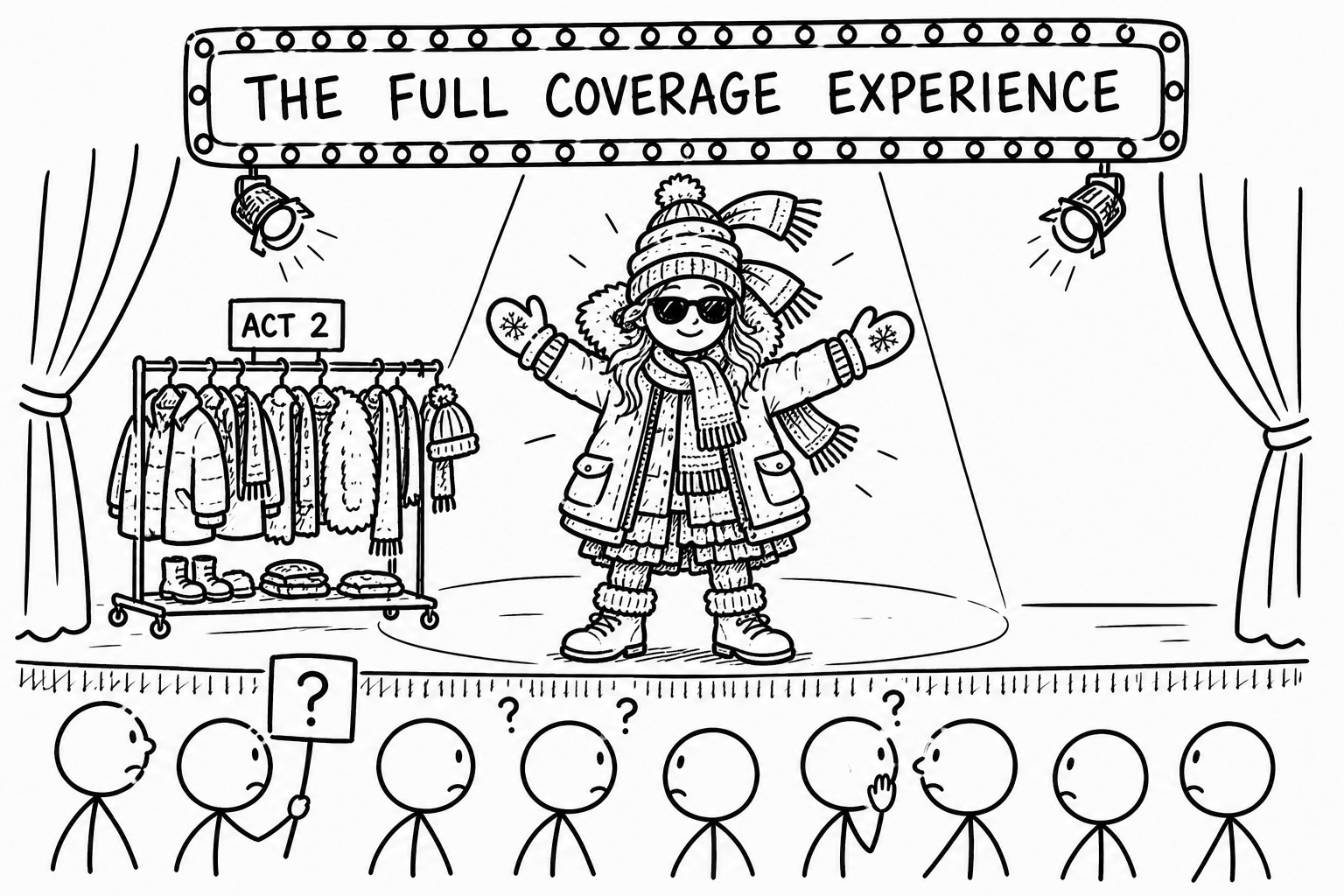
But I’ve been running this like a strip club where the dancer walks out in a sleek, stylish parka and keeps adding layers. Hat. Scarf. Second scarf. The audience came to see something real and instead got a masterclass in concealment. That’s what only posting finished work is. A performance specifically designed to hide the interesting parts.
Starting this week, here’s the experiment:
One “working” capture per day. A screenshot of a Claude conversation mid-draft. A before-and-after of a headline. A thirty-second screen recording of the voice pass. Something that shows the system running, not just the output it produces. Low effort. High signal.
More crappy Reels. I’m going to keep making the exact kind of video that embarrassed my entire content strategy. Screen recordings of the co-writing process. No production value. No script. Just the work, captured live. If the first one outperformed my best post, I want to see what happens when I do it consistently.
(I'm aware of the irony that I'm now building a system for being unsystematic. That's fine. Consistency and spontaneity have been sharing a one-bedroom basement apartment in my brain for years. They hate each other. The work gets done anyway.)
The Real-Time Bet Post predictions before I have results. “Publishing this title today. I think it’ll be my highest open rate this week. Placing my bet publicly. Check back tomorrow.” Then follow up. Was I right? Was I wrong? Now you’re invested in a storyline that costs me two Notes and zero extra production.
The polished post is the proof. The process content is the invitation. One without the other is only half a strategy.
This Isn’t A Spectator Sport
You’re reading this because you make things. And somewhere in your workflow, there’s a version of this same gap.
You’re producing outputs and hiding the process. Publishing the result and burying the three hours of frustration and iteration and bad ideas that made it worth reading in the first place.
Whatever you’re hiding is the interesting more part.
Your audience can find polished content anywhere. Ten thousand polished posts in their feed right now. Slick. Professional. Indistinguishable at scroll speed.
What they can’t find is someone doing the work in front of them. Making decisions. Struggling with the same paragraph they struggle with. Getting it wrong. Getting it slightly less wrong. Getting it right on the fourth attempt and not being totally sure why.
That’s rare. That’s worth stopping for.
And it takes thirty seconds to capture.
I spend hours perfecting my posts. Then I spent twenty minutes showing myself making one. The twenty minutes crushed. The lesson isn’t “stop polishing.” The lesson is “stop only polishing.”
🧉 Be honest: how much of your creative process does your audience actually see? If you had to guess a percentage, what’s the ratio of “finished output” to “messy process they never see”? Mine was about 99/1 until a crappy Instagram Reel humbled me into reconsidering everything. What’s yours?
Crafted with love (and AI),
Nick “Professionally Humbled by CapCut” Quick

PS... If the crappy Reel showed the what of my process, the Ink Sync Workshop teaches the how. It’s a free calibration system for getting AI to stop drifting from your voice in three rounds or less. The part where I’m catching AI drift during the voice pass? That’s Ink Sync running. Grab the workshop and learn the loop:
PPS... I publish a polished newsletter (almost) daily, and now the messy in-between stuff is showing up on Notes, Instagram, and Twitter feeds too. Subscribe if you want the full picture (not just the completed painting, but the paint-covered drop cloth underneath it). And forward this to that creator friend who spends four hours perfecting posts that get twelve likes. They need to hear that a screen recording with the production value of a parking garage security camera just outperformed my best work this month.
Nick, we need to see this reel! I deleted insta last year and I am almost willing to sign up again just to try and find it... lol.
This is a fascinating experiment. Crazy how the things we try so hard with sometimes end up with crickets. So interested to see if you replicate this again too!
Ok, so now I want to see the crappy reel. :)