
What If Only 200 Words Are Worth Keeping?
A 15-minute workflow to find out if your draft actually has something to say

I’ve written posts that felt important while I was drafting them.
You know the ones. You finish the last sentence. Lean back. Maybe crack your knuckles like God on the seventh day, surveying your creation. Think to yourself: yeah, this is going to land.
Then you come back the next morning.
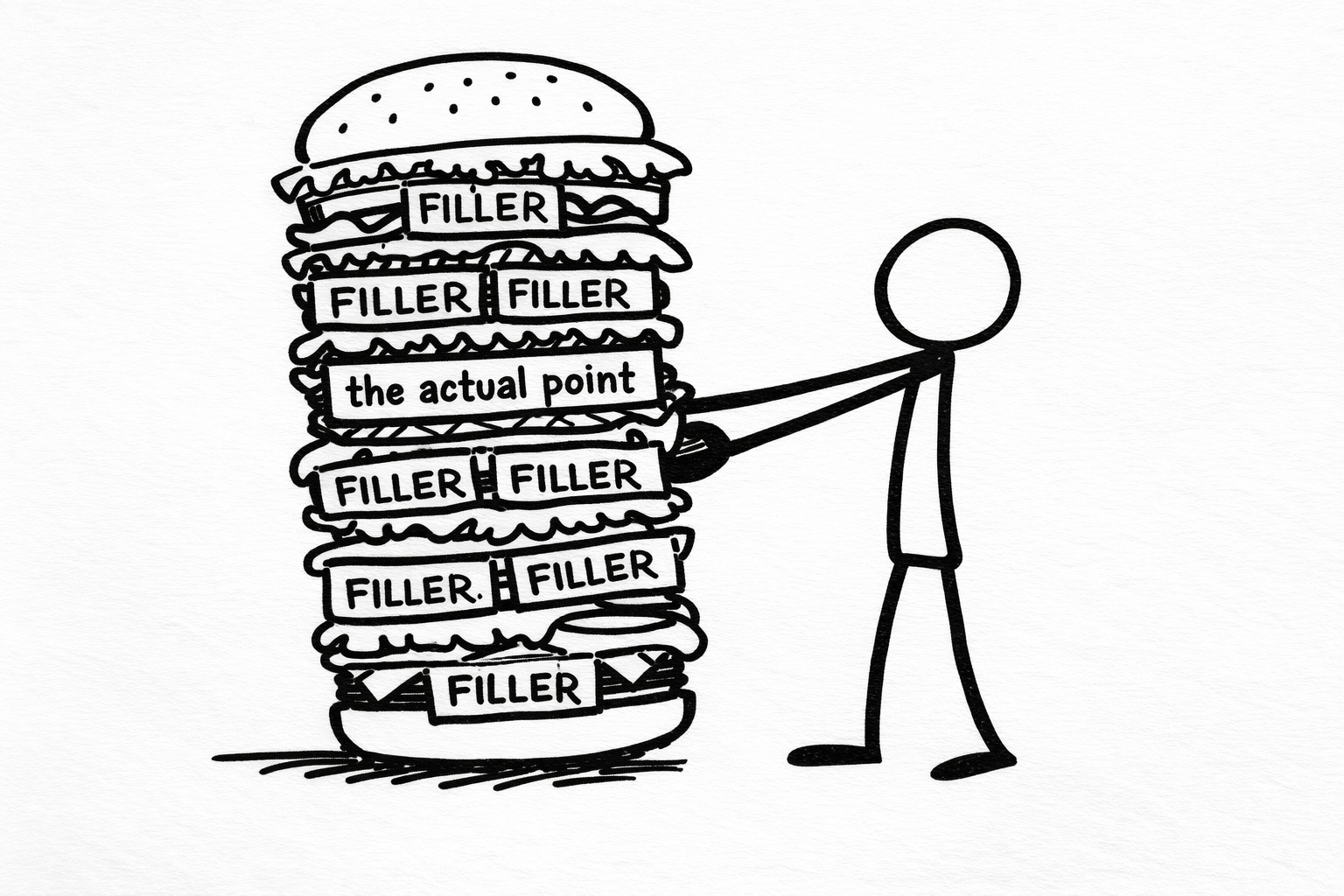
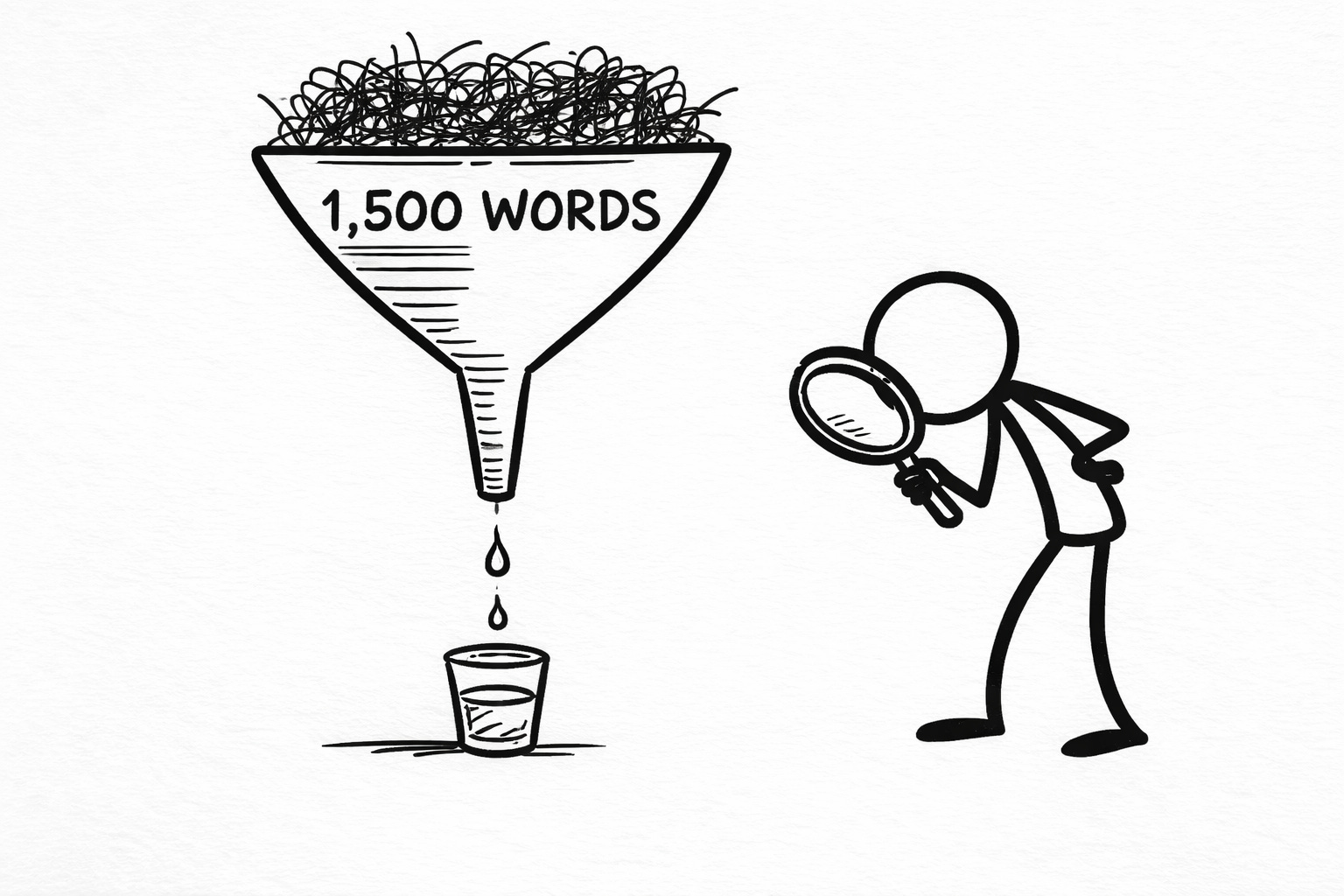
And you realize you’ve written 1,500 words of filler around a 200-word idea. Dressed it up. Gave it a second example. A third. An extended metaphor that overstayed its welcome by roughly four paragraphs and a lifetime.
The filler wasn’t malicious. It was protective. We pad because we’re not sure the core is enough. (Same reason first dates happen in dim restaurants. Flattering lighting. Plausible deniability.)
Most of us never ask the one question that would save us before we hit publish:
What’s the minimum viable version of this post?
Compression isn’t editing. It's the morning after. The draft looked better in the dark.
When you force AI to cut your draft in half, then half again, then down to a single paragraph, you’re not wordsmithing. You’re not “tightening the prose.” (I need a shower after typing that.)
You’re discovering what you actually came to say.
The irreducible core. The part that survives every cut. The argument that refuses to die no matter how much you strip away.
Sometimes that core is sharp. Worth rebuilding around with intention.
Sometimes it’s embarrassingly thin. A fortune cookie wearing a prom dress it bought on credit.
Both are useful information. One of them saves you from publishing something forgettable. The other saves you from believing you’re a better writer than you are. (I collect these humiliations like baseball cards at this point. My self-awareness is the only thing keeping my ego from requiring its own zip code.)
How to Strip a Draft to the Bone
This takes 15 minutes. You need a draft (first drafts work best, before you’ve convinced yourself every sentence is load-bearing) and access to Claude or ChatGPT.
What you’re about to do will feel violent. Good. Surgery usually does.
Step 1: Start with your draft
Grab something between 1,200 and 2,000 words. Paste the whole thing into a new chat. Don’t explain anything. Don’t apologize for it. The draft doesn’t need your emotional support.
Step 2: The 50% Cut
Prompt:
Cut this draft to 50% of its current length. Don’t trim evenly across paragraphs. Cut entire sections that aren’t essential. Keep only what’s load-bearing. Be ruthless.The AI will resist. It wants to be helpful. Trim a word here, a phrase there. Everyone stays friends.
Push back if needed. You want chunks to die. Not sentences. Whole paragraphs need to go missing like they owe someone money.
What survives the first cut is what you thought was important. (Spoiler: you were wrong about at least 30% of it. Welcome to the club. We have jackets. They're all ill-fitting.)
Step 3: Cut 50% Again
Prompt:
Now cut this in half again. Same rules. Cut sections, not sentences. What’s the essential argument that can’t be removed?Now it hurts. The “nice to have” paragraphs are gone. The extended examples. That clever tangent you were proud of. (It wasn’t as clever as you thought. The tangent never is. This parenthetical, for example, should’ve ended two sentences ago.)
What’s left is either your argument or your throat-clearing. You’ll start seeing which is which.
Step 4: The Single Paragraph
Prompt:
Compress what remains into a single paragraph. No bullet points. One paragraph that captures the entire piece.This is the final compression. One paragraph. Maybe five sentences.
If your post has a point, it survives here.
If it doesn’t, this is where you find out. And you’d rather find out here than from the silence after you hit publish. (The internet is full of posts that should’ve died in drafts. They walk among us. They have email lists.)
Step 5: Read the Paragraph
No prompt. Just you and the wreckage.
Read it out loud if you have to. Then ask:
Is this surprising? Or is it something everyone already knows, dressed up in fresh words?
Is this mine? Or could any reasonably competent person with a keyboard have written it?
Would I click on this?
If yes to all three, you have something.
If not, you learned something. Better to lose your pride now than your reader’s attention later.
The quiet part out loud: information alone doesn’t cut it anymore. The slop engines have that covered. They can churn out ten tips, seven frameworks, twelve ways to optimize your whatever. All day. Forever. That’s not a moat. That’s a commodity.
If you want to outrun them, every piece needs to hit. Not just exist. Not just inform. Land. The compression test isn’t about tightening your word count. It’s about finding out if you have something worth saying before you add to the pile.
What I Found When I Ran My Own Draft Through This
I had a post about why most creators skip voice documentation. 1,600 words. Felt complete. Felt important. (This is usually the first warning sign. Importance is a feeling, not a metric.)
The single paragraph compression came out to this:
Documenting your voice feels unnecessary because you assume you already know how you write. But knowing and articulating are different skills. Until you can describe your patterns explicitly, you can’t transfer them anywhere useful.
I stared at it for a while.
That was it. That was the whole post. Everything else (the examples, the three-part framework, the hypothetical scenarios I invented to sound authoritative) was noise. Elaborate set dressing for a very simple room.
I didn’t delete the draft. But I rewrote it from that paragraph instead of around it. Cut 600 words. The published version hit harder.
(Did this humble me? For about fifteen minutes. Then I started writing another 1,600-word draft. We are who we are.)
What To Do With What You Find
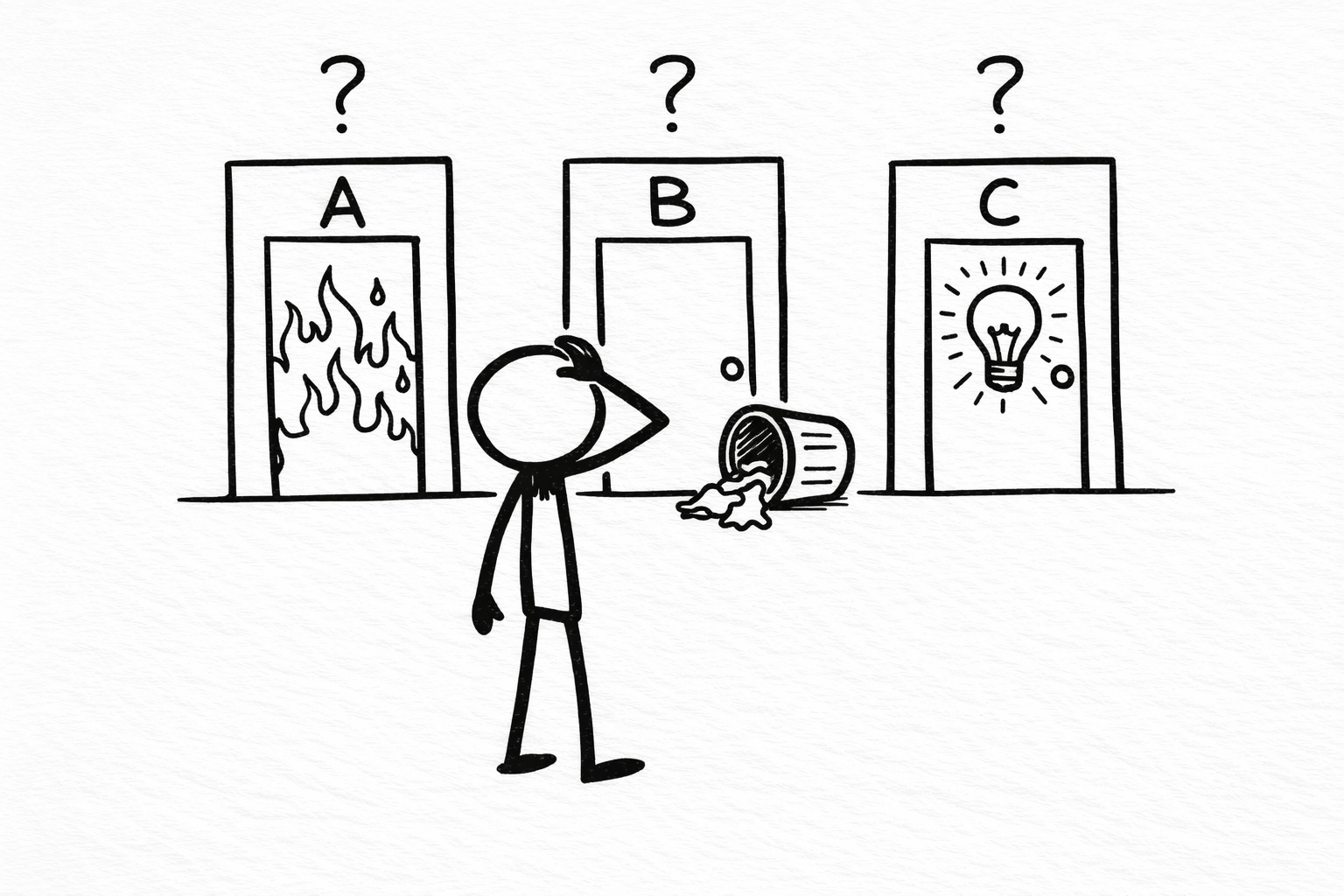
Three paths forward. Pick based on what the wreckage reveals.
Path A: The paragraph is fire.
Your 1,500 words were wrapping paper. The paragraph is the actual post.
Now expand from it. Not back to the original. Deliberately. Every sentence has to justify its existence against that core. If it can’t defend itself, it doesn’t belong. (This is how jury selection should work, probably. I don’t make the rules. Actually, nobody does. That’s the whole problem.)
Path B: The paragraph is thin.
You didn’t have a post. You had a Note. Maybe a tweet. Maybe a decent LinkedIn post, which is grading on a curve so generous it borders on charity.
This isn’t failure. This is reconnaissance. Kill the draft or strip it for parts. Move on. The draft thanks you for your service. (It doesn’t. Drafts are incapable of gratitude. They only take.)
Path C: The paragraph reveals a different post.
The compression surfaced an argument you didn’t know you were making. Your draft was a first attempt at something you can now write directly.
This happens more than you’d expect. Sometimes you have to write 1,500 wrong words to find the 200 right ones. The scenic route isn’t wasted if you learn where the destination actually is.
The Trench Coat Problem
Most posts don’t have 1,500 words of ideas.
They have 200 words of ideas wearing a trench coat. Standing on each other’s shoulders. Trying to sneak into the theater.
(We’ve all done it. We’re all doing it. The important thing is to catch yourself before the ushers do.)
Compression doesn’t just tighten your writing. It exposes whether you have something to say. And you’d rather find out in a Google Doc than in the engagement metrics after you publish.
Run one draft through this week. See what survives.
I’m betting it’s less than you think. Good. Now you can actually start.
🧉 What’s the lie you tell yourself when a draft feels “done”? Be specific. The vague ones are just more padding.
Crafted with love (and AI),
Nick “Minimum Viable Wordcount” Quick

PS… If you’re ready to document your writing patterns so AI can actually follow them (instead of just guessing and producing polished garbage), I built something for that.
The Voiceprint Quick-Start Guide walks you through extracting your core voice attributes in one sitting. No 47-page workbook you’ll abandon after page 3. No theoretical frameworks that sound smart but don’t do anything. Just the essential prompts and process to get your patterns on paper, so you can stop hoping AI gets lucky and start training it like it works for you.
Because it does.
PPS… I write practical workflows like this daily. Systems for co-writing with AI without producing slop. If this landed, subscribe so you don’t miss the next one.
And if you know another creator currently buried under their own drafts, drowning in words that don’t deserve them, send this their way. The share button’s right there. Use it. Or don’t. Free will is a beautiful and terrible thing.
Interesting point of view. Perhaps backwards from how I write. Start with the essence. Then expand. No more than necessary.
The rare disciplined approach. Respect.