
Good Writing Doesn't Get Found. People Find People.
Your Posts Aren’t Growing You. Your Comments Are. Here’s the ten-minute daily habit that actually grows your list: ten real comments and one honest message.

Geoff writes better than you. Probably better than me too. Genuinely sharp sentences, real ideas, an author photo where he’s gazing just past the camera like someone’s asked him a difficult question about Tolstoy.
Geoff has 200 subscribers. He’s had roughly 200 subscribers for two years.
He’s decided this is because readers got dumber. (Narrator: readers did NOT get dumber.)
Here’s what Geoff believes, with the serene confidence of a man who has never once been wrong out loud: the work speaks for itself. Write well enough, long enough, and the audience finds you. So Geoff writes well. He does not comment. He does not restack. He has never left a reply on another living person’s post, because engagement is for writers who can’t write. He publishes his beautiful thing into the feed, refreshes the stats, and waits for the world to notice the obvious. (I would like to find whoever coined “the work speaks for itself” and ask them to name one time the work picked up a phone. The work has never spoken. The work sits in a drawer being brilliant while you eat dinner alone.)
The world, meanwhile, has 4,000 unread emails and a dentist appointment. The world is not coming to lend a helping hand.
Three notches below Geoff on raw talent (clumsier sentences, fine ideas, an author photo that’s just her squinting into her front-facing camera in a disorganized kitchen) sits a writer with 40,000 subscribers and a paid tier that covers her rent. Same niche. Same two years. She did exactly one thing Geoff refuses to do.
That one thing is the whole post. And you can start doing it today.
The Algorithm Reads Signals, Not Sentences
The ways you actually get found on Substack come down to a handful: a recommendation (one publication pointing its readers at you), a restack from someone with real reach, a mention from a name people already trust. Those are the channels that move real numbers, and they last. Not one of them is a prize the algorithm hands out for writing well.
Every one of them is a human being deciding to spend their own credibility on you. (Credibility they spent years building and are now lending to another, for reasons that’d better be good.)
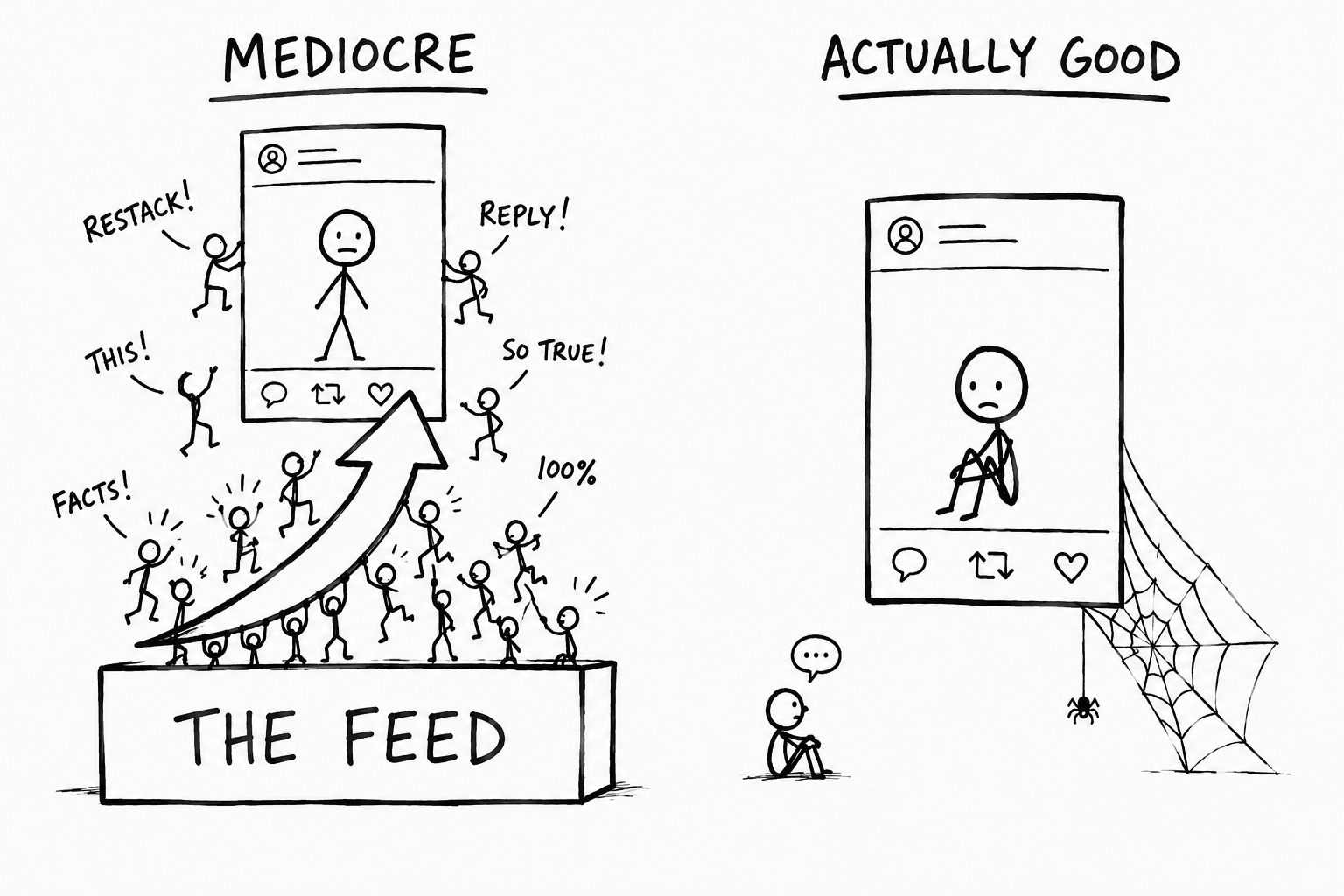
This is the part everyone gets backwards about the algorithm, so let me be unkind about it. The feed doesn’t push “good.” It doesn’t read nor does it give a damn. It pushes what’s already moving. It watches who replied, who restacked, who carried your thing into their own house, and it amplifies the motion that already exists. No motion, no amplification. You can write the sharpest post in your corner of the platform, hit publish, and watch it land softly on the couple hundred people who already subscribed before sinking into the silt at the bottom of the feed by the weekend. It just sits there. Excellent. Ignored. The feed moves on, because it never knew the post was good. It only knew that nobody moved.
We built an entire platform for writers and then quietly arranged it so the writing matters least and the showing-up matters most. Nobody puts that on their landing page.
You probably grew somewhere else before this. Somewhere the machine could decide to make you famous on a Tuesday for no reason at all. Not here. Here the machine waits to see if anyone cares first, and “anyone” is people. People Geoff has decided are beneath him. (Geoff refreshes his stats. Flat again. He concludes the algorithm holds a personal grudge. The algorithm doesn’t know Geoff exists. That is, in fact, the entire problem.)
How This Grows Your List, Not Theirs
Here’s the connection nobody draws for you, and it’s the reason none of this is charity.
A comment is writing. It’s a few sentences of your actual thinking, published. The only difference between your post and your comment is the street it’s standing on. Your post stands in your own house, where everyone reading it already subscribed (you are performing for people who bought tickets months ago). Your comment stands in someone else’s house, in a room packed with people who have never heard of you and are, this very second, paying attention to something.
That’s the move. A sharp comment is a free sample of your writing, set down in front of a borrowed audience. It is the one thing your own posts physically cannot do, because your own posts only ever reach the people you already have. (Geoff’s posts reach Geoff’s 200. They will reach Geoff’s 200 in the year 2050, assuming Geoff is still refreshing.)
Now follow one comment forward, because it pays you twice.
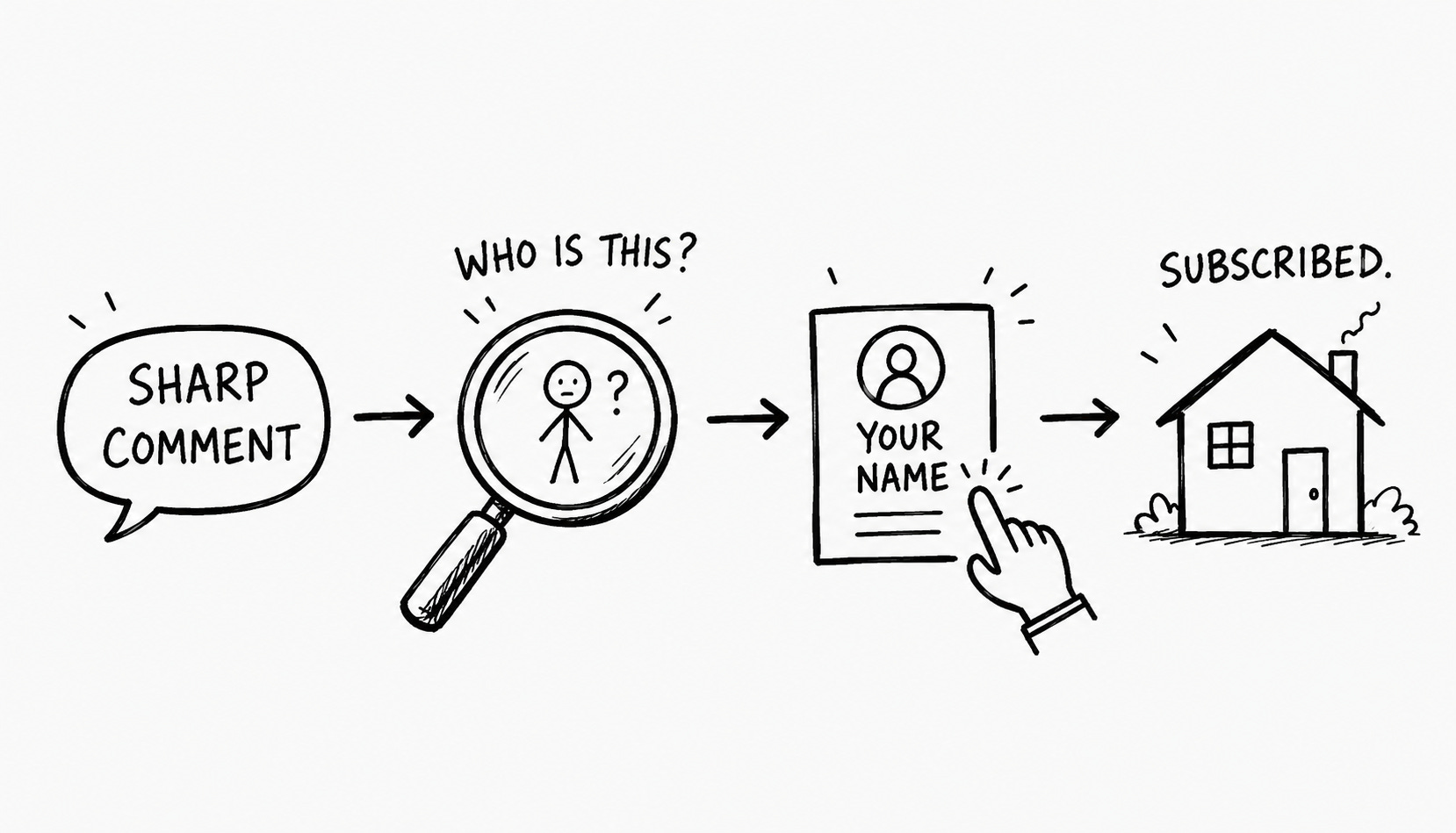
The first payoff is today. A few of the strangers in that room read your two sharp lines, think who is this, and tap your name. Some land on your publication and subscribe. Those are readers you couldn’t have reached from your own post in a hundred years, because your post never went anywhere near them. Ten good comments a day, in rooms full of the right strangers, is ten samples of your writing in front of new people, every single day. This is distribution. The exact thing your posts were failing at. It was hiding in the comment box the whole time.
The second payoff is slower and much bigger. The writer whose room you keep showing up in starts to recognize your name. You stop being a stranger and quietly become “oh, that one, the one who actually gets it.” And one day, with no prompting and no pitch and no awkward message, they restack you, or mention you, or recommend you to their entire list. That’s the big door. The one that sends 400 readers in an afternoon. It doesn’t open by magic. It opens because you spent two months being genuinely useful in someone’s comments with your hand nowhere near your own pocket. And it keeps paying, because a recommendation doesn’t spike and vanish, it sits on their page sending you readers for months off work you did one time. (Try getting that out of a post. Posts have the shelf life of a gas station hoagie.)
Both payoffs trace back to the same small act. So: same niche, same talent, same hours at the keyboard. The woman at 40,000 let her writing leave the building. Geoff guards his at the door like a bouncer who hates money.
Stop Clapping
I spent months doing this wrong, so I’ve earned the right to be smug about it now.
My comments used to be applause. Dressed-up applause, but applause. I never typed “Great post,” because I was better than that. (I thought I was better than that.) I’d leave four articulate sentences that, wrung of all their air, came out to “So true” and “Needed this.” A standing ovation with footnotes. Hundreds of them. Felt productive. Grew by approximately nobody. (I write about making AI sound human for a living. I was leaving comments that sounded like a microwave beeping. The irony was available to me the entire time. I ignored it for an embarrassingly long stretch.)
Here’s the problem with applause. Take “Great breakdown, so important!” and hold it under a light.
It anchors to nothing. (The writer can’t tell whether you read the post or fed it through a parser.) It makes no point. (You have contributed the conversational value of a bobblehead.) It would copy-paste onto ten thousand other posts without changing one syllable. (Which tells the writer precisely how much of you is in it.) And it ends on an exclamation mark doing the job three real words should have done. (Punctuation standing in for having had an actual thought.)
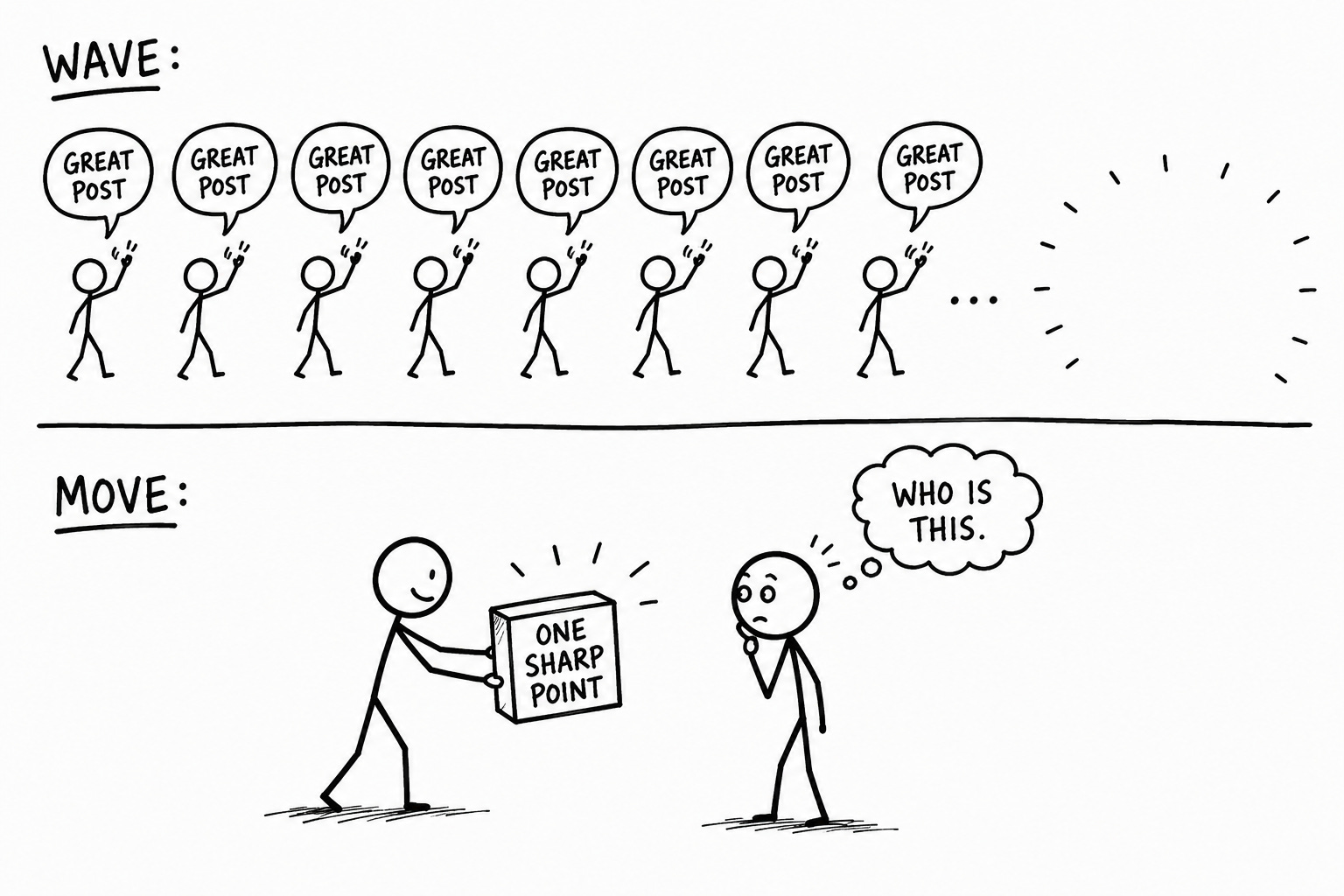
The writer glances at it, feels the faint warmth of being noticed by something, and goes back to their afternoon. Nobody tapped your name. Why would they? A wave is not a sample of anything.
The comment that works makes a writer stop, read it twice, and click your name to find out who the hell you are. Watch the gap.
Dead: “Great breakdown, so important!”
Alive: “The ‘six months of expenses’ rule is something everybody repeats and nobody pressure-tests. For someone with lumpy freelance income that’s a completely different number than for someone salaried, and the advice never admits it.”
Same post. Same sixty seconds of your life. One earns a heart and reaches the silt. The other earns a reply and a fistful of profile clicks, because it does three things the wave never does.
It anchors to a specific line. Not the post in general. The actual sentence. Naming the exact line is proof you read the thing, and a small flattery the writer feels in their spine, because you noticed the part they sweated over while everyone else skimmed.
It makes one real move on that line. One. (Not five. Five is some dude explaining your own essay back to you at a party.) The move is the entire value of the comment, and it’s what almost everyone skips, which is exactly why almost every comment lands with a wet thud.
It takes nothing out of the room. No link. No “I wrote about this too.” No “thoughts?” tacked on the end, because you are the guest, and the guest does not start rearranging the host’s furniture. You land the move and you leave. The give is the whole thing.
Four Moves You Can Use Today
A comment that lands does one of these four things, not all of them at once. Pick the one the post actually calls for, do it in two lines, get out.
React to a line. Pull one specific sentence out of the post and respond to that, not to the post in general. “This line stopped me: ‘most advice is just survivorship bias in a nicer outfit.’ Which means the only advice worth a damn comes from the people who also lost, and nobody ever interviews them.” The writer feels seen by someone whose attention seems worth having. (That’s the hook. People will forgive almost anything except not being noticed.)
Extend it. Take the idea one step further with a concrete case the writer didn’t mention. “This holds for pork chops too, which nobody talks about. Salt them the night before and a $4 chop eats like a steakhouse the next day.” You didn’t agree. You added a room to their house, and adding a room is what equals do.
Complicate it. Introduce a real tension the writer skipped. Not contrarian for sport (everyone can smell the guy who disagrees as a personality trait). The genuine edge case. “Works until the feedback runs upward. A junior telling a VP the plan is incoherent pays a career cost the framework never prices in.” Taking someone’s idea seriously enough to find where it cracks is a compliment most writers get roughly never.
Ask one narrow question. Not a vague one. A question so specific they can answer it in a sentence and actually want to. “Did the bigger-buffer version change how your readers behaved, or did they nod and keep the same number?” A sharp question hands the conversation back, which is how a one-off becomes a back-and-forth, which is how a stranger ends up knowing your name.
Notice not one of these asks you to be clever about yourself. You’re being useful about them, in public, where the writer and every lurker in the thread can see exactly how your head works. That’s the sample, doing its job while you do nothing else.
Leave Ten. Take Nothing.
Pick a number you can hit every day without negotiating with yourself. Ten is a good target. Five is fine. Three on a day when everything’s on fire still beats the zero you’d otherwise leave. The count was never the magic. The magic is that you keep showing up in other people’s threads with something real, on the days you feel like it and the days you don’t, which is the exact thingy nobody else can be bothered to do.
Each comment is a sample of your writing standing in a room you don’t own. More rooms, better odds a stranger taps your name or a writer starts to recognize it. But the second you’re padding to hit a number, you’re clapping again, and a small niche smells that from across the building. (That's Geoff's whole method. Volume, vocabulary, and the quiet confidence of a man talking to an empty room.) So the rule isn’t a quota. It’s that every one you leave is real, because a generic comment doesn’t merely waste your time. It tells the whole room you’ve gone on autopilot.
Aim them at people whose audiences you’d actually want to borrow. Peers in your lane, the occasional writer a notch bigger than you. Not whatever floats past your thumb on the scroll. To find them, start with the publications you already read, then watch who they restack and who keeps showing up in their comments (those people are standing in the exact room you’re trying to slip into). Work the Notes feed for your niche too. A sharp reply on a busy Note gets seen faster than a comment on a week-old post, and can put you in front of more strangers in an hour than that post will all month.
Two rules keep them honest. Take nothing out of the room (the link, the “check out my piece,” the soft little mention of what you sell, all of it goes somewhere else, never here, because the second you reach for the audience you stop earning it). And sound like yourself, not a language model wearing your name, because the sample a generic comment leaves is a sample of a machine, and machines don’t get recommended.
Send One. Want Nothing.
Once a day, on top of the ten comments, send one message.
Not a pitch. Not “loved your post, here’s a link to mine.” One genuine, personal note to one real person, asking what they’re working on or offering something you can actually help with. No ask attached. No hook waiting in paragraph three. A hand extended on purpose, to someone whose work you’ve been paying attention to.
Here’s why that single message might be the highest-yield thing you do all day.
Almost every message a creator gets wants something. A pitch, a swap, a favor, a “quick question” that is never quick and never one question. Every one of those hands a person doing the cross-legged bathroom dance another tall glass of water. Yours is the one that points at the door, before you’ve asked for a thing, which makes you the rare name in there they actually want to hear from again.
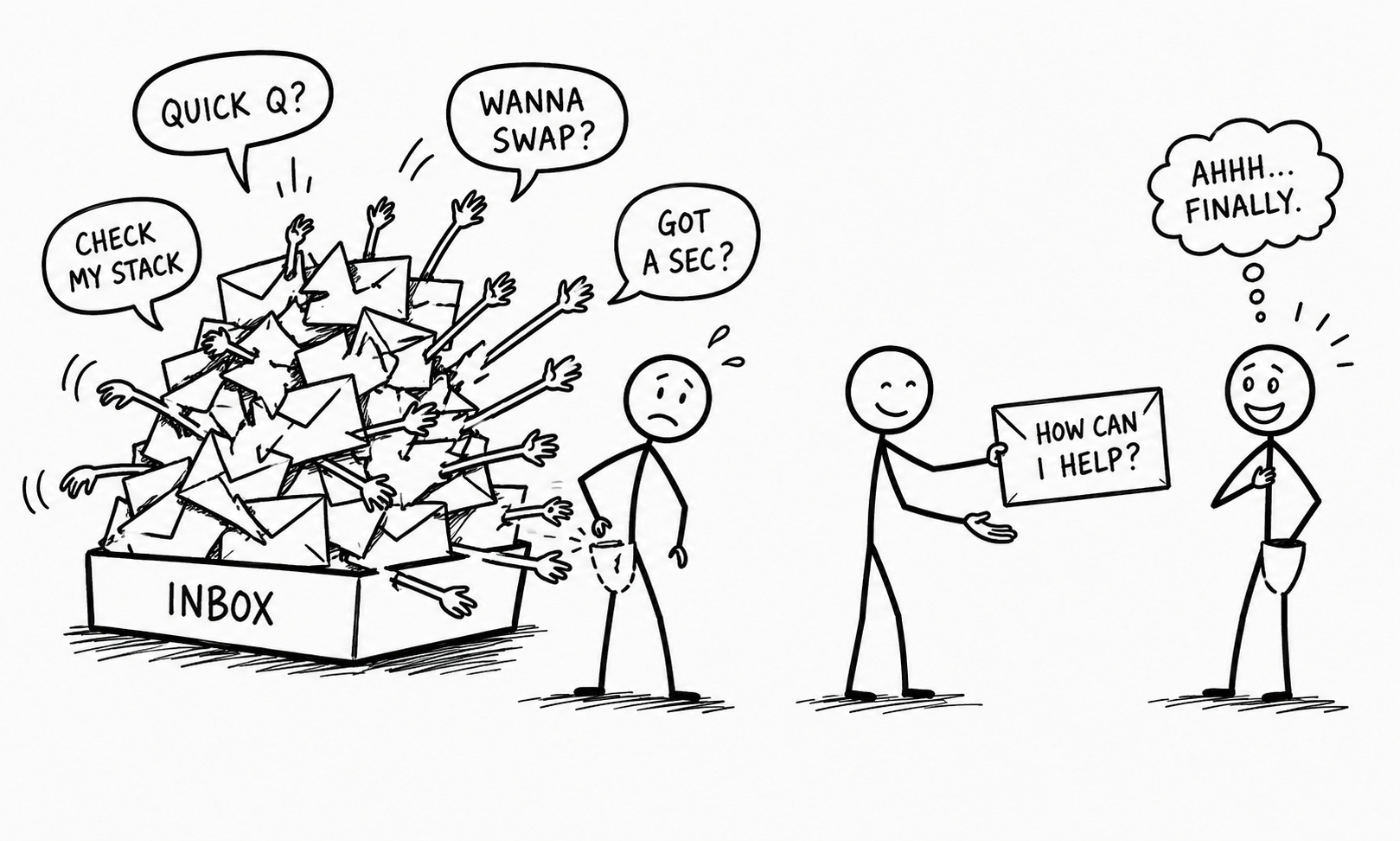
The inbox is where the real moves get made. A comment is public and shallow by design (it can only do so much in a stranger’s thread). A message is private and direct, and the recommendation, the cross-post, the collaboration, the “want to come on my podcast” all get organized in a one-on-one conversation, never in a comment section. The help-first message is how that conversation starts with no agenda, which is exactly what gives it the standing to grow one later.
The math is quietly ridiculous in your favor. One real message a day is thirty a month, a few hundred a year, each one an actual human you reached one to one with your hand nowhere near your pocket. Most won’t reply. Fine. The few who do are how you build the small stack of relationships that ends up carrying the entire publication.
One catch, because “how can I help” rots fast into its own kind of pitch. Mean it. Name their actual work, offer the specific thing (the introduction, the resource, the answer to the problem they posted about on Tuesday), not a limp “let me know if I can ever help,” which every recipient correctly hears as a handshake right before a sales pitch. If the offer isn’t real, don’t send it.
What that actually looks like, stripped of theory: “Your piece on pricing for freelancers said the thing I’ve been fumbling toward for two years, especially the part about hourly rates quietly training clients to nickel-and-dime you. Unrelated, you mentioned you’re redoing your sales page. I’ve rebuilt a few that started converting, and there was one change that did most of the work. Want me to send you the before-and-after? No pitch, I just got nerd-sniped by the problem.” Three sentences. It names their actual work, offers one specific real thing, and asks for nothing. That’s the entire shape.
Geoff would rather lose a toe than send a message that doesn’t serve Geoff. So Geoff doesn’t send messages. His (lack of) growth has noticed.
That’s the whole practice. The next post you read in your niche, don’t applaud. Find the one line carrying the weight, say one true sentence about it, and leave without taking a thing. Then send one message to one person, and ask how you can help.
Geoff won’t do any of this. Geoff is currently posting a thread to his remaining subscribers titled “Has Substack Lost Its Soul?” and refreshing it for replies. There are none. There are never going to be any. The room is empty because Geoff has never once walked into anyone else’s.
You’re not Geoff. You’ve got ten minutes, a comment box, and a message to send.
Your writing was never the bottleneck. The silence around it was. And silence is the one growth problem you can start fixing today: ten real comments in other people’s houses, and one message that wants nothing back.
Crafted with love (and AI),
Nick “People Finding People” Quick

PS... Two things, in ascending order of effort. One, subscribe if you haven’t (the button does the rest). Two, forward this to the person in your life who keeps insisting they “don’t get Substack.” Your mom counts. So does the friend who’s been about to start a newsletter since the Obama administration.
PPS... I’ve been building an engagement platform behind the scenes, code-named Stackwise. It’s most of this post turned into a system I run my own operation on. Want to know what I’m wiring into it? Hit reply, or say so in the comments, and I’ll send you my First-500-Subscribers guide. (Not the most glorious opt-in ever devised. I just feel like rewarding the people who actually reply.)
PPPS... Geoff made it this far and left without commenting. He’s letting the work speak for itself. We may not hear from Geoff again.
Interesting. A reciprocal altruism approach. Best if you enjoy the "helping" component itself, without concern for the payoff.
Ah, poor Geoff, will he ever learn? Would love to learn more about Stackwise!