
Your Hook Is Jacked AF. Everything Else Is A Wet Noodle.
The platform measures your hook. Your audience decides to return based on everything after it. You're winning the wrong game.

The post went live Tuesday at 9am on the dot.
By 10:17, the first restack landed. By noon, the opening line had been quote-restacked twice. Someone DM’d: “holy shit, that hook.” Another creator replied with the heart-eyes emoji, which on this platform is a slow clap from a guy whose thumb mostly slipped. (I have strong feelings about the emoji economy. We will get to them on a day when I am less professionally composed.)
The engagement spike was real. The data was real. The dopamine was real.
It lasted about six hours, which is roughly the half-life of being a person who still believes any of this means something.
A week later the final tally was in.
51 likes. 7 restacks. 5 quote-restacks. 341 opens past the first screen.
Every one of the quote-restacks pulled from the opening three sentences. Of the 7 restacks, 6 were the hook itself. The lone outlier was a restack of the middle section from a guy you went to college with who restacks everything you publish on principle, because he thinks that’s how you’re supposed to be a good friend on the internet. (He also likes every photo you post. He is doing his best. Do not take this away from him.)
Three comments, all responding to the opening.
A subscriber count that had moved about as much as a sedated houseplant.
Nobody quoted the middle. Nobody sent it to a friend because the fourth paragraph changed their Tuesday. Nobody restacked the conclusion. You told yourself that was just how it goes. Writers write hooks. Readers reward hooks. The middle exists to fill the space between the sentence that got them in and the button that signs them out. Load-bearing filler. A hotel hallway with a word count.
The writing was fine.
The market was the problem.
Photos Two Through Six
Substack measures attention the way a dating app clocks a profile.
The first photo does 95% of the work. Not because the other photos don’t exist, and not because they’re necessarily weak, but because most people never swipe past the first one. They look. They decide. They swipe, and photos two through six are gone before anyone noticed they were there.
The like button works the same way.
It is a verdict rendered on paragraph one. (Technically you can like a post from anywhere. Practically, nobody scrolls to the conclusion, weighs the full arc of the argument, and then renders a considered editorial decision about whether this warranted an opposable thumb. They like the hook. Five seconds in. Maybe seven if you got fancy. Then they move on with their Tuesday like you were a minor weather event.)
First impressions do 95% of the heavy lifting in every attention-based transaction humans have ever invented.
Bars. Interviews. Dating apps. Newsletters. (Also: bookstore displays, podcast cover art, and the first ten seconds of every phone call with your mother.)
That is not the problem. The hook was always going to matter. The hook will always matter.
The problem is what happens after, when the reward structure quietly teaches writers that photos two through six are not worth the effort, so they stop investing in photos two through six, so they stop investing in the middle, and the readers who actually matched find a piece that gave up somewhere around paragraph four.
The restack follows the same shape. So does the quote-restack. So does the share-to-DM. So does the “oh this is good” impulse that briefly overrides the algorithm pointing you toward your next distraction.
All of it measured at the front. None of it measured at the back.
Nobody is counting whether the reader finished what they started. Nobody is counting whether the reader came back next week because paragraph seven finally paid off. There is no column on the dashboard called did the middle land. That data point does not exist. The platform is not interested.
Writers noticed. We are not stupid. We watch what gets rewarded and we do more of that.
A rational creator looked at the data, saw every signal land in the first paragraph, and concluded the correct response was to dump 80% of their energy into the opening and treat the rest of the post like packing peanuts. (And then, because writers are a particular kind of unwell, we started competing for sharper hooks at higher stakes, escalating the arms race until some people were spending three hours sculpting a twelve-word opener for a piece whose middle got written during a commercial break for erectile dysfunction medication.)
Don’t call this a character failure.
It is economics. The system is doing exactly what it was built to do. You are just on the wrong end of it.
Kudos on the Dopamine
The dashboard doesn’t tell you this.
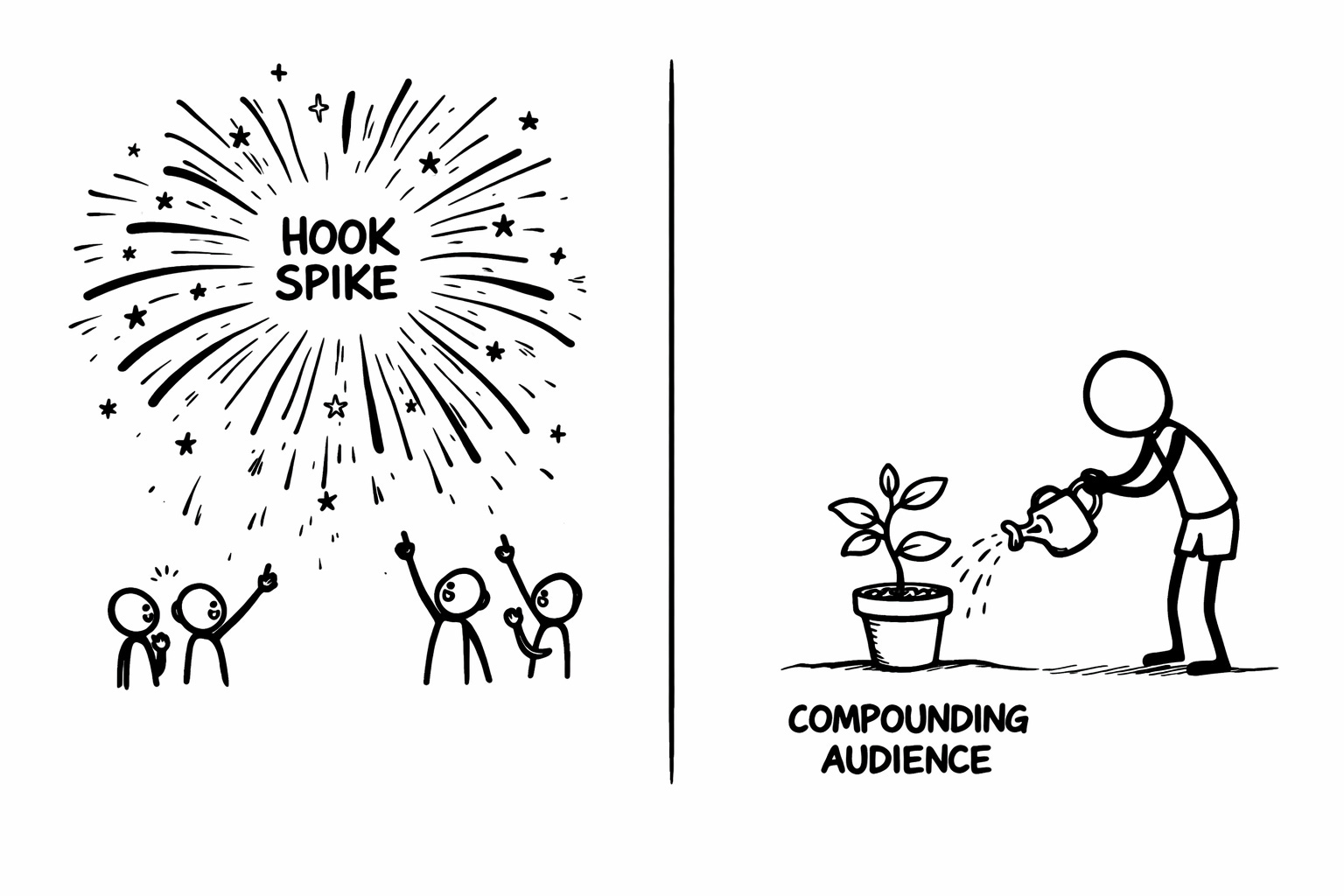
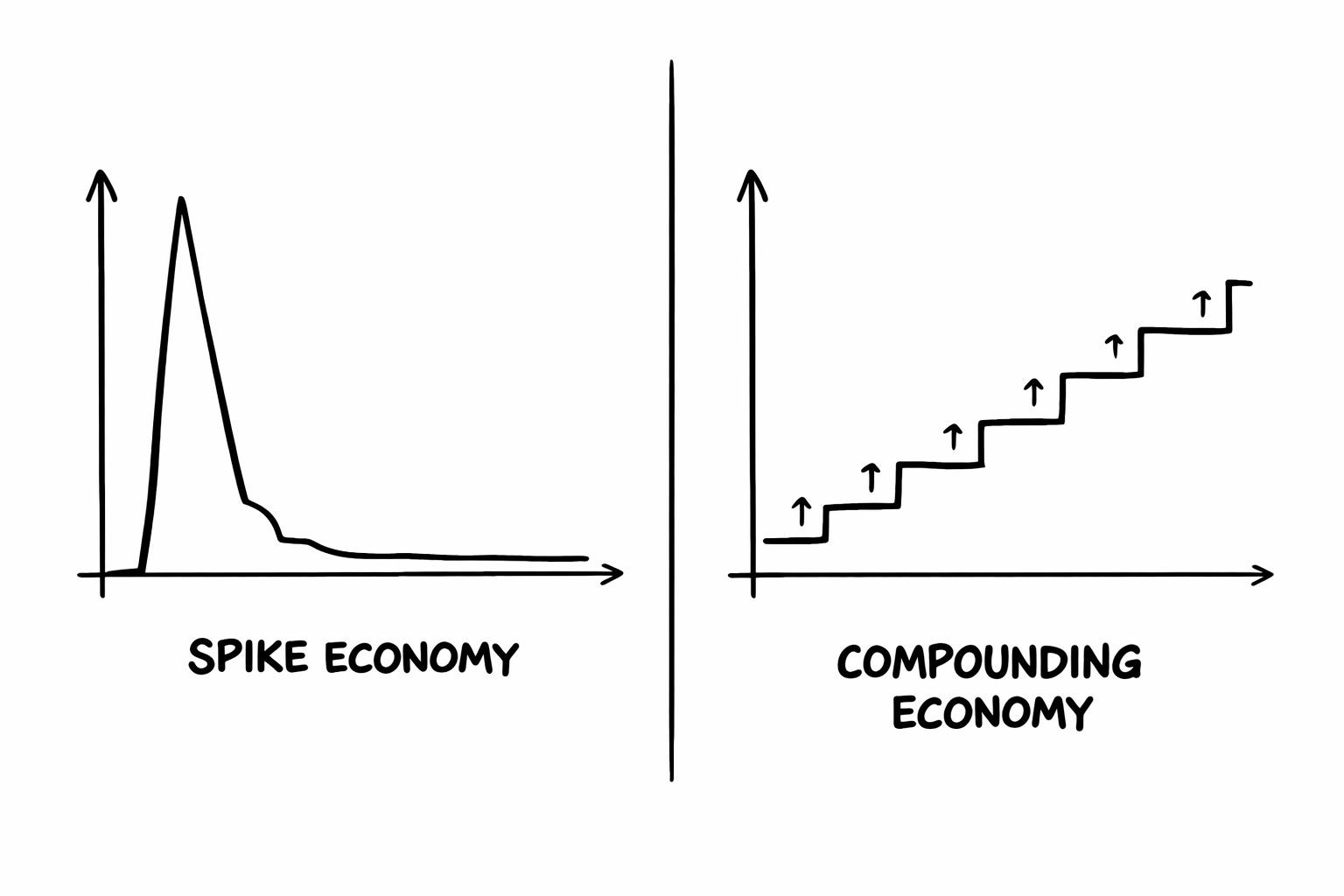
A viral hook attached to a forgettable post creates exactly one thing: a spike.
Clean. High-resolution. Screenshot-worthy. The kind of chart you show your partner across the dinner table while they nod supportively because they love you and understand the bit. (Every creator has a partner who has learned to make the exact right face at engagement screenshots. This is a form of love the legal system cannot enforce. They are heroes. We do not deserve them.)
A spike is weather.
It arrives, it leaves, and the forecast does not remember it by the weekend.
Real growth looks different.
Real growth is the reader who clicks, reads the whole thing, finishes, and at the moment the piece ends makes a decision that has absolutely nothing to do with the sentence that got them in.
The decision is: do I want more of this person in my inbox?
That decision is a function of what happened between paragraph two and paragraph twelve. It is not a function of the scroll-stopper that dragged them past the screen edge. The hook got them into the room. The rest of the piece decides whether they ever come back, or whether they leave muttering “the opener was better than the essay, which says what it says.” (This is the part where every creator running on hook metrics gets very quiet and stares at the middle distance. The silence is telling on itself.)
Two economies are stacked on top of each other, pretending to be one.
(The dopamine is genuinely delicious. I am not a monk. I enjoy the dopamine. If it came in powder form, I might snort it off the tank of a Texaco toilet through a rolled-up dollar bill with a history I did not want to know.)
The compounding economy rewards everything after the opening. It pays out slowly, in subscriptions that stick, readers who return, and eventually the kind of audience that carries you whether any individual post lands or not.
Most writers are winning the first economy and losing the second.
They think they are growing.
They are just spiking.
Spiking is what bad graphs do right before they flatline.
The Part Where You Stop Believing Me
Here it is, stated flat, no hedge:
A mediocre hook attached to a strong everything-else will outperform a great hook attached to a weak everything-else. Over any timeframe longer than a single post.
I know. I can feel you not believing me.
Every instinct the platform trained into you is screaming that this cannot be right, because if the hook is what the metrics reward, then obviously the hook is doing all the work. That is muscle memory talking. It is not thinking. You have trained a reflex, the reflex has trained you back, and the reflex is wrong. (I have watched this argument land on writers in real time. Disbelief first. Defensiveness second. Slow quiet nod about six hours later. The resistance is not logical. The resistance is four years of platform Pavlov wearing a lab coat.)
Here is why the claim holds.
Readers do not decide to return based on a sentence they already ate.
The hook did its job. It is spent. But the decisions that actually compound (the ones no dashboard is tracking) happen somewhere else entirely.
They happen when a subscriber opens your email first, before anything else in the inbox. When someone leaves a thoughtful comment on a line buried in paragraph nine because that line did something to them. When a reader forwards the piece to a specific friend with “point four has your name all over it.” When someone buys the offer without bothering to read the copy, because the trust was built three months ago in a newsletter they can’t even remember opening.
Those are the real transactions. The dashboard sees none of them.
The trust they run on gets built in the middle, when the argument either thickens or goes thin. At the close, when the piece either earns the ending or phones it in from a Marriott lobby. In the moment the reader realizes they are being treated like a person who finishes what they started, rather than a conversion metric to be captured and dragged into an email list. (You can feel the difference, as a reader, in under a minute. You know when a writer gave up on you three paragraphs in and started coasting. You stop coming back. Then you forget they exist. Then, six months later, you unsubscribe in a batch along with that meal-kit service you never actually canceled.)
The creators who figure this out first get the compounding audience. The one no dashboard is built to see.
The ones still chasing hook metrics get the Duolingo streak. One compounds. The other has a 1,400-day streak and cannot order a cup of coffee in a Colombian café. (A streak, to be clear, that the app is very proud of. The barista is not. The Duolingo owl is not sailing to Cartagena to help you.)
You Will Blame the Algorithm First
The platform tells you to chase the thing it can measure.
The thing it can measure is the hook. The hook is not what brings them back.
You can spend the next year sharpening them. You will be rewarded, consistently, in the short term. You will also, consistently, watch your numbers flatline in the medium term while you cannot quite figure out why the things that should be compounding keep resetting instead.
You will blame the algorithm. You will blame your niche. You will blame the time of day you published. (You will not, under any circumstances, blame yourself. That is a rule we collectively agreed on sometime in 2019 and have not once revisited.)
You will not blame the fact that you spent nine months sculpting openings and then wrote follow-ups with the same energy as a best man giving a speech he finished in the Uber ride to the chapel.
That is the bullshit of it. You trained yourself to excel at the one sentence the platform incentivizes, and now you get to watch the other six hundred sentences embarrass you quietly in the compounding that never arrives. (This is not a sermon. It is a field report. The algorithm is not the enemy. The reward structure is.)
The game is rigged in favor of the wrong metric.
You do not have to play it.
You will, though. Most people will. That is fine.
It leaves more oxygen for the rest of us.
Part 2 is about what a strong everything-else actually looks like, and how to know whether you’re building it or still decorating the door.
A great hook attached to a wet noodle is still a wet noodle. Dressed up. Marketing budget. Wet noodle.
Crafted with love (and AI),
Nick “Compounds Silently” Quick

PS... If you want your everything-else to be harder to ignore than your hook, it starts with sounding like yourself at the sentence level, not just the opening one. The Voiceprint Quick-Start Guide is the on-ramp:
PPS... If you restacked this at the hook and bailed on the middle, you are both the target of this piece and its most loyal reader. Welcome.