

Note: This article picks up where Your Readers Don't Trust You Yet left off. It’s Part 2 of 3.
The post that converted the most paid subscribers in my entire archive is the one where I admitted I’d been screwing up for three months straight.
Not a framework. Not a how-to guide with custom graphics and subheadings that would make an SEO consultant weep with joy.
A confession.
I told my readers I’d been lying by omission. That I’d been presenting a version of my publishing operation that was technically accurate and emotionally full of shit. Three people converted to paid within 48 hours.
Three people doesn’t sound like a lot. At my subscriber count, it was roughly 0.6% of my entire audience converting off a single post. If you’ve ever tried to move that needle (and I mean really tried, not just wished at it while posting another “7 tips for better content” listicle), you know that 0.6% from one post is borderline absurd. Most paid conversion happens across dozens of touches over weeks. Not from one essay where you publicly embarrass yourself.
(I checked the math twice because I assumed I’d botched something. I hadn’t. The math was just better than I deserved. Which is either encouraging or deeply unfair, depending on how many polished posts you’ve published to crickets.)
The post broke a rule I didn’t know existed. And that rule is the entire bridge between free and paid that almost nobody builds.
The Rule Nobody Teaches
Here it is: Trust doesn’t accumulate from value. Trust accumulates from evidence of judgment.
Every monetization guide in existence tells you to “provide value.” Publish good content. Be consistent. Give before you ask.
That’s not wrong. It’s just completely useless. Like telling someone who’s lost to “go in the right direction.” You could’ve just shrugged. It would’ve saved everyone time.
Value tells your readers you know things. Judgment tells them you know which things matter. And the gap between those two is the gap between “I read your free emails sometimes” and “here’s my credit card.” Readers don’t pay for information. Information is free. They’re drowning in information. They pay for the person who wades into the flood, pulls out the three things that actually matter, and throws the rest back. That’s curation. That’s perspective. That’s judgment. And the evidence of it comes from specific editorial choices that most creators either skip entirely or stumble into by accident and never realize what they did.
(Fourth-wall break: I’m about to hand you five editorial plays in a tidy list. I extracted them from a spreadsheet I’ve developed a parasocial relationship with over 100+ posts. The spreadsheet does not return my affection.).
Five Plays That Turn Readers Into Buyers
Play 1: Show Your Work (Including When It’s Ugly)
Every creator has a gap between what they know and what they’re willing to admit publicly. The stuff that’s still messy. The results that aren’t impressive yet. The process behind the polished output that would make people realize you don’t have it nearly as figured out as your content implies.
Publishing that gap does something no amount of “helpful content” can accomplish. It proves you’re not performing expertise from behind a curtain.
What this looks like depends on what you write about. If you teach marketing, it’s your actual campaign numbers (including the ones that flopped). If you write about writing, it’s the draft that came back from your editor bleeding red. If you’re a designer, it’s the version the client rejected before the version you posted to your portfolio. The specifics change. The principle doesn’t: let people see the seams.
When I published that I had just under 500 subscribers after months of daily publishing, a few people unsubscribed. Beautiful. The ones who stayed trusted me more because I’d just demonstrated that I wouldn’t inflate my numbers to protect my vanity. And vanity, for the record, is the most expensive thing a small creator can maintain. It doesn’t send you an invoice. It just shows up in every post where you rounded up, implied more, and quietly hoped nobody would ask for specifics.
Play 2: Publish the Post That Makes You Look Bad
Not vulnerability for vulnerability’s sake. (That’s a different disease entirely, and it’s reached pandemic levels on LinkedIn, where a prospect not returning a call becomes a 900-word essay on the nature of trust. “Being ghosted taught me everything about sales.” Trevor. A guy didn’t call you back. You’re not writing from the trenches. You’re writing from a WeWork.)
I’m talking about the post where the lesson requires you to be the cautionary tale.
The post where I told my readers I’d become a ghost (the real kind, not the LinkedIn kind) wasn’t fun to write. I published it on Christmas Day, alone, in Paraguay, while my chihuahua snored next to me. It outperformed the polished framework post I published the day before by a factor I’m still slightly embarrassed about. The post where I looked competent got a polite nod. The post where I looked like a mess got the most engagement of any post I’d published to that point.
The math is brutal and consistent: the posts where I’m the example of what NOT to do convert better than the posts where I’m the expert telling you what TO do.
Why this works: It’s evidence of judgment. Any consultant with a ring light and a Papyrus business card can teach a framework. Only someone with actual judgment would publish something that makes their stomach hurt because the lesson demands it. The willingness to be the cautionary tale proves you have standards high enough to notice when you’ve fallen short of them. Which is more than most people publishing “5 steps to authentic content” they rewrote from a BuzzFeed listicle called “5 Steps to Authentic Content” can say..
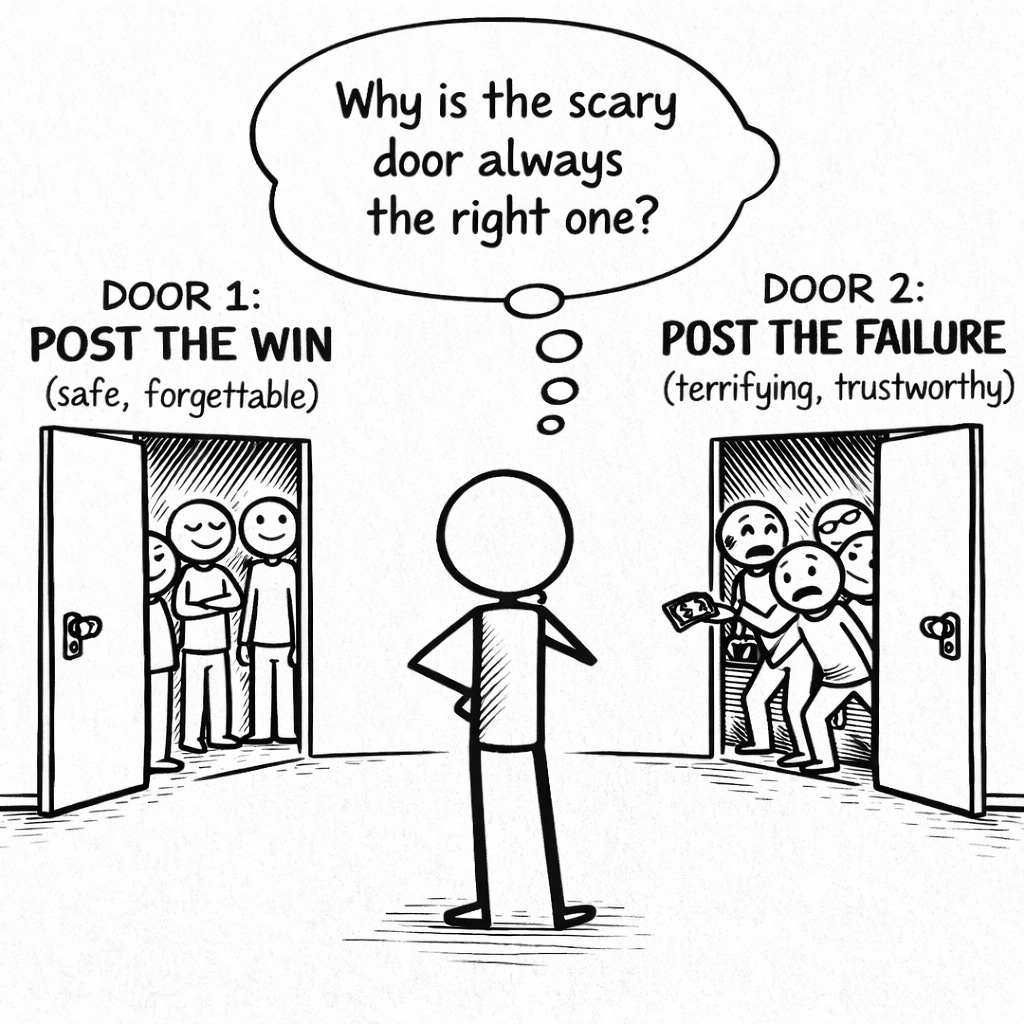
Play 3: Have an Opinion That Costs You Something
Generic content doesn’t build trust because generic content doesn’t risk anything. If everything you publish could have been produced by any warm body with a ChatGPT subscription, congratulations: you’re wallpaper. And nobody has ever pulled out a credit card because they were moved by wallpaper. (If you have, please don’t tell me. I’d like to keep this metaphor.)
Opinions cost subscribers. Literally. I’ve watched my unsubscribe count spike after every post with a strong take. And every time, I feel a tiny pang of something I’d like to call “principled conviction” but is probably closer to “nausea.” But the readers who stay? They climb to the next rung. They lean in. They start replying. They start paying.
This is the trade most creators refuse to make. They want permission to sell without ever risking rejection. They want the paid tier without the part where they say something that makes 2% of their audience decide “nah, not for me.” But the trust ladder doesn’t work that way. Every opinion you dodge is a rung your reader doesn’t climb. You’re keeping them comfortable at Rung 2 by never giving them a reason to decide if they’re Rung 4 or Rung 0.
(Some people read your opinion and unsubscribe. Those people were never going to pay you. You didn’t lose a customer. You clarified your audience. These are different things, and confusing them will make you write like a hostage negotiator who’s been told everyone in the room has feelings and all of those feelings are valid. They’re not. Some of those feelings are bad. Write accordingly.)
Play 4: Reference Your Own Failures in Real Time (Not Retrospectively)
Every creator has a “here’s what I learned” post in them. The failure that became a lesson. The experiment that paid off. The pivot that saved the business. These posts are fine. They’re also completely safe, because the ending already happened. You’re telling the story from the other side, and your reader knows it. There’s no actual risk in the telling. It’s a war story told from a recliner.
The move that builds the bridge is publishing without the ending.
Not “here’s what I tried and what happened.” Just “here’s what I’m trying right now and I genuinely don’t know if it’s going to work.” No resolution. No framework extracted from hindsight. No neat takeaway at the bottom. Just the live feed.
When I write about the machine while I’m still assembling it, I’m not telling you how the story ends. I’m telling you what it looks like right now, bolts missing and all. And that does something a polished retrospective can’t: it proves I’m not curating a highlight reel. I’m documenting the construction site in real time.
(This series is an example. I’m writing about my own monetization strategy while I have just under 500 subscribers and a paid tier with 17 members. I don’t know if any of this will work at scale. I’m documenting the blueprint while the building is still going up. If it collapses, you’ll get that post too.)
The retrospective gets you admiration. The real-time dispatch gets you trust. And trust, not admiration, is what gets people to pay.
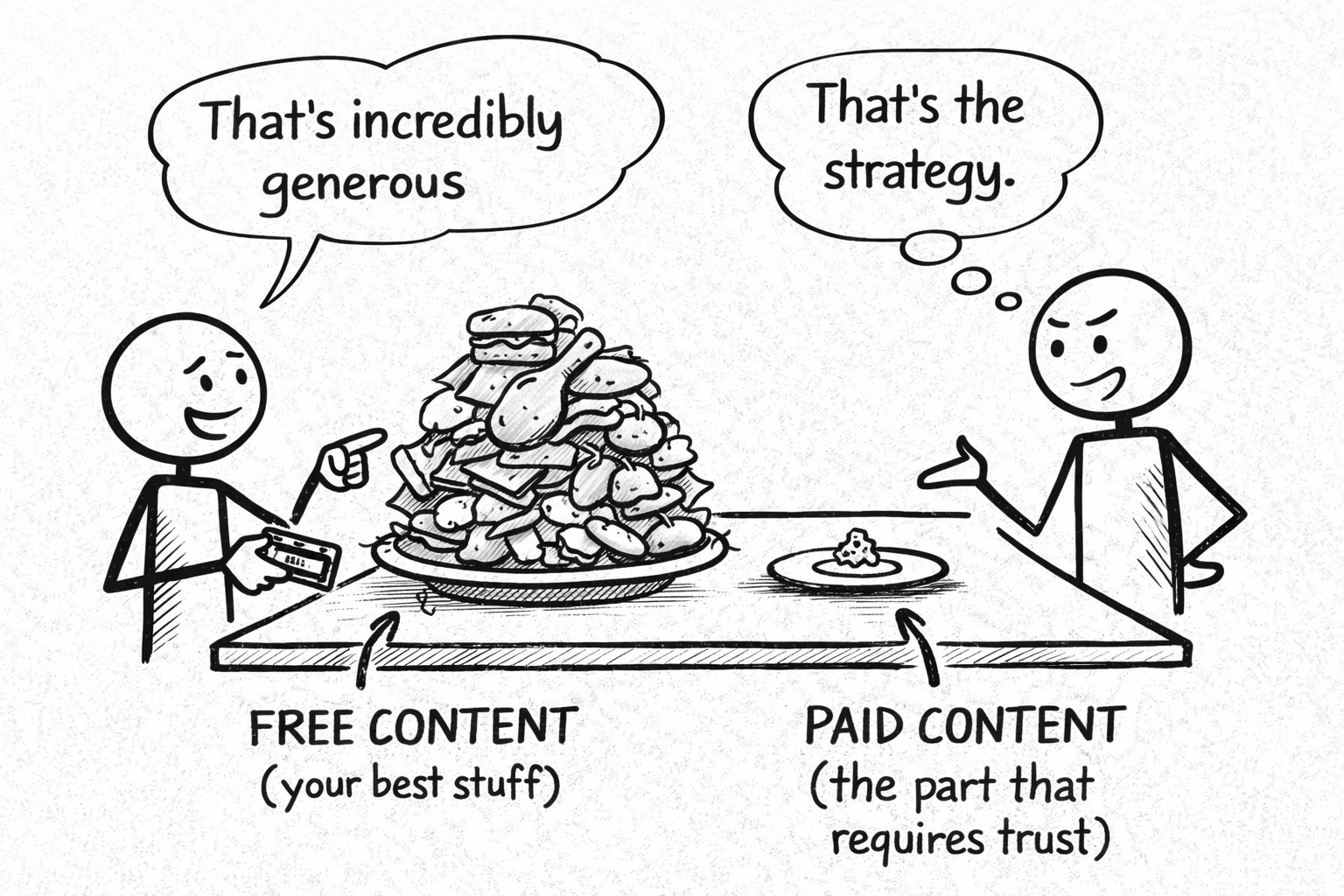
Play 5: Give Away the Best Stuff Free (Seriously)
This one makes creators physically uncomfortable. “If I give away my best content for free, what’s left for paid?”
Everything. Because people don’t pay for content. People pay for continued access to your judgment.
I publish free content every single day. Not “most days.” Not “3-4 times a week.” Every day. My best thinking. My actual frameworks. The methodology I could easily gate behind a paywall. I give away the farm, daily, on purpose.
And people paid me before I even had exclusive paid content for them. Let that sink in for a second. Readers converted to paid when the only thing on the other side was a thank-you and the knowledge that they were supporting the work. They weren’t buying access to hidden content. They were buying continued proximity to judgment they’d already decided was worth keeping.
(I can feel some of you clenching right now. Your business instinct is screaming “SCARCITY! SCARCITY!” like a fire alarm in a building that isn’t on fire. Save the argument for the discussion thread. But first, test it against your own behavior: think about the creators you actually pay for. Did you convert because of one great post? One brilliant framework? One PDF that changed your life? Or because of accumulated evidence across dozens of posts that this person’s perspective was worth keeping in your life? Sometimes a single post does it. But building your monetization strategy around that is like building your retirement plan around regularly finding twenties in your coat pocket. It happens. It’s great when it happens. It’s not a financial plan.)
The free content IS the bridge. Every free post that demonstrates your judgment is another piece of evidence stacking on the scale. Paid doesn’t need to be “better content.” Paid needs to be “the deeper implementation from someone whose judgment I already trust.” Now I do have the Voiceprint Vault for paid subscribers (templates, scorecards, calibration tools, the works), and it makes the upgrade worth it on its own. But the vault didn’t create the conversions. The 100+ free posts before it did. The vault is where you put the detailed blueprints for people who already believe in the architect.
Why These All Hurt
All five of these plays share a common thread: they cost you something in the moment.
Showing your work costs you the mystique of implied success. Publishing the bad post costs you the comfort of looking competent. Opinions cost you subscribers. Documenting before you know the outcome costs you the armor of retrospective wisdom. Giving away the good stuff costs you the illusion that paid needs to be “the premium vault behind the velvet rope.”
Every plank of this bridge requires spending something your brain would rather protect. Which is exactly why most creators never build it.
The Conversion Paradox
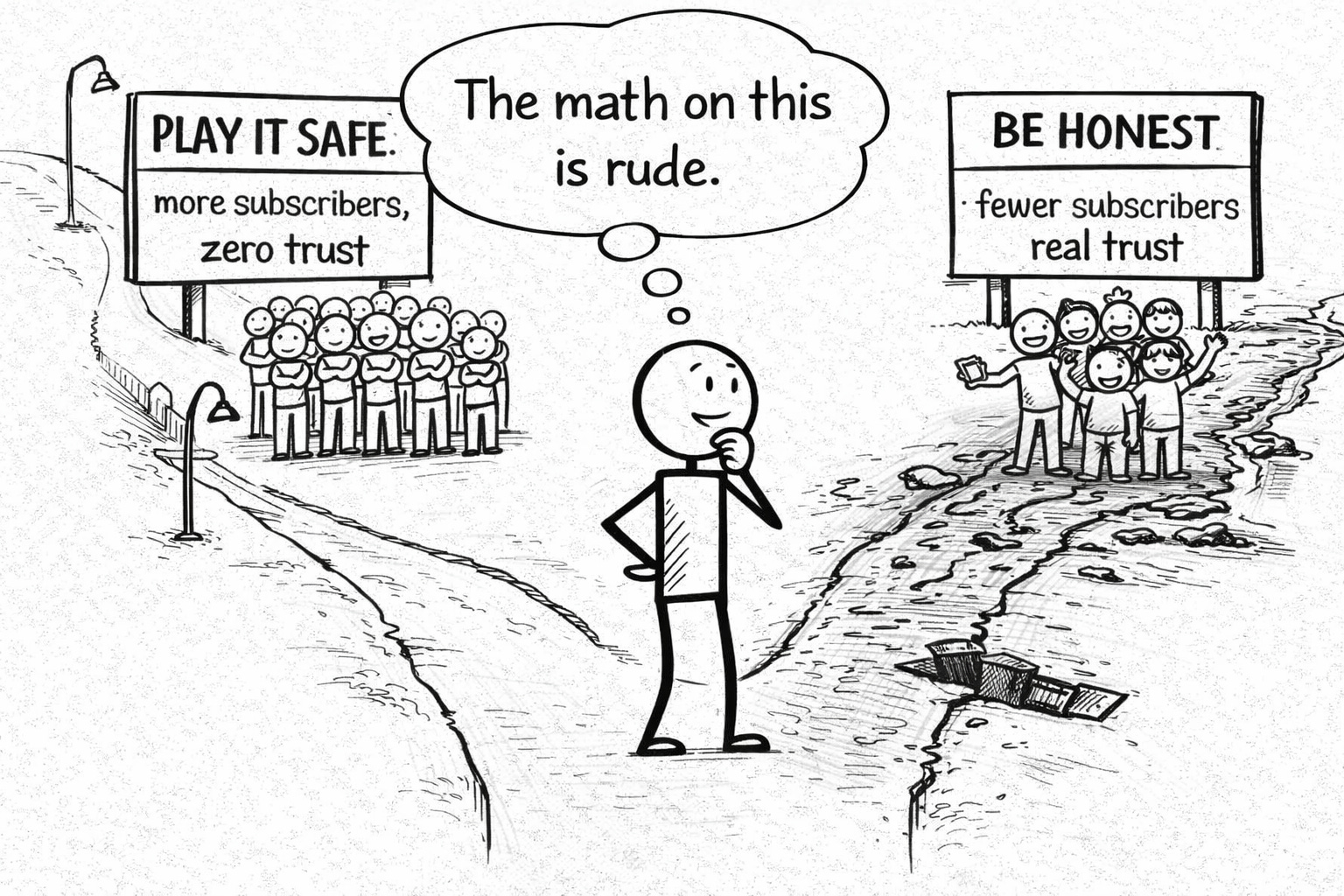
The hard part isn’t knowing these five plays. You know them now. The hard part is that next time you’re staring at a draft, your brain will quietly suggest the safe version. And the safe version will be good. It’ll be publishable. It’ll offend nobody and convert nobody.
That’s the trade. Not once. Every time you hit publish.
Part 3 covers the actual mechanics: when to pitch, how to frame it, the specific language that converts, and what my own data says about which asks worked and which ones made people click away so fast I could feel the breeze through my monitor.
🧉 Which of the five bridge-building moves feels hardest for you? Drop your answer in the comments.
Trust isn’t a switch you flip the day you launch a paid tier. It’s something your readers decide you’ve earned, one risky editorial choice at a time. Do the scary thing. The data says it works.
Crafted with love (and AI),
Nick “Voluntarily Embarrassed for Profit” Quick

PS... The five plays only work if what you publish actually sounds like you wrote it. If your AI drafts still come out generic and you're rewriting half of every post by hand, that's a calibration problem. The Ink Sync Workshop teaches the fix (it's free):

PPS... If this post made you think (or made your ego file a restraining order), hit the like button, drop your answer in the comments, and share it with a creator friend who needs to hear it. That stuff matters more than you think at this scale.
📚 How Readers Become Buyers (3-part series)
Part 1: The Trust Ladder | Part 2: The Five Plays (you’re here) | Part 3: The Ask (Tomorrow)