
The Machine Broke. So I Took It Apart.
I disappeared for a few weeks. Not because I ran out of ideas. Because I ran into a question I couldn’t answer while publishing.

I’ve been gone for a few weeks. You probably didn’t notice. (At just under 500 Substack subscribers, disappearing doesn’t exactly leave a crater in the discourse. More like a slight atmospheric disturbance that two people felt and one of them was my mom.)
But here’s what I was doing while I wasn’t writing to you.
I was trying to figure out if I believe my own bullshit.
The Doubt
I teach creators to beat slop factories with quality. Document your voice. Build a system. Collaborate with AI instead of handing it the keys. Your fingerprints on everything. Give a shit about what you publish.
I still believe all of that.
Mostly.
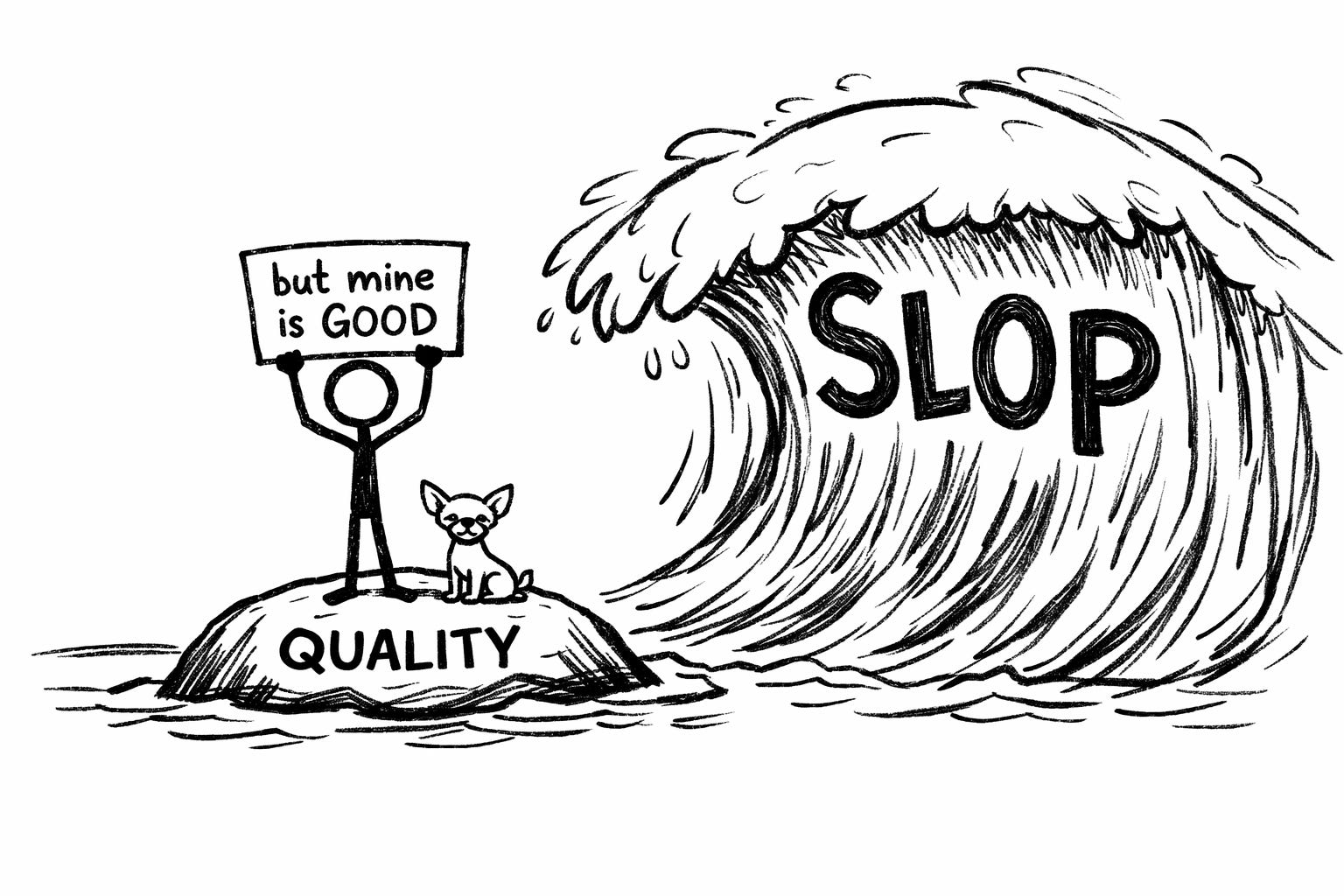
The problem is the “mostly.” Because while I was over here caring deeply about the integrity of each paragraph, slop factories were publishing fifty pieces to my one. And the algorithm doesn’t give a damn which took more effort. It just sees volume. It rewards volume. It buries everything else.
So I sat with an uncomfortable hypothesis: what if “good enough” content at massive scale just... wins? What if the person who builds the most efficient content engine takes the whole game on reach, discovery, and revenue, regardless of whether any individual piece is even worth reading in the first place?
I know what I’m supposed to say. Quality always wins. Readers can tell the difference. Authenticity compounds.
But I’ve watched AI-generated Instagram models build six-figure followings. (Fake people. Making real money. From real humans who know they’re fake and pay anyway.) I saw the New York Times run a blind test where 54% of readers preferred the AI-written articles. And I’ve watched newsletters with zero distinctive voice outgrow mine by 10x because they post three times a day and I post once.
So yeah. I questioned everything. For three weeks.
(Not exactly a spa retreat. More like pacing around my apartment in Paraguay while Butters, my chihuahua, yawned at me mid-spiral. Four pounds of weaponized indifference. He's seen me question my life choices before. He finds them boring now.)
What I Figured Out
The question “does quality beat volume?” is the wrong question. It’s a false binary that lets you feel righteous while you drown.
The real question is harder and less flattering: can a single person, with taste baked into their system, produce at sufficient scale to actually compete? Not by becoming a slop factory. Not by abandoning the work that matters. But by building a machine that does the lifting while you do the thinking.
One person. AI-powered. Automated where automation makes sense. Manual where it matters. Your voice as the quality filter, not the bottleneck.
That’s not the positioning I started with. My original pitch was basically “slow down and do it right.” Which is true, but incomplete. Slowing down while the flood rises around you isn’t a strategy. It’s a slow-motion drowning with excellent production values.
The new version is closer to: build the system that lets you do it right at a pace that actually competes.
I don’t know if it works yet. I haven’t proven it. But I spent three weeks tearing the operation apart to find out.
(The irony of a systems guy who hadn’t built his own system properly was not lost on me. Or Butters. Mostly Butters.)
The Rebuild
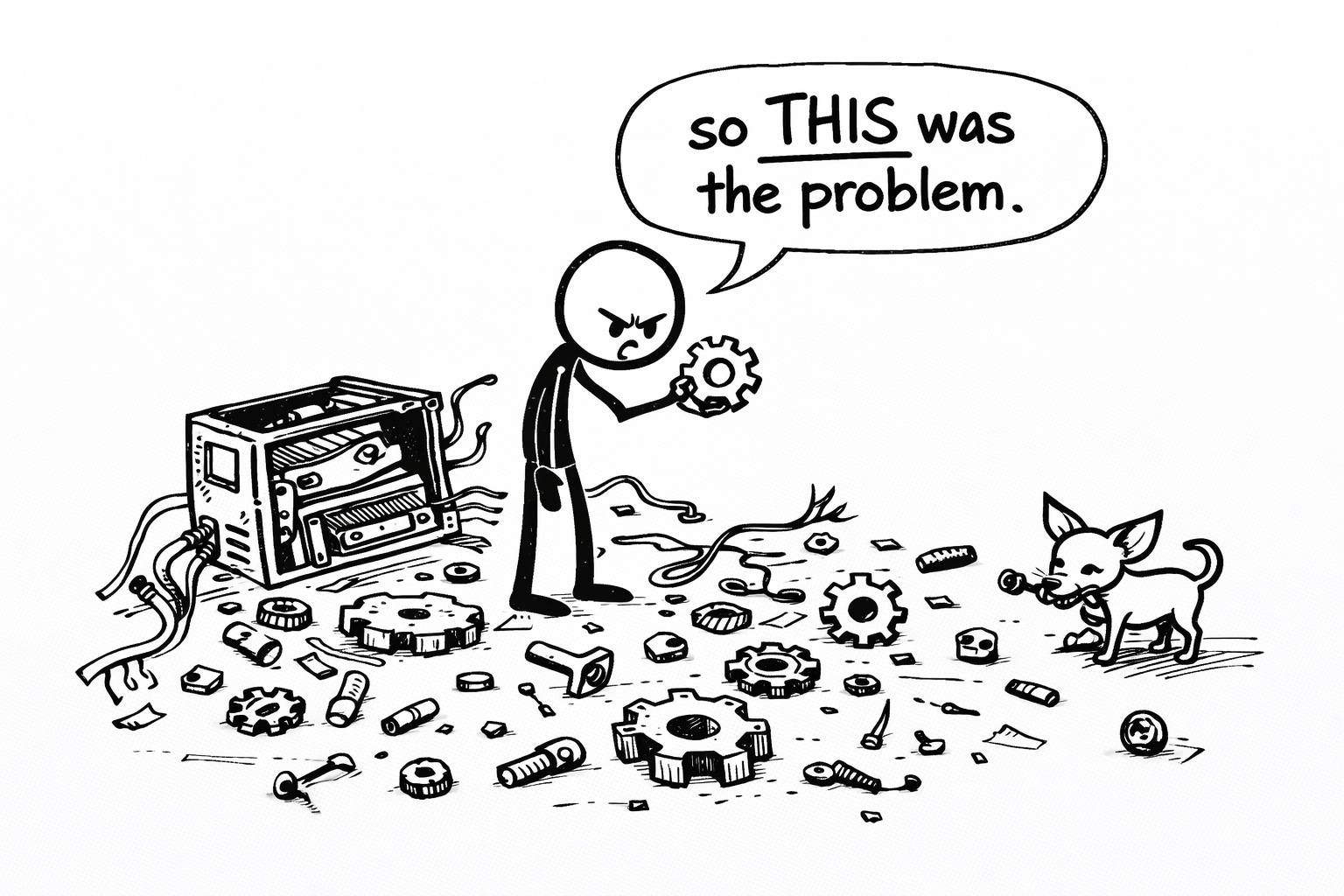
I’ll spare you the full audit. (28 issues. More spreadsheets than any sane person creates voluntarily. At one point I was auditing my process for auditing my process, which is when Butters bit my flippy-floppy and I took the hint.)
Here’s the short version of what changed:
The content got restructured. I was leaning too heavily into voice methodology as standalone content. Writing about writing about writing with AI. (That’s approximately two layers of meta more than anyone asked for.) The methodology still matters. But it’s a component of the machine, not the whole damn show.
The publishing rhythm got redesigned. I was trying to publish 3,500-word pieces daily and then wondering why I kept burning out. Turns out “do the hardest version of the thing every single day without variance” is less of a strategy and more of a personality disorder with a content calendar.
The engagement strategy got rebuilt. Posting Notes is fine. But the actual growth comes from strategically engaging on the right people's Notes. I was doing too much of the first thing and not nearly enough of the second.
The stuff I’d been ignoring got documented. Email sequences, DM outreach, collaboration mechanics, community features. All existed as vague intentions I felt guilty about not executing. Now they’re scheduled. (Whether I actually execute them is a different conversation, but at least the guilt is organized.)
What’s Coming
Starting tomorrow, I’m publishing daily again. Seven days a week. Here’s what’s different:
More build-in-public. You’ll see the machine being built in real time. Including when it breaks. (Especially when it breaks. Nobody learns anything from “and then it worked perfectly.”)
More industry commentary. When AI news drops, I’ll react fast instead of sitting on hot takes for a week while I polish an evergreen post that three people read.
More honest monetization talk. 500 subscribers. Three months of 16-hour days. Less than $100 in revenue. I’ll let you do the hourly math. (Don’t. It’s depressing.) I’m going to document what I try, what converts, and what falls flat. Without being obnoxious about sales. (One of the reasons I publish here instead of LinkedIn is that Substack hasn’t been fully colonized by revenue-screenshot culture. I intend to keep it that way.)
And still the methodology. Voiceprint, VAST, Ink Sync. But you'll see them working inside the system posts, not quarantined in their own little theory corner where methodology goes to die alone.
The question I couldn’t answer in silence is the one I’m going to answer in public.
Can one person build a publishing operation that produces quality at scale? Using AI as the collaborator, not the replacement? With fingerprints on every piece, and enough volume to not get buried alive by the slop flood?
I don’t know yet.
But you’re going to watch me find out. Or watch me fail spectacularly. Either way, it’ll be more interesting than whatever the slop factories published while I was gone.
Your turn.
🧉 What’s the one question about your own content strategy that you’ve been avoiding? The one you don’t ask out loud because you’re not sure you’d like the answer?
No judgment. This is a safe space for strategic existential crises.
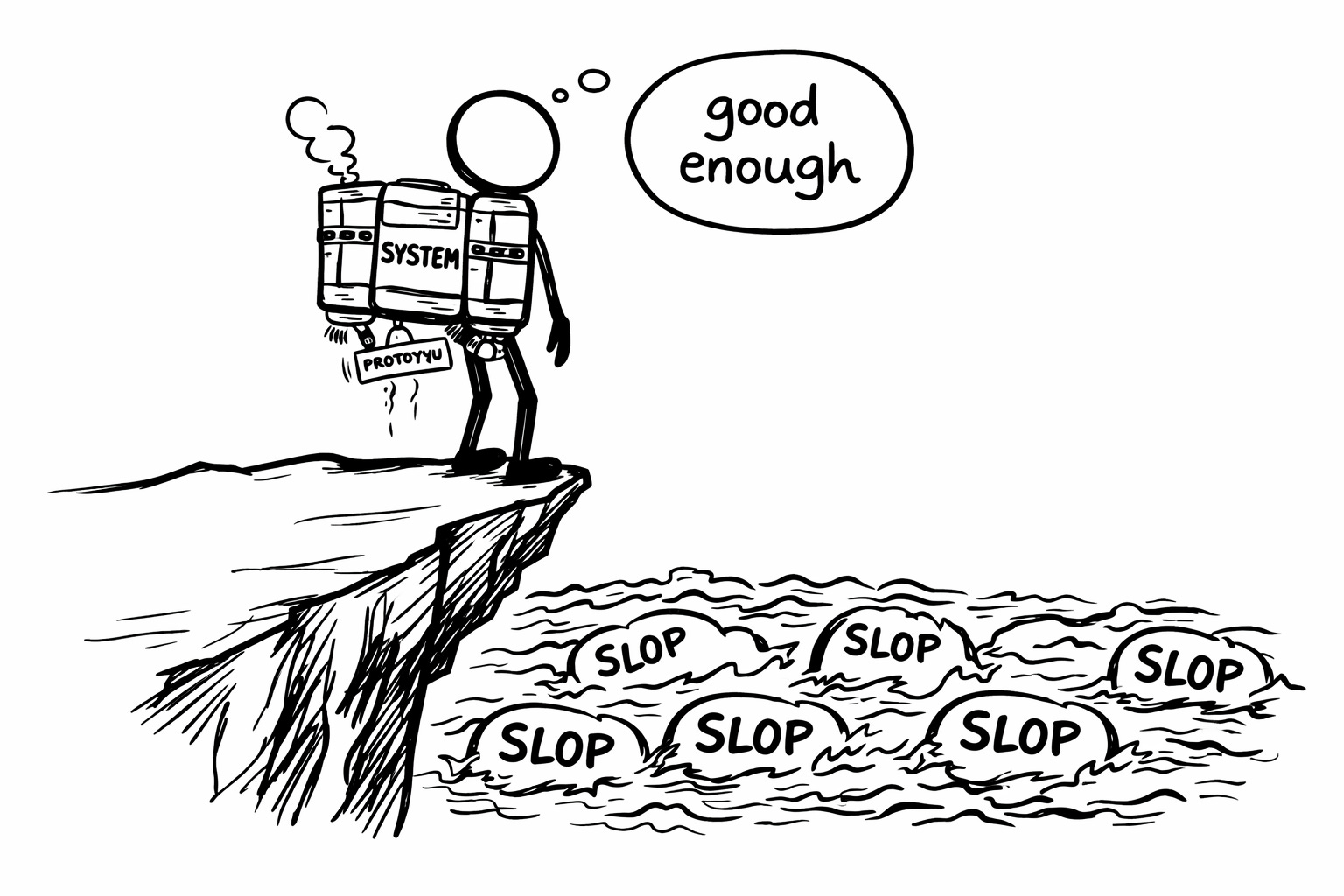
The machine is back online. It’s smoking a little. The jetpack is a prototype. But we’re doing this thang.
Crafted with love (and AI),
Nick “Back from the Dead (Again)” Quick

PS... If you’re new here (or you forgot what this newsletter is about during my absence, which is entirely fair and I respect your honesty), the Voiceprint Quick-Start Guide walks you through documenting your writing patterns so AI stops sounding like a corporate press release with a personality disorder:

PPS... If you’re still subscribed after three weeks of silence, you’re either loyal or you forgot I exist. Either way, I appreciate you. Hit like or drop a comment so I know somebody’s still reading this thing.
Welcome back Nick! We've missed you and your doodles!🩷
I really like how you move beyond the usual quality vs quantity debate, it feels a bit outdated at this point. Curious to see how you build a system that allows quality and volume to coexist. That feels like the real challenge. Here for the ride!!🦩
Nick, Butters needs a second Labubu stat. The doggo has been working hard from the sounds of things!
I quickly unsub from anyone who fills up my inbox with over publishing (I start getting super suspicious when I see the same name three days a week, very few have that much to say all the time), so you are a definite exception because I actually missed your posts! Very interested to see where you end up with this. We can sit on our high horses as much as we want but at the end of the day, I do think so much is about how we adapt to the world we live in while still somehow being proud of what we create.