

Tyler launched his paid tier on day 31.
He’d read the thread. Some newsletter guru with 40,000 subscribers said you should monetize early, while your audience is “most engaged.” Tyler had 247 free subscribers. An open rate hovering around 50%. Comments on most posts.
So he wrote the pitch post. Spent three hours on it. Listed everything paid subscribers would get. Hit publish with the confidence of a man who’d never been told no by a credit card form.
Four people converted.
His mom. His college roommate. A bot from Kazakhstan. And someone who emailed seventeen minutes later asking how to cancel because she’d “clicked the wrong button.”
(The bot stayed subscribed the longest. Six weeks. Make of that what you will.)
Tyler’s mistake wasn’t his offer. Wasn’t his price. Wasn’t even his timing, exactly.
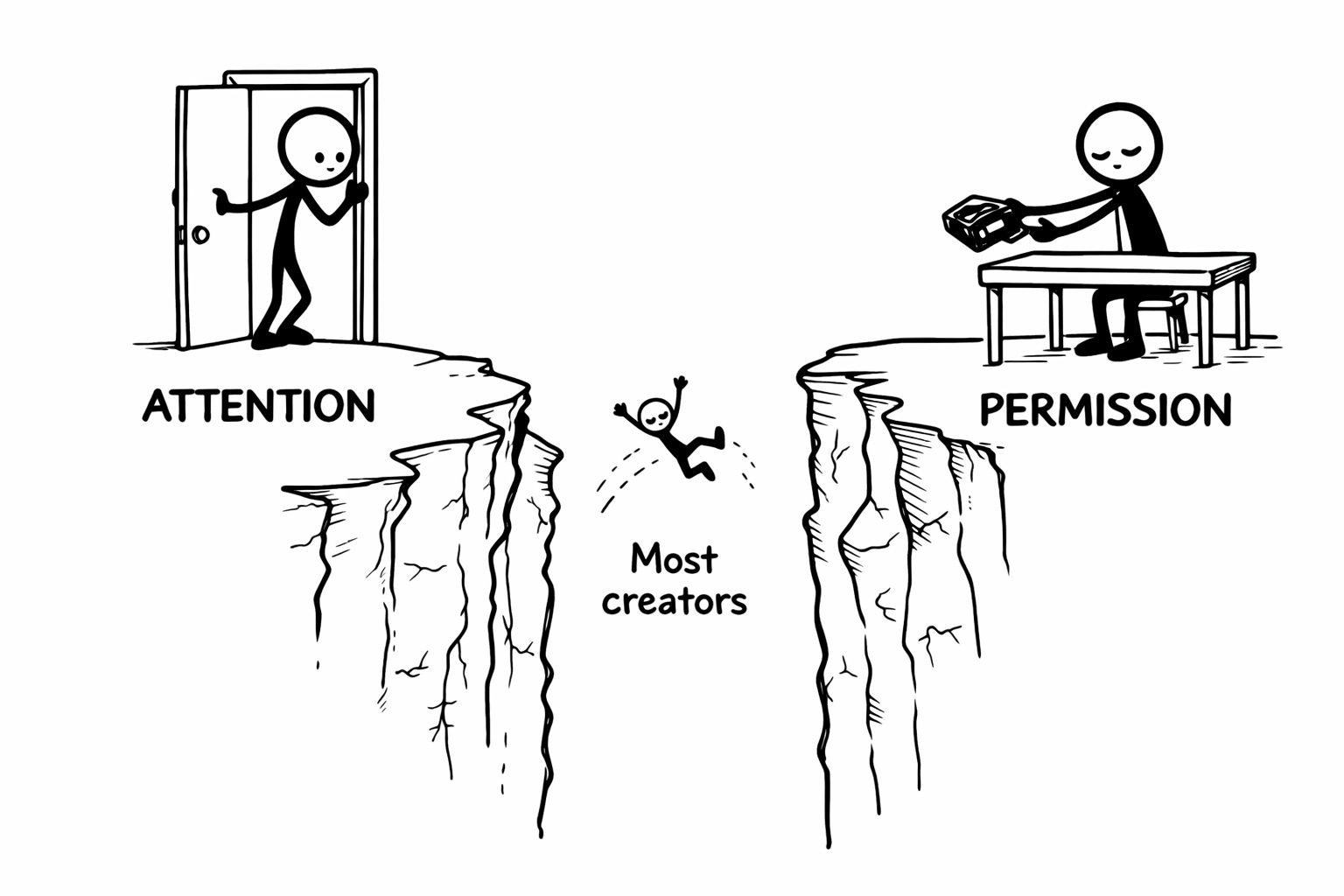
Tyler confused attention with permission.
Two Very Different Things That Feel Identical
Here’s what attention looks like from the creator side: someone subscribed. They open your emails. They read your posts. Maybe they leave a comment. Maybe they even share one.
Feels like trust, right?
It’s not.
Attention is someone walking into your store because the window display caught their eye. Permission is someone handing you their wallet and saying “pick something for me.” These aren’t adjacent stages. There’s a canyon between them, and most creators try to long-jump it after a few weeks of consistent publishing.
(I should know. I’ve done the running start. I’ve made the Wilhelm scream on the way down. The canyon is exactly as deep as your self-esteem is fragile.)
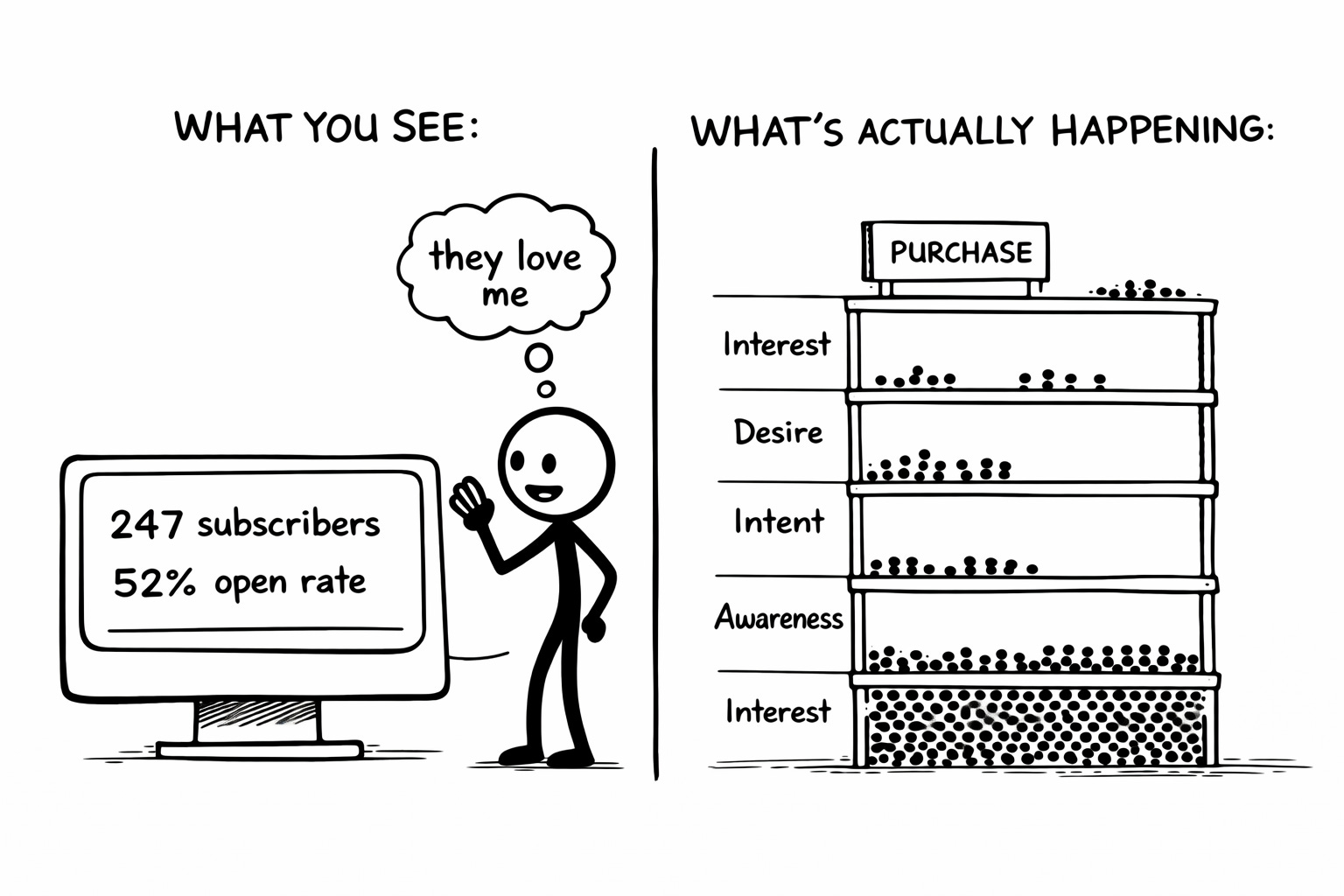
Your subscribers exist on a ladder you can’t see. Most creators don’t know the ladder exists. They just know some percentage of readers will pay and some won’t, and they assume the difference is... what? Income level? Generosity? Whether Mercury is in retrograde?
The ladder looks roughly like this:
Rung 1: “I opened your email.” Curiosity. Not investment. You survived the subject line filter. Congratulations. So did that Pottery Barn sale email and a phishing attempt from a Nigerian prince who’s been surprisingly persistent.
Rung 2: “I read the whole thing.” Interest. They scrolled past the fold. They didn’t bounce to the next tab. But they also read three other newsletters this morning. You’re in the rotation. You’re not the rotation.
Rung 3: “I told someone about you.” Social proof investment. They put their reputation on the line (slightly) by recommending you. Restacks show you a sliver of this. The forwarded emails, the DMs, the “you’d like this guy” over lunch? Those you’ll never see. (Your analytics dashboard just filed a grievance. Ignore it.)
Rung 4: “I’d notice if you disappeared.” Dependency. Habit. You’re part of their morning. They don’t just read you, they expect you. This is the rung where readers start detecting when something’s off about your voice, your energy, your presence.
Rung 5: “I trust your judgment enough to pay.” Permission. Not because your content is worth $5 a month (it is, but that’s not why they pay). Because they’ve accumulated enough evidence that you’re someone whose thinking is worth betting on.
Tyler pitched at Rung 2. He had an audience of readers who finished his emails. He asked for Rung 5 behavior.
(Tyler, buddy. That’s like proposing on a second date because she laughed at your joke about kombucha. The laugh was polite. It was not a yes.)
Publishing Daily Doesn’t Buy What You Think It Buys
I’ve been publishing daily for months. And I’m going to tell you something that every creator monetization thread conveniently forgets to mention.
Consistency earns you the right to keep showing up in someone’s inbox. That’s it. That’s what consistency purchases. It doesn’t automatically advance anyone up the ladder.
I’ve got subscribers who’ve opened every single email since day one and have never commented, never replied, never shared, never clicked a link. They’re Rung 2 permanents. And I love them (hi, you know who you are), but if I built my paid tier expecting all of them to convert, I’d be doing math in a currency that doesn’t exist.
The creators who figure out monetization at small scale (and by small scale I mean sub-2,000 subscribers, aka my neighborhood) are the ones who stop counting subscribers and start reading signals.
The Signals You’re Probably Ignoring
Substack gives you opens and clicks. Useful. Not sufficient. About as complete as a bathroom scale with no mirror. (You weigh 172. How tall are you? Are you muscular or retaining three days of takeout? Are you an athlete or someone who gets winded opening a jar? The number alone tells you nothing actionable.)
The signals that actually map where someone sits:
Rung 2 signals: They open consistently. Maybe click a link. You see them in your stats but never in your comments. Ghost readers. Friendly ghosts, but ghosts.
Rung 3 signals: They restack your posts. They tag a friend in the comments. They mention you in their own Notes. They show up in someone else’s audience because of you.
Rung 4 signals: They comment regularly (not “great post” but actual engagement with the ideas). They reply to your emails. They DM you. They notice when you miss a day and say something about it.
Rung 5 signals: They ask questions about your methodology. They reference your frameworks in their own work. They’ve already recommended you to multiple people. Some of them have been waiting for you to sell them something.
(That last one is real. Some of your readers are literally sitting there thinking “when is this person going to let me pay them” and you’re over here agonizing about whether it’s “too soon.” It’s not too soon for them. It might be too soon for the other 95%.)
The problem isn’t that you pitch. The problem is you pitch the same way to all five rungs simultaneously. Which means you’re either boring the people who are ready or terrifying the people who just got here.
So Where Do YOUR Readers Actually Sit?
Here’s the part that stings.
Most newsletters under 1,000 subscribers have a distribution that looks roughly like this:
60-70% at Rung 1-2 (openers, casual readers) 20-25% at Rung 3 (active but not invested) 5-10% at Rung 4 (habitual, would notice your absence) 1-3% at Rung 5 (ready to pay)
At 500 subscribers, that means somewhere between 5 and 15 people are actually ready to give you money right now. Not 500. Not 50. Five to fifteen.
(I just felt half of you wince. Sorry. But would you rather I lied and you launched a paid tier to the sound of your own echo? That’s not a rhetorical question. Some monetization advice literally depends on you not doing this math.)
But here’s the thing about knowing this number. (Can I say “here’s the thing” if I immediately acknowledge I just broke my own rule? Too late. Moving on.) Knowing this isn’t depressing. It’s strategic. Because having a clear, sometimes uncomfortable opinion about where your audience sits changes everything about how you write, what you publish, and when you ask.
Tyler didn’t have a conversion problem. Tyler had a ladder awareness problem. He was shouting his pitch into a room where 95% of the people hadn’t even decided if they liked him yet.
(Tyler, if you’re reading this: the bot from Kazakhstan says hi. It was your most loyal subscriber. Treasure that.)
What Actually Moves People Up?
This is where I should give you the framework. The specific editorial moves that advance readers from Rung 2 to Rung 5 in a way you can actually replicate.
I have that framework. It’s what Part 2 of this series covers.
But I’ll leave you with this: it’s not CTAs. It’s not funnels. It’s not “providing value” (a phrase so vague and overused it has the actionable content of a fortune cookie that just says "try harder").
It’s specific editorial choices. The decision to show your work, including the ugly parts. The willingness to publish the post that costs you three subscribers because it earns the trust of thirty. The unsexy math of accumulating evidence that you’re not performing expertise but actually doing the work.
The permission ladder isn’t a funnel you build once and crank. It’s a relationship that accumulates in the space between your posts and your reader’s quiet decision to keep opening them.
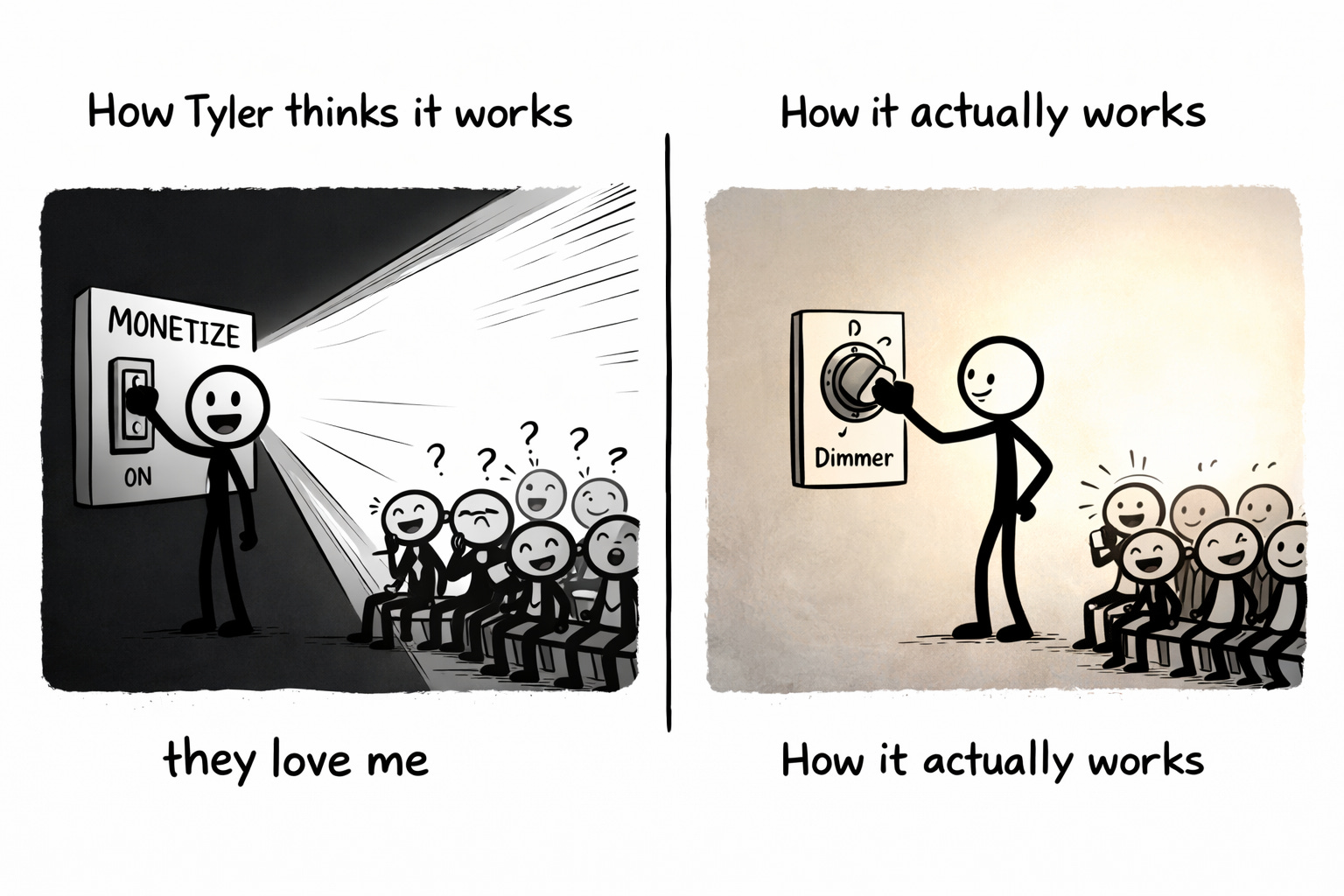
Tyler treated permission like a light switch. On or off. Subscribed or not.
It’s more like a dimmer. And most creators crank it to full blast while the bulb is still warming up.
🧉 Where are YOU on the permission ladder with the creators you subscribe to? Be honest:
A) I open emails from writers I’d never pay (Rung 1-2 permanent resident, no shame)
B) I’ve recommended a few newsletters but wouldn’t pay yet (Rung 3, comfortably camping)
C) I’d notice if my favorites disappeared but still haven’t gone paid (Rung 4, guilty as charged)
D) I’m already paying 2-3 creators and know exactly why I converted (Rung 5, credit card sends its regards)
The readers who’ll eventually pay you are already watching. They’re reading the signals you’re sending with every editorial decision you make. The question isn’t whether you’ve earned their attention. It’s whether you’ve earned their trust. Those are very, very different currencies. And you can’t exchange one for the other at any rate.
Crafted with love (and AI),
Nick “Permission Denied” Quick

PS... The permission ladder starts with voice. If your readers can’t tell the difference between your writing and anyone else’s, trust doesn’t accumulate. The Ink Sync Workshop builds the system that makes your voice unmistakable:

PPS... If you found yourself nodding at this while simultaneously being a Rung 4 reader of mine who hasn’t converted to paid yet... I see you. I’m not mad. (I’m a little mad. But the ladder says I haven’t earned the right to be mad yet. So we’re cool.)
📚 How Readers Become Buyers (3-part series)
Part 1: The Trust Ladder (you’re here) | Part 2: The Five Plays | Part 3: The Ask (Tomorrow)
Nick this is a great point about the ladder. I would add, every reader climbs at their own speed. And every reader is climbing a different ladder.
I've converted a reader after my first interaction with them. Others, I've engaged with daily for a year and they still aren't ready.
This is why I think it's so important to spend time every day engaging with your readers. It literally helps them climb their own ladder. Plus it gives you as the creator, a better sense of what that climb looks like, and how to ease it for the reader.
My stats hold up to your math. I have 415 total subscribers. I have 8 paid subscribers….real paid, not comps. That aligns with your calculation.
Additionally I just wrote a note this morning about how writing something yesterday with a changed tone, that was more personal caused 8 out of 420 people to unsubscribe in 12 hours. I don’t lament their going. I wont apologize for writing what I believe in, but it does speak to your fickle mass level 1/2 population.
When I started writing here 10 months ago, it was because of a need to share (and if Im honest, part therapy too 😊). I always wanted to build a place first, learn what my voice is, and assemble an audience that wants to hear).
I guess I am a folk club singer rather than a stadium pop idol. And I’m just fine with that.
Tip Jar remains open for those that care 😁