
The Disappearing Act
How I became a ghost (and why I’m finally talking about it)

I published my first blog post in 2006.
For fourteen years, I showed up. Wrote things. Built audiences. Had opinions loud enough that people either loved me or wanted me to shut the F up. (Both camps had valid points.)
Then 2020 happened.
Not a graceful exit. Not a “taking a break to focus on other projects” announcement. Just... silence. The kind that stretches from weeks into months into years until you’ve been gone so long that coming back feels like showing up to a party three days after everyone left.
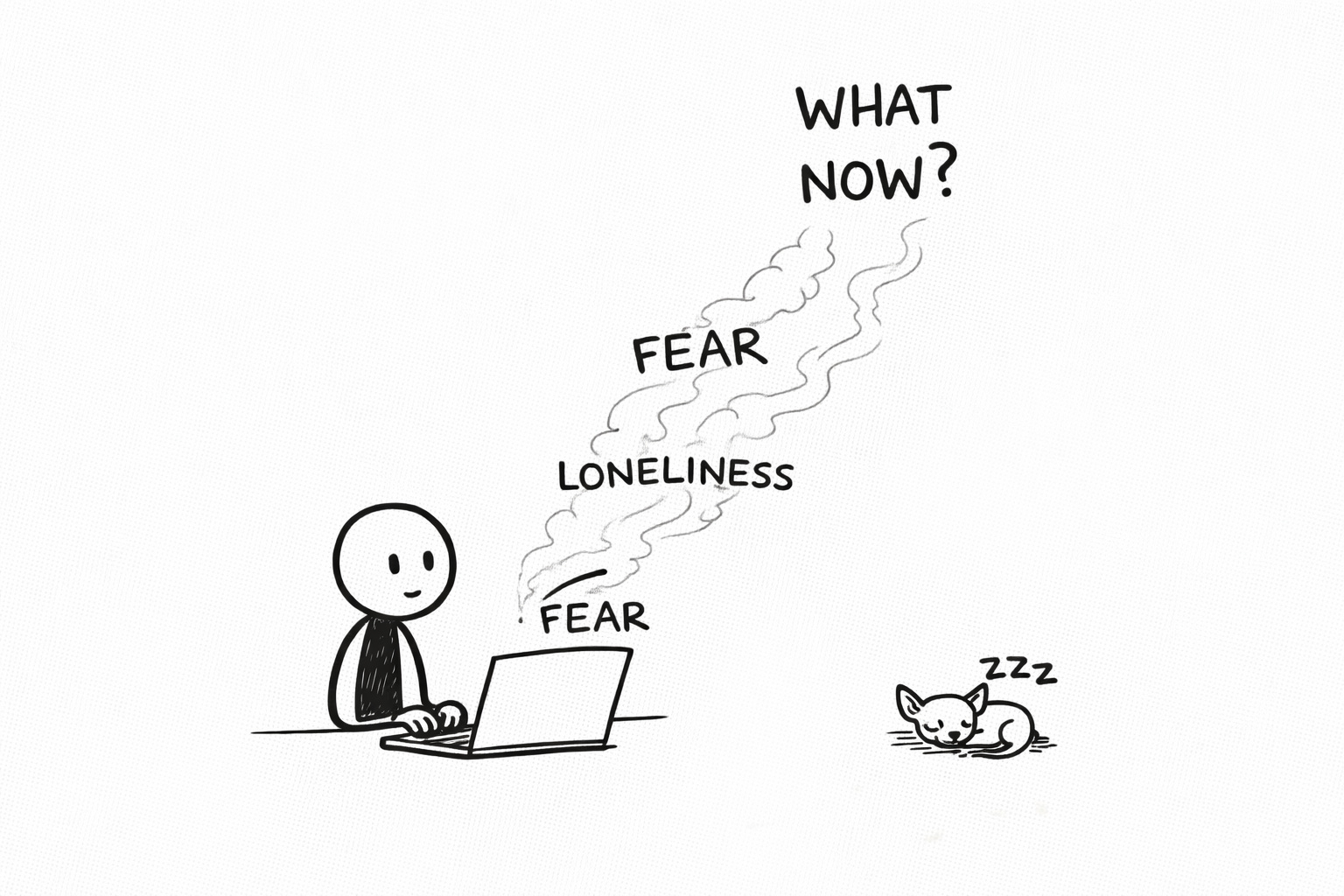
I’m writing this on Christmas Day, 2025. Alone. In Paraguay. With a chihuahua named Butters who is currently snoring with a violence that suggests he’s fighting demons in his sleep. (He’s six pounds and missing 3 teeth. The demons must be terrified.)
I’m telling you this because I spent the last five years becoming a ghost, and I think some of you might recognize the haunting.
The Optimist’s Guide to Global Catastrophe
March 2020. Peru announces lockdown.
I remember the exact thought I had: This will be good, actually.
(I know. I KNOW.)
But hear me out. I’d just rage-quit a job I’d poured nearly a decade into. Finally hit my financial targets, finally got the recognition I’d been chasing, and immediately torpedoed it because... I don’t know. Because that’s what I do.
I’ve never been able to break this cycle. Climb toward the thing. Get the thing. Blow up the thing. Repeat. Some part of me has decided that the moment I get what I want is the perfect time to destroy it.
(If you have a therapist’s number in Paraguay, I’m open to suggestions.)
Whatever the reason, I was suddenly unemployed, suddenly in Peru, and suddenly locked in an ocean-view apartment in Lima with nothing but time and an breathtaking sunset view I no longer deserved.
Perfect, I thought. I’ll use this to crystallize who I want to become. Emerge from this cocoon as a beautiful butterfly of self-actualization.
(The butterfly did not emerge. Something else did. We’ll get to that.)
The Gringo in the Building
Here’s something they don’t tell you about being the only American in a Peruvian apartment complex during a global pandemic that your country arguably made worse:
People notice you.
Peru had one of the highest per-capita death tolls in the world. They stayed locked down for over a year after everywhere else had started pretending things were normal. And there I was—the lone gringo in a building full of people who had very reasonable questions about why Americans couldn’t just stay home and stop spreading death across the globe.
They weren’t wrong about America. America has been spreading things to countries that didn’t ask for them long before 2020. (Still is, if you’ve been paying attention.)
But I became the token American. The one in the building. When the beloved telenovela actor across the hall succumbed to the mysterious illness, I was the obvious culprit—never mind that I hadn’t caught it yet. Wouldn’t for another year. Try explaining epidemiology to a grieving building that finally has a face to blame.
I don’t blame them for needing one.
The building turned. Slowly at first. Then all at once.
I’d hear whispers when I took Butters out to pee—a crime under quarantine rules, technically. The jails had filled up with violators early on, so police switched to corporal punishment. Garden hoses. They’d beat you and send you home with nothing but stinging welts to remind you not to do it again.
Butters is too well house-trained to go inside. He’d hold it until his eyes watered. So I’d sneak out, cash folded in my palm, ready to bribe whichever cop on the take found us on the empty streets. All so a six-pound chihuahua could pee on a tree like the good lord intended.
(The streets were empty and I was triple-masked and latex gloved. Who was I going to infect? But try making that argument while a cop decides whether to take the money or give the hose again.)
The neighbor who used to nod at me started looking through me. The security guard who once helped me carry groceries now watched me like I might spontaneously combust into a bajillion viral particles.
And every night—every single night—I’d lie in bed listening to my downstairs neighbor’s screams pierce through the floor as her husband did whatever he was doing to make her weep like that.
I couldn’t help her. I couldn’t leave. I couldn’t even be seen as a person worth trusting.
So I did what any reasonable person would do.
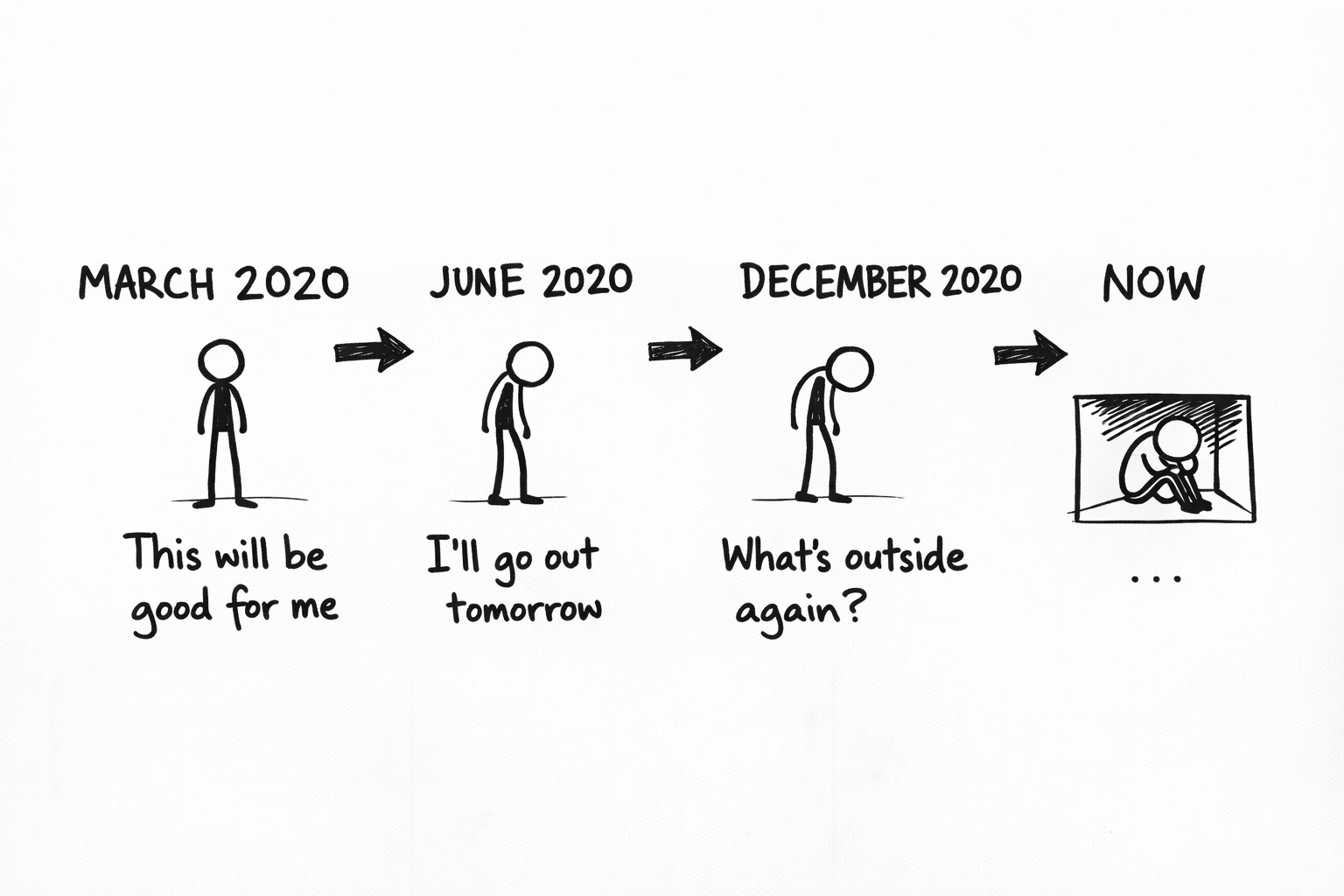
I stopped leaving my apartment entirely.
How to Become a Ghost in Three Easy Steps
Step One: Stop leaving the house.
Easy. There’s a pandemic. Everyone’s doing it. You’re not weird, you’re responsible.
I hired an assistant. Her job was to handle anything requiring a physical presence anywhere other than my living room couch. Groceries. Errands. Taking Butters to pee so I wouldn’t have to bribe another cop.
I told myself this was smart. Efficient. Adapting to circumstances.
(It was the beginning of the end. I just didn’t know it yet.)
Step Two: Stop talking to people.
Also easy. Video calls are exhausting. Texts feel performative. And everyone’s going through their own thing, right? They don’t need you adding to their pile.
(This is a lie you tell yourself. The truth is you’re not reaching out because reaching out requires being a person, and you’ve started to forget how to be one.)
Step Three: Let enough time pass that coming back feels impossible.
Here’s where it gets insidious.
A week of silence is a break. A month is a pause. Six months is a pattern. A year is an identity.
At some point—and you won’t notice when it happens—you stop being “someone who’s taking time off” and start being “someone who disappeared.” And the longer you’re gone, the weirder it feels to return.
What would I even say? Hey everyone, sorry I vanished for half a decade, anyway here’s my thoughts on content strategy?
The silence compounds. Each day you don’t reach out makes the next day’s silence feel more justified. You’re not avoiding people anymore. You’re avoiding the conversation about why you avoided people. Which means you avoid people. Which means—
You see how this works.
The Neuroses Collection
I’ve developed some fun new personality features since 2020. Thought I’d share.
The Voice Thing: I go days without speaking out loud. Sometimes I’ll say something to Butters just to check if my voice still works. It always comes out rusty. Like an engine that hasn’t turned over in months.
The Leaving Thing: Going outside requires a minimum two-hour psychological preparation period. Sometimes I do all the preparation and then don’t go anyway. The preparation counts as activity. (It doesn’t. But I count it.)
The Window Thing: My Lima apartment had a bay window overlooking the Pacific. Every evening, the sun would melt into the ocean over the cliffs of Barranco—the kind of view people retire early to afford. I kept the curtains closed for three years straight. Never turned on the lights. Sat in the dark with the most breathtaking sunset on the continent happening six feet away, unwatched. I couldn’t tell you why. I still can’t.
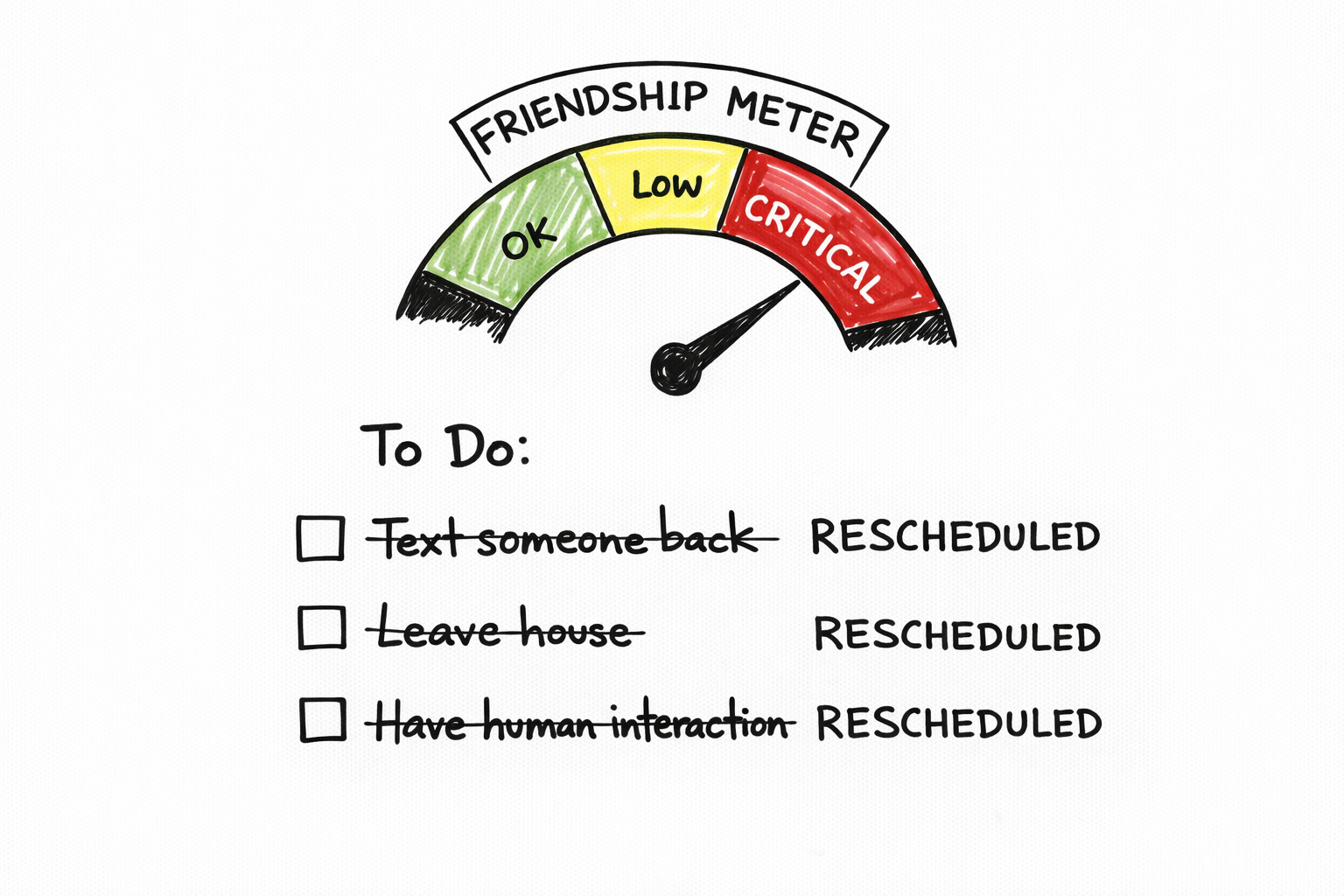
The Phone Thing: My phone is always on silent. Has been for years. When it actually rings, I stare at it like it’s a bomb until it stops. Then I text back: “Hey, saw you called. What’s up?” Like a normal person who definitely isn’t terrified of real-time human interaction.
The People Thing: I’ve forgotten how to have a conversation that isn’t transactional. “Hello, I would like to purchase this item. Thank you, kind sir. Goodbye.” That’s the whole script. Anything beyond that and I start buffering like a 2008 YouTube video.
The Dating Thing: I’m 48 years old and I don’t know how to meet someone special anymore. That’s not self-deprecation… it’s a genuine gap in my understanding of how the world works now. The old playbook died somewhere in 2020 and I never got the new one. Bars feel desperate. Apps feel like spam filters for loneliness. And somewhere between “I haven’t touched another person in years” and “I forgot how to hold a conversation that isn’t transactional,” I lost the thread entirely. I don’t know how to get it back. I’m not sure anyone’s teaching that class.
My text threads have dwindled to maybe four. I respond to half of them. Poorly. With the enthusiasm of someone filling out a government form.
So I sit here. Alone. On Christmas. Typing to strangers on the internet because that’s easier than whatever the alternative is supposed to be.
Butters just farted in his sleep. This is my social life now.
The Things We Don’t Talk About
Here’s what I think happened to a lot of us.
We went into lockdown thinking it would be a pause. A chance to reflect. Read those books. Learn sourdough starters. Become better versions of ourselves.
Instead, something broke.
Not dramatically. Not in a way that makes for good content. Just quietly. Like a bone that healed wrong and now aches when it rains.
The world reopened. Mostly. And we were supposed to just... go back? Pick up where we left off? Pretend that year (or two, or three) of isolation didn’t rewire something fundamental in how we relate to other humans?
Some people did. Good for them. (Genuinely. I’m not being sarcastic. I’m jealous.)
Some of us are still stuck.
Not in the lockdown—that’s over. Stuck in the after. In the patterns we developed when the world was terrifying and small, that somehow calcified into who we are now.
I developed a fear of leaving the house that started as caution and became a prison.
I developed a distrust of connection that started as self-protection and became loneliness.
I developed a habit of silence that started as “I’ll post again when I have something to say” and became five years of watching from the sidelines while my voice atrophied.
And I don’t think I’m the only one.
Why I’m Telling You This
I’m telling you this because I wrote a newsletter earlier today about using the silence to publish something scary. And then I realized I was a fraud if I didn’t.
I’m telling you this because I think there’s a version of my story that lives in a lot of people who came out of those years... different. Not better. Not worse. Just changed in ways we don’t have language for yet.
I’m telling you this because I’ve spent five years being invisible and I’m tired of it.
And I’m telling you this because Butters woke up, looked at me typing furiously on Christmas Day, judged me silently, and went back to sleep. If my chihuahua can witness my breakdown with that level of indifference, surely the internet can handle it too.
I Don’t Have a Neat Ending
This isn’t a recovery story. I haven’t fixed anything. I’m not writing this from the other side of some transformational journey.
I’m writing this from the middle. From the part where you know something’s broken and you’re not sure how to fix it and you’re starting to wonder if maybe the first step is just saying it out loud.
So here I am. Saying it out loud.
I disappeared for five years. Some of those reasons I’ll share. Some I won’t. (Everyone’s entitled to a few secrets. Even oversharing newsletter writers.)
I’m still mostly a ghost. I talk to almost no one. I leave the house only when necessary. I’ve forgotten how to be a person in the ways that matter.
But I’m writing again. Which is something.
And I’m publishing this—the thing that makes my stomach hurt—because I told you to do the same and I’d be a hypocrite if I didn’t.
Maybe you recognize some of this. Maybe you’re reading this on Christmas, alone, wondering when the “after” starts feeling like the after.
If so: hi. Welcome. Butters and I are holding down the fort.
The world got weird. We got weird with it. And maybe the first step back is just admitting that out loud.
I’m not sure what comes next. But I’m pretty sure it starts with not being silent anymore.
And maybe not blowing it up this time. (No promises. But I’m trying.)
What’s your version of the disappearing act? What broke during those years that you haven’t talked about? (Reply if you want. Don’t if you don’t. I’ll be here either way. Not like I’m going anywhere.)
Crafted with love (and AI),
Nick “The Ghost Who Sometimes Writes” Quick
PS: I publish daily. It’s either a comeback or a very public crashout. Subscribe and find out which. Butters shall remain indifferent either way.
I’ve spent my own share of quiet years, watching from the sidelines, and reading this made me feel a little less alone in it.
Somehow, your honesty makes showing up again feel possible.
Nick tells his personal ghost story, which is not scary in the conventional sense, but something many people can relate to in the post-pandemic years. Give it a read, preferably with a comfort pet or human nearby.