
What Readers Actually Notice About Your Writing
The 80/20 of AI editing: why you’ve been polishing the parts nobody remembers

Quick exercise.
Try to remember the last article you read. Not the topic. Not the “key takeaways.” The actual sentences.
Which specific lines do you remember?
If you’re like most humans with functioning brains and limited attention spans, you remember the opening. Maybe the ending. Possibly that one weird line in the middle where the author compared something to a ferret in a blender. (Why do I remember that? That article was about mortgage rates.)
But the fourth sentence of the third paragraph? Gone. Evaporated. Your brain composted it before you even finished the page.
This isn’t a failure of memory. This is how memory works.
And it has massive implications for where you should focus your editing energy when collaborating with AI. Specifically: you’ve been editing the wrong damn parts.
(This is the part where I save you approximately forty hours of wasted effort. You’re welcome.)
The Serial Position Effect (Or: Why Your English Teacher Was Accidentally Right)
Psychologists have known this for over a century, which means we’ve had plenty of time to ignore it.
The serial position effect is a fancy way of saying: humans remember the first things in a sequence and the last things in a sequence. Everything in the middle gets tossed into the cognitive equivalent of a junk drawer.
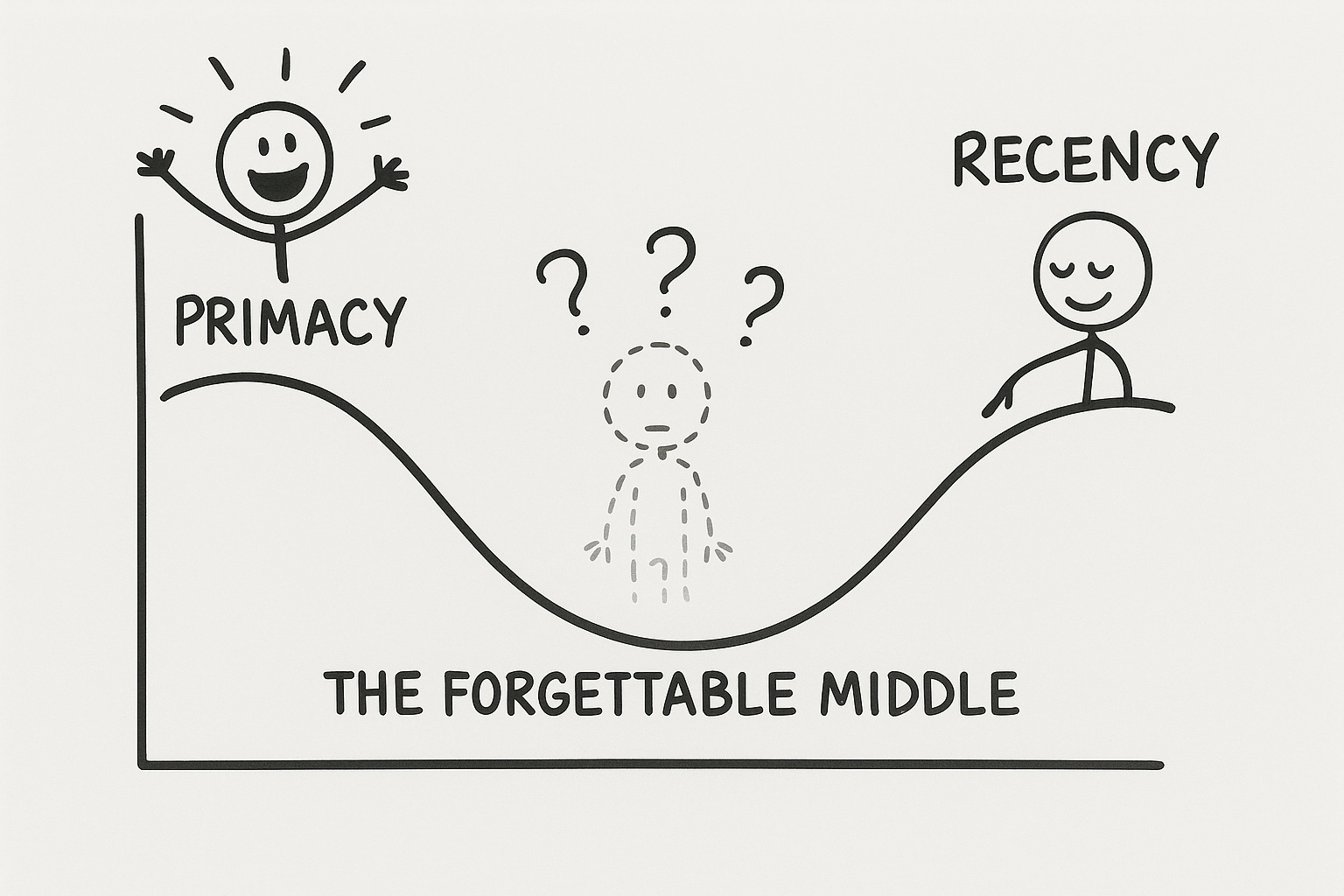
The fancy psychologists call the beginning part “primacy effects” and the end part “recency effects.” The middle part doesn’t get a cool name because nobody cares about the middle part. (Story of its life.)
This matters because your readers aren’t experiencing your writing like a scanner processing a document. They’re experiencing it like a human who also has a phone buzzing, a meeting in twelve minutes, and a vague sense that they should’ve eaten lunch by now.
First things: vivid.
Last things: vivid.
Middle things: composted.
Which means readers aren’t judging your voice evenly either.
Voice Evaluation Isn’t Fair (And Thank God For That)
Here’s where it gets interesting. (To me. I realize “interesting” is doing heavy lifting here.)
When readers decide whether something “sounds like you,” they’re not consciously grading every sentence with a rubric. They’re forming a vibe check. An impression. A gut feeling that happens faster than they can articulate.
And that impression is disproportionately shaped by:
First contact (opening lines)
Last contact (closing thoughts)
Moments of transition (section breaks)
Anything weird enough to stick out from the baseline
The middle? The middle contributes to a general sense of “yeah, this person knows stuff.” But it doesn’t determine voice perception. It’s the bass player of your content. (Sorry, bass players. You know I’m right.)
This is why you can read something that’s 90% well-written and still feel like it’s “off.” Because the 10% that’s generic happens to land in the positions that shape perception.
And it’s why AI content often feels soulless even when most of it is perfectly adequate prose. AI defaults to maximum genericness in exactly the positions readers use for voice evaluation.
It’s like AI studied the test, figured out which questions were worth the most points, and then specifically bombed those. On purpose. Consistently.
(I’m starting to think AI might be the problem.)
The Five Perception Points (A Framework I’m Naming Because I’m That Guy Now)
Five positions. That’s it. Five places in your writing that disproportionately shape whether content ‘sounds like you’ or sounds like a robot having a midlife crisis.
Position 1: The First Sentence
The first sentence isn’t just an opening.
It’s a voice contract. A handshake. A promise about what kind of person they’re about to spend the next five minutes with.
Within approximately seven seconds (I’m making this number up, but it feels right), readers form expectations about:
Who’s talking — personality, authority, vibe
How they talk — are we doing formal? Casual? Unhinged?
Whether to keep reading — is this worth their remaining attention span?
All of this happens before conscious evaluation kicks in. It’s lizard brain stuff. Fight or flight, except the options are “read” or “close tab and pretend this never happened.”
What readers notice: Specificity versus generality. Confidence versus corporate hedging. A human having thoughts versus a content template achieving sentience.
What AI typically produces: The most statistically probable opening sentence for that topic. Which is also the most generic. Which readers subconsciously register as “oh great, another one of these.”
I opened a draft last week and the first sentence was: “Effective content creation requires understanding your audience’s needs.”
I stared at it for a full thirty seconds.
Not because it was wrong. Because it was nothing. It was the written equivalent of elevator music. The opening sentence version of “working hard or hardly working?”
I deleted it so aggressively my keyboard filed for emotional damages.
Position 2: Section Openers
Every subheading creates a micro-reset.
Readers pause. Their eyes drift down to check how much content is left. (Don’t pretend you don’t do this.) They decide whether the next section is worth their precious remaining attention. Then they start reading again.
And in that moment—in that tiny pause before they commit to the next chunk—they’re re-checking the voice contract.
“Still the same person? Still worth my time? Or did this turn into something else when I wasn’t looking?”
A section opener that sounds like bridging language (”Now let’s examine the next crucial element...”) breaks the voice contract. Not dramatically. But enough to create a subtle sense that someone swapped writers mid-piece.
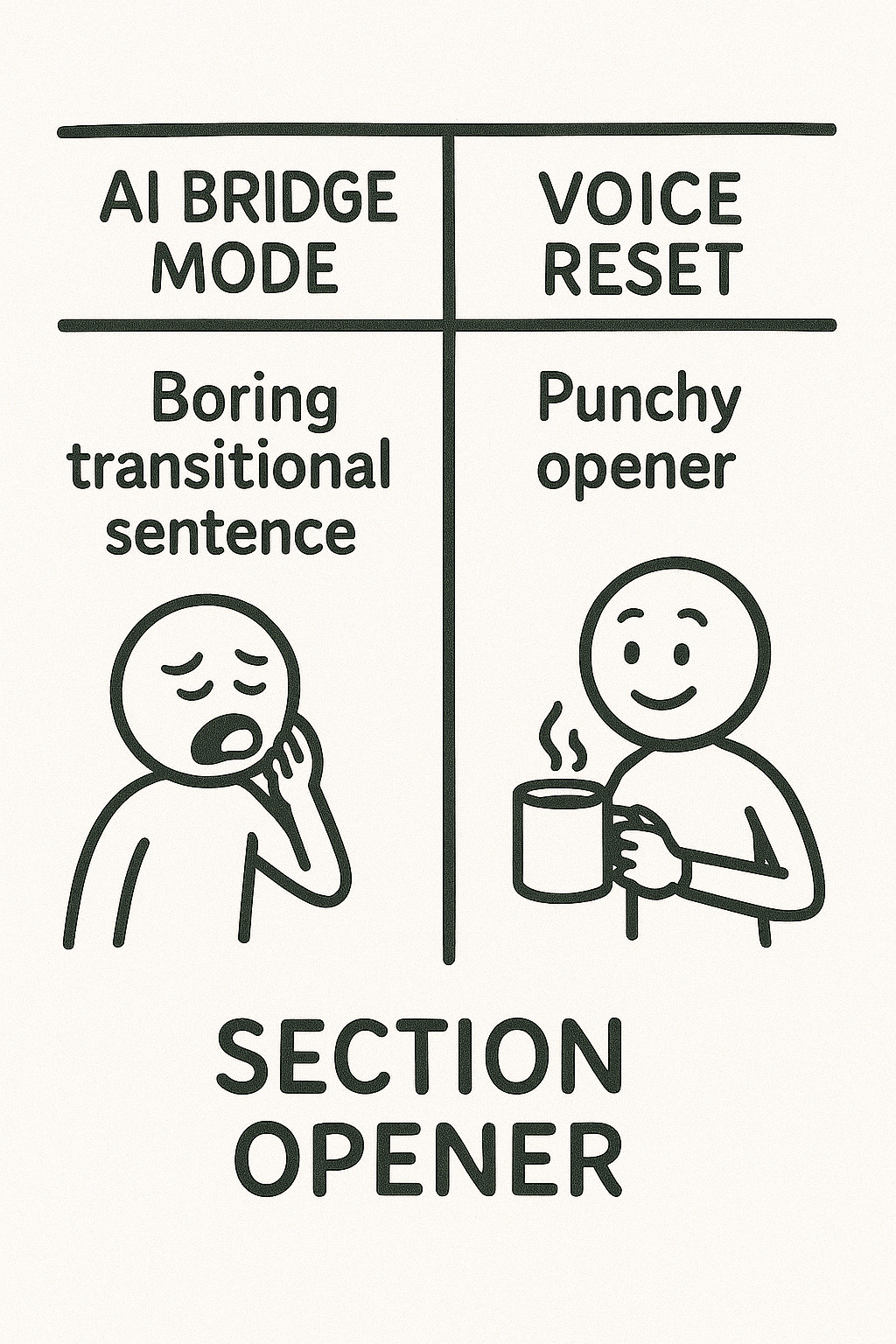
What readers notice: Whether the voice stays consistent after breaks. Whether the new section launches with energy or sounds like it’s filling out a form.
What AI typically produces: Transitional sentences designed to connect sections logically. Which is helpful! And also completely impersonal. Like being told ‘I love you’ by someone reading it off a cue card.
Position 3: Section Closers
The last sentence before a break is what readers carry forward.
Think about how you experience section breaks. You finish a section. You pause—even if just for half a second. Maybe you take a breath. Maybe you check if your coffee is cold. (It’s cold. It’s always cold.)
And in that pause, the last thing you read echoes.
A generic wrap-up sentence doesn’t echo. It closes a door quietly. No resonance. Just... done.
A voice-forward closer creates a something. A raised eyebrow. A small internal “huh?” A feeling that you want to sit with for a second before moving on.
What readers notice: Whether sections end with resolution that feels earned or wrap-ups that feel like the writer ran out of gas three sentences ago and just wanted to be finished.
What AI typically produces: Summary sentences that tie up each section with a neat little bow. Which feels organized. And also like someone who ends every conversation with “well, that about covers it!”
(We all know someone like that. We all avoid sitting next to them at parties.)
Position 4: The Final Paragraph
The ending determines the emotional residue of your entire piece.
Residue sounds gross. I know. But it’s accurate.
Readers might forget your third point. They might blur sections two and four together into some kind of content smoothie. But they’ll remember how you made them feel at the end.
Think about the last piece of writing that genuinely stuck with you. What do you remember? Probably not the middle. Probably the ending. The way it landed. The thought you carried away.
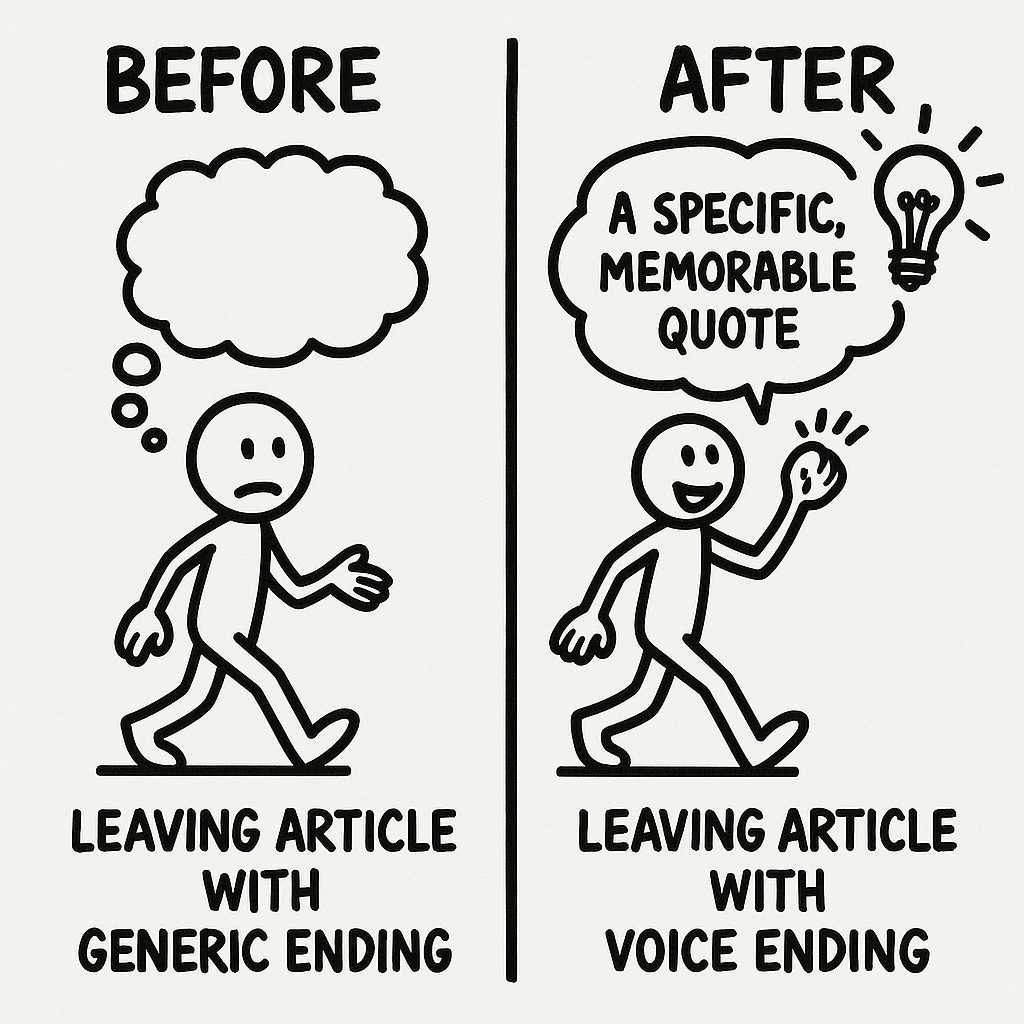
What readers notice: Whether they leave with a specific feeling or just... finished. Whether there’s a thought worth carrying or just the cognitive equivalent of credits rolling.
What AI typically produces: Summary + generic CTA. “In conclusion, by implementing these strategies, you’ll be well-positioned to achieve your goals. Start today!”
God, I felt my soul leave my body just typing that.
Position 5: Quoted Speech
This one’s contextual. Not every piece has dialogue or quotes. But when they do? Readers process them completely differently.
Something shifts when we encounter quoted speech. We stop reading and start hearing. We construct an internal voice. We evaluate whether this sounds like something a human being with blood in their veins would actually say.
And AI dialogue is... rough.
It’s not wrong, exactly. It’s just complete. Perfectly grammatical. Fully formed sentences with proper subject-verb agreement and appropriate punctuation throughout.
Which is exactly how real humans don’t talk.
What readers notice: Whether quotes sound like actual speech from actual mouths or like sentences that were focus-grouped into oblivion.
What AI typically produces: “I have found that implementing a consistent writing practice has been instrumental in developing my creative abilities and professional output.”
Nobody talks like that. Nobody has ever talked like that. If someone talked like that in real life, you’d check them for a battery compartment.
Real humans say: “I dunno, I just write every morning now. It sucks at first. But then it sucks less.”
Fragments. Self-interruption. Hedging. Trailing off. That’s how people actually sound.
Editing for Reader Perception (The Part Where This Actually Helps You)
Okay. Brain dump complete.
Here’s the practical bit: once you understand how readers actually experience writing, the editing strategy becomes almost embarrassingly obvious.
Don’t edit evenly. Edit strategically.
The middle can be competent. The perception points must be you.
The 10-Minute Focused Edit:
2 minutes on opening sentence (the voice contract)
3 minutes scanning section openers (the re-checks)
3 minutes rewriting closing paragraph (the residue)
2 minutes reading dialogue aloud (the speech test)
You’re not making the whole piece perfect. (Perfection is a myth anyway. And also exhausting.) You’re making the perception points perfect.
The middle sections? Let them be good enough. Let AI handle the bass line. Your job is the hook that makes people stay and the ending that makes them remember.
I made a printable version of this. [Grab it here →]
The Liberation of Uneven Effort
Here’s the uncomfortable truth I wish someone had told me two years ago:
Not all positions matter equally. Not even close.
You don’t have to make every sentence perfect. You don’t have to rewrite every paragraph until your eyes bleed. You don’t have to spend three hours “editing” a piece that should’ve taken forty minutes.
(I have done this. Multiple times. In a single month. It was not a good month.)
You need to nail the positions that shape perception. And let the rest be good enough.
AI can produce perfectly adequate middle sections. Fine. Great. Let it do that job.
But the opening sentence? The section openers? The closing paragraph? The dialogue?
Those need you.
Not because AI is incapable of producing text in those positions. But because the text it produces there is statistically probable. And statistically probable is just a fancy way of saying “what everyone else wrote.” Which is exactly wrong for voice perception.
Your voice shows up in the positions readers actually notice. Focus your energy there. Let the rest fade where it was always going to fade anyway.
You can’t out-edit the serial position effect. But you can work with it.
What’s the first sentence of the last piece you published? Does it sound like you—or like it could’ve been written by literally anyone with access to a keyboard? Drop it in the comments and let’s roast it together. (Lovingly. Mostly.)
Crafted with love (and AI),
Nick “Serial Position Stan” Quick

PS: Want more on collaborating with AI without losing your voice? Subscribe for new posts every Sunday and Wednesday.
PPS: I run a free Skool community where you can access my full course, Co-Write OS, at no cost. Everything I know about AI collaboration, organized into something resembling a curriculum. [Join here →]