
The 20-Minute Exercise That Reveals How You Actually Write
Document your Tempo layer: the sentence patterns that make your writing recognizably yours

Most writers can’t describe their own voice.
Ask them and you get vibes. “Conversational.” “Professional but approachable.” “Punchy.” (My personal favorite: “authentic.” What does that even mean? That you’re not a robot? The bar is underground.)
You’ve basically described a golden retriever. Friendly. Approachable. Energetic. Not a writing style.
Voice lives in mechanics… specific patterns you default to without thinking. And the most tangible of those patterns is what I call your Tempo layer: the rhythm of your writing. Sentence lengths. Structures you repeat. The music beneath the meaning that readers feel even when they can’t name what they’re feeling.
Here’s the uncomfortable part: these patterns are already in your writing. You’ve been using them for years. You just haven’t extracted them yet—which means you can’t teach them to anyone (or anything) else.
This exercise takes 20 minutes. By the end, you’ll have documented Tempo patterns you can hand to AI, use to edit your own drafts, or—at minimum—finally have an answer when someone asks “what’s your writing style?” that isn’t just gestures vaguely at vibes.
Let’s do it.
Why Tempo Matters for AI Collaboration
When AI writes in “your voice,” it’s guessing.
And it’s guessing badly.
It doesn’t know that you default to short punchy sentences. It doesn’t know you love em dashes (perhaps too much—I’m in recovery). It doesn’t know your paragraphs breathe with single-sentence breaks for emphasis.
So it produces its own patterns. Which sound like everyone else’s patterns. Which sound like... nothing. Like someone describing you to a police sketch artist based on your font choices.
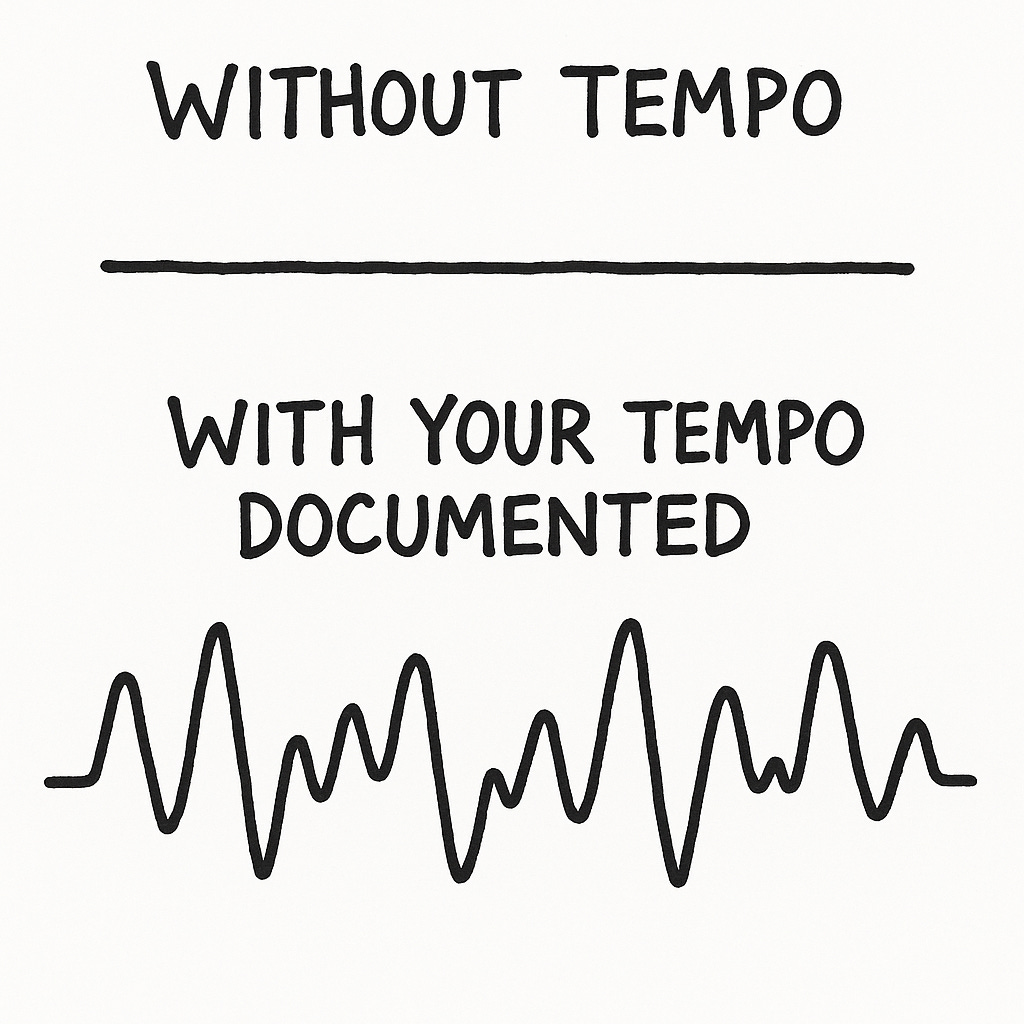
Tempo is where readers feel your voice even when they can’t articulate why. Get this layer documented, and AI stops guessing. It starts following. The difference between those two things is the difference between “this sounds like a robot wearing my skin” and “wait, did I write this?”
What You’ll Need
Three pieces of your writing (500+ words each)
Pick work you’re proud of—where your voice feels most you
A timer (your phone works, no need to buy another useless productivity gadget)
The template at the end of this post (or grab the worksheet version below)
Don’t overthink sample selection. I know you want to find the perfect representative samples. Stop it. Your patterns will show up regardless—that’s the whole point of patterns. They’re persistent. Grab three pieces you like, move on.
Part 1: Sentence Length Distribution (7 minutes)
Set your timer. (Yes, actually set it. This prevents the thing where you spend 45 minutes on step one and never finish.)
Step 1: Count sentences in your first piece.
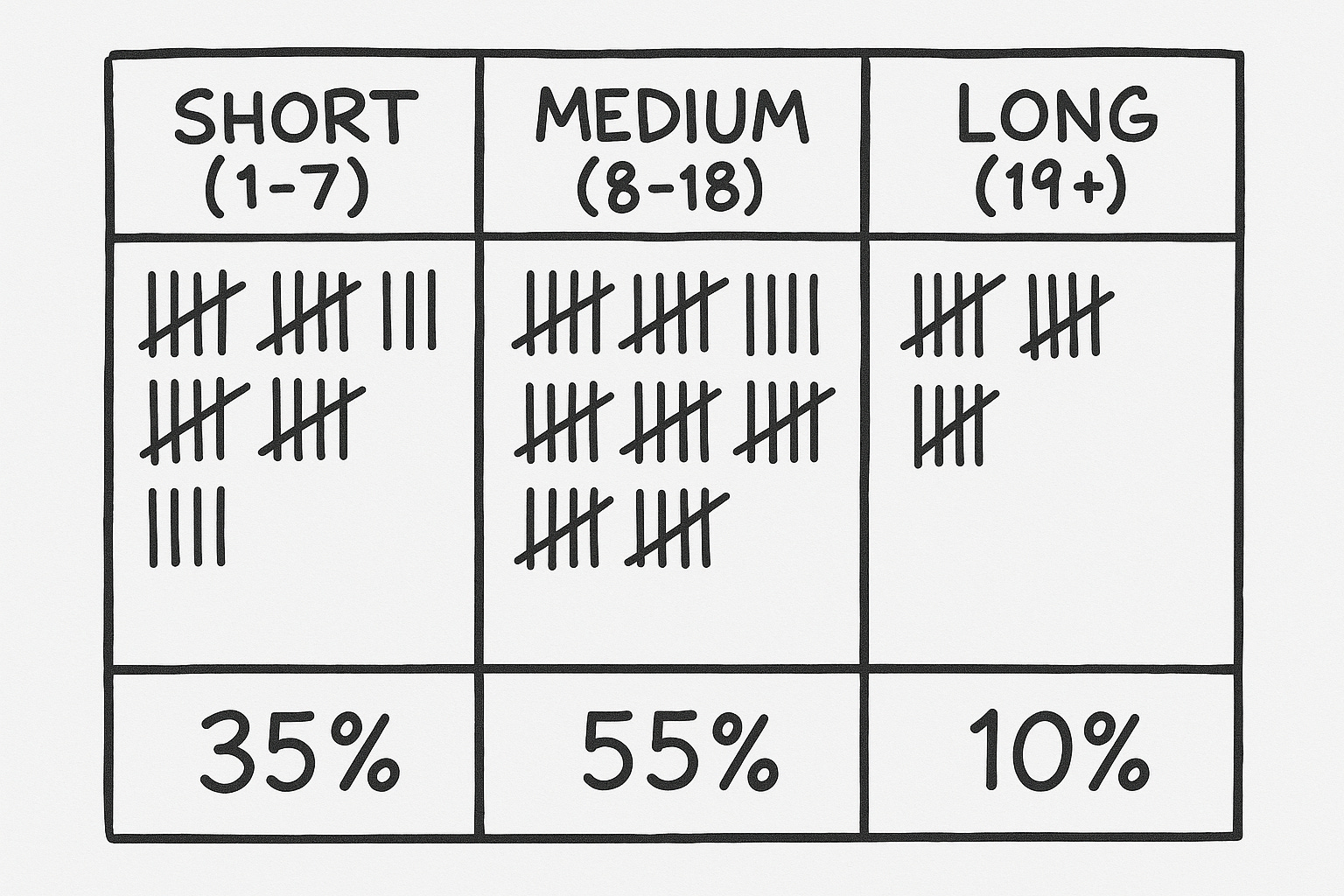
Go paragraph by paragraph. Tally how many sentences fall into each bucket:
Short: 1-7 words
Medium: 8-18 words
Long: 19+ words
Don’t count precisely. Ballpark is fine. You’re looking for patterns, not data for a peer-reviewed study. Nobody’s going to check your math. (And if they do, you have bigger problems than sentence length ratios.)
Step 2: Repeat for pieces two and three.
Step 3: Calculate your rough ratio.
Add up your tallies across all three samples. What percentage falls in each bucket?
Example result: “55% medium, 35% short, 10% long”
What This Tells You:
Heavy short sentences = punchy, declarative style. You make points and move on. No hand-holding.
Heavy medium sentences = explanatory style. You develop ideas within sentences, letting thoughts breathe a bit before closing them off.
Heavy long sentences = complex, layered style. You build through clauses, stacking ideas, letting readers hold multiple threads simultaneously. (This can be brilliant or exhausting depending on execution. You know which yours is.)
Most writers skew medium with a secondary tendency. Knowing yours means you can tell AI what ratio to target—instead of hoping it guesses right. Spoiler: it won’t guess right. It’ll default to monotonous medium-length sentences that put readers to sleep.
Write down your ratio now.
Mine is roughly 35% short, 50% medium, 15% long. Heavy on the punchy, light on the complex. Yours will be different. That difference is the point.
Part 2: Sentence Starters (6 minutes)
Reset your timer.
Step 1: List the first word of every sentence in your first piece.
Just the first word. Make a quick list down the page. This feels tedious. It takes three minutes. You’ll survive.
Step 2: Look for repetition.
Which words appear more than twice? Circle them.
Common patterns to watch for:
“I” — first-person dominant (you center yourself in the narrative)
“The” — noun-leading (you let content lead rather than personality)
“But/And/So” — conjunction starters (you write like you talk—this is mine)
“This/That” — reference-heavy (you build on previous statements)
“?” — question-leading style (you engage through inquiry)
Verbs — command/imperative style (”Try,” “Notice,” “Consider”—very teacher-voice)
Step 3: Check pieces two and three.
Do the same starters repeat across samples? Those are your defaults. The patterns that persist are the patterns that matter.
What This Tells You:
Heavy “I” starters = personal, perspective-driven. Your personality is the through-line.
Heavy conjunction starters = conversational flow. You write the way people actually think—in connected ideas, not discrete statements. (English teachers hate this. Readers love it.)
Heavy noun starters = content-focused. You let ideas lead rather than yourself. More objective energy.
Mixed starters = varied rhythm. You instinctively avoid monotony, which means you probably have good instincts. Trust them.
Write down your top 3-4 starter words and their approximate frequency.
Part 3: Signature Structures (7 minutes)
Reset timer. This is where it gets interesting. (Parts 1 and 2 were appetizers. This is the main course.)
Step 1: Scan for repeated structures.
Not repeated words—repeated shapes. Read through your samples looking for sentences that follow the same architecture.
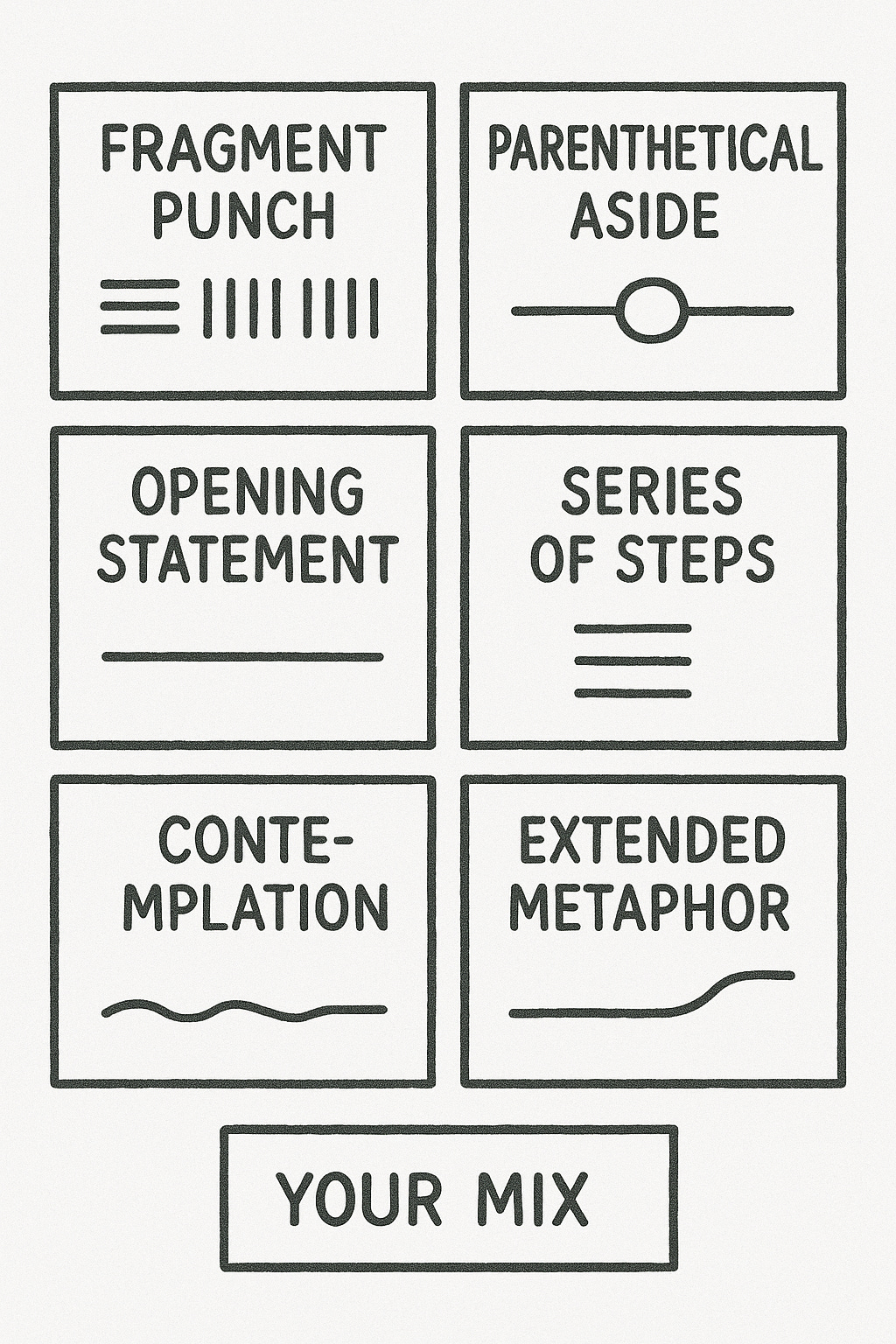
Here are six common signature structures. You probably use 2-3 of these regularly without realizing it:
The Fragment Punch:
Short sentence. Fragment. Another fragment. Then explanation.
The Parenthetical Aside:
Main point (with tangent or clarification tucked inside) continues here.
The Colon Setup:
Setup statement: payoff or expansion follows.
The Contrast Pivot:
One thing is true. But/Yet/However the opposite thing.
The Question-Answer:
Rhetorical question? Immediate answer.
The Rule of Three:
First thing. Second thing. Third thing.
(I lean hard on Parenthetical Asides. Probably too hard. It’s a problem I’m aware of but haven’t fixed because—honestly—I kind of like it.)
Step 2: Mark every instance where you use one of these (or spot your own pattern).
You might discover a signature structure that’s not on this list. Good. That’s yours. Name it something memorable.
Step 3: Identify your top 2-3 signatures.
Which structures appear multiple times across samples? Those are yours. The fingerprints you leave on everything you write.
What This Tells You:
Your signature structures are your most recognizable patterns. Readers feel them even if they can’t name them. It’s like recognizing someone’s laugh from across a crowded room—you know it’s them before you see them.
When AI writes without knowing your structures, it defaults to its own. Which are the same structures it uses for everyone. Which is why AI content has that sameness—it’s not just word choice, it’s architectural monotony. Same sentence shapes, over and over, for every writer it “helps.”
Write down your 2-3 most common structures with an example of each from your writing.
Mine: Parenthetical asides (constant—see above), Fragment emphasis (frequent), Contrast pivots (moderate). Knowing this means I can tell AI “use parenthetical asides to inject personality” and it actually knows what I’m asking for.
Your Tempo Profile
Congratulations. You’ve just done something most writers never do: examine the machinery of your own voice.
You now have three documented components:
Length ratio: ___% short, ___% medium, ___% long
Starter defaults: Top words you begin sentences with
Signature structures: 2-3 architectural patterns you repeat
That’s not mood. That’s not vibes. That’s mechanics.
And mechanics can be taught to AI.
Using This With AI
Here’s a prompt template that incorporates your documented Tempo:
Write [CONTENT TYPE] about [TOPIC].

Match these Tempo patterns from my writing:

SENTENCE LENGTH MIX:
- Approximately [X]% short sentences (1-7 words)
- Approximately [X]% medium sentences (8-18 words)
- Approximately [X]% long sentences (19+ words)

SENTENCE STARTERS:
- Frequently start with: [your top starters]
- Vary starters to avoid monotony

SIGNATURE STRUCTURES I USE:
- [Structure 1]: [brief description or example]
- [Structure 2]: [brief description or example]
- [Structure 3]: [brief description or example]

Write a draft that follows these rhythm patterns.
Paste your documented patterns into this template. Save it somewhere you can grab it. (I keep mine in a note called “Voice Stuff” which is not a sophisticated system but it works.)
The Template
Copy this and fill in your findings:
MY TEMPO PROFILE

Completed: [Date]
Based on: [List your 3 sample pieces]

LENGTH DISTRIBUTION:
- Short (1-7 words): ____%
- Medium (8-18 words): ____%
- Long (19+ words): ____%

DOMINANT STARTERS:
1. [Word] - [frequency: often/sometimes/occasionally]
2. [Word] - [frequency]
3. [Word] - [frequency]
4. [Word] - [frequency]

SIGNATURE STRUCTURES:
1. [Structure name]
   Example from my writing: “[paste example]”

2. [Structure name]
   Example from my writing: “[paste example]”

3. [Structure name]
   Example from my writing: “[paste example]”

NOTES:
[Anything else you noticed about your patterns]
Want the Worksheet Version?
I put together The Tempo Extraction Worksheet—a PDF version of this exercise with:
The complete exercise on one page (no scrolling back and forth)
A fillable Tempo Profile template with examples showing what “good” looks like
A Signature Structures reference card (all six patterns defined)
The AI prompt template ready to paste
[Download the Tempo Extraction Worksheet →]
Free for subscribers. Takes the same 20 minutes, just easier to work through offline with a pen in hand.
What’s Next
Tempo is one of four layers in what I call VAST—the complete map of your writing voice:
Vocabulary — The words you choose (and the ones you’d never use)
Architecture — How you organize ideas
Stance — How you position yourself relative to readers
Tempo — The rhythm of your writing (you just documented this)
Tempo is the most tangible layer. It’s where you can literally count patterns. But—and this is important—it’s not where AI drifts hardest.
That would be Stance. The layer that determines whether you sound like a peer sharing what you’ve learned or a guru dispensing wisdom from on high. AI defaults to guru. Always. If your actual voice is peer-to-peer (mine is), Stance drift will make your content feel wrong even when the Tempo is perfect. You’ll read it and think “technically this matches my patterns but it sounds like a completely different person wrote it.”
We’ll get there. For now, you’ve got your Tempo documented. That’s one layer of four—and it’s the foundation the others build on.
Voice isn’t mystical. It’s mechanical. And mechanics can be documented, taught, and replicated—by you editing your own work, or by AI working alongside you.
What surprised you most about your Tempo patterns? I’m genuinely curious which signature structures showed up—and whether you discovered one that’s not on my list. Drop it in the comments.
Crafted with love (and AI),
Nick “Vibes Are Not Voice” Quick

PS…If you actually do this exercise, screenshot your Tempo Profile and share it. I’m building a collection of patterns to see what signatures cluster together. (Early hypothesis: heavy parenthetical users also tend toward conjunction starters. Prove me wrong.)