
How to Get a Silent Chat Talking (Then Get It to Run Without You)
The exact prompts that pull replies, a weekly rhythm a solo writer can actually keep, and the plays that turn a quiet room into one that carries itself.

You posted in your Chat. “Hey everyone! What’s everyone working on this week?” Then you refreshed for ten minutes while forty subscribers said nothing and the only reply came from a bot trying to recruit you into a Telegram pump ‘n dump group.
Yesterday I made the case for why Substack Chat earns its keep (retention, not growth, the room where casual readers turn into people who’d feel a loss if they left). Today I stop philosophizing and hand you the playbook. Three plays. The prompts that pull a silent room into conversation, the weekly rhythm you can run without it becoming a second job, and how the room starts talking when you’re not even there.
Why Your Openers Keep Getting Crickets
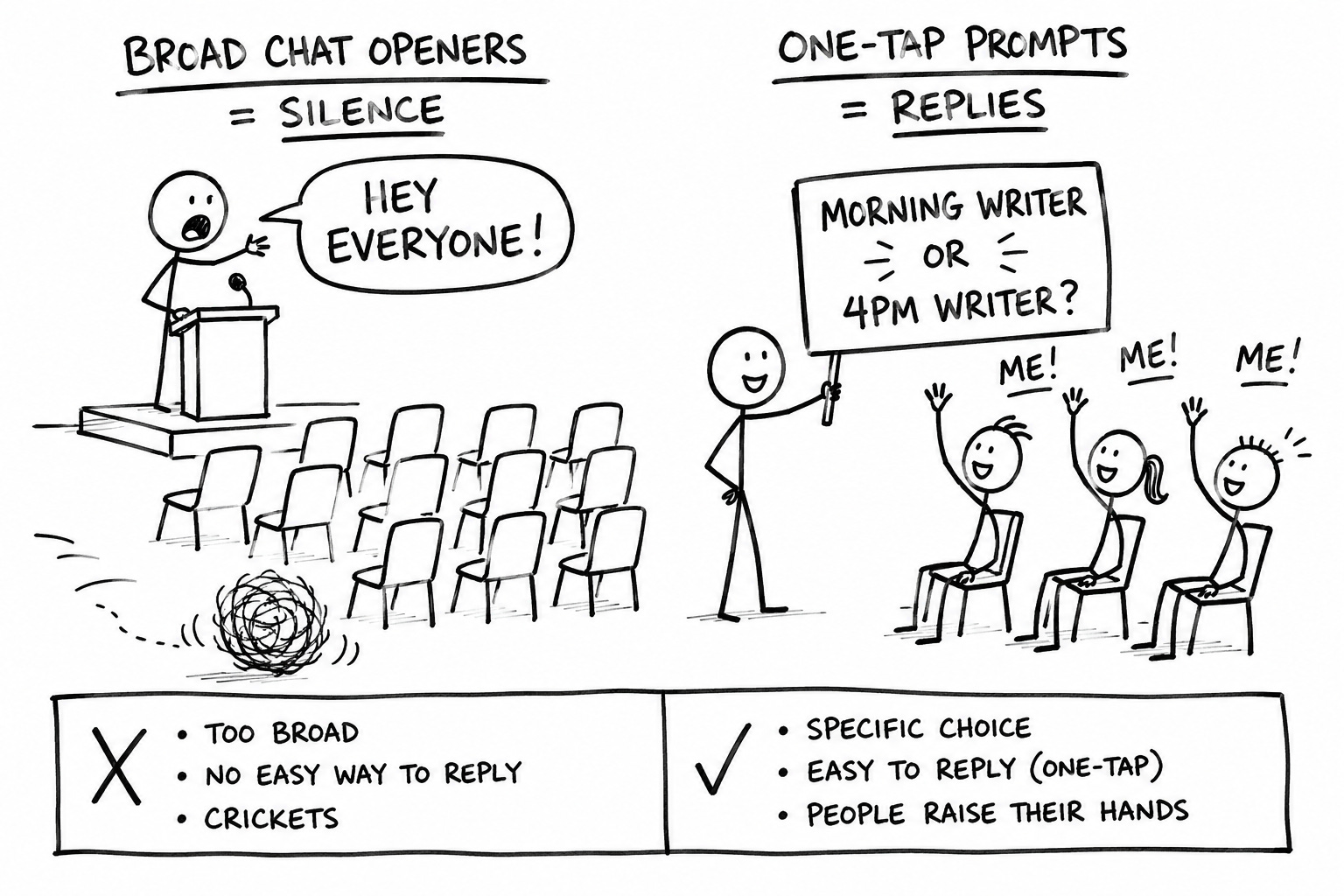
Most Chat prompts get silence for the same three reasons, every time.
They’re too broad. “What’s on your mind this week?” is not a question. It’s a blank page with a cursor blinking at someone who came to Substack specifically to escape blank pages.
They sound like a substitute teacher. “Hey everyone!” is what you say when you’re addressing a room you can’t name a single person in, cranking the cheer to cover for not belonging there yet.
And they ask for labor. Anything that needs a reader to compose a paragraph, dig up a link, or actually think hard gets filed under “later”… And “later” always means “never.”
A good Chat prompt is answerable in one line, on the spot, by someone holding their phone in a grocery line. You’re not asking for an essay. You’re handing them a slot to fill.
(Worth saying out loud, because people blur these constantly: Chat is not Notes. Notes are a public broadcast aimed at strangers in the feed. Chat is the room your subscribers already walked into. You can be more insider, more familiar, more “you already know me” in here. Different surface, different voice.)
Here are openers you could post today. Notice they all give the reader an easy thing to grab, and notice that you go first every time. The room mirrors the host. If you want replies, model the reply.
“Quick gut check. Morning writer, or ‘one more coffee and suddenly it’s 4pm’ writer? I’m aggressively the second one.”
“Finish this. The one AI phrase that makes me want to launch my laptop across the room is ______.”
“I’ll start. 212 articles saved to ‘read later’ that I know I’ll never read. What’s your number? Just the number.”
“Drop one Substack you read that nobody’s talking about yet. I’ll leave a comment on each of their latest posts.”
“One word for how your writing week went. I’ll go first: feral.”
The “drop one Substack” move does something sneaky and good. It makes the reader the expert for a second, which feels great, which is exactly the feeling you want them associating with your room.
Then reply to every single person who bites. Not “love this.” React to a specific line, extend their point, complicate it gently, or ask one narrow follow-up. (Those are the same four moves that win you a stranger’s attention in the comments, which I broke down in Good Writing Doesn’t Get Found. People Find People. The room is just where you run them on people who already chose you.)
A Rhythm You Can Run In The Grocery Line
The two ways to wreck a Chat are equal and opposite. Treat it like a second newsletter and you burn out by week three. Treat it like a pitch channel and the room mutes you by week two. Same self-inflicted bullshit, different costume.
The fix is daily presence, not daily posting. Those are two different jobs.
Here’s a week a solo writer can actually keep.
Early week, drop one conversation starter from the list above. Two minutes.
Midweek, give them access to something. A screenshot of your mess. A line you cut and why. A thing that broke. No question required. People respond to being let into the room behind the room.
End of week, run your ritual (more on that in a second).
And every day in between, the only real work: scan what came in and reply. Same day if you can. This is five minutes, not fifty.
Put it on a rhythm so you’re not relitigating “should I post today” every single morning. I’m a broken record about building writing habits on consistency instead of inspiration, because inspiration is a flake and consistency shows up even hungover (the whole case for ritual over willpower is 30 Minutes, Same Prompt, Every Sunday).
One discipline holds the entire thing together. Give roughly eight to ten times before you ask for anything once. If you run three threads a week, that’s nearly a month of pure giving before you’ve earned a single “by the way, paid subscribers get the templates.” Most people invert that ratio and then act surprised when the room treats them like a guy handing out flyers at a silent meditation retreat.
The Day You Go Quiet And It Doesn’t
Everything so far still has you holding the room up. The goal is a room that holds itself up. That starts the moment readers begin talking to each other instead of only to you.
You engineer it on purpose.
Introduce people. When two readers are circling the same problem, say so out loud. “Devon, you need to see what Maria said about this last week.” You become the connective tissue, then you step out of the middle of the conversation you just started.
Name your regulars. The ones who show up every week, call them by name, reference what they said last time. Recognition is the easiest yet strongest retention move there is. Someone who knows your name is in orbit. Someone whose name you know back is on their way to the center.
Run one recurring thread. Same prompt, same day, every week. “Friday confession.” “What broke this week.” Rituals do the work random posting can’t fake, because the room starts showing up before you post. They know it’s coming. That’s when the thing develops its own pulse.
Then comes the step-back. Once the regulars are talking to each other, you climb down out of the lifeguard chair. You post less and react more. You let a question sit for an hour without your answer, because someone in the room will answer it first. They always do, once they stop treating the room like it’s yours and start treating it like theirs.
That progression has a shape. Close (they know your name) becomes core (genuinely invested, they buy, they open up) becomes the people who’d notice you were gone. The ones who’d reply to a missed week with “everything okay over there?” That’s not a number on your dashboard. It’s the entire reason the room exists.
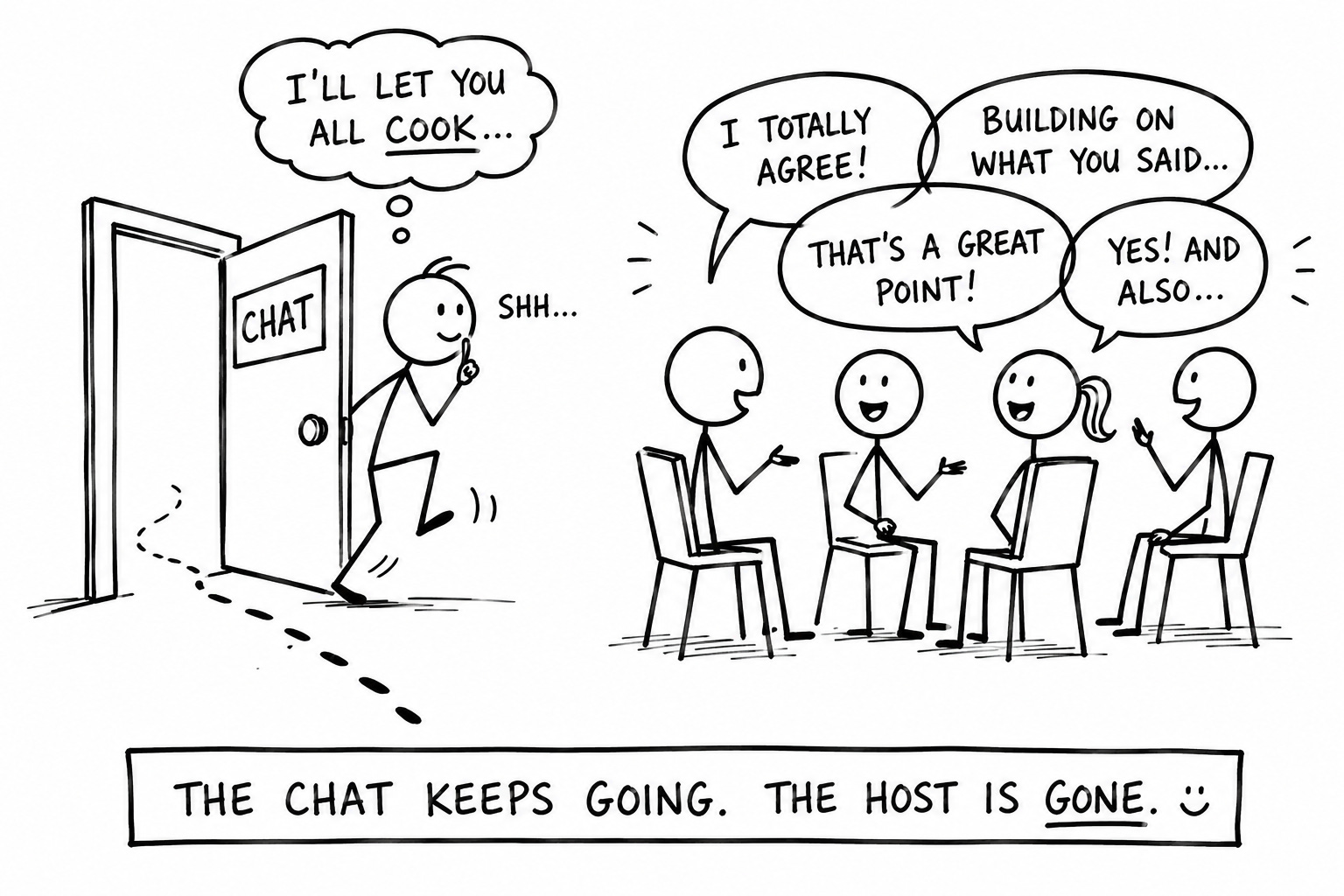
It’s not that the room runs without you. It’s that you’ve baked enough of yourself into it that it keeps its own heartbeat between your visits.
A subscriber list is a stack of permission slips. A Chat that talks back is a place people belong. The work is small, daily, and deeply unglamorous, and it’s the closest thing to a moat a solo writer on Substack ever gets.
Crafted with love (and AI),
Nick “Off-Duty Chat Lifeguard” Quick

PS... got a writer friend whose Chat tab has tumbleweeds rolling through it? Forward this. They’ll either thank you or quietly resent you. Both count as engagement.
PPS... I’ve been quietly helping a few clients jump-start their Substacks, and I packed what actually works into one guide. Want your first 500 subscribers, or just want to bolt 500 more onto what you’ve already got? Hit reply (or flag it in the comments) and it’s yours. No funnel. I’m too tired to build a damned funnel right now.
I am about to try these Notes as a test... let's see ...
I'll take that guide :-)