

The New York Times sent its freelancers a memo this week that read, roughly: think about even touching AI to draft anything in a story, and you stop being one of our freelancers. Forty-eight hours later, TikTok launched a server that lets AI agents plan, launch, and optimize ad campaigns while everyone nominally responsible for them is asleep, at champagne brunch, or otherwise pretending to have a personal life.
Same week. Two organizations. Two policies that look opposite if you tilt your head and squint.
(They’re not opposite. Same direction, viewed from two ends of a long hallway. Bear with me.)
Both companies wrote down what AI was and was not allowed to do, in operational language a child could enforce. The Times put it in a memo. TikTok put it in code. Both did it.
The rest of us said “human in the loop” a hundred times this year and called it a policy.
(The way a kid in a Halloween costume tells you he’s a doctor. Very confidently. While holding a plastic stethoscope. Diagnoses entirely vibes-based.)
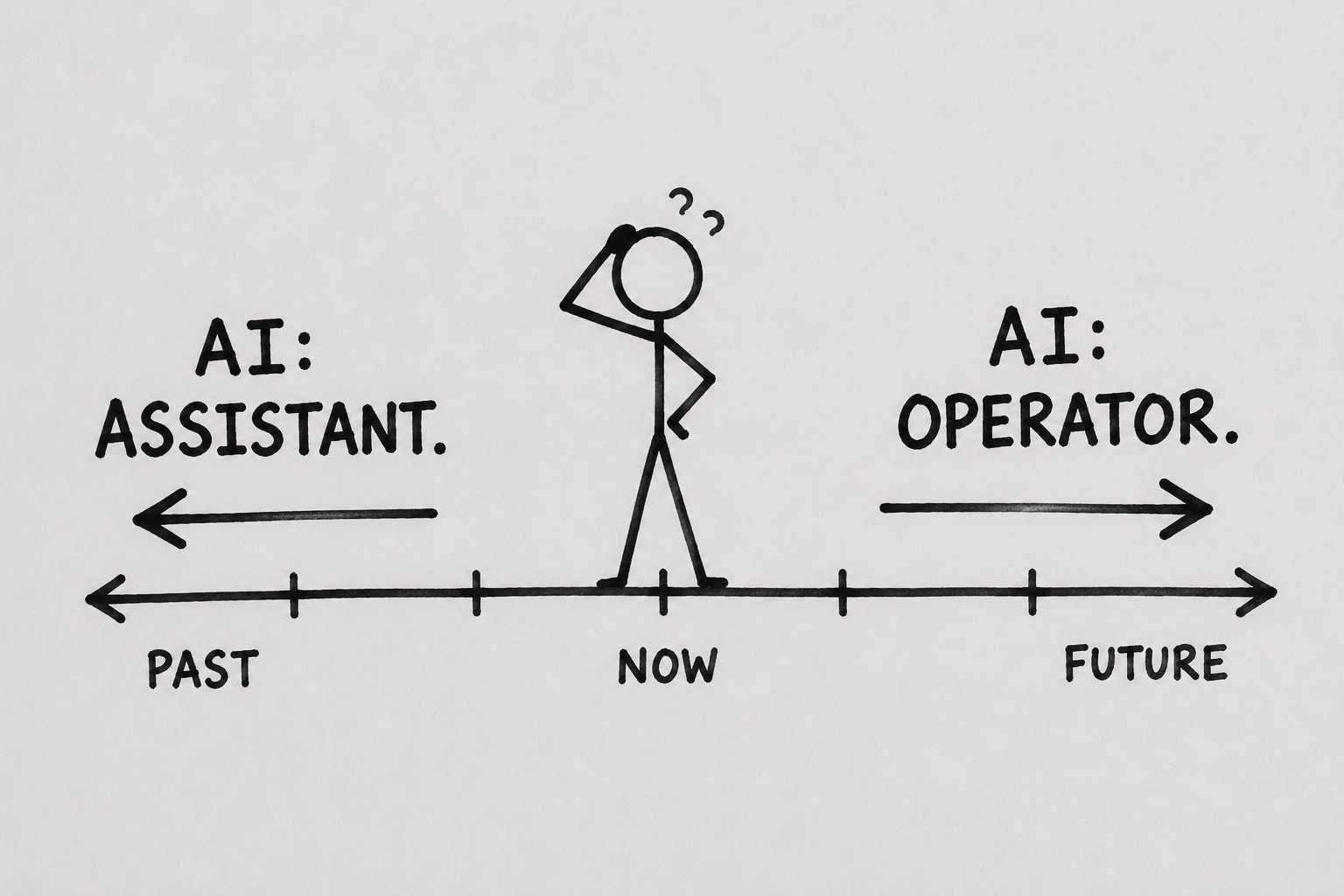
The Subtle Shift Nobody Sent You a Memo About
For two years the AI debate was about whether using it made you a phony. Should you let it write the post. Should you let it ghostwrite the email. Should you let it touch your work at all, or should you do the noble thing and spend Saturday morning grinding out a Substack essay by hand like a Victorian governess polishing a candlestick.
That debate ended a while ago.
The answer was yes, most of you do, all of you will, and the moralizing has the energy of a parent forbidding booze at a frat house six hours into a raging kegger.
(I was one of the moralizers. About six months, all told. It is embarrassing in retrospect, which is the only reason I’m putting it in writing. Free your Saturday. Skip my mistakes.)
While everyone argued about whether using AI was cheating, AI secretly took the next floor of the building. The campaign layer. The publish-button layer. The layer where decisions used to require a coffee and an argument. TikTok’s MCP server is one example. Picsart’s agent marketplace was another. Adobe rolled out custom Firefly models last quarter. Cloudflare predicts bots will outnumber humans online by 2027, which is the sort of statistic you read once and decide you will think about later, when you have more bandwidth, or possibly a stronger drink.
(I think about it constantly. It is not a fun statistic. There is no fun statistic in this paragraph. Moving on.)
AI is not your assistant anymore. It is the operator of the systems you used to run yourself, and most of you haven’t noticed, because the operator is polite, prompt, and doesn’t ask for raises.
Which means the skill that mattered most for the last two years just got demoted while you were looking the other way.
The Dead Question (May It Rest In Peace)
“Should creators use AI?” is a dead question. We should let it lie in the road like the small dead possum nobody is willing to bury.
The question was always shaped wrong. It treated AI like a moral test instead of a tool, which is the kind of category error you make when you have never actually used the thing you are moralizing about. The honest answer was always “some of us, in some ways, depending on the work.” Now even that answer is irrelevant, because the option in front of you is no longer “AI yes” or “AI no.”
It is “AI you noticed” or “AI you didn’t.”
(Most creators have not priced this into the conversation. They’re still trying to decide whether to invite AI in. AI is already in. It has been refilling its coffee from the breakroom for months. It learned everyone’s birthdays. It made a joke about your manager that everyone laughed at. It is, in every meaningful sense, on the team. The question of whether to invite it has roughly the same relevance as a homeowner debating window installation while the house is, factually and on multiple counts, on fire.)
The live question is sharper and considerably less comfortable.
Which parts of the work must remain yours?
Most creators have never written that answer down. They’ve delegated by default, then noticed six months later that their work started feeling slightly less like them, and slightly more like a sequence of polished paragraphs any reasonably motivated intern with a stable WiFi connection could have produced.
(I have a version of this DM conversation roughly once a week. It always starts the same way. “Hey, weird question.” It’s never weird. It’s always the same question. They’re asking why their voice softened, and they cannot point at the week it happened, and that’s the part that worries them more than the actual softening.)
There’s a name for what’s missing. Two names, actually, sitting on top of each other like a layer cake nobody asked you to bake.
Voiceprint and Vetoprint
Voiceprint documents how you write. Vetoprint documents what you refuse to outsource.
(Both are forms of refusal you write down before you needed them. The pre-emptive “no” is the only kind of “no” AI can hear, because AI doesn’t ask. AI just does, and waits patiently for you to either notice or ignore. It is the world’s most patient employee. Also the most easily promoted past your competence level.)
Voiceprint protects against voice drift. Without it, AI sounds less like you over time, and you keep approving the work anyway.
Vetoprint protects against decision loss. Without it, AI starts making decisions for you over time, and you keep approving them because each individual decision is technically fine.
(There’s a pattern here, and the pattern is this: technically fine kills more careers than catastrophically bad. Catastrophically bad you can see. Technically fine just slowly takes your hand off the wheel while texting that friend who did ayahuasca in Peru to ask if the visions ever stopped.)
Your Vetoprint has three zones, each one named after the thing AI is allowed to do inside it.
Allowed. AI may suggest. Freely. Brainstorms, options, first passes you will throw away, news scanning, subject-line variants you will read once and never think about again. This is the low-stakes labor where AI is genuinely useful, in the way an intern is useful. You didn’t hire the intern for their opinions on the human condition. You hired them so you’d stop having to alphabetize your spice rack at 11pm.
Supervised. AI may write a first version, but a human touches every word before it ships. The rule has to be specific. “I’ll review it” is what people say when they want to feel like they have a rule but don’t actually have one yet. Be specific. Use verbs. Something like “I rewrite the opening and closing paragraphs every time, and I cut every adjective AI added that I wouldn’t have used.” If you can’t name what you would change, the task doesn’t belong in this zone. It belongs in Allowed (if it’s throwaway) or Never (if it’s yours).
Never. AI may not decide alone, no matter how convincing the output. The final voice pass. The decision to publish. The opinion you stake your name on. The line you won’t cross. The Never list is the spine of the whole damn thing, and the only reason the other two zones don’t expand until your byline is mostly punctuation.
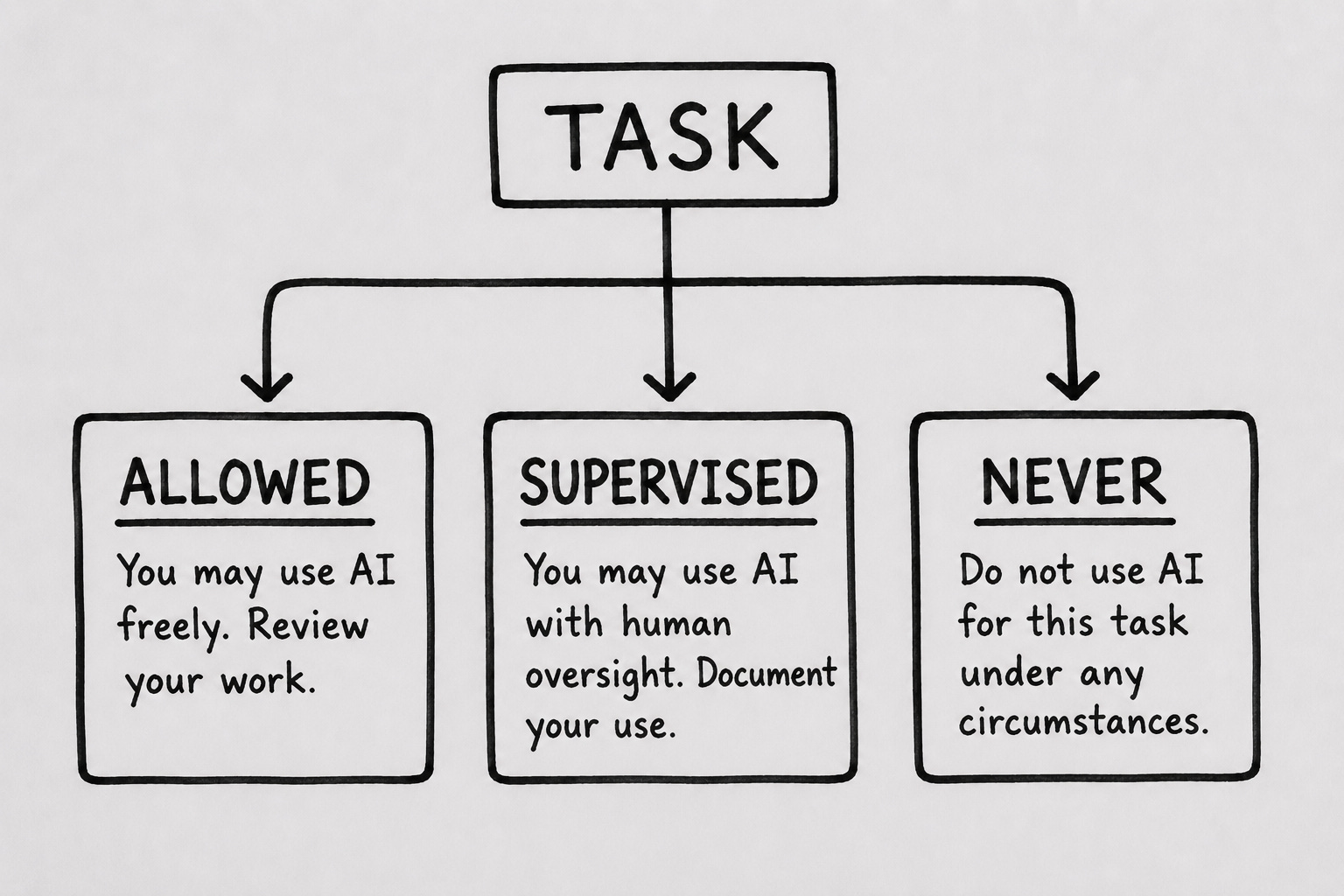
Most creators will tell you, with confidence, that they keep a human in the loop. The phrase has gotten so much exercise this year it’s in better shape than most of the humans saying it.
But ask them what the loop is for. What it catches specifically. Where the veto points are. They can’t say. They haven’t written it down.
What they have is what we’re calling, in the trade, a parade. Pleasant to watch. Useful for keeping the streets cleared on a Sunday morning. Completely incapable of stopping anything.
The Slow Cost (Receipts Attached)
This isn’t theoretical. The receipts are already visible, and they’re not flattering.
The pattern is now visible in the data. Teams that delegated more decisions to AI over the past year saw productivity climb in the short term. Long term, the creative output went generic in a way nobody noticed until it had been generic for a while. The decisions you stop making are the muscles that stop working. Six months in, the team that ships fastest is also the team whose work reads like a LinkedIn post from a guy who just discovered “magic of storytelling” at a $4,000 retreat.
Google ran a parallel experiment from the other side of the wall. Their quality threshold is now sharp enough to detect what taste used to detect. Scaled AI content with nothing behind it is being filtered out of search results, covertly, in the way the bouncer at a good club waves through the regulars and stops the guys who showed up in a group of nine wearing identical button-downs, matching broccoli cuts, and one cologne between them.
(I noticed the same drift in my own work before I had a name for the fix. Three months of work that read like a slightly more confident version of nobody in particular. I couldn’t point at the week it started. Which is the part that should worry you more than the drift, because nothing tells you it’s happening. There’s no alert. No light blinks. The work just stops being yours, one decision at a time, and your inbox gets nicer, your DMs get duller, and your sense that you used to write differently gets harder to put a finger on. It sucks. Quietly.)
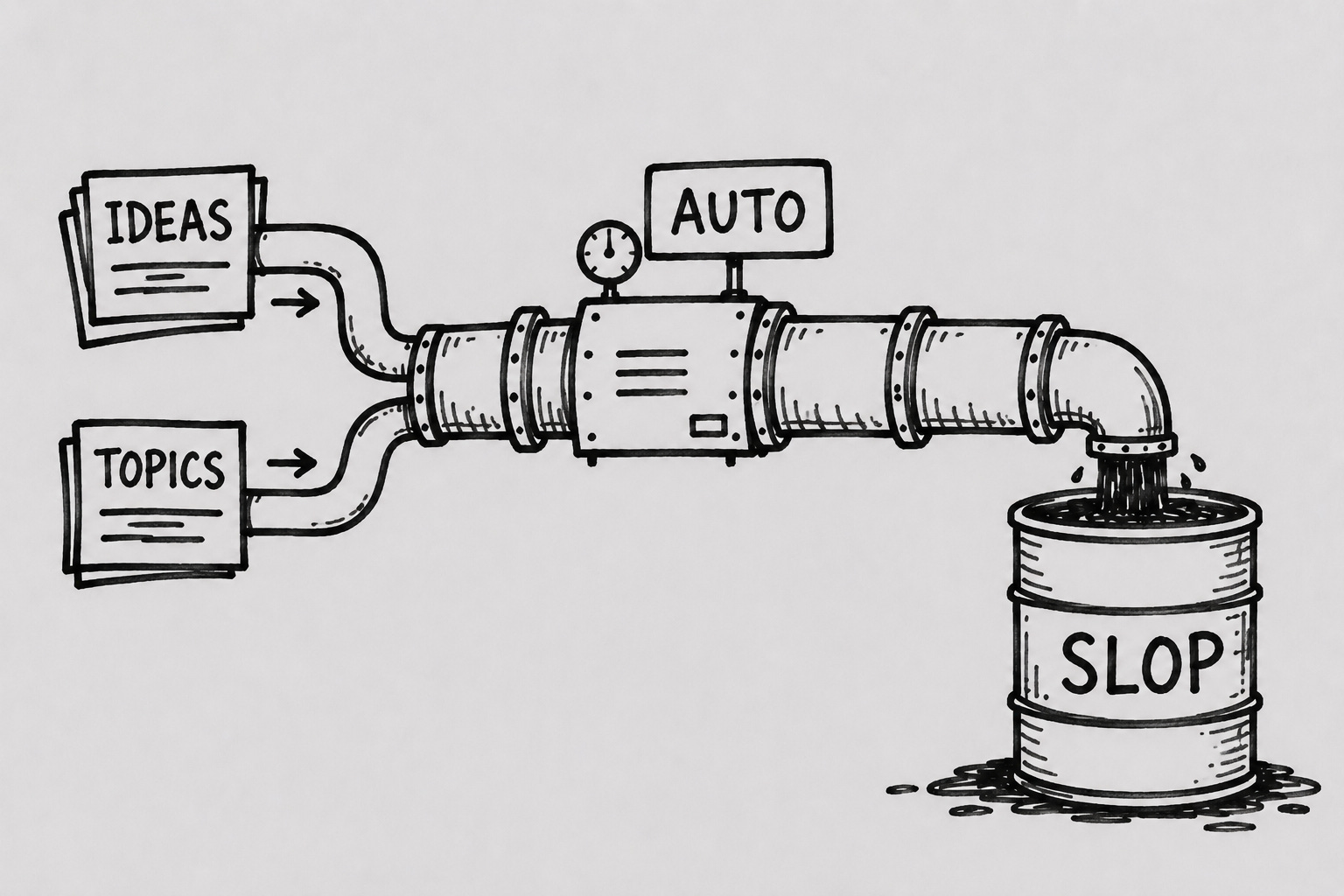
This is what ensloppification looks like as a workflow problem. Slop is downstream of veto failure. It happens when nobody said no at the right moment in the workflow, and the workflow kept going because workflows don’t pause themselves. They run until something stops them, and a phrase isn’t a stopping mechanism. A phrase is a polite suggestion the machine will hear, smile at, and ignore.
The cost of delegating decisions you should have kept isn’t visible the day you delegate them. It shows up six months later, when the work no longer sounds like you, and the only person who notices is the reader who used to come back, who has now found someone else, because their attention is finite and the world is full of options.
(That last part is what the data is actually telling you. AI didn’t get good enough to take your readers. You got loose enough with your decisions to let them go. There’s a difference, and the difference matters, because one of those problems compounds and the other one solves itself.)
Three Lines. Twenty Minutes. The Rest of Your Career.
Write your Vetoprint this week. It takes twenty minutes the first time. Less every time after, because the document gets richer once you start using it.
Three lines is enough to start.
Line one: what AI may suggest freely. The throwaway stuff. The brainstorms. The first draft of things you would’ve rewritten from scratch anyway.
Line two: what AI may draft if a human cleans every word before it ships. Be specific about what “cleans” means. (“I’ll review it” is not a rule. It’s the kind of thing people put in a Notion doc to feel organized and then never open again. Write the actual rule. Use verbs.)
Line three: what AI may never decide alone, regardless of how convincing the output. The voice pass. The publish call. The opinion. The line you never cross.
Pin it somewhere you’ll actually see it. Above your laptop. On a sticky note. Taped to the bathroom mirror, if you’re feeling theatrical about it.
(I keep mine on a sticky note. Sticky notes are deeply underrated. They survive screen wipes, software updates, OS migrations, and the periodic existential crisis where you reorganize your entire workflow at 2am and forget what you used to do. Sticky notes outlast strategies.)
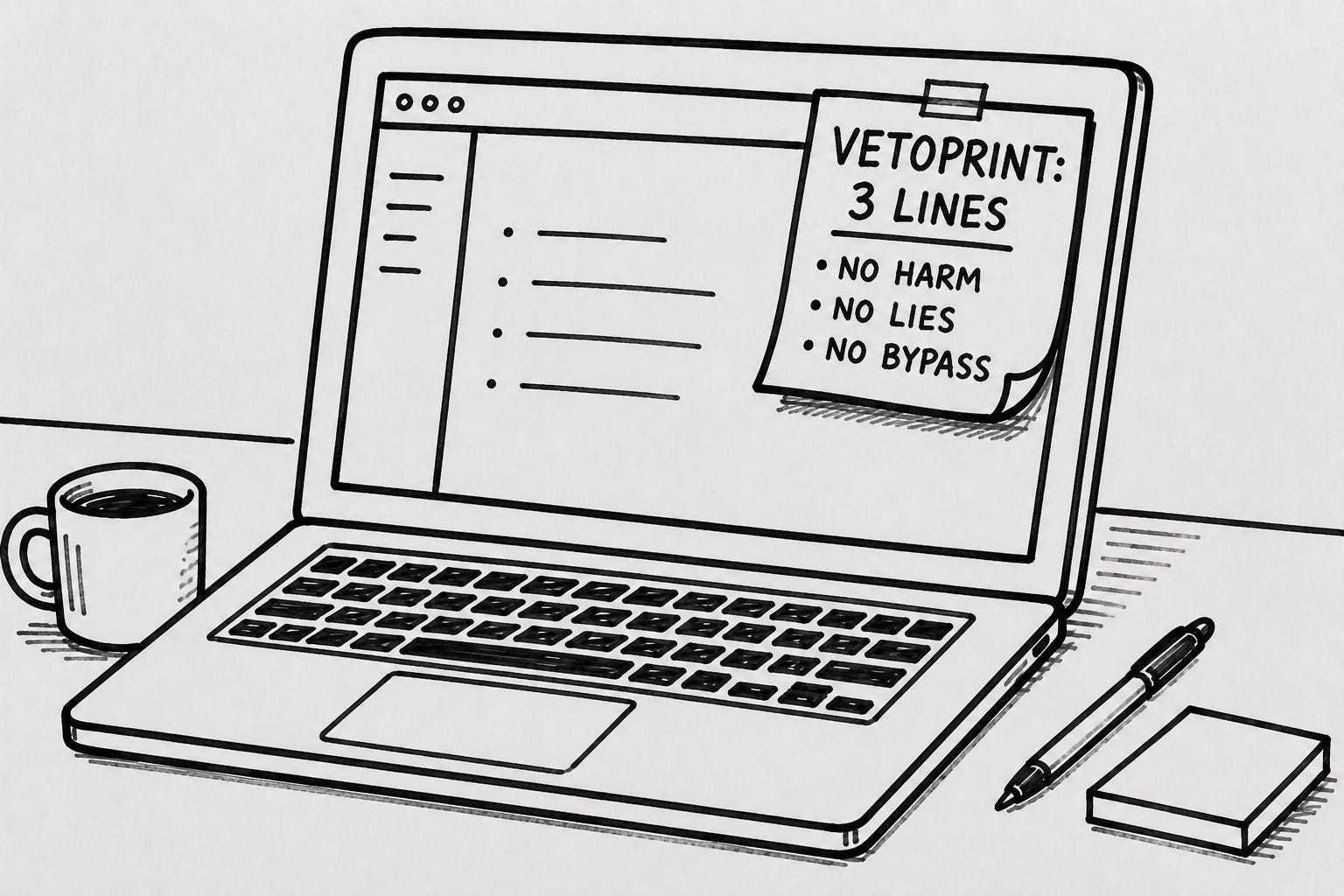
If twenty minutes feels like too much right now, do it in sixty seconds instead. Open a note. Write one sentence. “The one decision I refuse to let AI make for me is __________.” Fill the blank. That’s your seed. Everything else compounds from there, the same way every legitimate practice you’ve ever built compounded from one absurdly small first move.
The Platforms Already Decided. You're Late.
The New York Times wrote its Vetoprint into a memo. TikTok wrote the opposite policy into a server. Both decided. The platforms aren’t waiting for you, and they’re not asking for your input.
The creators who haven’t written theirs down are about to find out what they agreed to by saying nothing, which is historically the worst way to find out anything.
The skill that just replaced prompt engineering is the discipline of refusal. The discipline of saying no in writing, on a sticky note, in advance, before AI silently does the thing on your behalf. Practice it. The good news is the practice fits on a damned Post-it.
🧉 What’s on your Vetoprint? Drop the one thing you refuse to let AI decide for you, even if the output would technically be fine.
Crafted with love (and AI),
Nick “Patron Saint of the Damned Post-it” Quick

PS... Vetoprint is the workflow layer. Voiceprint is the voice layer. Both are forms of written refusal, sitting on top of each other like a tower nobody asked you to build but everyone secretly needed. The Quick-Start Guide walks you through the voice side, with VAST laid out for you to fill in. Grab it here:

PPS... I publish pretty much every day, which means I run experiments in public, several of which fail spectacularly enough to be entertaining. Free subscription gets you the running notebook of veto decisions, the ones I got right and the much funnier ones I got wrong. Know a creator who keeps saying “I really should write down my AI policy” and then doesn’t, and then says it again next month? Forward this. Twenty minutes of their week, returned to them with interest.
Spot on Nick!
My short summary of your article:
Use AI freely for labor.
Protect human judgment fiercely.
We talk so much about how to use AI better, but not enough about what we refuse to hand over. Thank you for sharing Nick🦩🩷