
My Writing Brain Atrophied. Here’s How I Fixed It.
A 10-minute test most writers can't pass anymore

I need to confess something, and I need you to not be weird about it.
Three months ago, I sat down to write a blog post. Simple stuff. Topic I’d been chewing on for weeks. Ideas practically composting in my skull, ripe and ready.
I opened a blank document.
And my brain produced the cognitive equivalent of dial-up static.
Not writer’s block. I’ve had writer’s block. Writer’s block is a dignified struggle, the tortured artist staring out rain-streaked windows, wrestling with the muse. This wasn’t that. This was reaching for a muscle and finding it had been replaced with room-temperature oatmeal.
I knew what I wanted to say. Vaguely. In a vibes-only sort of way, the way you know you want Thai food but couldn’t name a single dish if someone held a gun to your head. But the mechanism that translates “vague feeling” into “actual sentence structure”?
Gone.
Just... gone.
(I write about making AI sound human for a living. Which makes this next part extra humiliating. Like a personal trainer getting winded opening a jar of Kosher dills. The universe has a sense of humor, and it’s a real bastard about it.)
My fingers hovered over the keyboard. My cursor blinked. Mocking me. Little vertical line of judgment, blinking like, “Well? We doing this or what, chief?”
And my first instinct, my automatic, muscle-memory, Pavlovian-dog instinct, was to Alt-Tab to Claude.
“Help me outline an article about...”
I caught myself mid-prompt.
That’s when the horror settled in like a cold hand on the back of my neck.
I wasn’t using AI to polish my drafts anymore. I was using AI to have thoughts for me. Somewhere in the last eighteen months, I’d stopped being the driver of my own creative process and become a passenger. Sitting in the backseat. Watching the scenery blur past. Occasionally mumbling “turn left here, I think” while having no actual idea where we were going.
The robot was driving. I was just along for the ride.
And here’s the really fun part: I hadn’t even noticed the handoff.
The GPS Effect (Or: How We All Forgot Where We Live)
Here’s an analogy that’s going to haunt you for the rest of the week. Consider it a gift. You’re welcome. I accept payment in whiskey and spite.
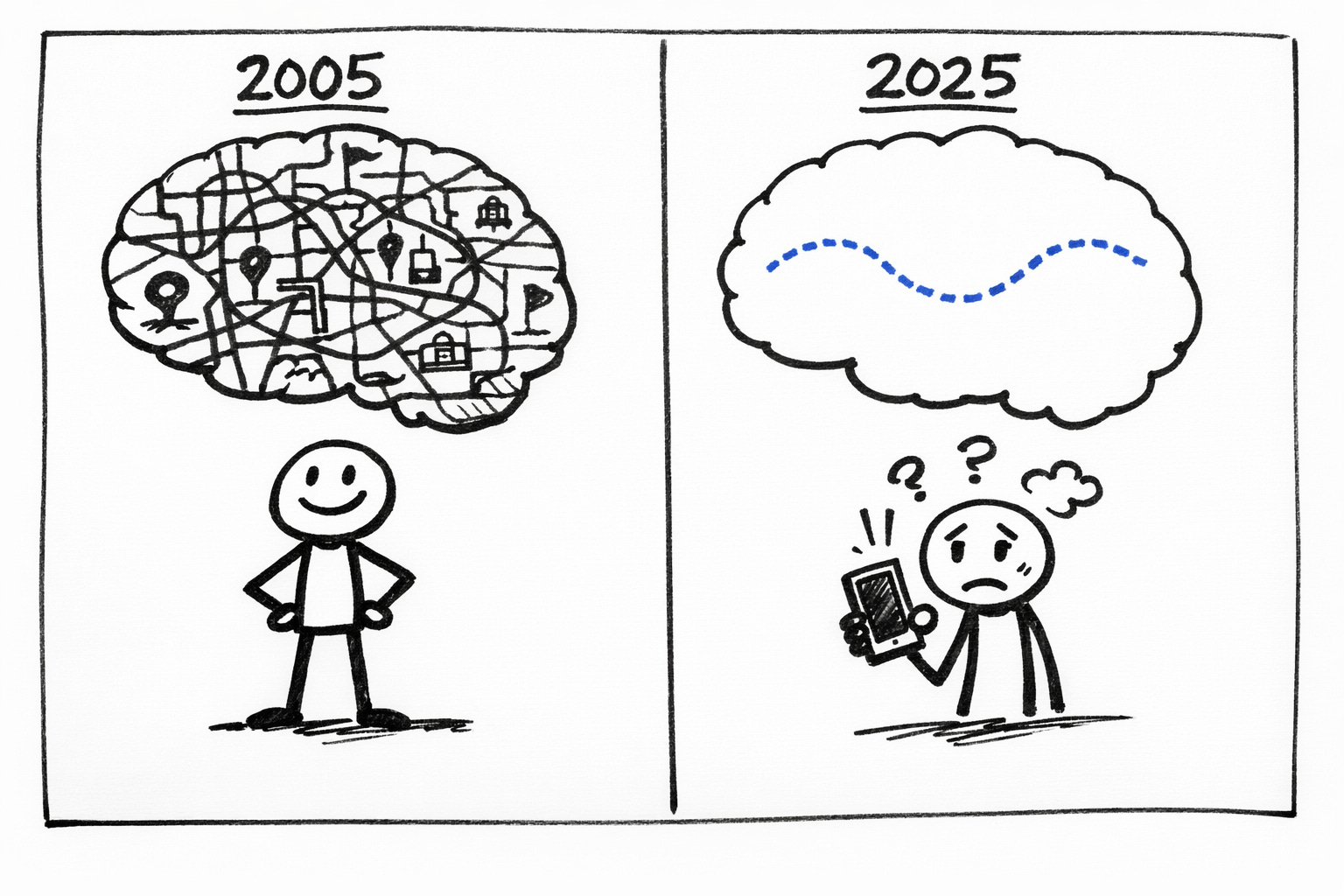
Cast your mind back to 2005. Before smartphones. Before Google Maps lived in your pocket like a concerned mother who always knows where you are and judges your route choices.
If you lived somewhere for six months, you knew it. You built mental maps. Actual neurological architecture dedicated to remembering that the weird yellow house meant turn left, the gas station with the creepy attendant meant you’d gone too far, and whatever you do, don’t take Maple Street after 5pm because that intersection is a war crime against traffic flow.
Now?
I’ve been bouncing around South American cities for fifteen years. Medellín. Lima. La Paz. Buenos Aires. Asunción now. Can’t sketch you a mental map of a single one. I follow the blue line to the coffee shop, the blue line to the gym, the blue line home. Fifteen years of cities that should be in me by now. Instead they just happened near me. GPS-coddled. Geographically numb. Experiencing cities the way luggage experiences airports.
I follow the blue line. The blue line is all I know. The blue line has become my entire relationship with physical space. My brain saw the blue line, decided “oh good, we don’t need to store this information anymore,” and repurposed those neurons for remembering song lyrics from 1993.
(Thanks, brain. Very helpful. I definitely needed to retain all the “words” to “Informer” instead of knowing how to navigate my own neighborhood. Licky boom boom down is really paying dividends in my adult life. Great prioritization.)
I’m about to say something annoying but true:
AI is the blue line for your brain.
It gets you to the destination. Faster, even. The finished post. The polished draft. The “content” you needed to ship yesterday.
But it robs you of the mental map.
You arrive at the destination with no idea how you got there. No memory of the route. No ability to retrace your steps. No understanding of the architecture of what you just created. Someone asks “how did you structure that argument?” and you stare at them like they asked you to recite pi to the fortieth digit.
We are becoming passenger writers.
We sit in the backseat while the machine drives. We think we’re traveling somewhere. We’re just being carried. And carried people, given enough time, forget how to walk. Then they forget they ever could walk. Then they get defensive when someone suggests walking was ever an option.
“I’ve always been carried. Carrying is efficient. Why would anyone walk when carrying exists? Walking is for people who can’t afford carriers.”
Meanwhile their legs turn to linguine.
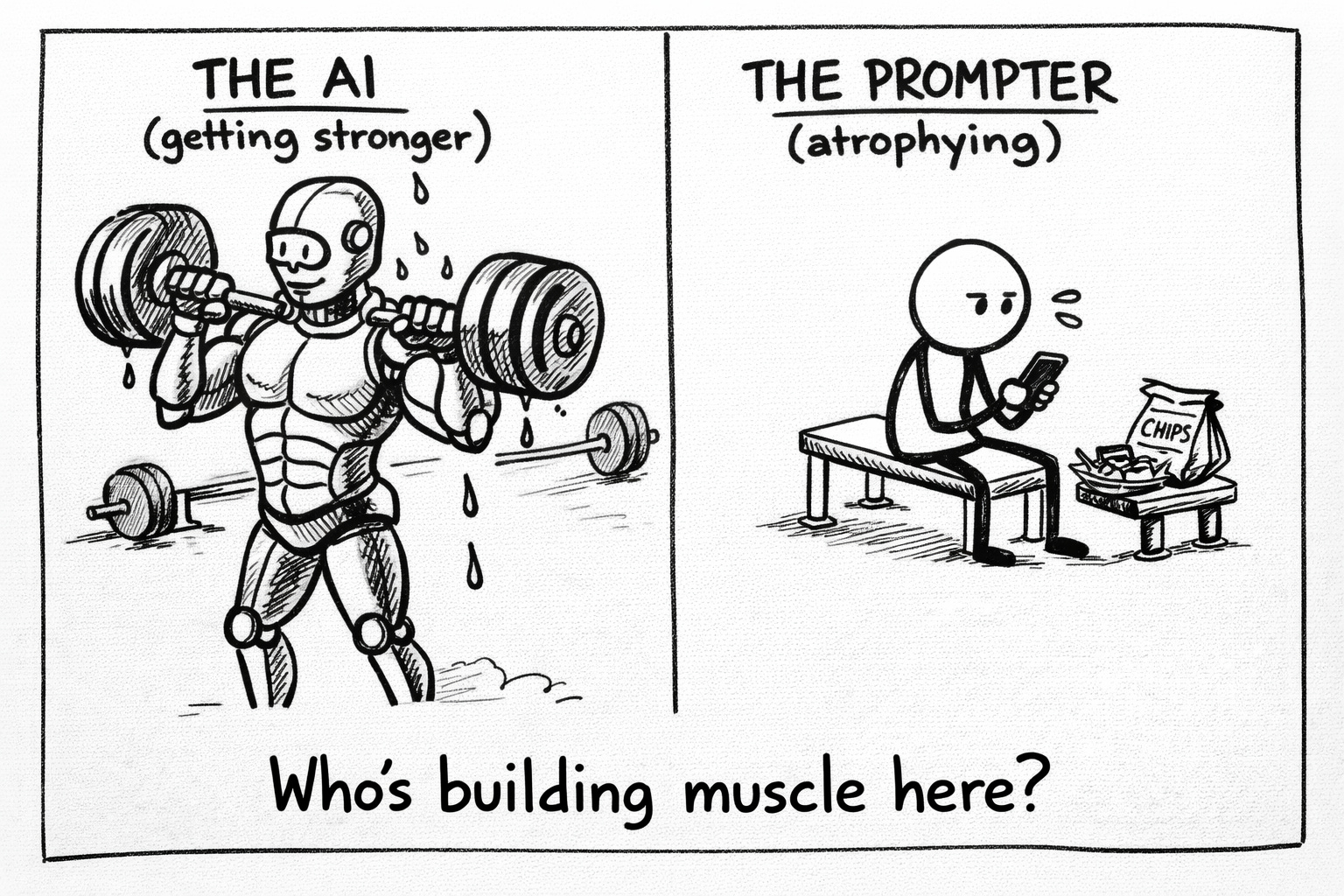
The machine gets stronger. We get weaker. And nobody notices until they need to stand up.
The Physiology of Thinking (Or: The Gym You Stopped Going To)
Let me get obnoxiously precise about something for a second. Pour yourself another drink. This is the part where I ruin your afternoon.
There is a difference between Text and Writing.
Text is the product. The words on the page. The deliverable. The thing your editor sees.
Writing is the process. The cognitive act of wrestling vague, half-formed, mostly-vibes ideas into concrete language that means something. It’s the translation layer between the chaos in your head and the order on the page. It’s thinking, just... slower and with more typos.
The AI promise is seductive. God, is it seductive. “Skip the messy draft. Get straight to the final product. Why struggle when the machine can struggle for you? Why suffer when suffering is optional? Why lift weights when a robot can lift them in your name?”
But the messy draft is the thinking.
That friction you’re trying to skip? The staring at walls? The typing a sentence, hating it, deleting it, typing it again slightly differently, hating that too, standing up to make coffee you don’t need, sitting back down, trying a third time, wondering if you should just become a park ranger instead?
That’s not inefficiency.
That’s the workout.
Using AI to write your drafts is like sending a robot to the gym in your place.
The robot comes back absolutely jacked. Veins popping. Muscles glistening. Ready to pose for fitness magazines.
You come back... exactly as soft as you were when you left. Possibly softer. You ate cheese straight from a spray can nozzle while the robot did squats.
But here’s the really sinister part: You feel like you went to the gym. You were technically present. Someone representing your interests performed the exercises. You have the receipts. You have the outputs. You have everything except the actual benefits.
(This is the part of the movie where the protagonist stares into a rain-streaked window and whispers “what have I become?” Except I was staring at a Claude window. And my first instinct was to ask it for a better way to phrase the question.)
Your brain doesn’t care about your outputs. It cares about the effort demanded of it. Neural pathways strengthen through use. They wither through neglect. They don’t understand “but the robot was technically me.” They understand: “Did this pathway get used? No? Cool, we’re shutting it down. Redirecting resources to doom-scrolling and and rehearsing arguments you'll never have."
Every time you outsource the first draft, you’re sending a memo to your neurons: “We don’t need the origination department anymore. Lay them off. Reallocate resources to Netflix and cool ranch Doritos cravings… PLUS remembering every boneheaded thing we did in high school.”
Your brain, efficient little capitalist that it is, obeys immediately.
The layoffs are immediate. The paperwork is never filed.
The Three Signs Your Brain Is Rotting
(Too dramatic? Not dramatic enough. We’re talking about cognitive decay here. I’m not going to euphemism my way around it. We’re adults. We can handle the ugly words.)
How do you know if it’s happening to you?
Here’s your diagnostic checklist. Spoiler: I failed all three. Spectacularly. With the kind of confidence usually reserved for people who are about to learn an expensive lesson.
Sign 1: The Template Crutch
You can’t write without a framework handed to you first.
No AI outline? No structure? No scaffolding? No problem, you just... won’t write. You’ll stare at the blank page like it personally insulted your mother. You’ll convince yourself you need to “do more research” or “let the idea marinate” or whatever other elegant excuse your brain manufactures to avoid the terrifying act of origination.
You’ve lost the ability to play jazz. You can only paint by numbers. And the really sad part? You’ve convinced yourself the numbers are the painting.
Test: Can you write 500 words on something you care about with zero structure given to you beforehand? No outline. No framework. No “proven system.” Just thoughts becoming sentences through sheer force of will?
If that sounds like asking you to perform surgery on yourself without anesthesia, congratulations. You have Symptom 1.
(Welcome to the club. Meetings are Tuesdays. We just stare at blank documents together for an hour. It’s exactly as depressing as it sounds. We have snacks, though. Little finger sandwiches. The sandwiches help.)
Sign 2: The Vibe Problem
You have a feeling about what you want to say.
Kinda. Sorta. In a “I’ll know it when I see it” way that sounds reasonable until you realize you’re waiting for a machine to show you your own thoughts.
You can’t articulate your point until ChatGPT takes a guess and you react to the guess. “No, not quite... warmer... colder... actually, go back... yes! That’s what I meant!”
Except it wasn’t what you meant. It was what the machine meant. You just recognized it as close enough to claim ownership. You’re not creating anymore. You’re shopping. Browsing the machine’s inventory until something fits well enough to wear home.
Test: Before your next piece, try explaining your core argument out loud. One sentence. No writing. No AI. Just your voice making sounds in a room.
If you can’t do it without “seeing what the AI comes up with first,” you’re not a writer anymore. You’re a content sommelier. Swirling the machine’s outputs, noting the bouquet, declaring this one acceptable.
Sign 3: The Specificity Drain
Read your last five pieces.
Count the details that only you could have written.
The sensory stuff. The weird memories. The specific pho place that closed down in 2019. (RIP, Pho King Good. Your broth was transcendent and your name was a gift to humanity.) The exact way your apartment smells when the rain comes through the windows you should have fixed months ago. The sound your upstairs neighbor makes that you're 80% sure is either tap dancing or a petty misdemeanor. The texture of life as you experience it.
If that count is low, congratulations. Symptom 3.
AI doesn’t have senses. It doesn’t prompt you for specificity because it doesn’t know what specificity tastes like. It generates averages. Statistical likelihoods. The most probable next word based on everything it’s ever ingested. And when you start from the average, you finish near the average, smoothed and sanded into content that fills space without taking any up.
The work is getting done, sure. But there’s no evidence you were ever there. No fingerprints. No DNA. Just a clean scene where something technically happened but nobody could prove who did it.
Efficient. Professional. Completely empty.
The Rehab Protocol (Or: Physical Therapy for Your Atrophied Mind)
Here’s the good news, if you’re the kind of person who considers “you must suffer to heal” good news. (Personally, I'd prefer the kind of good news that involves inheriting a vineyard from a mysterious uncle I never knew existed. But here we are.)
Atrophy is reversible.
I’m not asking you to quit AI. That’s not the point. I’m not a Luddite. (Well, not about this specifically. I still think smart fridges are unnecessary and slightly threatening. But I digress.)
The point is rebuilding the muscle so you can actually lift something when the AI assists you. So you’re the one doing the heavy cognitive work and AI handles the polish. So you could survive without it but you’re stronger with it.
Think of this as physical therapy. Unglamorous. Painful. Nobody posts their PT sessions on Instagram because nobody looks cool doing ankle rotations with a resistance band.
But absolutely necessary.
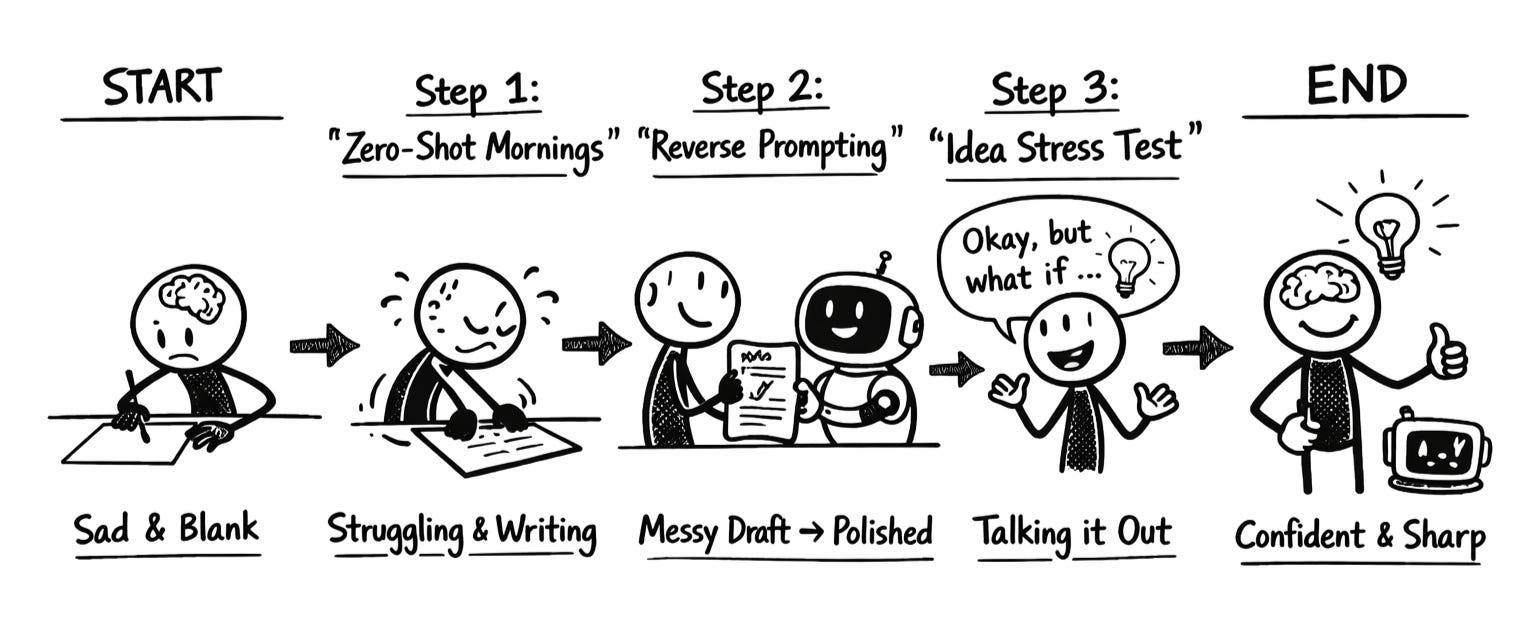
Step 1: The Zero-Shot Morning
Every day, the first 30 minutes of writing must be 100% biological.
No AI. No internet. No “just checking one thing real quick, I swear.” Pen and paper if you can stomach it. Airplane mode laptop if you can’t.
Here’s the crucial part: it doesn’t have to be good.
Write hot garbage. Write three sentences that go nowhere and collapse under their own weight like a souffle in an Andean earthquake. Write a rant about how stupid this exercise is and how your brain feels like someone filled it with the stuff inside a beanbag that's been sitting in a garage since 2004. Write an angry letter to me personally. (I probably deserve it for something. Most people do, eventually.)
It just has to be yours.
All yours.
Generated between your ears without a middleman translating for you.
You’re rebuilding the bridge between thought and page. That bridge has collapsed from disuse. Each morning session lays another plank down. It will feel like failure at first. Then it will feel like struggle. Then, eventually, it will feel like you again.
And you’ll realize you missed yourself. Weird, right? Missing your own brain? But that’s what happens when you let the machines do your thinking. You forget what your own thoughts taste like.
Step 2: The Reverse Prompt Method
When you do use AI (and you will, because we’re not monks here, we’re just trying not to become husks), flip the order.
Old way: “Claude, draft an article about [topic].” Then you edit the machine’s attempt into something usable.
New way: You write the messy draft first. Raw. Ugly. First-thought-best-thought. The written equivalent of showing up to a black-tie event in sweatpants and some bitchin’ Crocs.
Then you bring in the AI.
Prompt:
Here’s my raw, messy thinking on this topic. Help me organize this and tighten the language. Keep my specific examples. Don’t change my voice or remove my weird tangents. Those are load-bearing tangents.You did the heavy cognitive lifting. The thinking. The origination. The part that actually builds the neural pathways. The AI does the cleanup.
You're the DJ. AI is the playlist algorithm. One of you reads the room. The other one thinks "Despacito" is always appropriate.
Step 3: The Idea Stress Test
Before you open Claude. Before you type a single prompt. Before you even look at a blank document.
Stand up. Walk away from your desk. Ask yourself, out loud, like the kind of person your neighbors worry about:
“Can I explain, in one sentence, what I’m trying to say?”
If you can’t say it, you can’t write it. Not really.
Don’t ask the AI to find your point for you. Find the point. Then use AI to amplify it.
A megaphone doesn’t create messages. It just makes them louder. If you have nothing to say, the megaphone amplifies silence. And bruh, there’s enough amplified silence on the internet already. We’re drowning in professionally produced nothing. We don’t need more.
The Fork in the Road (Or: Choose Your Own Obsolescence)
I’ll make a prediction. I might be wrong. I’m frequently wrong about things. I once predicted that TikTok was a fad. I thought Bitcoin was a scam in 2013. My track record on predictions is... humbling.
But here’s what I think happens in five years if we don’t address this:
Two classes of people will work with words.
The Operators.
The prompters. The curators. The people who type instructions and make minor adjustments to machine outputs and call it a day. They’ll be everywhere. They’ll be cheap. They’ll be interchangeable in the way that identical parts are interchangeable. Because when the machine does all the real work, the human attached to it is just... a handler. A supervisor. A person who clicks buttons and fixes typos and occasionally changes “utilize” to “use” and calls that editing.
Operators will get paid in pennies. If they get paid at all. There’s always someone willing to click buttons for less.
The Authors.
The people who maintained their cognitive fitness. Who can still think in words. Who can sit down with a blank page and make something happen through sheer force of brain. Who use AI as an exoskeleton, not a wheelchair. Who could survive without it but are undeniably stronger with it.
They’ll be rare. They’ll be expensive. They’ll get hired when it actually matters.
The difference between these two classes isn’t talent. It’s not intelligence. It’s not even hard work.
It’s whether you kept the muscle alive while everyone else was letting theirs rot.
The easy path leads to the Operator class. It’s comfortable. It’s efficient. It’s exactly what the machine wants you to choose.
The hard path leads to mastery. It’s painful. It’s slow. It requires you to struggle when struggling is optional and suffer when suffering could be outsourced.
You have to decide. Not “eventually.” Not “when you have time.” Now.
Because the neural pathways you’re not using today are the ones that won’t exist tomorrow. And “I’ll rebuild them later” is the lie every atrophied brain tells itself right before it discovers that later has become too late.
The Assignment (You’re Not Getting Out of This)
Here’s what I want you to do.
Not share this newsletter. Not tweet about it. Not summarize it to your group chat while they pretend to care. Not screenshot the parts that made you feel seen. Not add it to your “read later” pile where it will die of loneliness alongside three hundred other articles you saved with good intentions.
Close this tab.
Open a blank document.
Set a timer for 10 minutes.
Write about the last thing that made you angry. Yourself. No AI. No outline. No “let me just get a quick structure first.”
Just you and the cursor and whatever emerges from your own skull.
It will probably be bad. Mine was bad. Somewhere between “ransom note” and “manifesto found in an abandoned cabin” on the readability scale.
Doesn’t matter.
What matters is whether you can.
Prove to yourself that you still can.
The cursor is blinking. It’s waiting for you. It’s been waiting for months, honestly. It was starting to think you forgot about it. Starting to think you’d replaced it with something shinier. Starting to feel like an old friend you only call when you need help moving.
Go prove it wrong.
Don’t let the machine think for you. That’s your job. That’s the whole damn job. Everything else is just typing.
🧉 Discussion Thread: Did you actually do it? The 10-minute challenge? I want the honest answers. Not the “I’ll try it later” answers. Not the “I did something similar once” answers. The real ones. What happened when you sat down with nothing but your own brain? What did you find in there? What wasn’t there anymore? What surprised you?
Crafted with love (and AI),
Nick "Backseat No More" Quick

PS…I’m shipping these daily at the moment. Daily. Like someone with something to prove and questionable work-life balance. Subscribe if you want more on beating the slop factories without becoming a prompt-monkey whose brain has forgotten how to originate a single goddamn thought. We’re building cognitive muscle over here. Bring protein.
The GPS analogy wrecked me - fifteen years in South American cities and you can't sketch a mental map of any of them because you just follow the blue line. I've been doing the same thing with writing, shopping through AI outputs until something fits close enough to claim ownership. The Zero-Shot Morning challenge is going on my wall as a non-negotiable.
Great assignment and potentially another lost art that rarely produces a large audience but a great writer cardio: journal.
The other day I gave ChatGPT a fully written article to check for editing errors. It said the equivalent of: wow most people can’t write an article on their own. So get ready for some AI compliments.