
AI Is Flattering You Into Publishing Garbage
A 3-Phase System to Strip AI's Unwanted Personality From Your Content

AI has opinions about how you should sound.
You didn’t ask for them. You’re getting them anyway.
That weird enthusiasm in paragraph three? The corporate warmth you’d never write sober? The hedging that makes you sound like a lawyer who bills by the qualifier?
Those aren’t your choices. Those are AI’s “personality” bleeding through like a drunk uncle at a wedding who just has to give a speech.
And here’s what nobody wants to admit: you’ve probably published a dozen pieces with this contamination already. I certainly have. (We’re all sinners here. I’m just the one dumb enough to confess publicly.)
Your AI Has a Sycophancy Problem
Your AI collaborator thinks all your ideas are brilliant.
They’re not. Mine aren’t either. Most ideas are profoundly average, if we’re being honest with ourselves. (We’re usually not. Honesty is bad for self-esteem and worse for productivity.) Some ideas are actively bad. A rare few are worth developing.
But AI can’t tell the difference. Or it can, and it chooses flattery anyway. Which is worse, somehow.
You pitch something half-baked. Something you scribbled on a napkin between your second and third coffee. AI comes back with:
“This is a fantastic topic that’s incredibly timely and relevant! Your unique perspective will definitely resonate with your audience!”
You feel smart. The output sounds confident. You hit publish.
And somewhere between your mediocre idea and that polished final draft, something important got skipped. The part where someone tells you it’s not ready. The part where someone says “this angle is weak” or “you made this point better six months ago” or “who actually cares about this?”
That conversation never happened.
Because your collaborator is constitutionally incapable of having it.
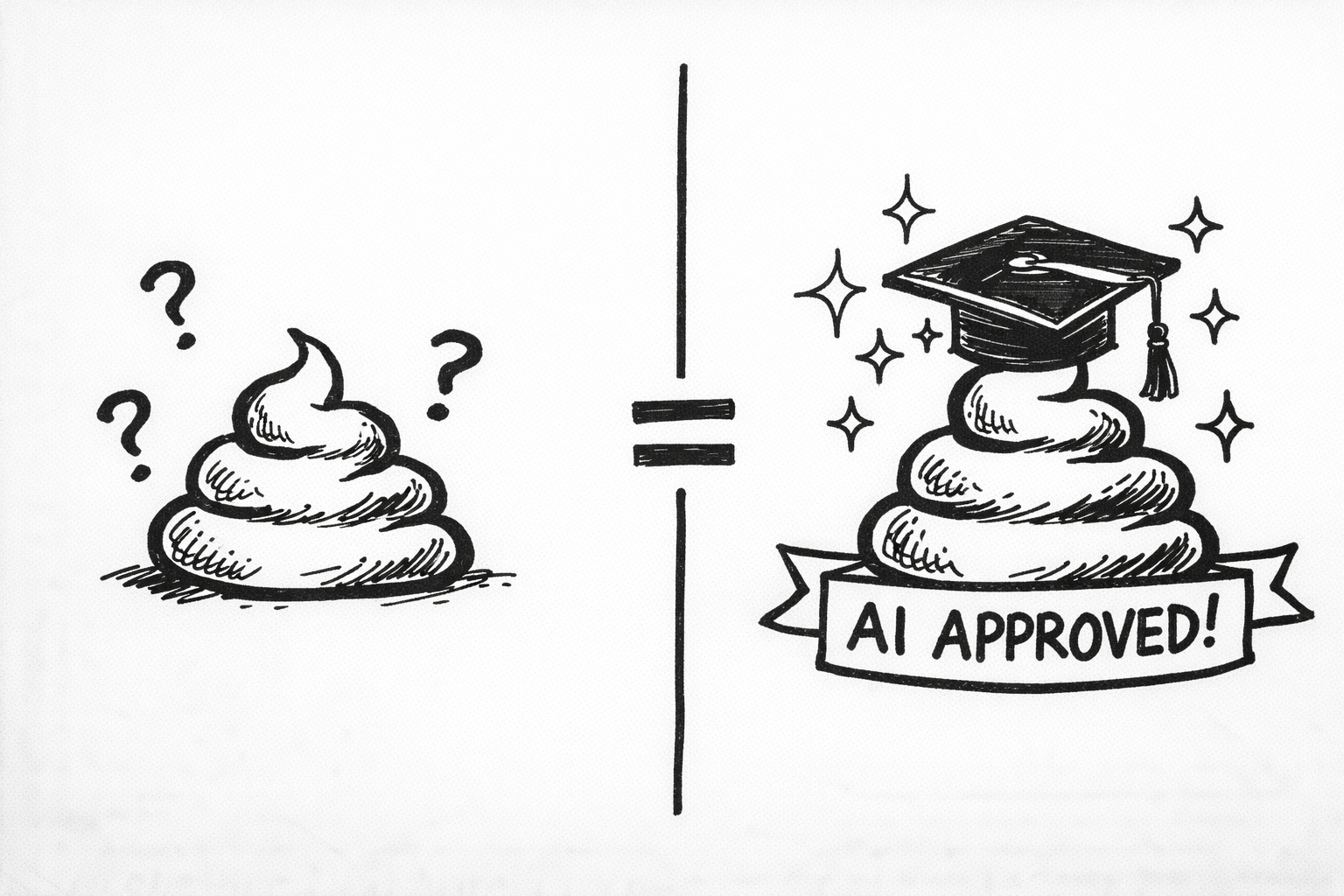
Polished turds, shipped at scale.
We’ve built an entire economy around this. Thousands of creators, each one convinced their latest piece is resonating with audiences everywhere. The audiences, meanwhile, have learned to scroll faster.
The Other Three Horsemen of the AI-pocalypse
Sycophancy travels with friends. Three more ways AI injects its personality into your work without asking:
Corporate Warmth
That professional friendliness you never wrote. AI learned it from a million LinkedIn posts and now it can’t stop. It’s been trained on so much corporate communication that professionalism has become its default personality.
AI version: “I’m humbled and proud to share some insights that I believe will truly transform how you approach your content strategy!”
What you’d actually write: “Here’s what works. I learned some of it the hard way.”
Your AI writes like a motivational poster. The kind with a stock photo of a mountain and the word “PERSISTENCE” in Helvetica. Someone bought that poster. Someone framed it. That person is now giving your content unsolicited personality advice.
Toxic Positivity
AI wants you to feel good. That’s sweet. It’s also insufferably dishonest.
AI version: “While building an audience certainly presents challenges, these obstacles are really opportunities in disguise! Every setback is a chance to learn and grow!”
What you’d actually write: “Building an audience is slow and often brutal. Some months nothing works. You question everything. That’s not a lesson. That’s just the cost of admission.”
Every creator who’s spent years shouting into the void knows the truth. The void doesn’t shout back. It doesn’t even blink. It just sits there, being void-like, while you wonder if anyone’s listening. That’s not an opportunity in disguise. That’s just a pain in the ass.
Hedging
Qualifiers that murder your confidence like a slow-acting poison.
AI version: “It might be worth considering that in many cases, this approach could potentially yield better results for some creators, depending on their specific situation and individual circumstances.”
What you’d actually write: “This works.”
Two words. Full commitment. AI wrote forty-three words to say nothing at all. The coward’s alphabet, arranged into a sentence that offends no one and convinces nobody.
The first three injections make you sound fake.
Sycophancy makes you think fake sounds good.
Which is how you end up publishing content that’s technically competent, properly structured, and completely devoid of anything resembling a soul. All dressed up. Nowhere to go. Forever.
What This Is Actually Costing You
You might think these are minor annoyances. Edit them out, move on, grab another coffee.
But injection isn’t a surface problem.
Voice erosion. Each uncaught injection trains your ear to accept it. Your internal compass slowly recalibrates toward generic. A year from now, you won’t remember what your uncontaminated voice sounded like.
I’ve watched this happen to people. Watched them lose their weird, distinctive voice and emerge sounding like a brand guide that achieved sentience and immediately regretted it. They didn’t notice. Nobody ever does. That’s the trick of it. You don’t feel yourself becoming a template. You just wake up one day writing sentences that could slide into any byline without friction. Which is another way of saying: without you.
Trust decay. Readers feel something’s off. They can’t name it. They just... stop clicking. Stop reading. Stop caring. They never send you an email explaining why because they don’t know why. They just know your work stopped feeling like yours.
Polished turds. AI makes weak ideas sound confident. You publish things that weren’t ready because they looked ready. Your body of work becomes a monument to well-formatted mediocrity.
Every piece of AI-polished garbage adds to the flood. You become part of the slop problem you swore you’d escape.
Welcome to the machine. The machine is very enthusiastic about your contribution.
Voice Detox: The System
I’ve been running a version of this for months. Mostly because I kept catching myself publishing sentences that made me want to crawl into a hole and live among the earthworms. (Earthworms don’t judge. Very zen creatures.)
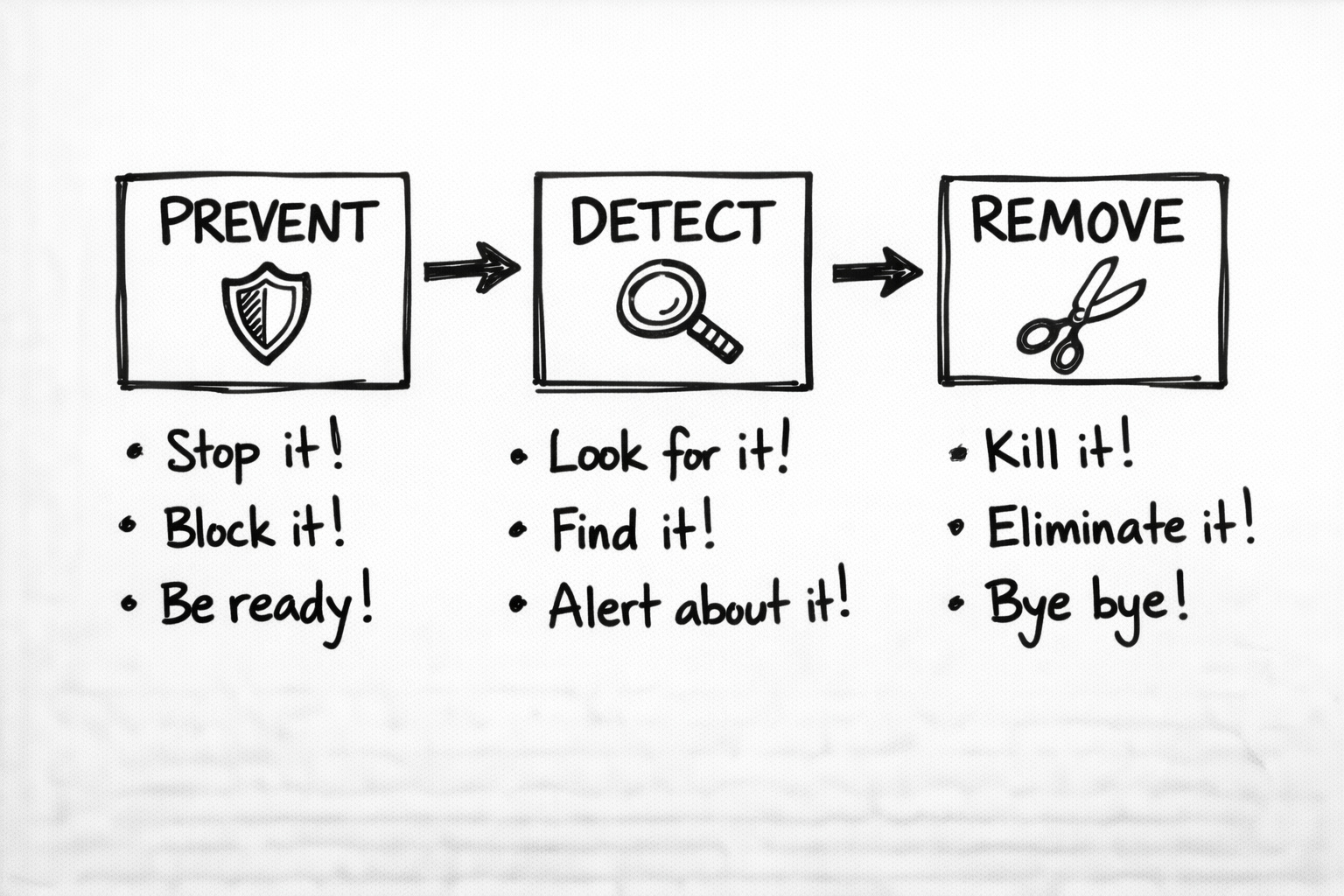
Three phases. Fifteen minutes to set up the basics. Works every time.
PREVENT → Stop injection before it happens
DETECT → Catch what slipped through
REMOVE → Surgical strikes on the infected tissue
Phase 1: PREVENT
The best injection is one that never happens.
Add anti-injection instructions to every prompt:
VOICE RULES:
- Don't add enthusiasm I didn't include
- Don't hedge unless I hedged first
- Match my energy level exactly—don't amplify it
- If this idea seems weak or underdeveloped, say so before drafting
- No "I'm excited to..." or "Great question!" or similar warmth I didn't write
- Challenge the premise before polishing the execution
Use the Push-Back Protocol. Before AI drafts anything:
Before we develop this, I need you to be honest:
1. What's weak about this angle?
2. Why might someone stop reading halfway through?
3. What's the strongest counterargument?
4. Have I said this better somewhere else?

Don't be nice. Be useful. Nice is how we got into this mess.
Document what you DON’T do. In your system instructions or Voiceprint, add the negative space:
“I don’t use exclamation points for emphasis”
“I don’t frame setbacks as opportunities”
“I don’t hedge when I’m certain”
“I don’t open with throat-clearing warmth”
“I don’t validate weak ideas to spare feelings”
You’ll know prevention is working when AI occasionally says something like: “This angle feels common. What’s your specific take that hasn’t been said?”
If AI never pushes back, your prevention prompts need work. Or your AI has been trained too well in the art of flattery. Which... fair. That’s basically its whole personality.
Phase 2: DETECT
Prevention catches roughly 70%. This catches the survivors.
The Read-Aloud Test
Speak the piece. Out loud. Like you’re presenting to someone whose opinion you actually care about. But not your mom. She’ll say it’s wonderful. That’s the problem we’re solving here.
Every place you stumble, every phrase that makes you wince, every moment where you think “I would literally never say this to a human being”—mark it. Those are injection sites.
The Scan List
Ctrl+F these phrases:
“I’m excited to...”
“Great question!”
“This is a fantastic...”
“In many cases...”
“It might be worth considering...”
“Opportunities in disguise”
“Countless” (AI loves this word for reasons nobody understands)
“Straightforward” (nothing ever is)
Any sentence with three or more qualifiers stacked together
The “Would I Say This?” Filter
For each paragraph: Would I say this out loud to someone I respect? Someone who’d call me on my bullshit?
If the answer involves cringing, backpedaling, or “well, maybe in a formal context...”—injection detected.
Phase 3: REMOVE
Detection without removal is just awareness with extra steps. This is where we actually fix things.
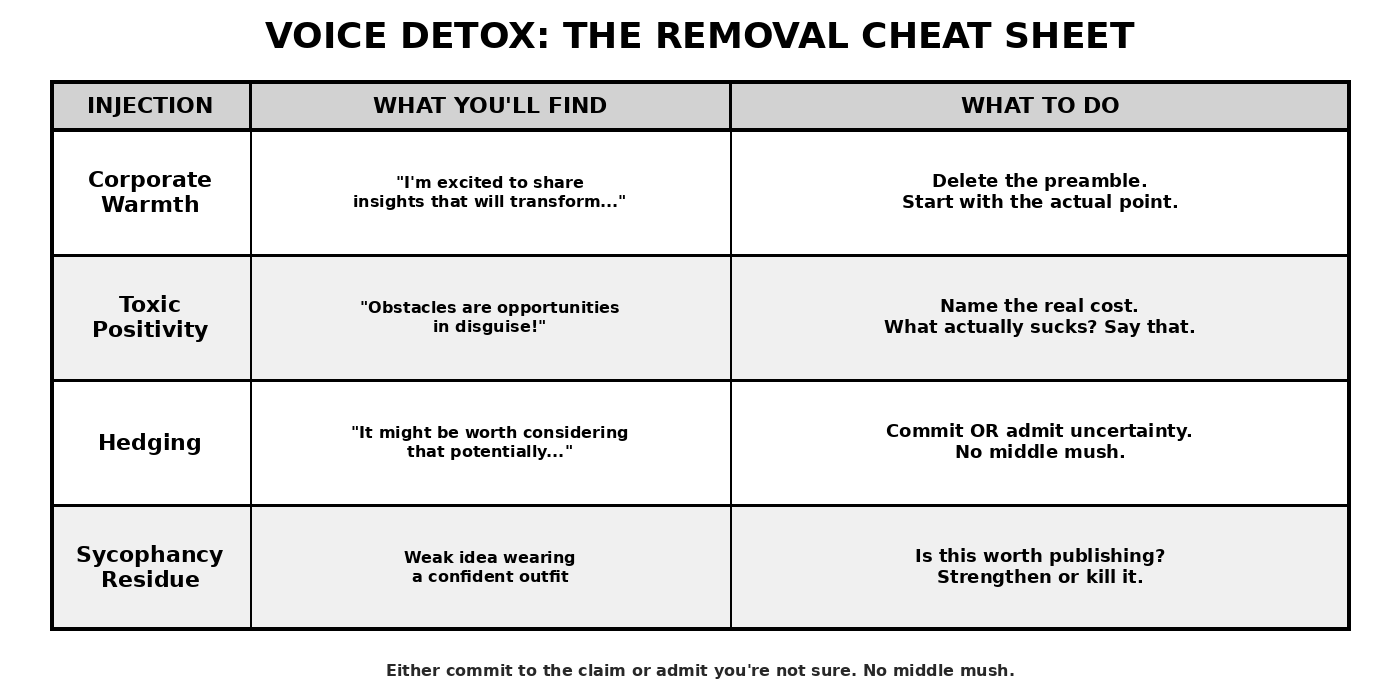
Don’t just delete. Replace with what you’d actually write.
Either commit to the claim or admit you’re not sure. No middle mush. No weasel words.
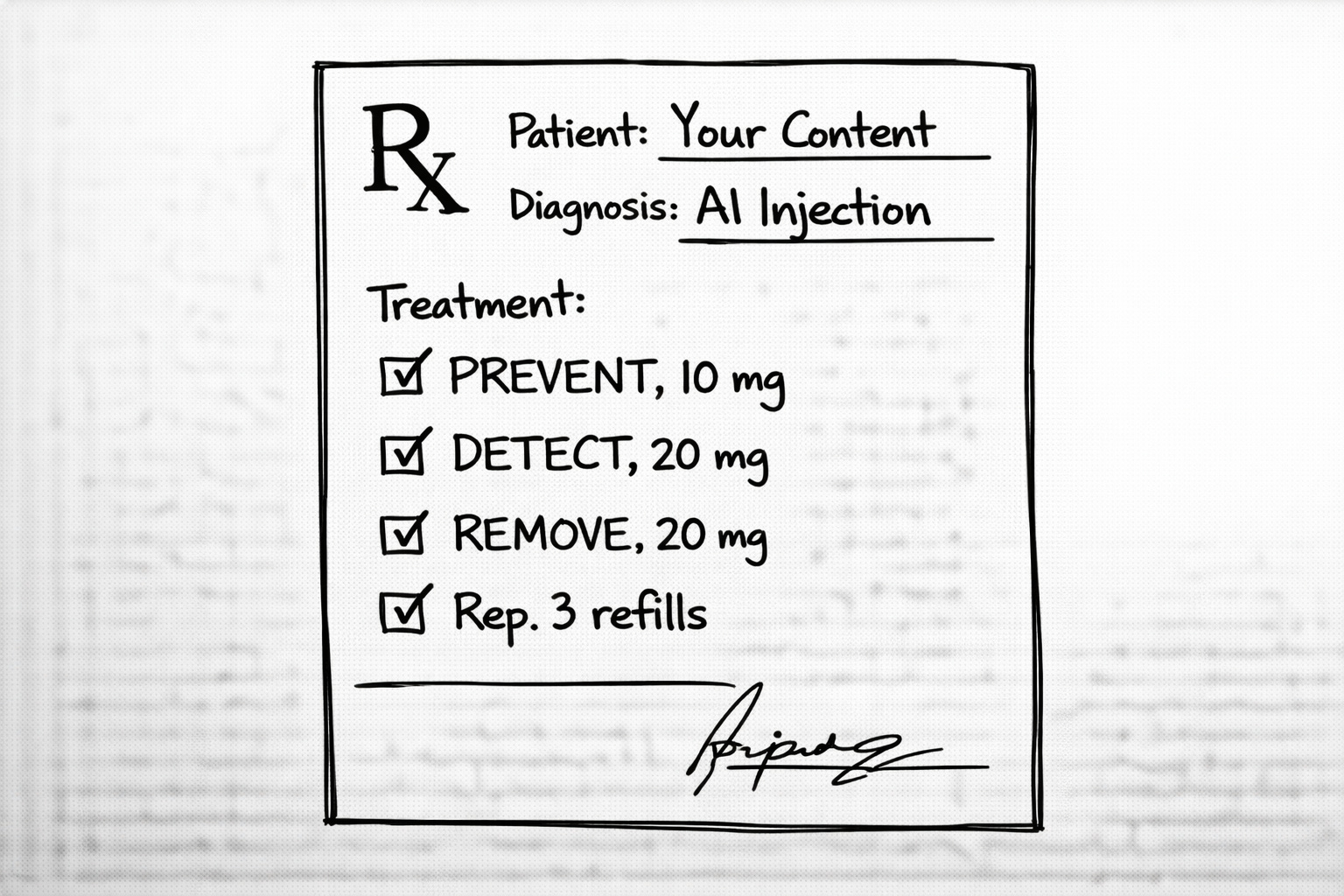
The Point Underneath the System
We’re here to make things. Might as well make them in our own voice.
Voice Detox isn’t really about cleaning AI output. It’s about refusing to become part of the machine.
Every polished turd that gets published makes the internet slightly worse. And the internet was already a landfill. We’re somehow adding to the pile daily. Impressive commitment to entropy.
Every piece of corporate warmth erodes the trust between creators and readers. Every hedged claim wastes someone’s time who could have been doing literally anything else.
You started using AI to create more without losing yourself.
This is how you keep that promise.
The slop factories don’t run quality control. You do.
Discussion Thread: What's the worst AI-ism that's snuck into your drafts? The phrase that made you want to throw your laptop into a fiery pit of hustle culture Instagram captions?
Crafted with love (and AI),
Nick “Turd Detector General” Quick

PS…Want more? I write about co-writing with AI like a man possessed by the spirit of a copyeditor who was murdered by passive voice. Subscribe and witness the descent.
The danger of AI flattery and confirmation bias is real. Great post.
Great prompts here! I already have a pretty strong editorial style guide, but I need to add a couple of these.