
Not Everything Needs AI (Revolutionary Concept, I Know)
The Three-Zone System for When to Use AI vs. When to Write It Your Damn Self

You’re using AI like a drunk uses a lamppost—for support rather than illumination.
And we both know it.
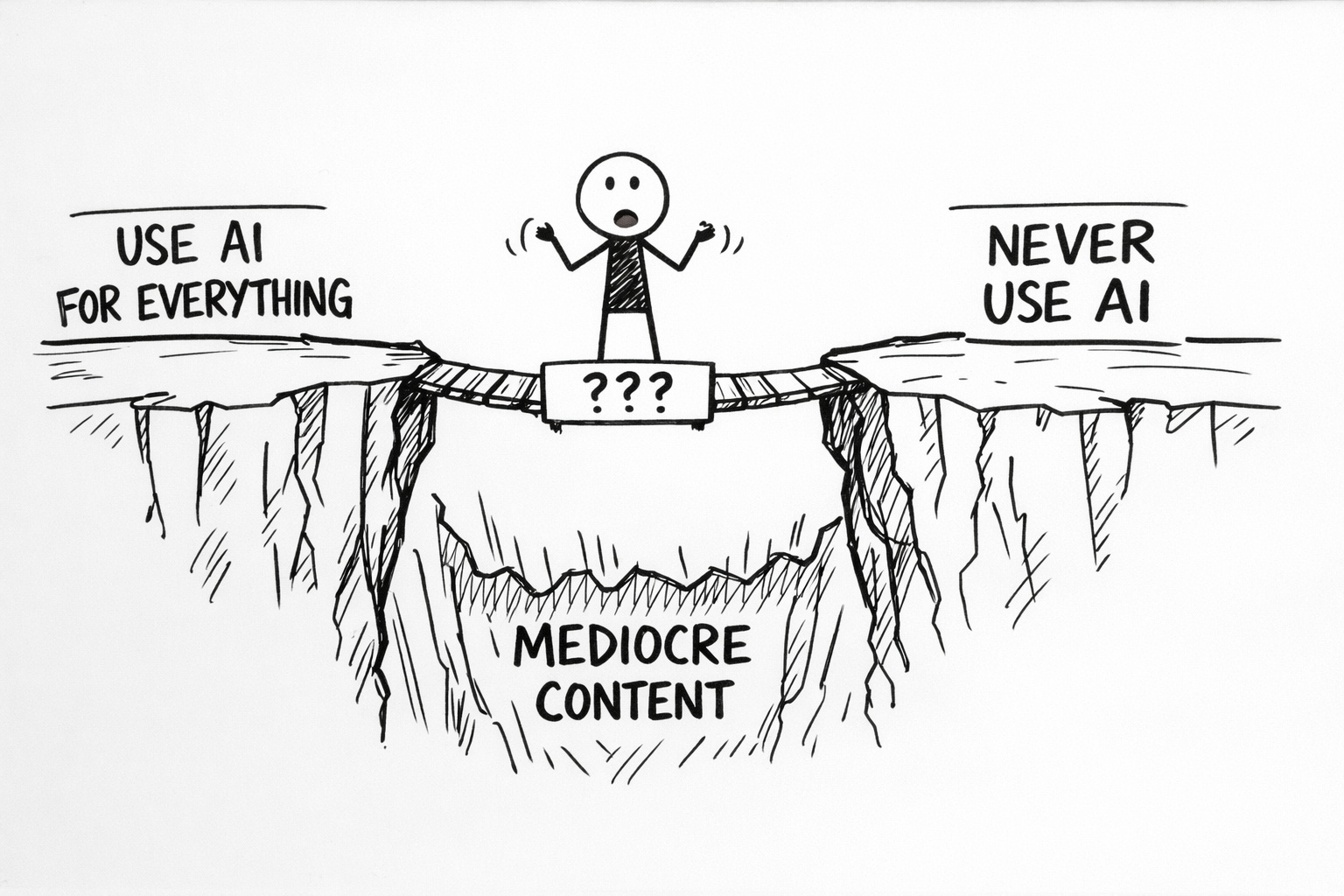
You’ve got two modes now: AI-for-everything (because you’re terrified of falling behind) or AI-for-nothing (because you’re terrified of sounding like everyone else).
Both are stupid.
You’re either letting AI write everything and wondering why nobody remembers your content. Or you’re writing everything yourself and wondering why you can’t keep up.
Both problems have the same root cause: You don’t know when to use the damn thing.
You’re using a chainsaw to butter toast and wondering why breakfast tastes like gasoline.
The Thing Everyone’s Too Polite to Say
Here’s what happened last week:
A creator—talented, thoughtful, the kind of writer who actually gives a shit—used AI to write about their father’s death.
The output? Technically perfect. Structurally flawless. Emotionally vacant.
They published it anyway.
“AI wrote 90% and I only edited 10%,” they told me. Proud.
That’s not efficiency. That’s malpractice.
Then—same week—different creator spent four hours manually writing “5 SEO Tips for Beginners.”
Four. Hours.
On content that AI could draft in three minutes and nobody would notice or care.
“I was afraid it would sound too AI,” they said.
Also stupid.
The absurdity is this: Both creators thought they were doing the right thing.
One automated what should’ve been sacred. The other hand-crafted what should’ve been templated.
What You Actually Need (And Why Nobody Taught You This)
A decision system.
Not another Voiceprint. Not more advanced prompts. Not a better AI tool.
A framework that tells you—before you write a single word—which content needs AI and which content AI should never fucking touch.
Three zones. Three questions. Three workflows.
Nothing more.
The truth is rarely pure and never simple. Especially when it comes to AI collaboration.
Because here’s what’s actually true: Some of your content should be 80% AI. Some should be 50/50. And some should be 90% you with AI only checking if you spelled “definitely” wrong again.
The skill isn’t using AI better. The skill is knowing which is which.
The Three-Zone Framework (Or: How to Stop Killing Your Own Content)
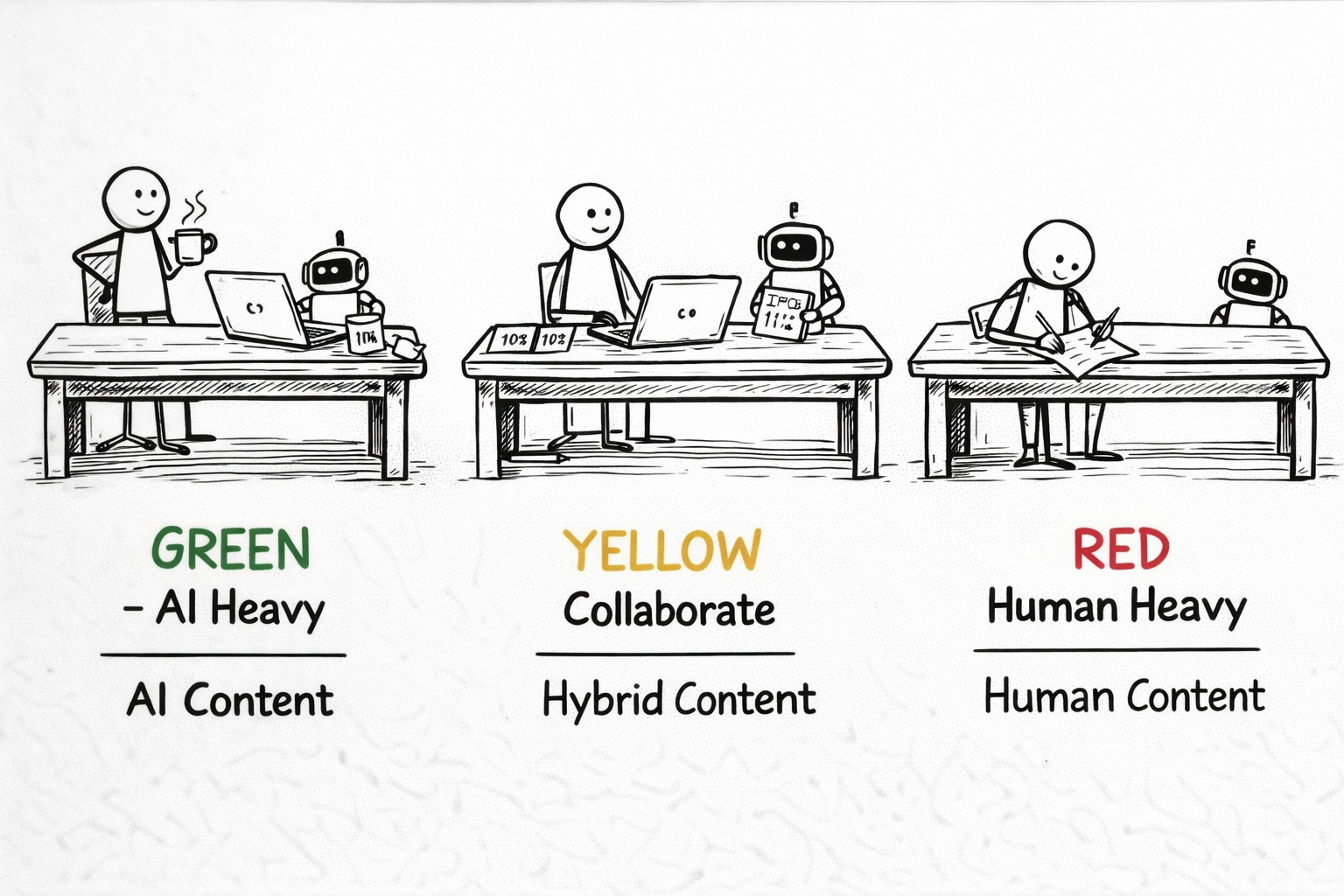
GREEN ZONE: AI Does the Heavy Lifting
This is content where the value lives in the information, not your philosophical musings about the information.
AI does 80% of the work. You do 20% polish. Ship it.
What belongs here:
Research synthesis (AI reads 47 articles so you don’t have to)
First drafts of factual/educational content
Repurposing your existing work into new formats
Structural outlines and frameworks
SEO optimization passes
Social posts promoting content you already created
The workflow: Prompt → AI Draft → Quick Polish → Publish
Example: You wrote a killer newsletter about your content system. Now you need five LinkedIn posts promoting it. The value already exists in the original piece. AI extracts key points, reformats for LinkedIn, adds hooks. You spend ten minutes making sure it sounds like you instead of a motivational poster. Done.
Time saved: Two hours you would’ve spent manually rewriting the same ideas five times.
Guilt felt: Zero. Because this is literally what AI is good at.
YELLOW ZONE: Actual Collaboration (Not Pretend Collaboration)
This is content where BOTH the information AND your take matter.
50/50 partnership. AI isn’t writing for you. You’re writing together.
What belongs here:
Newsletter drafts (standard educational content)
Framework explanations where your angle matters
Long-form how-to content
Email sequences with personality
Tool comparisons and reviews
The workflow: Human Outline → AI Draft with Voiceprint → Heavy Human Voice Pass → AI Polish → Human Final
Example: You’re explaining your three-megaprompt content creation system. AI can structure it. AI can explain the mechanics. But AI can’t inject YOUR specific examples. Your war stories. Your screw-ups. The time you tried to automate idea generation and ended up with “5 Ways Blockchain Disrupts Artisanal Cheese-Making.”
You outline the structure. AI fills in the scaffolding. You inject the soul. AI polishes the typos. You do final pass.
Neither of you could do this alone as well.
Time: Two hours. Not twenty minutes (that’s Green Zone). Not five hours (that’s Red Zone pretending to be Yellow).
This is where you take the time to make it short. And good. And yours.
RED ZONE: Human Only (Or: Where AI Goes to Die)
This is content where YOUR perspective IS the entire value proposition.
Your lived experience. Your vulnerability. Your voice defining itself.
AI’s job: Check for typos after you’re done. That’s it. That’s the whole job.
What belongs here:
Personal stories that only you lived
Hot takes that could get you in trouble
Vulnerable moments that make readers feel less alone
“Flagship” pieces that establish who you are
Any content where readers specifically came for YOU
Anything where your experience IS the product they’re buying
The workflow: Human Draft → AI Checks for Typos → Publish
Example: This post. Right now. The one you’re reading.
I’m explaining my framework from my experience. AI didn’t draft this. AI didn’t structure this. I did.
Because you’re not here for information about AI collaboration. You could get that anywhere.
You’re here for MY take on it. The way I explain it. The metaphors I choose. The profanity I deploy. The way I call you out for your bullshit while simultaneously admitting mine.
That’s Red Zone.
If I’d let AI write this, you’d be reading something technically correct and spiritually dead. My voice run through Google Translate thrice.
Time: Four hours. Worth every minute.
Some work takes time. Not because you’re slow. Because you’re doing it right.
The Three Questions That Solve This
Before you write anything—email, newsletter, social post, manifesto, whatever—run it through these three questions.
Takes thirty seconds. Saves you hours of misapplied effort and existential regret.
Question 1: “Is the value in the information or in MY take on it?”
Information → Green or Yellow My take → Yellow or Red
Most people lie to themselves here. They think everything is “my take” because they care about it.
Caring about something doesn’t make it Red Zone. Your opinion about five AI tools? That’s Yellow. Your story about the time you almost quit because AI made you feel replaceable? That’s Red.
Be honest.
Question 2: “Would readers notice or care if AI wrote this?”
Wouldn’t notice → Green Might notice → Yellow Would definitely notice → Red
Another honesty test. Your “5 Tips for Better LinkedIn Headlines”? Nobody would notice if AI drafted that. Your essay about why you’re rebuilding your newsletter from scratch? Everyone would notice if AI wrote it.
The difference is obvious. Until you’re the one writing. Then suddenly everything feels important.
It’s not. Be ruthless.
Question 3: “Does this piece define my voice or just use it?”
Uses established voice → Green or Yellow Defines or evolves my voice → Red
This is the killer question.
Most of your content uses your voice. You’ve established patterns. AI can follow them.
But some content—maybe 10% if you’re lucky—defines your voice. These pieces show readers who you are. What you stand for. Why you’re different from everyone else saying similar things.
Those pieces can’t touch AI. Not for drafting. Not for “collaboration.” Only for typos.
Because if AI writes the content that defines you, you’re not defining yourself. You’re letting an algorithm average out your edges.
And averaged edges aren’t edges anymore.
Common Fuck-Ups (And How to Stop Making Them)
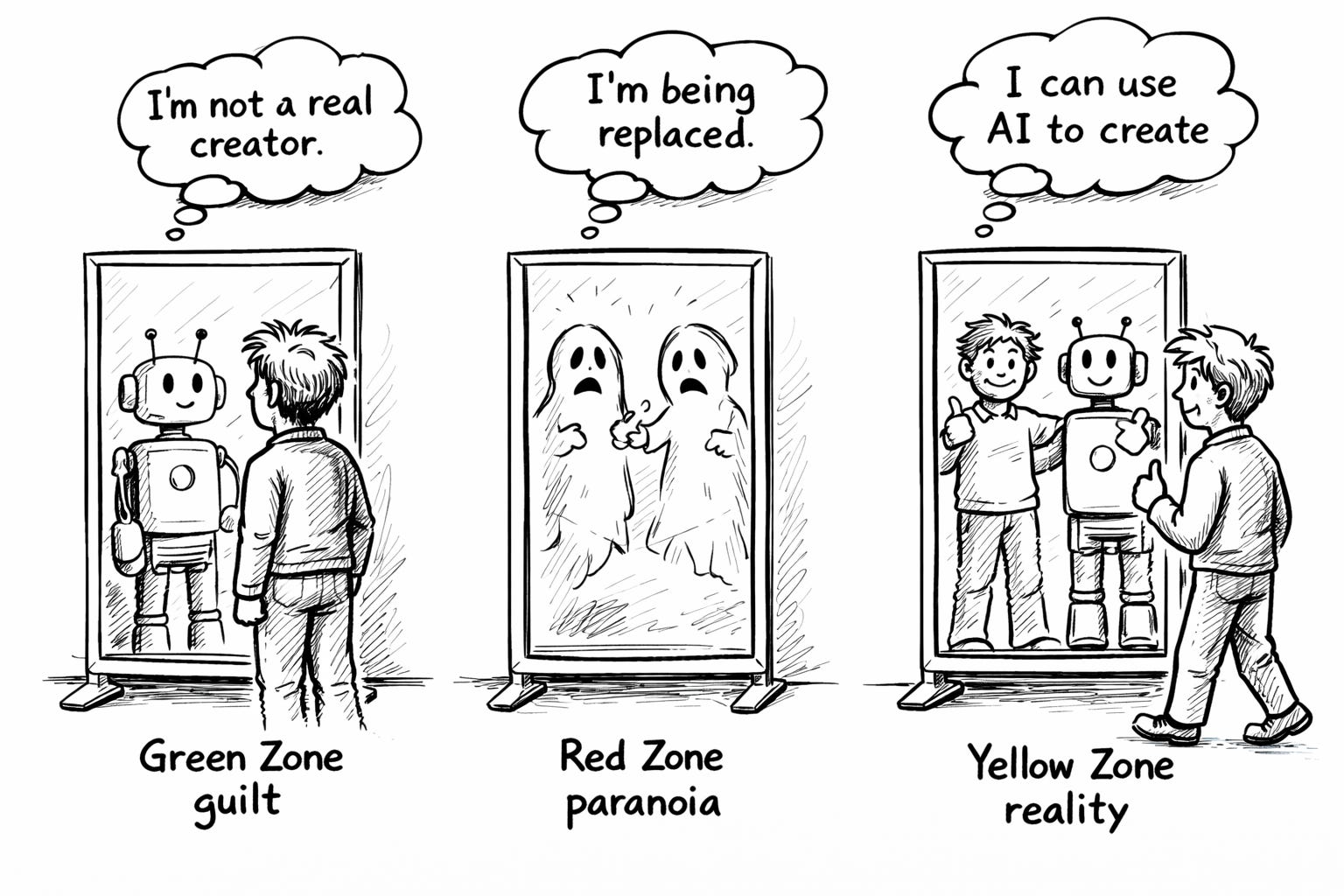
Fuck-Up #1: Green Zone Guilt
“But if AI did most of the work, did I really create this?”
Stop.
You’re not a medieval monk illuminating manuscripts by candlelight. You’re a creator solving problems at scale.
If the value is in the information and AI can compile it faster, that’s not cheating. That’s smart resource allocation.
Your guilt is costing you time that should go to Red Zone work. The work that actually matters.
Fuck-Up #2: Red Zone Paranoia
“What if people think AI wrote this?”
If you’re in Red Zone and following the workflow (you write it, AI just checks typos), this isn’t possible.
The paranoia comes from not having a system. Once you have clear zones, the paranoia evaporates.
Also: Readers can tell. Not because they’re running your content through detection tools. Because distinctive voice hits different. And AI can’t fake distinctive.
Fuck-Up #3: Yellow Zone Confusion
“I can’t tell when I should lead vs. when AI should lead.”
In Yellow Zone, you ALWAYS lead. Always.
You outline. You define the angle. You inject the personality. AI fills in the mechanical middle.
If you’re letting AI lead in Yellow Zone, you’re actually in Green Zone. Which might be fine. But be honest about it.
Fuck-Up #4: Everything Is Yellow (The Most Common Lie)
“Everything I create is collaboration because I always edit AI output.”
No.
Editing isn’t collaboration.
If AI did the first draft and you cleaned it up, that’s Green Zone.
True Yellow Zone means YOU created the structure and perspective FIRST. Then AI helped execute your vision.
Huge difference.
Most people who think they’re doing Yellow Zone are actually doing Green Zone with extra steps. Or—worse—they’re doing Red Zone content in Green Zone and wondering why it feels dead.
Know the difference.
Your Assignment (Do This Before Your Next Post)
Step 1: List your last ten pieces of content
Go ahead. I’ll wait.
Step 2: Honestly assign each one to Green, Yellow, or Red based on how you actually created it
Not how you should have created it. How you did.
Step 3: For each piece, ask: “Should this have been in a different zone?”
This is where it gets uncomfortable.
Step 4: For your next piece, decide the zone BEFORE you start writing
Not during. Not after. Before.
The pattern you’ll see (because everyone sees this pattern):
You’re overusing Yellow Zone for content that should be Green. You’re wasting three hours on “collaboration” for content where AI should just do it and you should polish it.
Or—more likely if you’re reading this—you’re underusing Red Zone because you’re afraid of the vulnerability. Afraid it’ll take too long. Afraid readers won’t care about your personal experience.
So you let AI draft everything and wonder why your content feels like everyone else’s slop.
Fix it.
Green for scale. Yellow for substance. Red for soul.
The Part Where I Tell You the Truth
You already know which content needs your unmediated voice.
You’re just scared to admit it. Because it means you can’t automate your way out of doing hard work.
And you already know which content doesn’t need your philosophical musings on every damn sentence.
You’re just indulging yourself because it feels more “creative.”
The Collaboration Triage System doesn’t make new rules.
It just names what you already know.
Some content scales with AI. Some content collaborates with AI. Some content tells AI to sit in the corner and shut their pie-hole.
The only question is: Are you brave enough to be honest about which is which?
Use AI for what it’s good at. Ignore it for what only you can do.
And for fuck’s sake, stop using the same workflow for everything.
Which piece of content did you create this week that was in the wrong zone? Be honest. Which zone should it have been in?
Crafted with love (and AI),
Nick “Captain Three-Zone” Quick

PS: Subscribe for more frameworks that actually work. I publish when I have something worth saying—which lately is more often than I planned. Sometimes educational. Sometimes vulnerable. Sometimes calling out the bullshit nobody else will. Never generic.