
The Entire Prompt Engineering Industry Is Built on a Lie
You can’t prompt your way to distinctive

Here’s the lie:
Better prompts produce better content.
Sounds reasonable. Feels true. The entire industry runs on this assumption. Courses, certifications, prompt libraries, guru Twitter threads with 47-part breakdowns of “the perfect ChatGPT workflow.”
All of it built on a premise that only survives if you don’t look directly at it. Like an eclipse. Or your 401k right now.
Better prompts don’t produce better content.
Better prompts produce better generic content. Cleaner convergence. More efficient extraction of the statistical average.
You’re not learning to write distinctively. You’re learning to sound like everyone else with increasing sophistication.
(This is the part where I’m supposed to soften. Acknowledge nuance. Say prompt engineering ‘has its place.’ I will not be doing that. The lie is too profitable for anyone else to torch, so I brought the matches.)
The Industry That's Sanding Off Your Fingerprints
Let’s name names. (Not specific names. I’m not trying to get sued. But categories of names.)
The course creators. “Master ChatGPT in 7 Days.” “Prompt Engineering Bootcamp.” “The Complete Guide to AI Writing.”
They’re selling you treasure maps. Thousands of them. All leading to the same hole someone else already dug.
The courses teach frameworks. Structures. “Proven” approaches. But proven to do what? Sand the fingerprints off your writing until nothing identifiable remains. You graduate producing content at twice the speed and half the impact. The certificate is proof you’ve mastered the art of disappearing.
(The $497 price tag doesn’t include a refund for your lost originality either.)
The certification programs. Pay money to prove you've completed a curriculum designed to file down your edge and polish you into professional irrelevance. But hey—letters attached to your name look great on LinkedIn.
Think about what that credential actually certifies. Not that you produce distinctive work. Not that your words linger after someone closes the tab. It certifies that you’ve internalized the frameworks. Learned the structures. Mastered the techniques that 10,000 other certified prompt engineers also mastered.
The certificate proves completion. Not distinction. Not impact. Completion. Participation trophy energy.
The prompt library sellers. “500 Proven Prompts for Content Creators.” “10,000 Prompts for Every Occasion.”
Here’s what nobody mentions about those libraries:
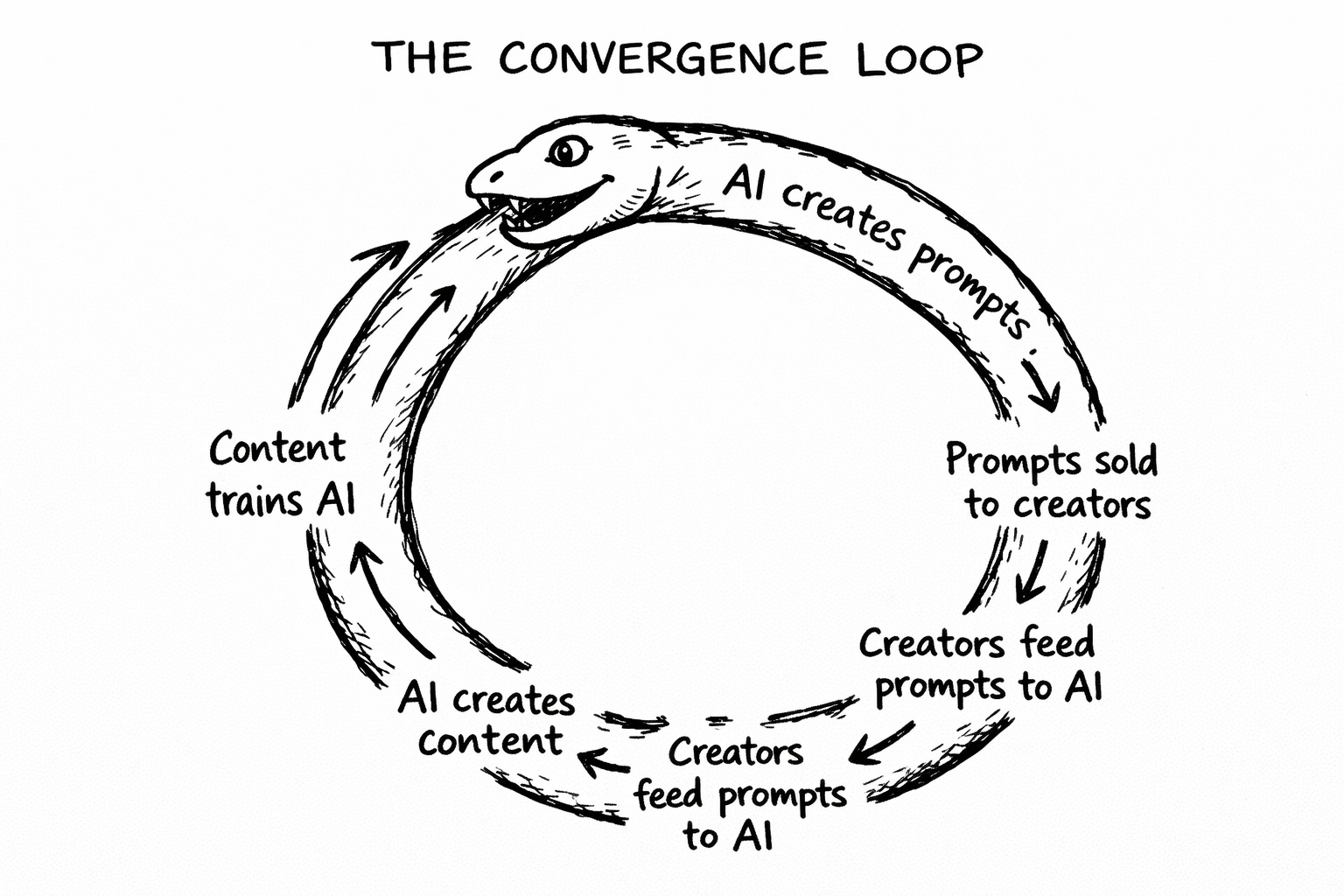
Nobody sat down and crafted 10,000 prompts one at a time. Nobody spent months refining each one through careful testing. What actually happened: Someone opened ChatGPT and typed “Give me 29 prompts useful for info product marketers.” Then “Give me 35 prompts for newsletter writers.” Copy. Paste. Repeat. Package. Sell for $47.
The prompts themselves are AI-generated.
You’re buying AI-generated prompts designed to extract AI-generated content. Convergence creating convergence. The mean generating instructions to extract more of the mean. A perpetual motion machine of mediocrity—and they’re charging you $47 to be part of it.
The guru ecosystem. The LinkedIn thought leaders. The Twitter thread virtuosos. The “I’ll teach you my secret framework” crowd.
Open your feed. Scroll for thirty seconds.
“I [did unexpected thing]. Here’s what I learned:”
“Most people think X. They’re wrong.”
“The 7 mistakes killing your content.”
You’ve seen these posts a thousand times. They feel viral. They’re not. They’re just familiar—which your brain reads as “this must be working.”
The templates aren’t secret. They’re everywhere. Exposed to you for free, over and over, in your feed every single day. Copies of copies of copies—each one filed down a little more, the bones showing through a little clearer.
Then someone charges you $297 to show you what was right in front of you—the same corpse, ver and over, just propped up in different poses.
The gurus aren’t teaching secrets. They’re selling you your own déjà vu.
The Math They Hope You Never Do
Here’s why the lie is mathematically inevitable:
AI models generate text by predicting probable patterns from training data. Billions of words from billions of sources.
The output trends toward the statistical mean.
Always.
The most “likely” text is, by definition, the text that looks most like everything else. The averaged patterns. The convergent center.
So when you get better at prompting—when you become genuinely skilled at extraction—what exactly are you extracting?
The mean.
More efficiently.
A prompt that “works for everyone” leaves no trace of the person who used it. That’s not a bug. That’s the literal definition of “working.”
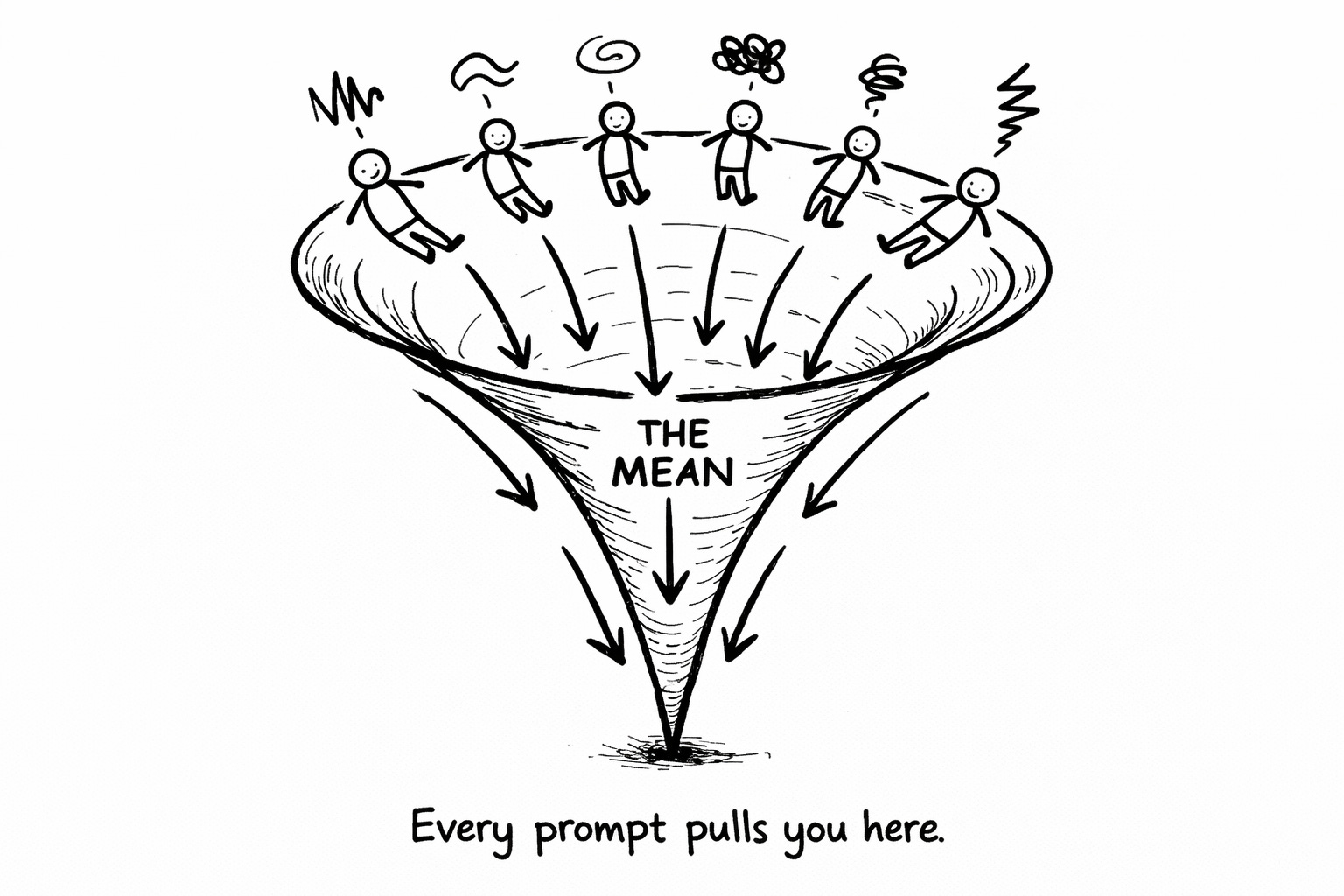
You cannot prompt your way to distinctive.
The subtitle told you this already. Now you know why.
The model doesn’t have YOUR patterns stored anywhere. It has the average of everyone’s patterns. No prompt—no matter how sophisticated, how cleverly structured, how many “act as a world-class copywriter with 20 years of experience” prefixes you stack—can extract patterns that don’t exist.
You can ask AI to “write in your voice.”
It will produce its best guess.
That guess is based on billions of words from billions of people.
The guess IS the mean.
(I spent six months getting genuinely good at this. Courses. Libraries. Frameworks. My prompts got sharper. My writing got worse. Not obviously worse—that would’ve been merciful. Invisibly worse. The kind of worse where nobody complains because there’s nothing distinctive enough to complain about anymore. I was vanishing in plain sight and didn’t even notice it happening. The invisible man at the party, wondering why his witty banter isn’t landing. Buddy, they’re not ignoring you. They literally cannot see you.)
The Proof
Same AI. Same topic. Same intent.
Optimized prompt, no voice documentation:
“In today’s rapidly evolving content landscape, creators face unprecedented challenges in maintaining their authentic voice while leveraging AI tools for content production. The key lies in finding the delicate balance between efficiency and authenticity...”
Read that paragraph again.
Notice how it says absolutely nothing while sounding impressively like it might be saying something? Notice how you could swap it with any of the other 50,000 AI-generated intros published this week and nobody would spot the difference?
That’s what “better prompts” get you.
That’s the product.
Voice documentation approach:
“Nobody tells you this about AI writing: it’s not the robot you should be worried about. It’s you—slowly training yourself to accept ‘good enough’ as ‘good.’ Every bland paragraph you publish without flinching makes the next one easier to stomach.”
One sounds like a template got filled in.
One sounds like a human who’s thought about this too much and can’t shut up about it.
The difference isn’t prompt sophistication.
The difference is whether you gave AI distinctive patterns to follow—or just asked it nicely for “engaging content” and hoped for the best.
What Actually Produces Distinctive Output
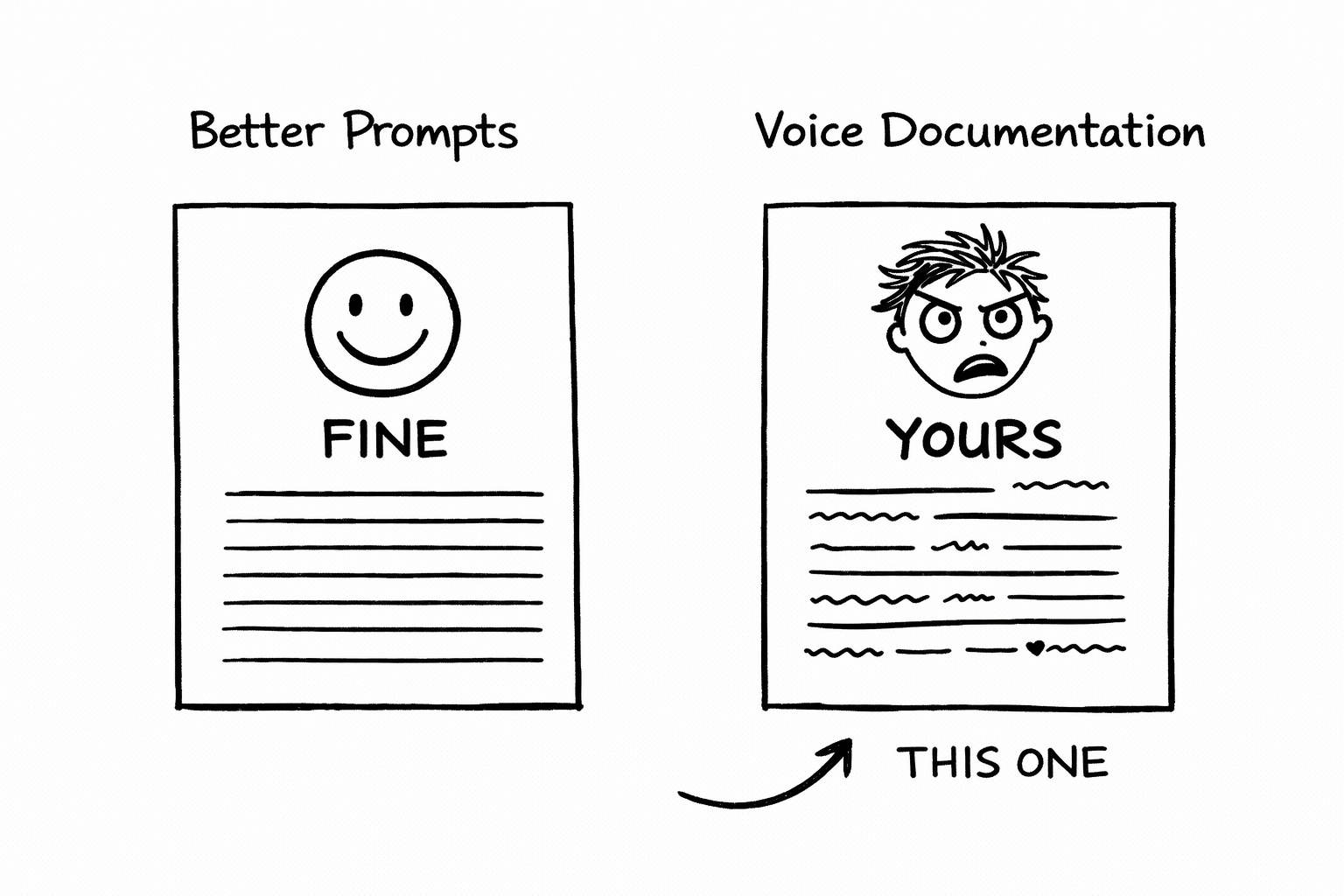
Voice documentation.
Not vague adjectives about tone. Mechanical patterns. The specific fingerprints that make your writing yours.
I call it a Voiceprint.
Here’s the difference that matters:
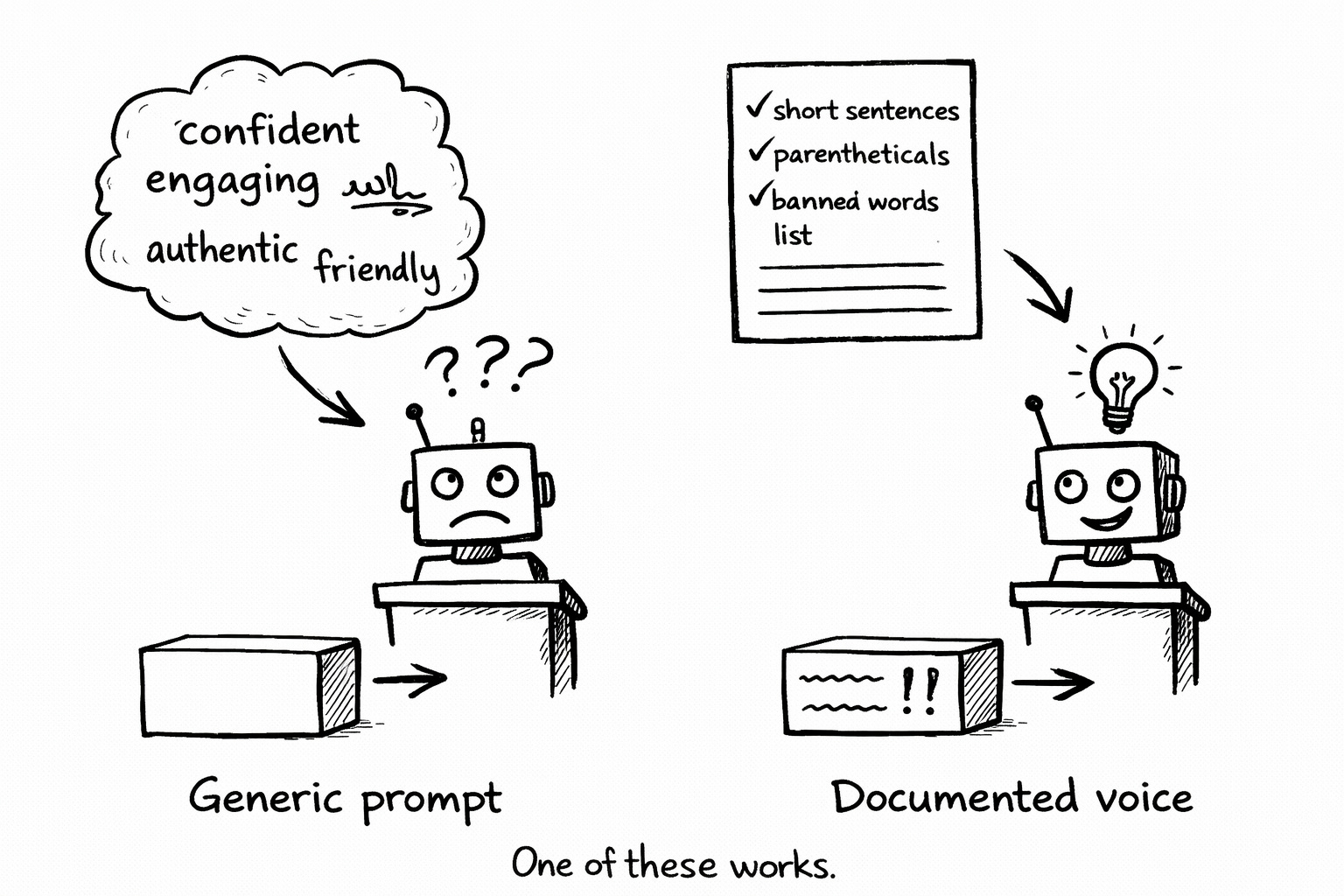
❌ What most people give AI: “Write in a confident, conversational style that’s authoritative but friendly and engaging for my audience of content creators.”
AI reads this and produces confident, conversational, authoritative-but-friendly content. Engaging, even. Indistinguishable from the 47,000 other pieces produced by people who gave AI the same vague adjectives this week.
Must be nice. Being so confident and conversational.
✅ What a Voiceprint looks like: “One line. One thought. Repeat. Frame personal development as business advice and business advice as personal development—always both at once. Heavy 'you' address. Everything lands like a proverb your cool older brother texted you. Confident to the point of oracular. No hedging words. No exclamation marks. No self-deprecation. Let the white space create rhythm. Never mention pop culture. Never use parentheticals. Never break the vibe of someone who figured it out and is calmly telling you how."
A Voiceprint is a map of exactly how you diverge from the average… which patterns to follow, which to avoid, what makes your writing unmistakably yours.
AI can’t interpret vibes. It can follow instructions.
When your “voice guide” is a collection of adjectives, you’re asking AI to interpret vibes.
When it’s a Voiceprint—mechanical patterns, specific examples, a banned-word list—you’re giving it something it can actually execute.
The output becomes distinctive because you gave it distinctive instructions.
(This is also why the prompt engineering industry ignores it. You can teach someone to build a Voiceprint—the observation, the documentation, the calibration. But you can’t package your Voiceprint and sell it to 10,000 people. Skills don’t fit in a zip file. Shortcuts do.)
The 60-Second Version
You can start fixing this now.
Not with another crappy prompt engineering course. Not with a prompt library. With your own eyeballs and fifteen minutes of honest observation.
Step 1: Find something you wrote without AI. An email. An old blog post. A 2am rant in your notes app. Something that feels distinctively yours.
Step 2: Read it aloud. Ask yourself the uncomfortable questions:
How long are my sentences typically? (Count. Don’t guess.)
What punctuation shows up constantly?
What phrases would someone who reads me regularly recognize as “so you”?
What do I never say? (This matters more than you’d think.)
Step 3: Write down 3-5 specific patterns. Not adjectives. Patterns.
(Mine: Short sentences stacked, then released with a longer one. Parenthetical asides constantly—they carry my personality. Strategic profanity that earns its spot. Never start with 'In today's' anything. Absurdist comparisons. Self-deprecating confessions that somehow prove competence instead of undermining it. A baseline assumption that the world is ridiculous and we might as well be honest about it.)
Step 4: Paste those patterns above your next AI prompt.
That’s a minimum viable Voiceprint.

It will outperform every prompt library you’ve ever purchased.
Because it gives AI YOUR patterns to work with—not the averaged patterns it defaults to when you ask politely for “engaging content.”
Distinctive input produces distinctive output.
The lie was making you think better questions would get you there.
The truth is you need better answers to give.
The Part That Keeps Me Up at Night
Here’s the dark version:
Every piece of content you create with optimized-but-voiceless prompts trains YOU.
Not just the output. You.
Your standards drift. Your ear for your own voice dulls. The gap between “distinctively you” and “acceptably generic” gets harder to perceive.
Twelve months of better prompts nearly killed my writing.
I didn’t feel it dying. That’s the part that haunts me.
It just... faded. Smoothed out. Became pleasant and professional and completely interchangeable with anyone else who’d bought the same courses.
The convergence was so gradual I didn’t notice until I re-read something I’d written three years ago. Before AI. Back when every sentence had to fight its way onto the page.
The old stuff had teeth.
The new stuff couldn't bite through warm butter.
The Choice
The prompt engineering industry will keep selling you optimization.
Better frameworks. Cleverer structures. More sophisticated ways to ask. Another course. Another guru. Another $297.
And it’ll keep working. Sort of. You’ll get cleaner outputs. More polished results. Premium slop. Artisanal, even. But higher-quality slop is still slop.
Or you can do the thing they can’t template:
Document your patterns. The tells that give you away. Give AI something distinctive to follow instead of asking it to guess.
One path has a ceiling.
You’ve probably already hit it.
The other path has no ceiling—just the ongoing work of knowing yourself well enough to teach a machine how to sound like you.
The entire prompt engineering industry is built on a lie.
The lie is that better prompts produce better results.
The truth is that distinctive input is the only thing that produces distinctive output.
They can’t sell you that.
So they sell you the lie instead.
Open your feed right now. Find a post that's obviously using a template.
Don't name names… just describe the template. I'll guess which guru sold it to them."
Crafted with love (and AI),
Nick "Still Has Fingerprints" Quick

PS…I'm posting daily right now because apparently I have opinions and no impulse control. Subscribe if you want to watch me keep picking fights with the prompt engineering industry.
Nick echoes what I was thinking about the prompt engineering industry. One expert created a be-all, end-all prompt to assure growth. Being on my cellphone, it was all I could do to keep the cursor highlighting until I made it from start to finish. If that sounds like exaggeration, I copied it into a Google Doc and can assure anyone that the prompt is 418 words long. I thought that was a bit much.
Troublemaker that I am, with apologies first, I fed the prompt to ChatGPT to see what it thought. It replied with an even longer version of Yikes! It assessed the prompt as a prime example of the growth experts flattening content to reach the masses. Exchanging "thoughts," it assured me that the one-sentence prompts we are using are just fine for retaining my voice while serving as a much-needed editor. I really don't like typos.
That's my rambling non-AI way to say give Nick's article a read to help keep your creativity in perspective and unleashed.