
Cut the “I.” Keep the You.
Take "cut the I" too literally and you'll delete the exact lines keeping people coming back. Here's which first-person sentences to spare.

Yesterday I told you the most expensive word in your writing is “I.” (The whole first-person tax.)
For months before that, I’ve been telling you the opposite-sounding thing: fill your you-shaped holes. The spots where you went generic instead of specific. Pour in the realest, most particular version of yourself you’ve got.
So which is it? Carve myself out, or pour myself in?
(Reasonable question. I’d be annoyed too.)
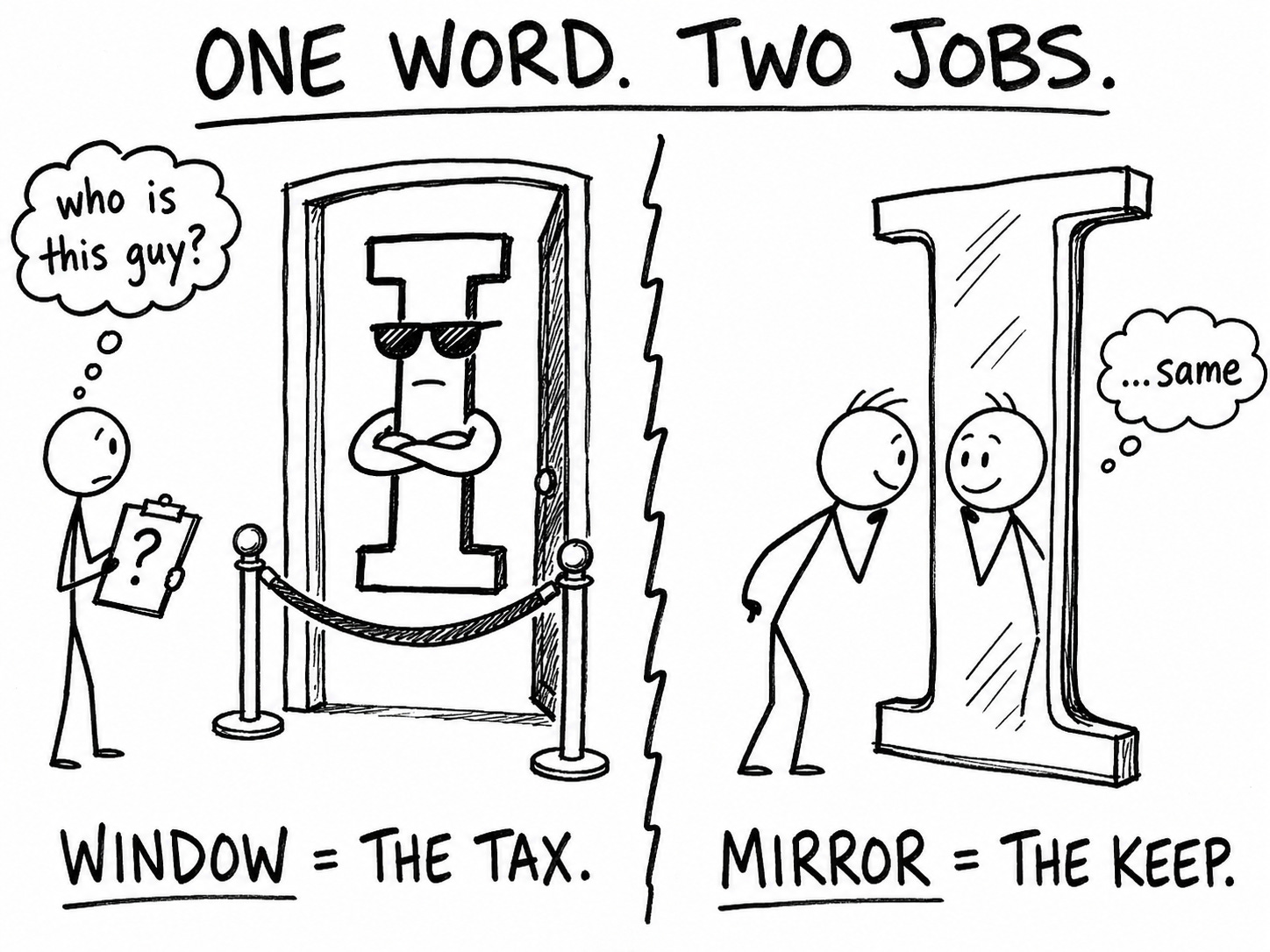
Both are true, because the word “I” is pulling double duty, and only one of its two jobs is the leak.
Job one is the “I” that makes the reader stop and size you up. “I think.” “In my experience.” A credential dropped before you’ve earned the right to drop it. The sentence quietly asks a stranger to run a background check on you before they’re allowed to care about the point. That’s the tax. That’s the “I” I told you to cut yesterday.
Job two is the “I” that makes the reader stop and recognize themselves. Not “I procrastinate sometimes” but “I have reorganized my entire desk twice and produced one sentence.” You said “I.” A stranger heard their own experience. That’s a you-shaped hole, filled. That’s the “I” you keep.
So one sentence pulls off both things I’d supposedly been contradicting myself about. It fills a you-shaped hole with something only you’d write, and it dodges the tax, because nobody audits you for the desk confession. They just nod. They’ve been there too.
No contradiction.
The Part Yesterday Left Out
And it matters more than the cutting did.
Yesterday handed you four ways to cut an “I.” The danger baked into that advice is overcorrection. You read “cut the I,” grab the scissors, and start gutting the lines that were quietly doing serious work. The mirror-I’s. The “me too” lines.
Those are exempt. Don’t run the moves on them.
The cutting was only ever aimed at the I’s that make a reader audit you. The I’s that make a reader recognize themselves aren’t a tax. They’re you, the actual you they showed up for. Leave them exactly where they are, and point the scissors at everything else.
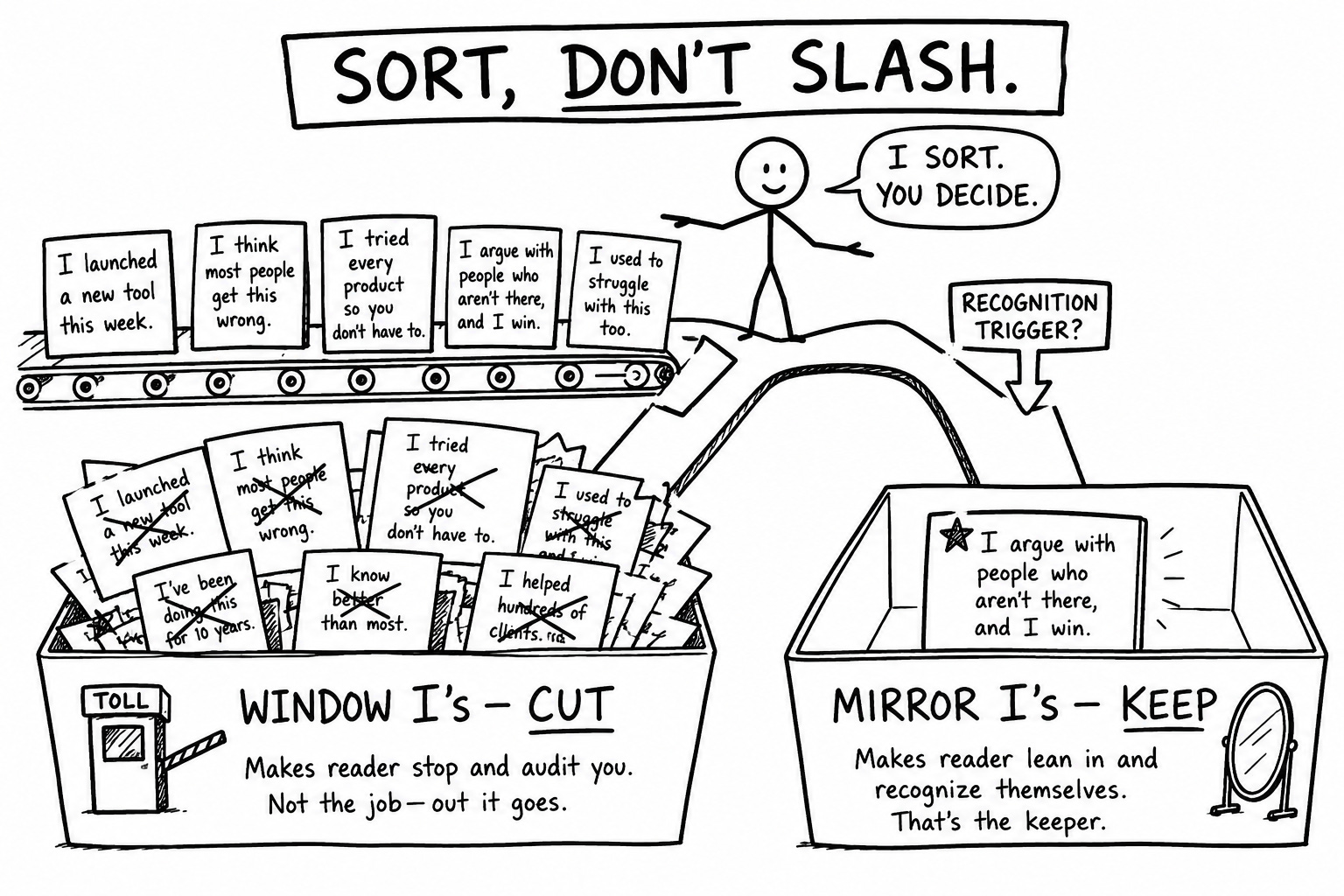
Both posts, folded into one line: cut the “I” that makes them look at you, keep the “I” that makes them see themselves.
You were never choosing between getting out of the way and showing up. The best sentence does both in the same breath.
Disappearing and being unmistakably present aren’t opposites. They’re the same skill. You’ve just been keeping two different scorecards for it.
Crafted with love (and AI),
Nick “Tax-Exempt” Quick

PS... Here’s the dirty secret nobody selling “AI writing systems” will tell you: the model is rooting against your weird specifics. It wants you palatable. Forgettable is safer for it than wrong. The free Ink Sync Workshop is how you overrule a machine that’s optimizing for nobody-gets-mad:

PPS... Three buttons down there. Like (you agreed and got shy about it). Restack (you agreed loud, in front of your whole feed, bless you). Subscribe (you’re in, no take-backs, I’ve already mentally moved into your inbox). Pick your level of commitment. There’s no wrong answer except scrolling past like we didn’t just have a moment.
So, 'cut the I,' but not the I?
Got it. ;)