
Your AI Should Be a Goblin, Not a Ghostwriter
A blank page asks too much. Ten bad options ask much better questions.

I recently encountered a writing trick called Goblin Mode.
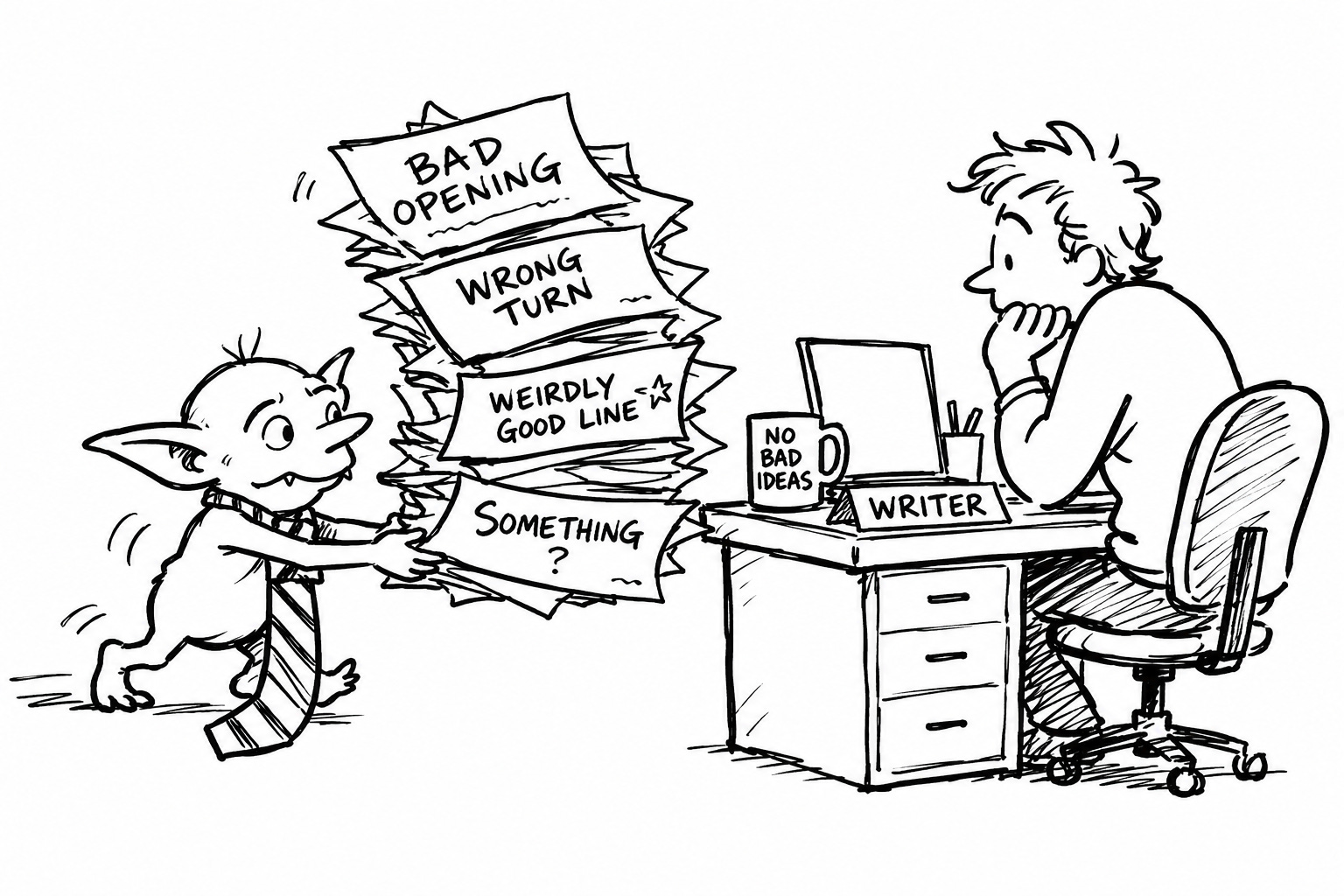
You imagine you’ve hired a tiny, stupid goblin to write the first version of whatever you’re working on. He’s underqualified. His dialogue is terrible. He appears to have learned punctuation from several unrelated ransom notes.
None of this matters.
You paid him doodley-squat.
The goblin’s job isn’t to write something good. His job is to get to the end, preferably without eating the keyboard. Then you come back, survey the damage, and turn whatever he left behind into something you’d admit was yours.
It’s ridiculous.
It’s also a very good cure for the blank page.
Not because bad writing is secretly good.
Because bad writing gives you something the blank page refuses to provide.
Something to push against.
The Blank Page Asks Too Damn Much
A blank page asks an unlimited question:
What should this become?
That sounds innocent enough. It’s not.
Now you have to choose the opening, angle, structure, tone, examples, level of detail, and exact point before a single sentence has earned the right to exist. You’re inventing and evaluating at the same time, which is roughly like learning to drive with someone grading your parallel parking before the engine starts.
No wonder the cursor stops.
You aren’t merely trying to write a paragraph. You’re trying to write the paragraph your readers will see. The one that proves you still know what you’re doing. The one that should be original, useful, funny in precisely the correct dosage, and somehow arrive fully dressed before you’ve worked out where the piece is going.
A perfectly ordinary opening sentence arrives dragging a parade float shaped like your entire reputation.
Then we act surprised when it can’t move.
The goblin has no such problem. He has no subscribers. No respected peers. No internal committee asking whether sentence two is sufficiently original to justify its continued existence.
He just starts typing.
The Goblin Changes The Question
Once something exists, the problem gets smaller.
You’re no longer asking:
What should this become?
Now you can ask:
Is this the right angle?
Is the opening too broad?
What’s missing?
Why do I hate option four?
What does option seven almost understand?
Those are easier questions because writers are often better at reacting than originating. Give me a blank page and I can stare at it until one of us develops a personality disorder. Give me ten questionable openings and I’ll know within minutes that six are wrong, two are boring, one contains a useful question, and the last one has accidentally tied the whole piece together.
That’s what Goblin Mode actually does.
It turns writer’s block from a generation problem into an editing problem.
AI happens to be very good at making that conversion quickly.
The Modern Goblin Is Annoyingly Competent
The metaphor breaks a little when you hand the job to current frontier models.
AI isn’t stupid. It can produce clean, coherent writing in seconds, often better than the average person could produce cold. The average person doesn’t regularly write for publication. AI has absorbed more competent prose than any human could read before the sun expands and newsletters become a secondary concern.
So the modern goblin is articulate.
Fast.
Educated.
And completely free from the emotional baggage you’ve attached to beginning.
It doesn’t need the opening to prove anything about itself. It won’t stare at sentence one for forty minutes because sentence one may determine how strangers perceive its entire body of work. It doesn’t open the refrigerator six times while hoping an angle materializes behind the Dijon mustard.
It can simply make something exist.
Sometimes the result will be weak. Sometimes it’ll be irritatingly competent. Occasionally it’ll contain a sentence, structure, or turn you couldn’t reach while supervising every word like a mall cop guarding the coin-operated kiddie helicopter.
All three outcomes can be useful.
The goblin’s job isn’t to lower the quality of the writing.
It’s to lower the cost of finding a direction.
Give It The Embarrassing Job
Take one real idea you’ve been avoiding.
Not an empty topic you hope AI will somehow make meaningful. A worthwhile idea you already have, but can’t find your way into.
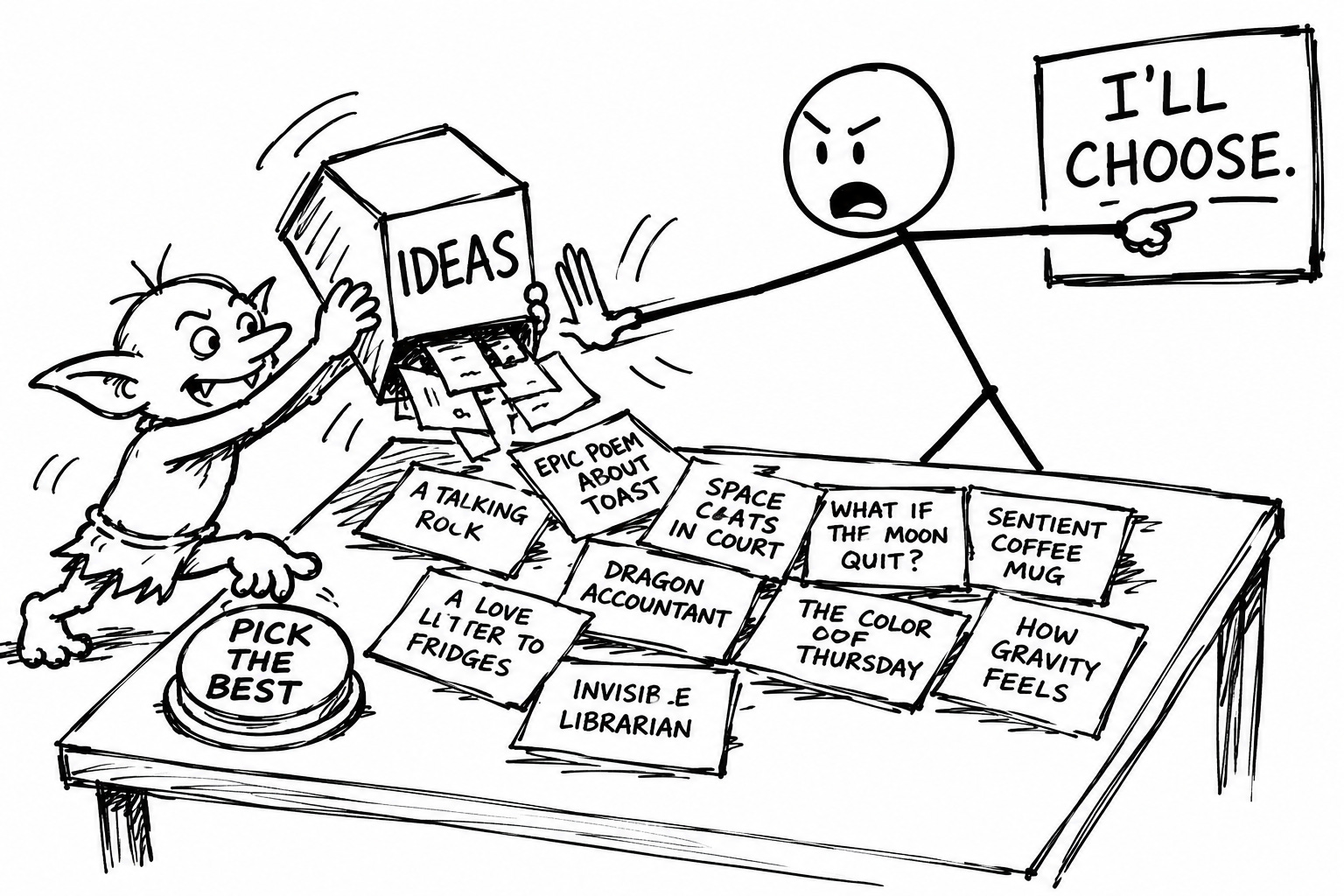
Give the model the topic, the intended reader, and the rough point you think you’re making. Then ask for ten genuinely different approaches. Different structures. Different angles. Different openings into the same room.
Generate ten genuinely different approaches to this idea. Vary the structure, stance, and angle. Don’t rank them, combine them, recommend one, or imitate my voice.
Then read what comes back.
Don’t search for a finished post.
Search for a reaction.
Too broad.
Wrong story.
Good question.
Keep that line.
That response is the value. The model has turned one enormous creative demand into a series of specific decisions you already know how to make.
Choose the useful move yourself. Rewrite it. Challenge it. Follow the part that creates energy.
The goblin can’t make the idea worth publishing.
It can give the idea a rough shape you can finally argue with.
That’s when your standards return. That’s when the writing starts becoming yours.
The goblin got the cursor moving. It earns Employee of the Minute.
Use AI to stop inventing and evaluating the same sentence at the same time.
Let the goblin bring you something.
🧉 What idea have you been carrying around because you can’t find the right way into it?
Crafted with love (and AI),
Nick “Regional Director of Goblin Labor Relations” Quick

PS… Once the goblin gives the idea a shape, you still need standards for making it yours. The free Voiceprint Quick-Start Guide helps you document those patterns:

PPS… I publish about putting AI to work with a frequency that suggests poor adult supervision. Subscribe, then send this to the writer currently asking an empty document to produce the correct answer from thin air.