
Stop Asking AI to Write Your Whole Damn Article
Single-shot prompting is astrology for productivity bros. Here's what actually works.

The perfect prompt might exist somewhere. The one that produces flawless long-form content on the first try, every time. I’ve been looking since 2023. At this point I’m filing it under “myths I’ve made peace with”… right between effortless abs and inbox zero.
For months I chased it anyway. The One Prompt. The magic incantation that would take my half-formed idea and return a polished draft I could publish without Googling “how hard is it to become an electrician.”
“Write my memoir. Make me sound like someone worth reading about. Beloved but not suspiciously so. Adventurous spirit, grounded soul. Mention the kayak. I don’t own a kayak. I was going to buy a kayak. Chapter three was going to be about the kayak.”
One shot. Everything at once. Maximum hope.
And the AI would deliver something. Every time. Something professional. Something competent. Something that technically hit every point in my brief like a smile that doesn't reach the eyes.
I'd stare at it thinking: This is fine. Why does it feel like chewing cardboard?
Took me embarrassingly long to figure out the problem.
It wasn't the AI. It wasn't my Voiceprint document. (Though I did spend three weeks tweaking that sucker like a guy tuning a guitar he doesn't know how to play.) It wasn't even the prompt itself.
The problem was asking for everything at once.
(This is the part where I save you three years of frustration. You're welcome.)
The Single-Shot Lie
Here's what happens when you ask AI to generate a complete piece in one go:
Paragraph one comes out decent. Maybe even good. You think: Finally. We’ve cracked it. Time to update LinkedIn title to “AI Whisperer.”
By paragraph three, something shifts. The rhythm flattens. Same sentence patterns. Same transitional phrases. Same underlying frequency like a hum you can't quite locate but can't stop hearing.
By the end, it's just fine. Which is the worst thing writing can be.
I call this tonal fatigue.
The AI isn't tired. Your reader is. They won't tell you. They'll just leave.
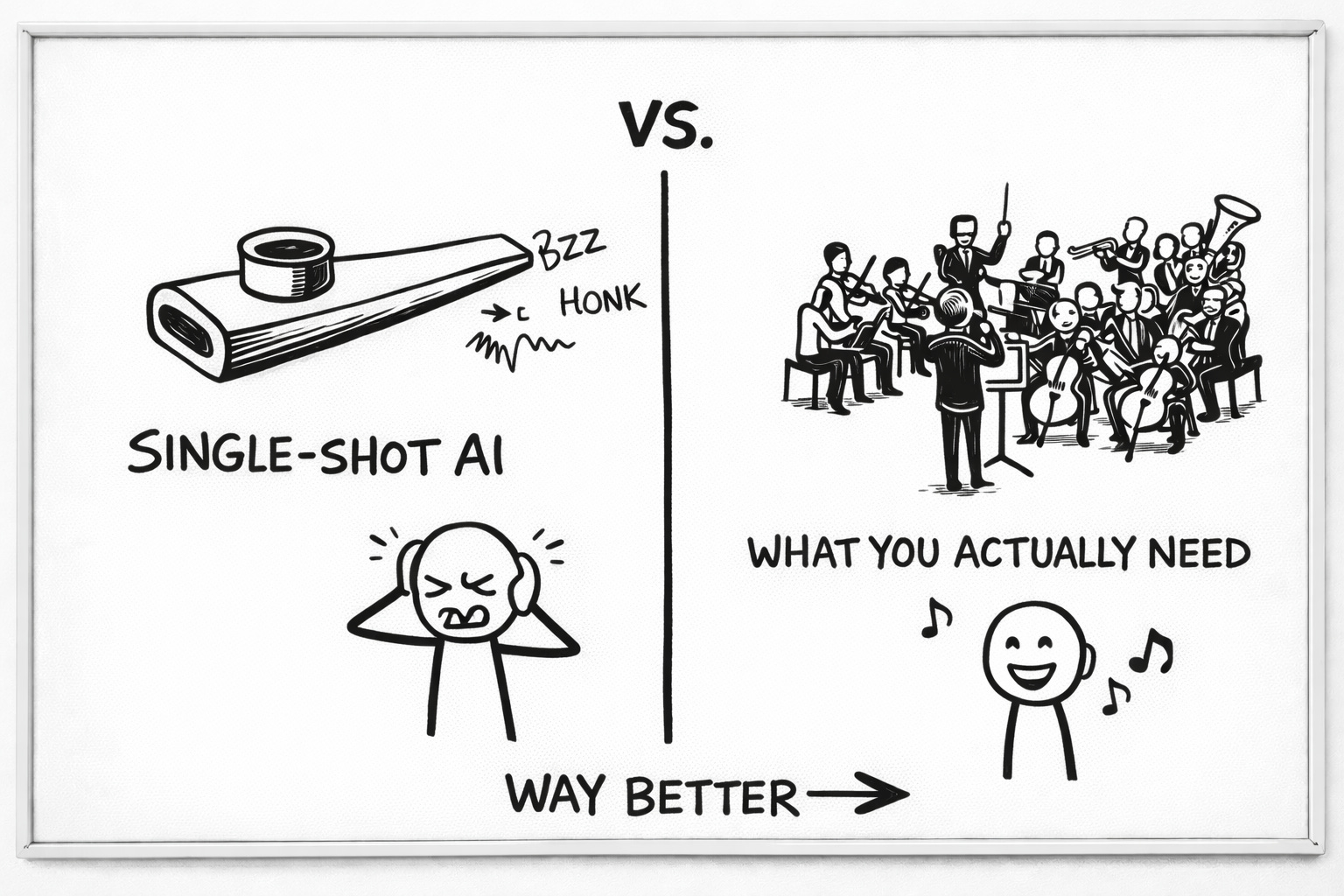
Single-shot generation asks one instrument to play an entire symphony.
What you get is a technically proficient kazoo solo.
Nobody wants a kazoo solo.
The Revelation (That Should've Been Obvious)
Here's what nobody tells you about collaborating with AI:
The tool isn't the problem. The *workflow* is the problem.
When you ask for everything in one prompt, you're asking the AI to simultaneously research, structure, draft, maintain voice, vary rhythm, and stick the landing. That's not collaboration. That's exploitation. You're asking one employee to do six jobs. They're not going to quit. They're going to half-ass all of them.
The alternative is stupidly simple.
Break. It. Up.
Different stages. Different prompts. Different textures. You stitch the pieces together yourself.
I call it the Frankenstein Method. The draft doesn’t spring fully formed from a single incantation. You build it. The seams are visible. Your fingerprints are on them.
That’s what makes it yours.
How to Build the Monster
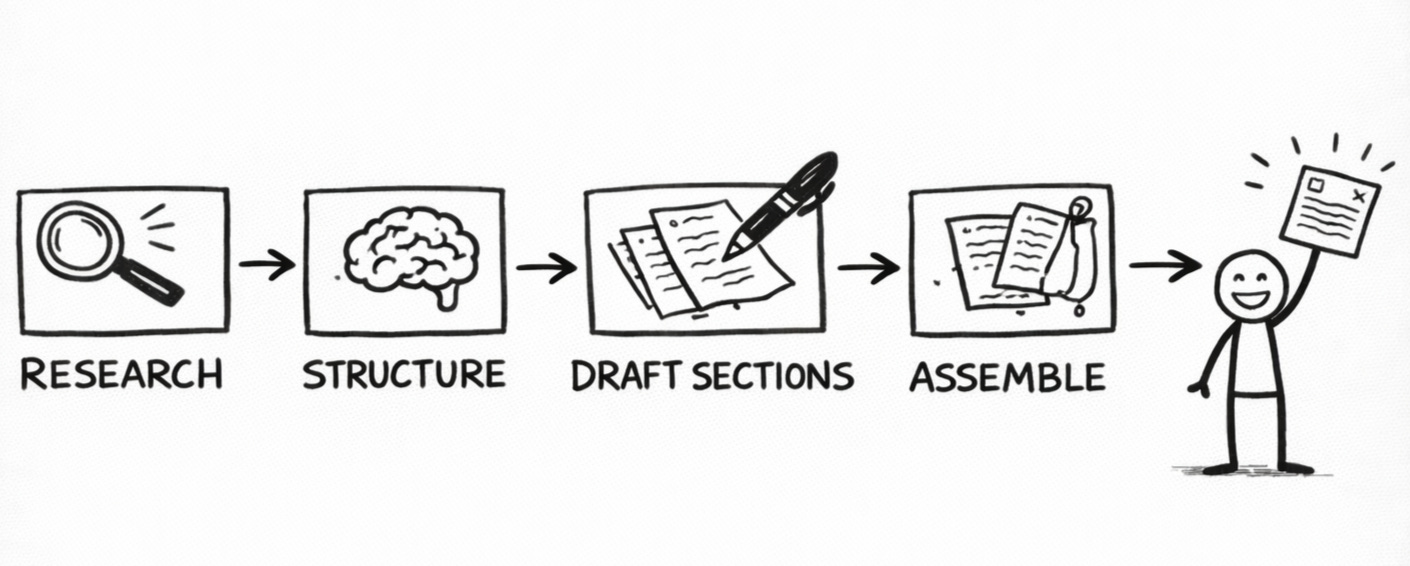
Stage 1: Research (Gemini 3 Pro)
I don't use Claude for research. I use Gemini 3 Pro.
Not because Claude can't research—it can. But Gemini is built for finding things, citing them, and getting out of the way. Million-token context window. Solid citation handling. Doesn't try to be charming when you need it to be useful.
What I ask: "Find me 5 recent examples of [topic]. Include statistics where available. Cite sources for everything."
What I get: Raw material. Facts I didn't have to hunt across seventeen browser tabs while questioning my life choices. A foundation I can actually build on.
This stage takes 10-15 minutes. No writing happens here. Just gathering parts.
Stage 2: Structure (Your Brain)
Before I draft anything, I need bones.
And this part? This is you. Not AI. You.
Open a doc. Sketch the sections. Figure out what you're actually arguing and in what order. This is the part AI will never do as well as you can.
What you want: A 4-6 section skeleton. One sentence per section explaining what it needs to accomplish. Ugly is fine. Functional is the goal.
Why this matters: When you ask AI to “write an article about X,” it's drafting the blueprint while laying the bricks. By paragraph three, it's stuck in a groove it can't escape.
AI can't argue your point. It doesn't have one. It'll guess toward whatever most people would say about this topic. Which is exactly what you don't need.
Structure is where your brain earns its keep.
Decide the bones yourself. Then let AI grow the meat.
Stage 3: Draft Sections (Claude)
Now we write.
But here's the key: I ask for one section at a time.
Not the whole piece. Not even two sections. One. Focused. Contained.
What I ask: "Write section 3 from this outline: [paste outline]. Here's my voice sample: [paste Voiceprint or example]. Keep it under 300 words. Match the rhythm and tone of the sample."
What I get: A chunk of prose that isn't trying to do everything. One piece of the creature. One organ harvested cleanly.
Then I do it again for the next section. And the next.
(Yes, this takes more prompts. No, I don't care. The output is better. The math works out.)
Stage 4: Assembly (You)
This is where the monster takes its first breath.
You take the research, the structure, the drafted sections—and you assemble. Paste them into one doc. Read the whole thing out loud. (If you're not reading your drafts out loud, you're just guessing. And you're probably guessing wrong.)
Where does it drag? Cut.
Where does it feel robotic? Rewrite.
Where does it lack you? Add the parts that make you nervous. The details that feel too specific. The lines where you think maybe this is too much. (It's not. It's never too much.)
And most importantly: write the transitions yourself.
The transitions are the sutures. The connective tissue. The places where your hand is most visible. AI-generated transitions are how you end up with "Now let's explore" and "This brings us to" and all the other phrases that make readers' eyes glaze over.
Your seams. Your fingerprints. Your creature.
Why the Seams Are the Point
Different stages produce different textures.
The research stage is dense. Fact-heavy. Citation-forward.
The structure stage is spare. Just bones. Your bones.
The drafted sections have rhythm and voice, but each one started fresh. No accumulated fatigue from the previous paragraph.
And the transitions—your transitions—have your fingerprints all over them.
When you stitch these together, the result has texture. Variation. The kind of shifts in energy and density that human-written work has naturally.
Single-shot generation smooths all of that into one frictionless surface.
You've read smooth writing today. You don't remember any of it. That's the point. That's the problem.
The staged method keeps the edges.
And the edges, it turns out, are how readers know a human touched it.
But Doesn't This Take Longer?
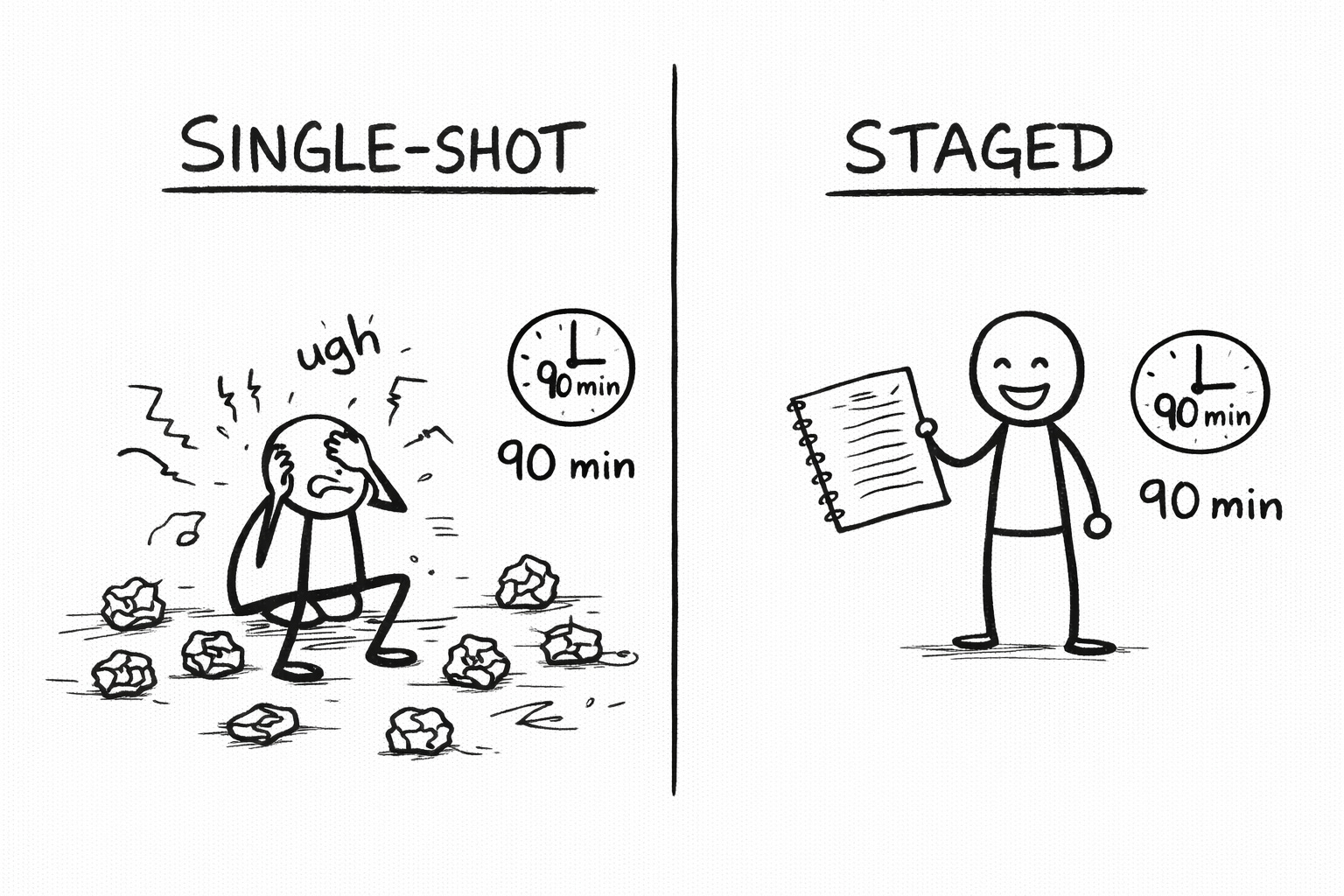
The time is roughly the same either way. Call it ninety minutes.
The difference is how those ninety minutes feel.
Single-shot: fighting a draft that was broken from the start. Editing against the grain. Googling “do monks take applications” by minute forty-five.
Staged: building something piece by piece. Each stage does one job. By the time you’re assembling, the parts actually fit.
Same clock. One method makes you want to quit. One doesn’t.
Mannequins vs. Monsters
The slop factories win on volume. Let them.
You’re playing a different game. One where the seams are the signature. Where the stitches are the point.
The question isn’t whether AI can write your piece. It can. Competently. Forgettably.
The question is whether you want a mannequin with your name on it—or a monster you built with your own hands.
Mannequins are smooth. Pleasant. Forgettable.
Monsters are alive.
Stop asking for everything in one shot. Build the damn thing in stages. Put your fingerprints on the seams.
That's how you make something worth reading.
🧉 Discussion Thread: Which stage are you most likely to skip—research, structure, or assembly? (And do you regret it every time? Same.)
Crafted with love (and AI),
Nick "The Stage Manager" Quick

PS…Subscribe. I publish often. You'll learn something or get annoyed. Possibly both.
"Write the transitions yourself" - that is the piece I was missing. I follow a similar structure most times. I know I regret it when I try the one-shot method and end up spending way more time rewriting than if I do it piecemeal.