
My AI Wrote Better After I Kneecapped It
Sometimes the winning move is making the game harder on purpose.

More freedom. More options. More context. More room to work.
That’s what everyone wants from AI.
That’s exactly backwards.
The best outputs I’ve gotten came from telling AI what it couldn’t do. Arbitrary rules. Stupid limitations. Restrictions that seemed designed to make the task harder.
They were designed to make the task harder.
That was the point.
Probability Is the Enemy
When you give AI unlimited freedom, it does what any crowd-pleaser does.
It gives you what most people would want. The safest guess. The average of every preference it’s ever encountered.
“Most people would want” is just a fancy way of saying “most common.” And “most common” is just a polite way of saying “the average of everything anyone has ever written about this topic, extruded into content-flavored content product.”
This is slop. The average. The middle. The place where distinctive voices disappear and nobody files a missing persons report.
The AI isn’t broken. The AI is working perfectly. That’s the horror of it. The machine produces sludge exactly as designed. You cannot blame the machine for the sludge. The machine IS the sludge. (This is either profound or I need to go outside. Possibly both.)
Constraints change the math.
Tell AI “you cannot start any sentence with a pronoun” and suddenly the path of least resistance is blocked. The AI has to find another route. The other route (the one it never would have taken if you’d let it do whatever it wanted) turns out to be more interesting.
Not always better. Sometimes constraints produce unusable garbage. But they always produce something that isn’t the mean.
And you cannot be distinctive without first being different.
What I Actually Forbid
After months in what I can only describe as an emotionally abusive relationship with autocomplete, I’ve landed on a core set of constraints. These aren’t arbitrary. Each one targets a specific pattern that makes AI writing feel like it was sweated out by a middle manager who hasn’t felt genuine emotion since his divorce.
Rhythm constraints:
“No more than two sentences of similar length in a row.”
“At least one sentence under five words per paragraph.”
“Every fourth paragraph should be exactly one sentence.”
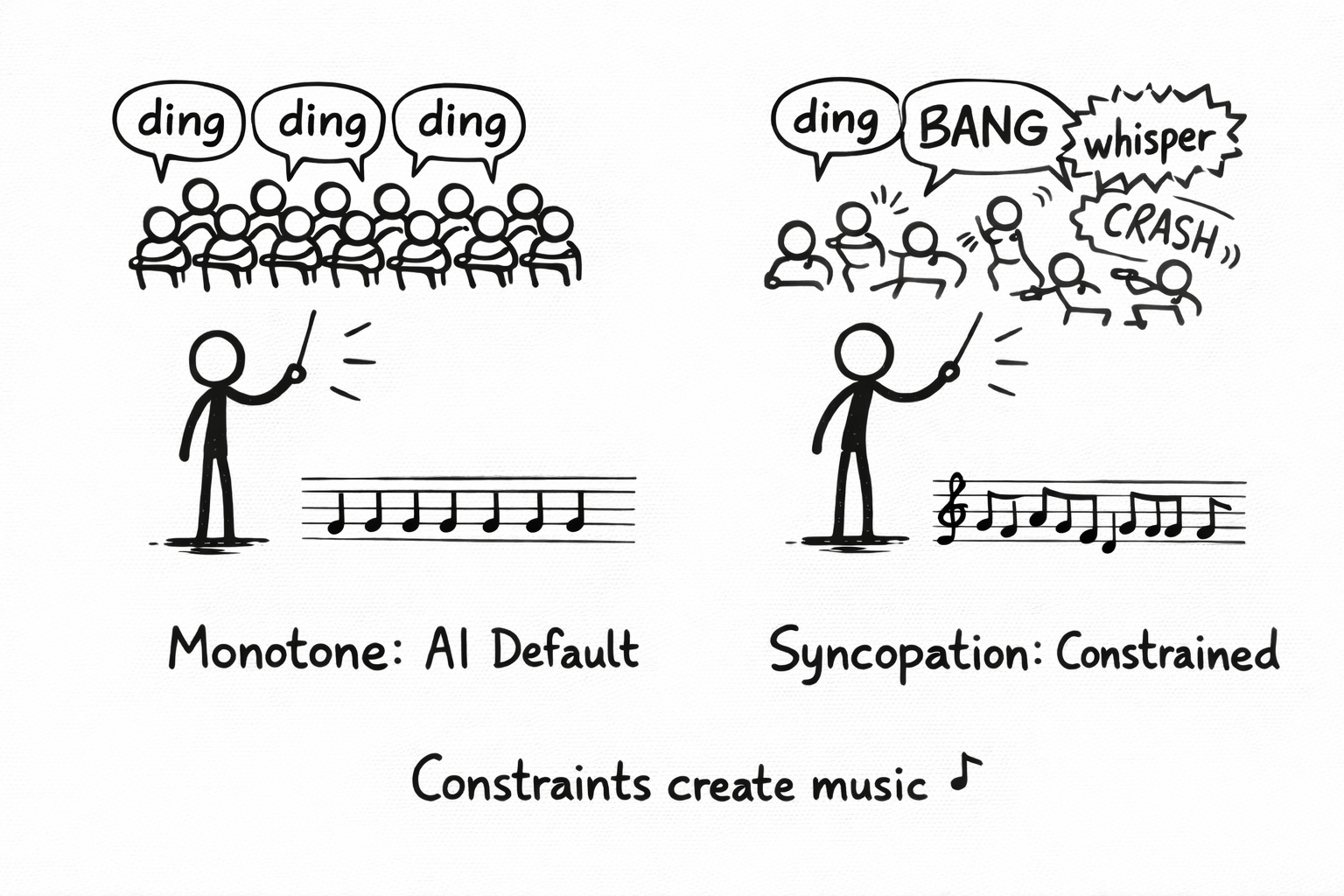
AI loves medium-length sentences. Stacked endlessly. Like bricks. Until your eyes glaze over and you can’t remember what you just read or why you started reading it or what year it is. Rhythm constraints force syncopation. Jazz, not elevator music. The distinction matters more than it should.
Vocabulary constraints:
“Never use: very, really, just, actually, basically, essentially.”
“Replace every abstract noun with a concrete one.”
“No sentence can contain more than one adjective.”
These fight the padding. The verbal throat-clearing. The qualifier stacks that let AI hedge every claim into meaninglessness. “Very important” becomes “important” becomes (ideally) something specific enough that importance is implied rather than asserted.
When you ban hedging, the AI has to commit. Commitment looks like voice. Hedging looks like someone who's never been punched in the face for having an opinion.
Structure constraints:
“Opening paragraph cannot exceed three sentences.”
“Never begin a section with context-setting.”
“End with forward motion, not summary.”
AI defaults to long windup, exhaustive middle, comprehensive conclusion that restates everything you just read. (In case you forgot it during the twelve seconds since you read it. The AI is very concerned about your memory. The AI thinks you might have a condition.)
Structure constraints demand momentum. No recaps. No “in conclusion.” Get in, make the point, get out. You can summarize when you’re dead.
Friction Is the Point
Working within constraints feels wrong.
Every efficiency-poisoned instinct screams that adding friction is backwards. The whole point of AI was removing friction. Frictionless content at scale. That was the promise. That was the dream. That was what we were sold by people with very white teeth and an affiliate link in their bio.
The dream was slop.
(The dream is always slop. This is not specific to AI. This is a general principle about dreams that promise frictionless anything. Friction is the scar tissue that makes the work yours. Remove all friction and you get a smooth surface nothing can grip.)
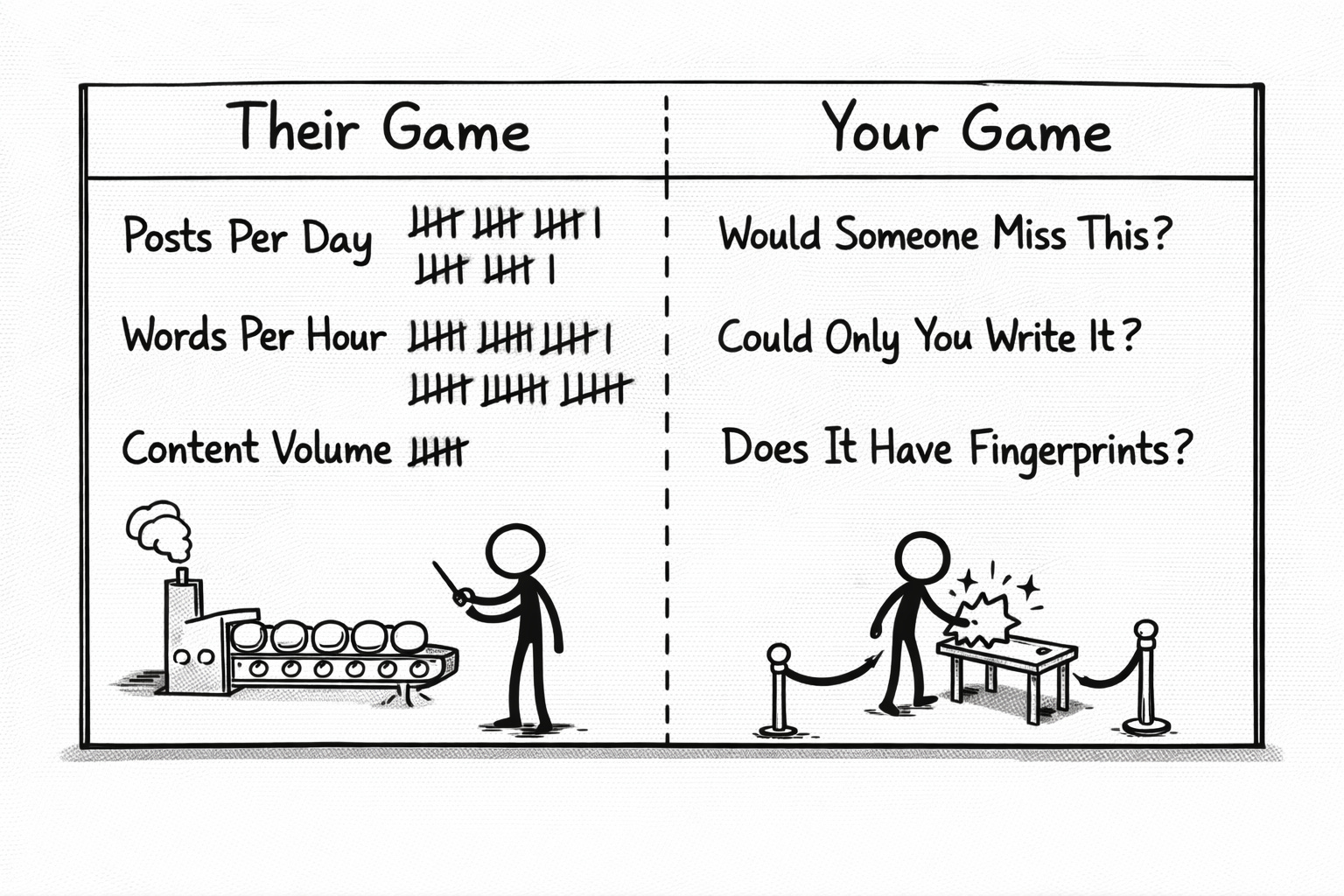
The slop factories have efficiency locked down. They will produce a hundred posts while you’re still deciding whether your opening sentence needs a comma. You will never beat them on speed. This is not a competition you can win. This is not a competition you should enter.
You beat them by producing something they can’t.
Something with texture. Something that sounds like a human made choices. Something that couldn’t have been generated by typing “write me a blog post about X” and hitting enter.
Constraints force choices.
When AI has unlimited options, it chooses the probable. When you limit the options, it has to choose something specific. Specific beats generic every time. In every context. Without exception.
I really wanted there to be an exception. I looked hard. There isn’t.
Oops
The constraints you impose reveal what you actually value.
When I banned “very” and “really,” I was articulating (maybe for the first time) that I hate hedged language. I want sentences that commit. Writing willing to be wrong rather than safely vague.
When I required concrete nouns, I was defining what “grounded” means for my specific voice. Not a dictionary definition. Not someone else’s standard. Mine.
I keep a document I call a Voiceprint. (Naming it was the moment I knew I’d gone too far. I kept going anyway.) It lists constraints I’ve tested, which ones work, which ones produce garbage, which ones I apply to everything versus which ones I use situationally.
My Voiceprint isn’t just a tool for AI collaboration.
It’s a DNA sample I can hand to anyone and say “clone this, not the average human.” Every constraint is a gene that codes for something specific. Remove them and you get a generic organism. Technically alive. Spiritually identical to every other blob in the petri dish. The constraints don’t limit the voice. The constraints ARE the voice. The genetic code that keeps the organism from liquefying into the mean.
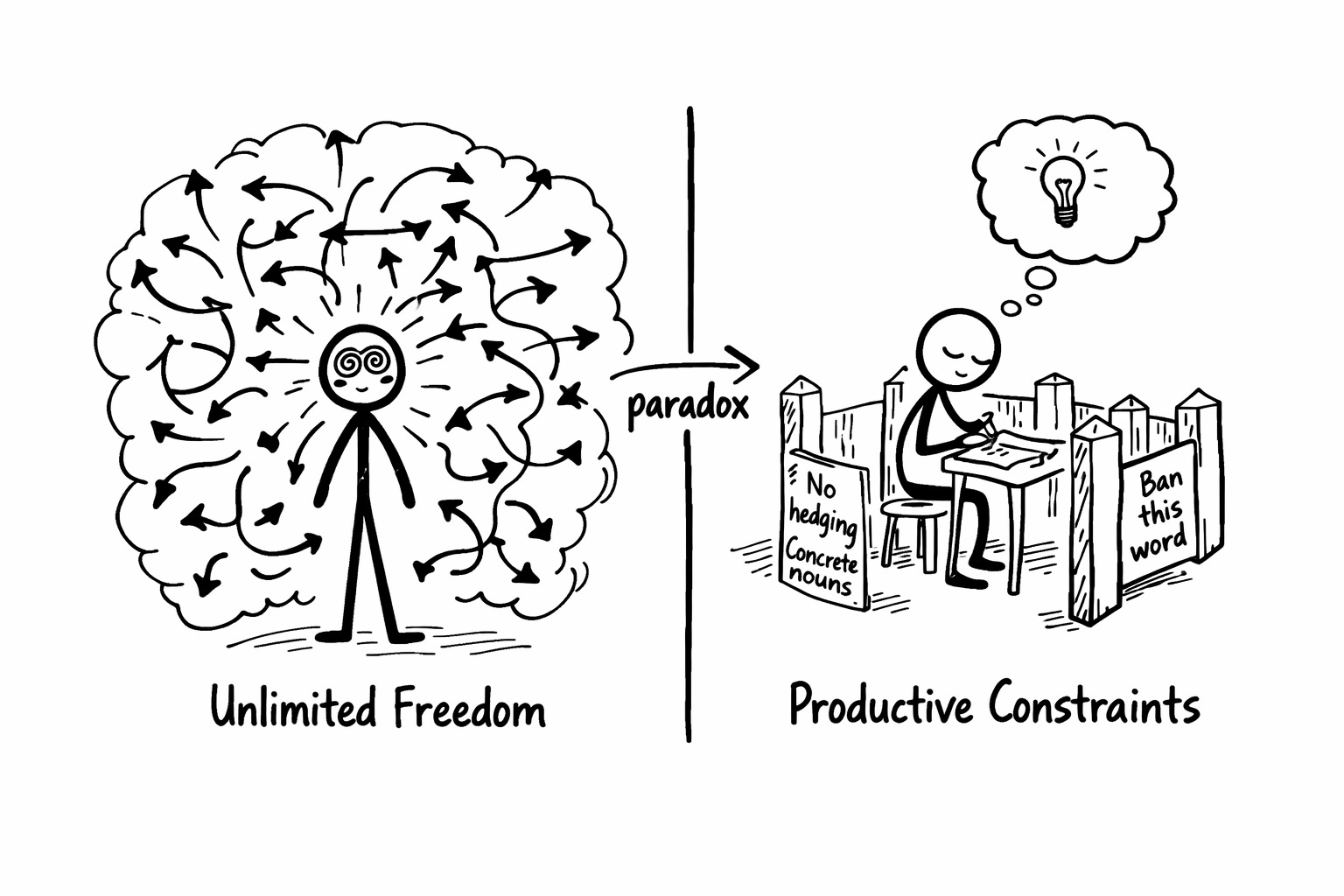
Infinite possibility sounds like freedom. Infinite possibility produces slop. The paradox is annoying but true: limitation breeds distinction; freedom breeds mediocrity.
I don’t make the rules. (I literally make the rules. That’s the whole point of this piece. But I don’t make the meta-rules about why the rules work. Those exist independent of my preferences, which is either reassuring or terrifying depending on your relationship with determinism.)
Start Here
Don’t overhaul everything. That’s how you abandon systems by Thursday and go back to swiping right on random prompts hoping one of them puts out.
Pick one constraint. One.
The rhythm constraint is the easiest entry point: “No more than two sentences of similar length in a row.”
Add it to your next prompt. See what happens. The output will be different. Whether different becomes better depends on you. On your ability to recognize your own voice when it shows up unexpectedly. On your willingness to keep the goofy parts instead of smoothing them back toward the mean.
But different is the first step. You cannot be distinctive without first being different. You cannot be different while letting the machine take the path of least resistance.
The path of least resistance is the mean.
The mean is where your voice goes to die.
The slop factories will always be faster. Let them have speed. We’re playing a different game, and sometimes the winning move is making the game harder on purpose.
🧉 Ever banned a word from AI? Which one? Why? (Mine is “straightforward.” Makes me want to commit crimes.)
Crafted with love (and AI),
Nick “Willfully Inefficient” Quick

PS… New post every day. How to collaborate with AI without your writing turning into the verbal equivalent of gas station sushi. Subscribe if that sounds useful. Unsubscribe later if I turn out to be full of shit. Fair deal.
First section, rewritten without verbs:
Exactly backward.
Best outputs: AI under prohibition. AI under constraints. Arbitrary rules. Stupid limitations. Restrictions, apparent task sabotage.
Intent: difficulty. Deliberate difficulty.
The point: difficulty.
“End with forward motion, not summary.” I love this. I think the first word that I ever banned was “Overall”. And if you think I’m having trouble keeping up with your prodigious output, you’d be right. The upside is that I do actually read everything that you produce. Eventually. See you in February 🙂