
The Day My Brain Forgot How to Make Words
A Confession About AI Dependency (And How to Recover)

I figured out the difference between collaboration and dependency by getting it catastrophically wrong first.
Three weeks of full-immersion AI writing on client work. Ghostwriting, content marketing, SEO pieces. The stuff that paid the bills but didn’t require my voice. I figured I’d save my creative energy for the work that mattered. Let the machines handle the assembly line.
Output through the roof. I was delivering more, billing more, clearing my task list faster than I’d cleared it in years.
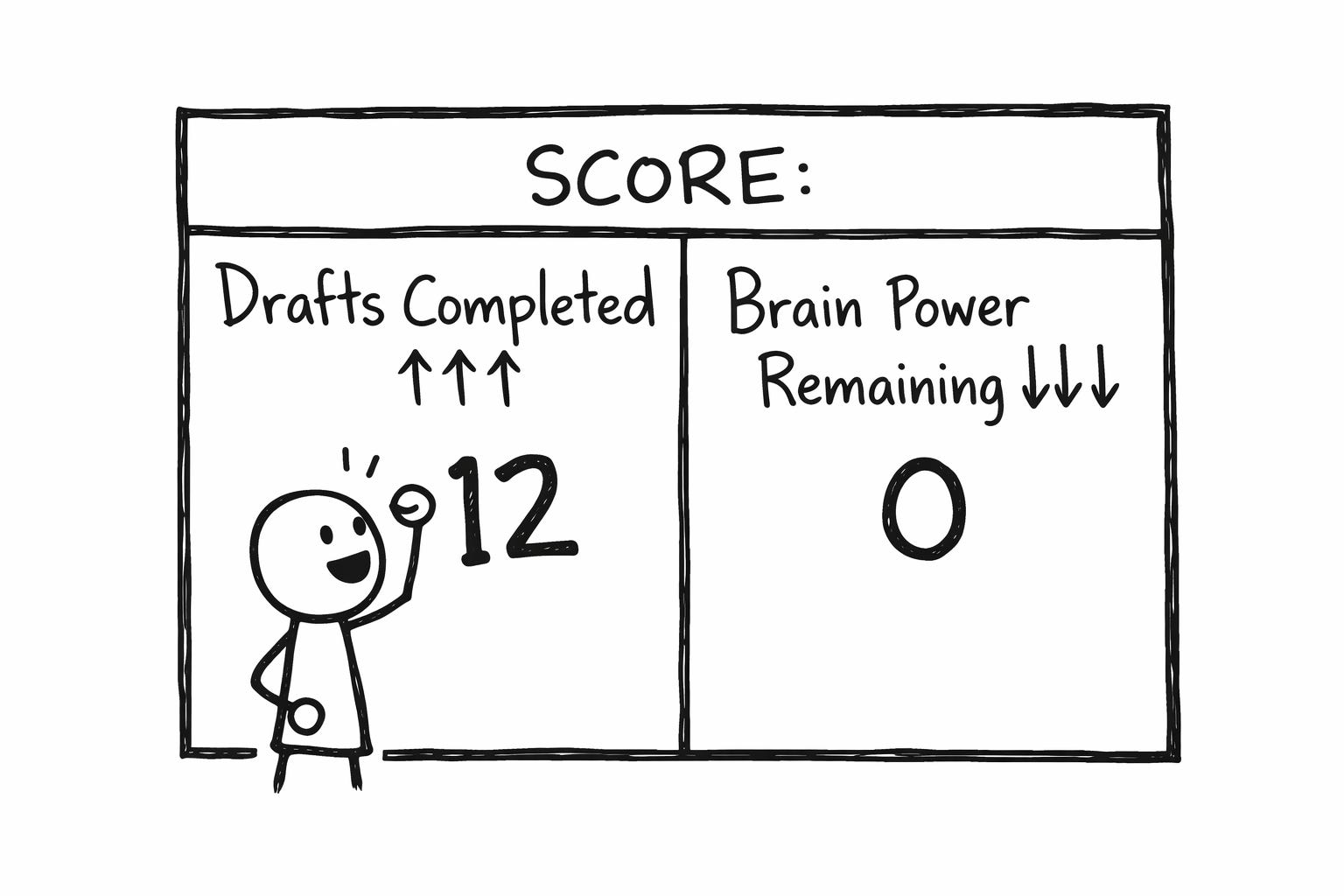
And at the end of it, I couldn’t write a damned thank-you email.
Not a proposal. Not a manifesto. Not even a strongly-worded complaint to an airline. (Those take craft.) A thank-you email. The kind of thing I’ve typed ten thousand times while half-asleep, mid-hangover, possibly while performing active listening for someone I’d mentally muted.
I sat there for forty-five minutes. The cursor blinked at me with the patience of a therapist who’s heard this before and knows I’m not ready to hear the answer.
My brain had packed its bags, moved to a small coastal town, and opened a pottery studio. It wasn’t taking calls.
That’s not a hypothetical. That’s not a cautionary fable I invented to sell you something. That’s a Tuesday I actually lived through, wondering if I’d accidentally lobotomized myself in the name of content velocity.
The system I use now exists partly because of that morning. Not entirely. But that email was the first moment I realized the thing I’d been celebrating was quietly eating my creative capacity from the inside like some kind of productivity-flavored parasite.
The Part Where Everything Fell Apart
(Spoiler: Your brain doesn’t know the difference between “important” writing and “unimportant” writing. It just knows whether you’re using it or not. This is the lesson I learned the hard way. Everything else is just the story of how I learned it.)
For two weeks, the AI immersion felt like I’d discovered infinite money. Client work appeared from nowhere. Projects I’d been dreading materialized into full drafts before I finished my coffee.
Then week three arrived.
I tried writing a newsletter intro. My own newsletter. My own voice. Kept deleting sentences. Everything sounded borrowed from someone I’d never met but instinctively wanted to argue with.
I tried summarizing a client call. Stared at the document like it was a riddle from a hostile sphinx. Recorded a voice memo instead.
I tried writing a tweet. Took twenty minutes. Hated every word. Posted it anyway because spite is an underrated creative fuel.
Then the thank-you email incident.
I’d been so busy being productive on the “unimportant” work that I hadn’t noticed the “important” work was dying too. The contamination didn’t stay in its lane. Turns out when you stop exercising your word-finding muscles, they don’t check which project the words are for before they atrophy.
What I Started Calling It
There’s a specific type of creative withdrawal that heavy AI users experience.
The productivity gurus don’t mention it. The tool companies definitely don’t mention it. (They have shareholders, and shareholders don’t love warnings that your product might cause your brain to quietly relocate without leaving a forwarding address.)
I’ve been calling it the voice hangover.
That foggy, disoriented, vaguely shameful feeling after a night of decisions you’ll spend the morning regretting. Except the intoxicant was efficiency and the hangover hit my ability to string words together without supervision.
The symptoms:
Mental fog. Trying to write without AI felt like running through honey while wearing a sweater made of more honey. Words that usually showed up uninvited had dried up at the source.
Phrase borrowing. I’d catch myself typing AI-ish phrases even when writing manually. Smooth. Polished. Corporate. The verbal equivalent of a guy in a rented tuxedo trying to convince you he owns the building. (He does not own the building. But the tuxedo fits well and confidence is a hell of a drug.)
Resistance to struggle. The friction of finding words, which used to feel like creative work, suddenly felt like punishment. Why suffer when the machine does it faster?
(This is how addictions talk, by the way. The logic is airtight right up until you’re forty-five minutes into a thank-you email and your brain is halfway to Maine shopping for kilns.)
Voice uncertainty. I’d read my own writing and genuinely couldn’t tell if it was me or an echo of patterns I’d absorbed. The boundary between my voice and The Voice had blurred.
And nobody. Was. Talking. About. This.
We celebrate the AI writing high. But the crash? The cognitive hangover? The slow forgetting?
Silence. Convenient, marketable silence.
What’s Actually Happening
I’m not a neuroscientist. I once read half of Thinking, Fast and Slow and then got distracted by a horror novel about a lighthouse with too many stairs. These are my credentials.
But here’s what I’ve pieced together:
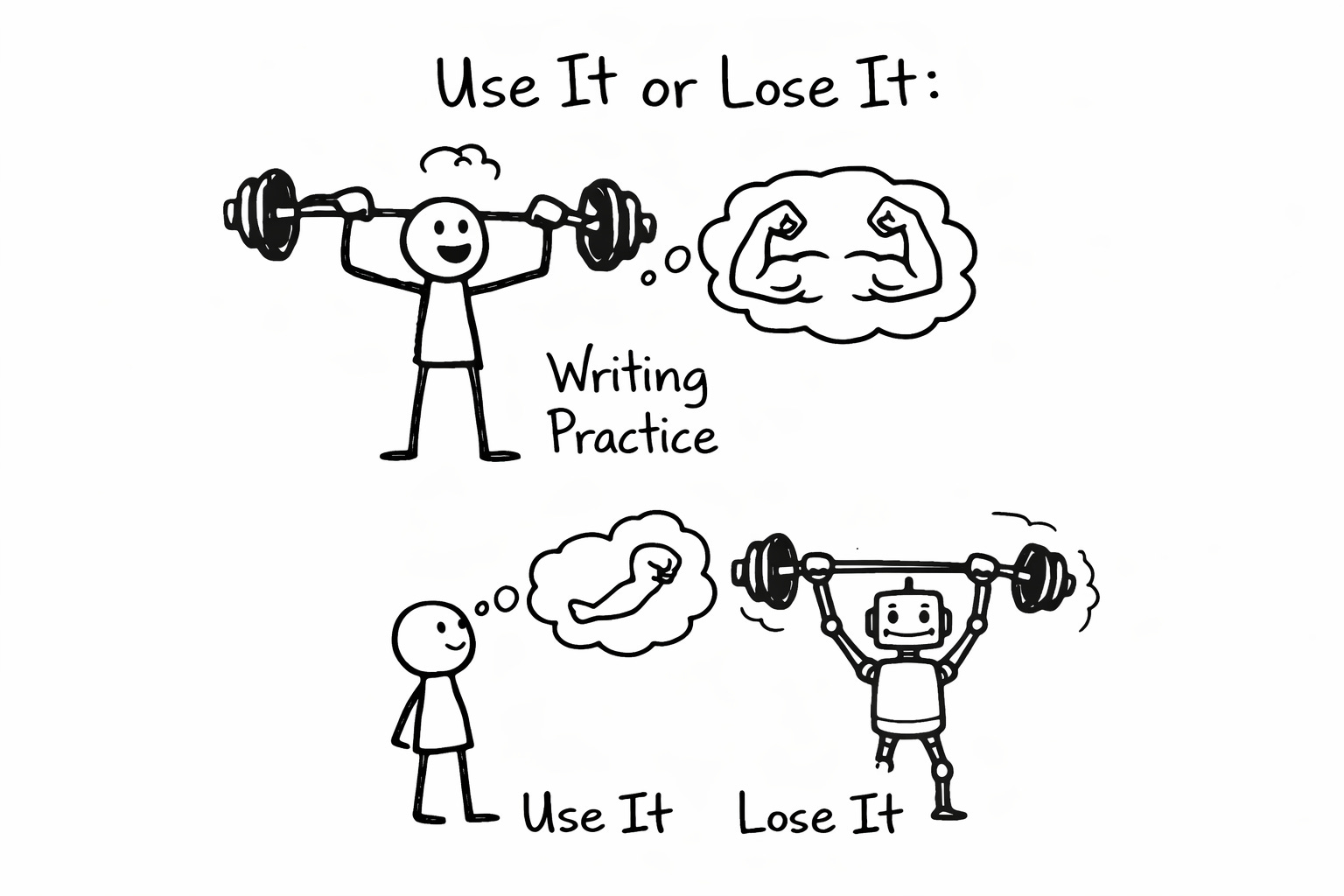
Writing manually activates specific neural pathways. The struggle to find words. The process of rejecting wrong ones. These are cognitive muscles. They require exercise.
When AI handles the word-finding, those pathways take a nap. Not permanently. But consistently. The way any muscle atrophies when you stop using it. The way languages fade when you stop speaking them.
And your brain doesn’t care which project the words are for. Client work. Personal work. Thank-you emails. Your neurons don’t check the invoice before deciding whether to fire. They just notice: Am I being used, or is the machine handling this?
Train your brain to expect AI assistance on client work, and it stops showing up for personal work too. The atrophy doesn’t read the org chart.
Why This Actually Matters
Generic AI content isn’t just a quality problem.
It’s a symptom of creative capacity that’s been quietly outsourced while nobody was paying attention.
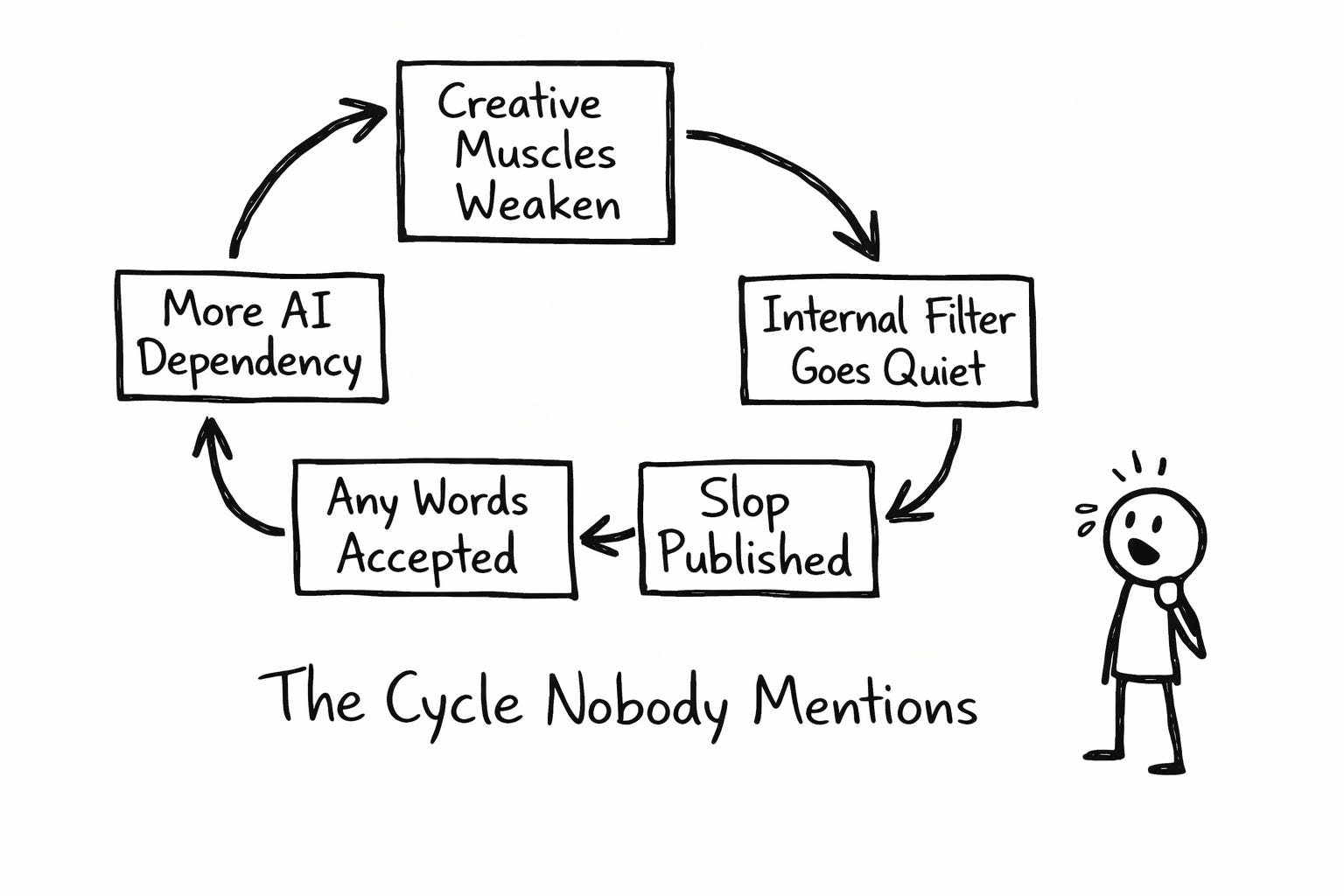
When your brain loses the habit of finding your words, it starts accepting any words. The internal filter that used to reject phrases that don’t sound like you goes quiet. Because the comparison mechanism has atrophied from disuse.
You can’t recognize wrong when you’ve forgotten what right felt like.
Slop starts in the brain before it hits the page.
By the time you’re publishing content that sounds like everyone else, the damage is already done. Your voice has become a vague memory you can’t quite articulate. The thing that made your writing distinctly yours has faded because you stopped exercising it.
Even if you only stopped exercising it on the “unimportant” stuff.
What I Changed
I didn’t quit AI. The tool isn’t the problem. My relationship with the tool was the problem.
I’d convinced myself I could outsource selectively. Use AI for the “unimportant” work and preserve my brain for what mattered. My brain had other plans.
So I changed everything. Not just how I used AI on personal work. How I used it everywhere.
I stopped pretending I could compartmentalize. I now treat all writing as exercise for the same muscle. Client work, personal work, random emails. There is no “unimportant” writing. There’s only writing I do myself and writing I let the machine handle. And the ratio matters across the board.
I protected raw writing time. Every morning, before AI touches anything, I write something manually. Newsletter intro, random rant, unsent letter to a company that wronged me in 2017. (They know what they did.) The point is keeping the pathways open.
I documented my patterns obsessively. Building my Voiceprint wasn’t just about teaching AI how I write. It was about keeping me conscious of how I write. You can’t forget your patterns if you’ve written them down and stare at them regularly.
I started noticing the hangover symptoms. Now when I feel that foggy, borrowed-voice sensation creeping in, I recognize it. Creative withdrawal. Treatable. Temporary. If I do something about it.
I built collaboration instead of dependency. Collaboration means AI handles specific tasks while I maintain creative control and keep my brain actively engaged. Dependency means AI handles the heavy lifting and my brain quietly forgets how to lift anything at all.
One keeps your voice intact. The other erases it slowly while you celebrate your output metrics.
The Bottom Line
The debate isn’t AI versus no AI. That’s over. The train left. We’re all on it now.
The question is whether you’re a passenger or cargo.
We’re here to make things as ourselves. Our own weird angles. Our own stubborn rhythms. Our own inexplicable attachment to certain words and phrases that nobody else would choose.
Outsource that completely and what’s left?
Very productive content. Very efficient content.
Slop. With a byline.
🧉 The hangover is treatable. But only if you’re willing to admit you have one first.
What symptoms have you noticed after heavy AI sessions? The fog, the phrase-borrowing, the quiet panic when the blank page stays blank? Tell me below.
Crafted with love (and AI),
Nick “Still Hungover” Quick
PS… I write every day now. Every. Day. Like a person with a problem, or a person solving one. Subscribe if you want to watch me find out which.
Been there 😅 Creative burnout hits everyone. The “brain forgets how to make” moment is just the signal you need rest and a fresh perspective. Sometimes the best ideas show up right after you stop forcing them.
definitely feel that "voice hangover" thing lately too. its scary, what do you do to snap you out fast?