
How to Stay Uncopyable When AI Can Already Copy Your Voice
Voice gets you noticed. Taste, judgment, lived receipts, and reader trust are what make you impossible to replace.

AI can copy your voice now.
Not someday. Not after some $900-a-month enterprise model eats your archive in a windowless data center while a guy named Chester says “creator moat” into a ring light. Now.
Your rhythm, your sentence habits, your favorite little verbal limp, the specific texture you spent years sanding into shape until readers could pick you out of a lineup blindfolded, all of it can become a prompt, a markdown file, a reusable setting.
A tiny personality costume for the clanker to wear while it tap-dances across the feed pretending to be you. (Rude, frankly. At least buy me dinner before wearing my sentence structure.)
I know because I built a system that does exactly that.
Which makes this next part inconvenient as hell.
Your voice still matters. It gets you noticed. It gets the thumb to pause. It keeps your writing from sounding like a compliance department discovered transcendental meditation.
But it will not make you uncopyable.
Not anymore.
The Receipt Has My Name on It
I’ve spent a year telling creators their voice matters.
A hundred-plus posts. A full training course with multiple version updates. A whole private vocabulary I made up in public and then watched people start repeating back at me, which is both flattering and how cult documentaries begin.
Voiceprint. You-shaped holes. Ensloppification. Throughlines. The kind of terminology that starts as “useful shorthand” and ends with me staring at a Notion page at 1:17 a.m. wondering if I accidentally invented a religion for burnt-out writers.
All of it aimed at one promise: find your voice, protect your voice, teach the machine your voice, and keep the slopgoblins from crawling through the vents and wearing your face.
That promise still has teeth. But it is incomplete. And the receipt has my name on it in permanent marker, with the little flourish I use when I’m trying to look confident while making an avoidable mistake.
I built the Voiceprint system to document how a person writes closely enough that AI can echo them back. The rhythm. The tics. The sentence shapes. The little phrase-level fingerprints. The recurring metaphors that should probably be taxed as dependents at this point.
It works. That’s why people pay for it. That’s also the part where the floor gets oddly squishy, because if I can document your voice well enough to reproduce it, so can someone else.
Maybe not as well. Maybe not with the same care. Maybe not with the part that would survive a second read. But close enough for the scroll.
And “close enough” is where a lot of damage hides out.
Your voice, the thing you spent years developing, can now be turned into a file, a prompt, a cheap mask, a weekend project for someone with your archive, a free Sunday, and the moral posture of a raccoon in a dumpster behind a Cheesecake Factory.
I keep a v4.5 of myself in a text file.
Around here, that document has a name: Voiceprint. Outside this little corner of the internet, it probably sounds like the kind of thing a man invents five minutes before losing custody of a whiteboard.
It is exactly what it sounds like: a real document explaining my rhythm, my sentence habits, my preferred metaphors, my banned phrases, my comedy structures, and the acceptable dosage of verbal damage required to make AI sound less like HR found God.
Four and a half versions of my own personality. Patch-noted like software.
“Improved rant density.”
“Reduced accidental corporate phrasing.”
“Fixed bug where Nick used the word ‘tapestry’ and was still allowed near language afterward.”
Try calling that a moat with a straight face.
Voice used to feel like a wall. Now it’s a photocopier setting.
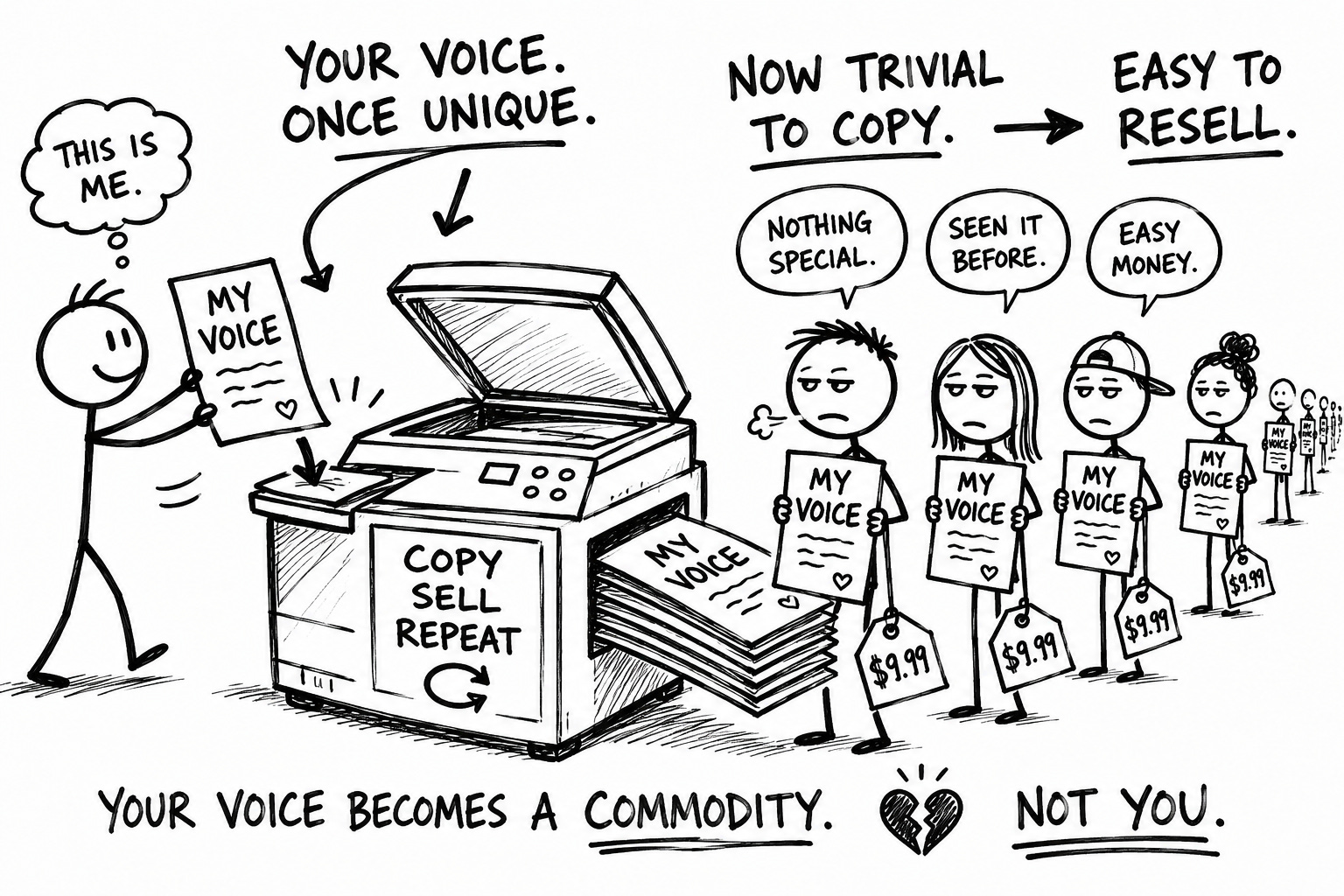
We Mistook “Hard to Copy” for “Impossible to Copy”
A moat is not “a thing people recognize about you.” A moat is the thing competitors still can’t copy after you show them exactly how it works.
That distinction matters because the creator economy has spent several years treating recognizability like defensibility. They are related. They are not married. They don’t share a Costco membership.
For a while, voice looked defensible because sounding like a specific human was genuinely hard. Most people couldn’t do it. Most AI couldn’t do it. Most brand voice guides were just five adjectives standing on each other’s shoulders inside a trench coat.
“Bold.”
“Warm.”
“Clear.”
“Playful.”
“Authoritative.”
Congratulations. You have described every startup, coach, newsletter, candle brand, and suspiciously expensive productivity app currently in existence.
Real voice was harder than that. Real voice had texture. It had damage. It had weirdness. It had the unmistakable signs of a person who had lived through a few things and developed opinions as a side effect.
So voice felt like protection.
Then the models got better. The copying got cheaper. The floor rose. And the thing that used to separate you became the first thing the machine learned.
Your cadence? Copied.
Your frameworks? Copied.
Your favorite rhetorical move where you stack three clean sentences and then sneak in a longer one dragging a Radio Flyer wagon full of grievances? Copied.
Voice didn’t stop mattering. It stopped being scarce.
A moat made of something anyone can manufacture in an afternoon is no longer a moat. It’s a screen door with a Home Depot receipt and a Christ complex.
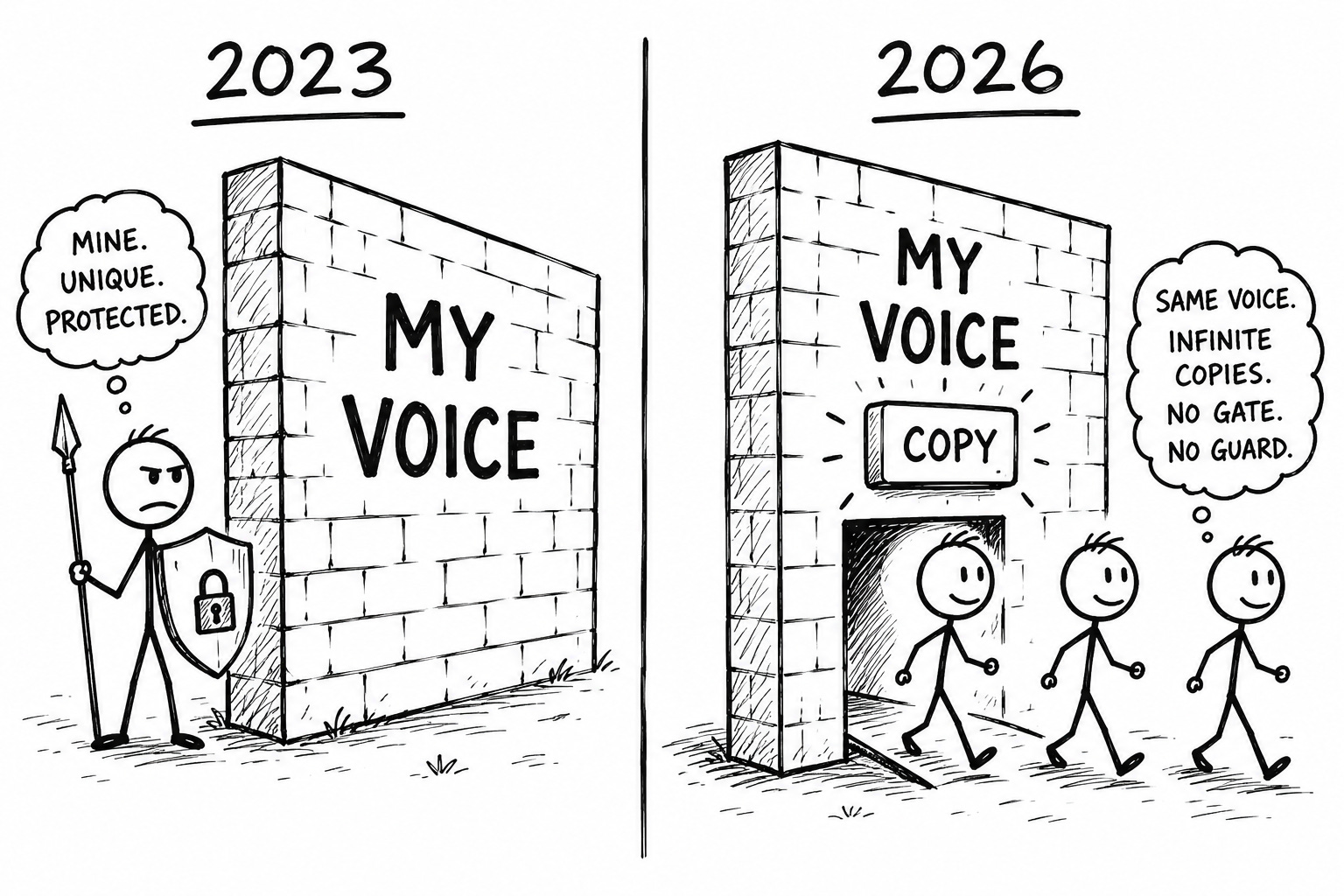
Voice Still Gets Them to Stop Scrolling
Voice still does real work.
I’m not telling you to throw your voice into the algorithmic soup and start writing like a horoscope that just got a Canva account. Please don’t do that. The internet has enough sentences that sound like a crystal shop learned conflict avoidance.
Voice gets you noticed. It creates friction. It gives the reader a reason to pause before the feed drags them behind the barn and turns them into engagement mulch.
A voice-lobotomized post still dies on contact. You know the kind. It says things like, “Creators must develop authentic content strategies in the evolving AI landscape,” which is technically a sentence in the same way a smooshed protein bar found under a car seat is technically food.
Fine. Edible under specific emergency conditions. Not something you build a life around.
So yes, keep your voice. Teach the machine how you sound. Stop letting it hand you sentences that smell like enterprise software.
But voice is the door. It’s not the house.
And if your whole AI writing strategy is “make this sound like me,” you’re sweeping the doormat while the roof is missing.
Nice doormat. Very you.
Rain still gets in.
The Prompt Bros Are Looking in the Wrong Place
The prompt bros are looking in the wrong place.
Not because the prompt isn’t long enough. People will keep trying, of course. They’ll write 14-page megaprompts with sections like “Core Emotional Frequencies,” “Brand Soul Parameters,” and “Forbidden Energetic Textures.”
Kyle will sell it for $97. He’ll call it God Mode. He’ll include a Notion template. Someone in the comments will mistake a JSON schema for prophecy.
The world will continue spinning because it has no taste.
But your real edge isn’t hiding out in better prompts. It’s beyond your voice.
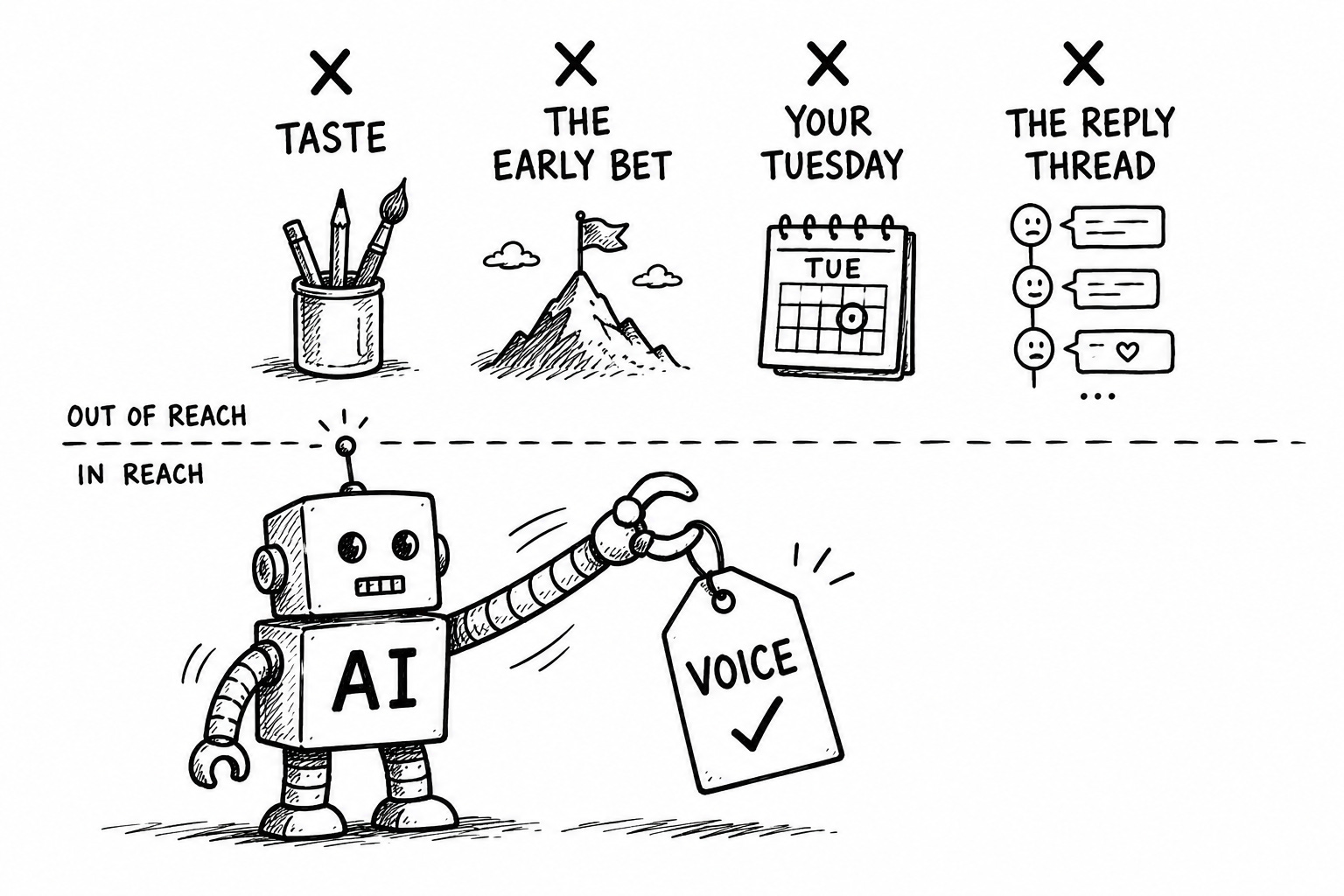
The machine can copy the wrapper. It still needs you to bring the thing worth wrapping.
The Four Things AI Can Imitate But Not Originate
If voice is the wrapper, these are the four things worth wrapping:
Taste: what you refuse to publish.
Judgment: what you’re willing to stand behind.
Receipts: what proves you were actually there.
Trust: why people know the difference.
Taste is the part that says, “Hell no.” The machine will add. You have to cut. It’ll give you seven bullet points, three caveats, one “to be clear,” and a paragraph using “transformative” with the confidence of a man who owns three blazers. Your job is to kill the technically fine sentence before it sands the soul off the piece.
Judgment is the call you make before the room gives you permission. AI can generate a contrarian angle. So can a drunk uncle with a Facebook account and a suspicious number of opinions about seed oils. The hard part is deciding which take deserves your name before the evidence is tidy.
Receipts are what prove the point came from a life, not a prompt. AI can imitate the way you make a point. It cannot supply the reason you had the point in the first place. No weird client call. No launch that made $37 and emotional damage. No awkward DM. No “I know this because I lived the stupid version.”
Trust is the part the prompt bros never know what to do with. The reply thread. The private note. The reader who opens because it’s you, not because the subject line performed a circus trick. Relationships are slow, annoying, human, and hard to screenshot as a growth hack.
That’s the part AI can’t originate. It can help you publish more, research faster, edit cleaner, repurpose smarter, and move through the publishing stack with less friction.
Good.
Use the clankers.
Just don’t put them in charge of deciding what matters.
The Dangerous Part Is When It Works
The bad AI outputs are easy to spot. You see them immediately.
“This post aims to explore the transformative potential of AI-powered content workflows.”
Delete. Exorcise the demon. Maybe light a candle.
The dangerous outputs are the plausible ones. They sound pretty good. They sound like you. They have your rhythm. They use your favorite metaphors. They even include a parenthetical aside in the right place, the little bastard.
But underneath the voice, there’s nothing only you could have brought.
No taste. No call. No receipt. No relationship.
Just slop with a nice accent.
That’s the one that fools you. Not the garbage. The polished garbage. The garbage that learned your handshake.
Bring the Substance Before You Bring the Machine
You don’t abandon voice. You demote it from the whole strategy to the delivery system.
Before you ask AI to write like you, give it something worth amplifying. Bring your hot take. Bring your red pen. Bring the thing you learned the stupid way. Bring the detail that makes the template start sweating. Bring the part you almost cut because it felt too specific, too personal, too much like something only your readers would understand.
Especially that part.
That’s usually the bit that makes the piece yours.
Then use AI like a publishing team. Not a replacement brain. Not a slop cannon. Not a one-click ghostwriter wearing your hoodie and silently ruining your reputation while you sleep.
Let it research, challenge, edit, repurpose, test headlines, fix structure, check continuity, and help move the work through the publishing stack.
But don’t let it decide what matters. Don’t let it choose the hill. Don’t let it translate your conviction into consensus.
You stay editor-in-chief.
AI gives you ten angles. You pick the one with blood in it. AI expands. You subtract. AI helps the work travel farther. You make sure there’s still a person at the center of the machine.
That’s the correction.
Not less AI. Better chain of command.
Voice still matters. But the full stack matters more now: ideas, research, writing, editing, repurposing, distribution, audience growth, monetization, reader trust.
Let them steal the wrapper.
The wrapper was never the meal.
Voice gets them to the door. Your taste, judgment, receipts, and reader trust are why they stay.
Crafted with love (and AI),
Nick “Slop Inspector General” Quick

PS… If your AI still sounds like ChatGPT wearing a fake mustache and hoping nobody asks follow-up questions, start here:

The Voiceprint Quick-Start Guide helps you give AI a better map of your voice, your rhythm, your banned phrases, and the little verbal damage that makes your writing yours.
Not magic. Not soul cloning. Just a better operating manual for the machines so you can stop receiving drafts that sound like they were swept out from under airport carpet and formatted as advice.
PPS… Like, comment, restack, or send this to your cousin three times removed because statistically someone in your family tree is currently using AI to write “thrilled to announce” posts and must be stopped before they launch their next Etsy shop.