
Kyle the SEO Ninja Is Back. He Sells Prompts Now.

It’s 2010.
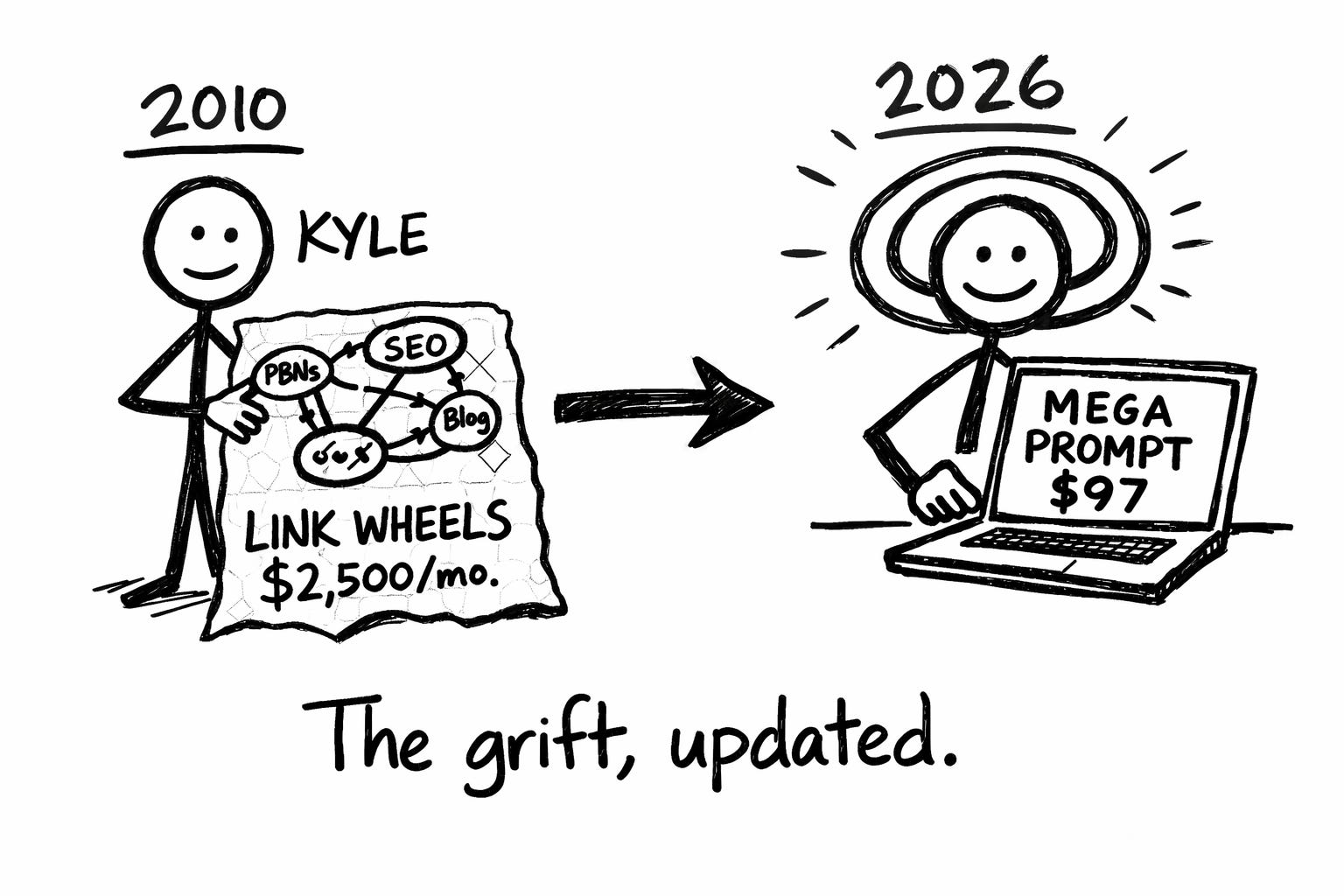
You’re sitting across from a guy named Kyle. (His business card says “SEO Ninja” in Papyrus font, which should have been warning enough. Nobody with useful skills has ever printed “Ninja” on cardstock.)
Kyle is explaining why your website isn’t ranking. Something about “link wheels” and “PageRank sculpting” and “anchor text density ratios.” He draws a diagram on a napkin that looks like a schizophrenic’s vision board. Red string everywhere. Arrows pointing to other arrows. Circles within circles.
You nod along.
You don’t understand a single word.
But Kyle seems confident. And the jargon is so dense, so impenetrable, it must be legitimate. Complexity is the costume competence wears when it has nothing underneath.
You hire Kyle for $2,500 a month.
Six months later, nothing has changed. Then Google updates its algorithm. Kyle blames the update. (Not his six months of nothing. The update.) He vanishes like a man who’s been waiting for an excuse.
And the world kept spinning. As it does.
Fast forward to 2026.
You’re scrolling Twitter. (I refuse to call it X. I also refuse to call Kanye “Ye” or pretend memecoins are an actual thing. I have limits.)
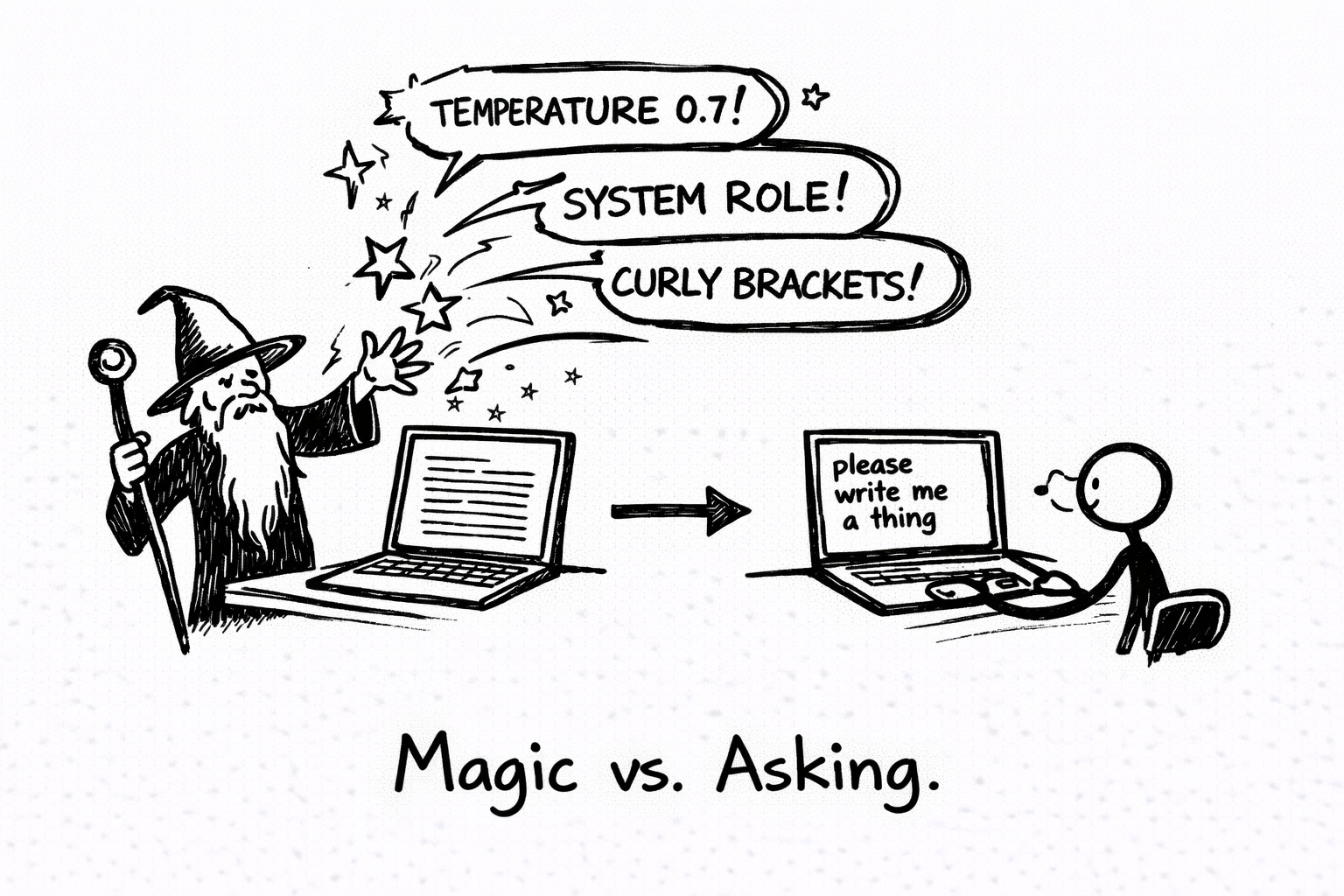
A guy with a blue checkmark and a ring light is selling a “God Mode Mega-Prompt” for $97. It’s 1,200 words of arcane instructions. Curly brackets. Temperature settings. System role assignments. “Act as a senior content strategist with 15 years of experience in B2B SaaS who specializes in conversion-focused copywriting with a background in behavioral psychology and an inexplicable confidence that borders on clinical delusion...”
The jargon is dense. The complexity is theatrical.
It must be legitimate, right?
I have bad news.
That’s Kyle.
He’s back. He learned how ring lights work. He pivoted. (God, I hate that word. People don’t pivot. They fail at one thing and start lying about another thing.) Kyle didn’t pivot. Kyle is running the same grift with a different product.
The costume changes. The con stays the same.
The Gospel According to Complexity
Here’s how the grift works. (Pay attention, because once you see this pattern, you’ll see it everywhere. It’s like learning what a laugh track is. Ruins sitcoms forever. You’re welcome.)
When a technology is new, it’s genuinely difficult. Midjourney v1 required Discord commands and arcane syntax. Early SEO required understanding server logs and HTTP headers. The learning curve was real. Experts existed because expertise was necessary.
But here’s the thing about technology. (God, I sound like a TED talk. Bear with me.)
Technology matures. It gets easier. That’s the entire goddamn point of technology. The printing press wasn’t invented so we could employ more scribes. Cars weren’t designed to create jobs for horse-whisperers.
Google became “type what you want, moron.” ChatGPT became “talk to it like you’d talk to a reasonably intelligent intern who’s never heard of sarcasm.”
The hard phase ends.
But the grifters need you to believe we’re still in the hard phase.
They treat the English language like a spellbook. They invent proprietary frameworks with mysterious acronyms. (MEGA-PROMPT-3000-TURBO-FRAMEWORK™. Patent pending. Terms and conditions apply. Side effects may include wasting money and feeling vaguely humiliated.)
They speak in code so you think you need a translator.
Because if you realized you could just... ask the AI what you want... in plain English... like you’d ask a person...
Kyle’s out of a job again.
And Kyle really doesn’t want that.
The Part Where I Admit Something Embarrassing
I tested this. (Because a few years back, bright-eyed and gullible, I spent over $1,000 on these mega-prompt packs. Plural. I was going to be soooo ahead of the curve.)
I’ve never used a single one.
1,200 words of “system instructions.” Curly brackets arranged like hieroglyphics. Temperature settings calibrated to the third decimal. Role assignments so specific the AI probably developed an identity crisis.
All of it. None of it useful.
Then I wrote this:
Write a collection email for a freelance designer whose client is 60 days overdue on a $3,000 invoice. Firm but professional. Maintain the relationship. Under 100 words.One sentence. Seventeen seconds to compose. (I timed it. I time everything. I’m deeply unwell.)
I ran both.
The outputs were nearly identical in quality.
Both produced competent emails. Both struck the right tone. Both did the job.
One required me to understand “token optimization” and “system prompt architecture” and “optimal temperature settings for professional correspondence.”
The other required me to know what I actually wanted.
The mega-prompts worked. The free one-liner worked exactly as well.
The difference was a thousand dollars and a lot of theater.
The bigger problem isn’t people who know the price of things but miss the value. It’s people who know the complexity of things but miss the simplicity. They’ve invested so much in making things hard that easy solutions feel like personal attacks.
The prompt engineering industry isn’t selling expertise.
It’s selling permission to feel like a professional.
Those 1,200 words don’t make AI better. They make you feel like you’re doing something sophisticated. Like the ritual matters. Like the incantation has power.
The ritual has no power.
The incantation is just words.
The emperor’s mega-prompt has no clothes.
The Only Framework You Actually Need
You don’t need a prompt library.
You don’t need a swipe file.
You don’t need Kyle’s 1,200-word incantation or his Papyrus business card or his ring light or his confidence.
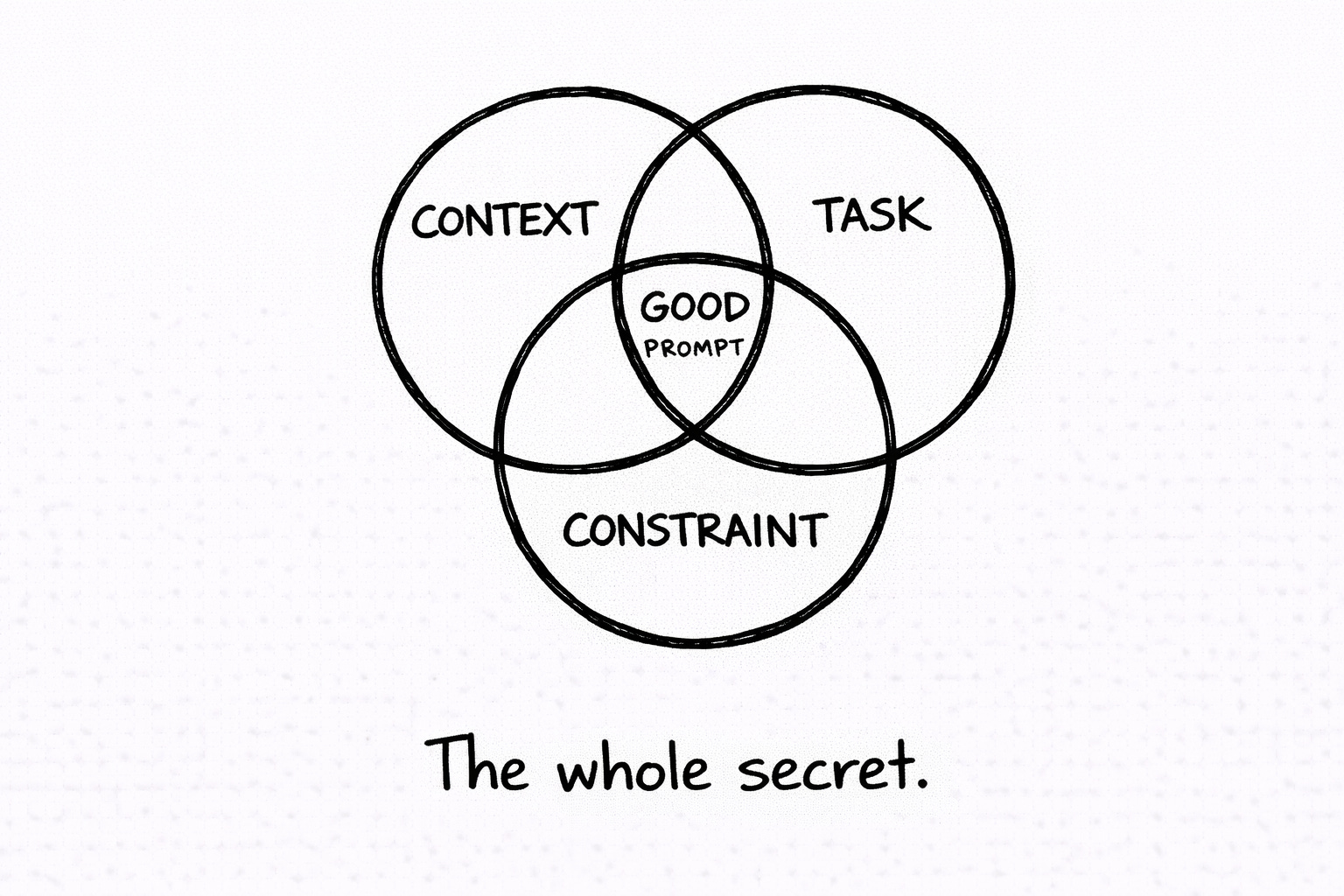
You need three letters.
C.T.C.
That’s it. That’s the framework. (Yes, I’m aware I’m now “that guy” who has a three-letter framework. I’ve become what I mock. This is called character development. Or hypocrisy. Depends who’s asking.)
Context — Who are you? What’s the situation?
Not: “Act as a senior content strategist with 15 years of experience in B2B SaaS who specializes in conversion-focused copywriting and has a mortgage and lower back pain and opinions about oat milk...”
Just: “I’m a freelance designer. My client owes me $3,000 and is 60 days late.”
That’s context. Real context. The kind you’d give a friend if you were asking for help.
Task — What do you need done?
Not: “Generate comprehensive outreach content that leverages persuasive frameworks while optimizing for conversion metrics across stakeholder touchpoints...”
Just: “Write a collection email that’s firm but doesn’t torch the relationship.”
Specific. Clear. Human.
Constraint — What are the rules?
“Under 100 words. No passive aggression. I still need this client to pay me, not hate me.”
Context. Task. Constraint.
Seventeen seconds. Zero dollars. Works every single time.
The Uncomfortable Part (Where I Tell You It’s Your Fault)
Nobody selling prompts wants you to figure this out. (Which is why I’m telling you for free. I’m a giver.)
If you can’t get good output from AI, the problem isn’t your prompt syntax.
The problem is you haven’t figured out what you actually want.
AI is a genie with no sense of subtext. It grants exactly what you asked for… not what you meant, not what you actually wanted, what you said. Specificity is survival.
No mega-prompt fixes unclear thinking.
No framework substitutes for knowing what you want.
The prompt engineering industry is selling you scaffolding for a building you haven’t designed. “Buy my blueprint!” they shout. But it’s not your blueprint. It’s theirs. And your building will look like everyone else’s building who bought the same blueprint.
Which defeats the entire purpose.
The universe doesn’t care. It keeps expanding regardless.
Kyle’s Expiration Date (A Prophecy)
Here’s my prediction.
Two years. Maybe less.
Kyle will be unemployed again. “Prompt Engineer” will join “Webmaster” and “Social Media Guru” in the graveyard of job titles that sounded important until you thought about them for thirty seconds.
Not because people will wise up. (Some will. Most won’t. Nobody ever went broke underestimating the human appetite for expensive shortcuts.)
Because AI is getting better at predicting what you want before you ask. Voice interfaces. Predictive suggestions. Systems that understand context from your previous work.
(Eventually they’ll learn to read minds. Then we’ll have much bigger problems than prompt syntax. But that’s a different newsletter.)
“Prompt Engineering” has a two-year shelf life. Clear communication compounds forever. Works on AI. Works on employees. Works on clients. Works on everyone except cats. (Cats don’t care what you want. Respect their boundaries.)
There is no test. There’s only the work.
Leave Kyle’s spellbook on the shelf where it belongs. (Next to The Secret and Who Moved My Cheese and every other book that promised transformation but delivered vibes.)
Discussion Thread: What’s collecting dust in your digital graveyard? Courses you never finished, templates you never used, PDFs you swore you’d read. No judgment. I just showed you mine.
Crafted with love (and AI),
Nick “Former Client of Kyle’s” Quick

PS…I write about AI collaboration almost every day now. Partly because I care. Partly because I have a thousand dollars in bad prompts to justify. Subscribe and watch me process it in public.
That reminds me of the SNL skit with Ryan Gosling 😆
His business card says “SEO Ninja” in Papyrus font