How to give AI your voice (step-by-step template)

I spent six months frustrated with ChatGPT's Custom Instructions before I figured out why they weren't working.
The character limit is brutal. 1,500 characters to somehow capture your entire personality as a writer? That's roughly 250 words. A single long paragraph.
So I tried cramming everything in. "I'm conversational but professional, I use short paragraphs, I like metaphors, I avoid jargon, I prefer active voice, I sometimes start sentences with conjunctions..."
Useless. The AI still produced generic content.
The problem wasn't the character limit. It was the approach.
You don't need your entire voice compressed into one text box. You need a proper document—a Voiceprint—that you can reference, update, and use flexibly across different AI tools.
Here's exactly how to build one.
The Voiceprint Framework: 5 Essential Sections
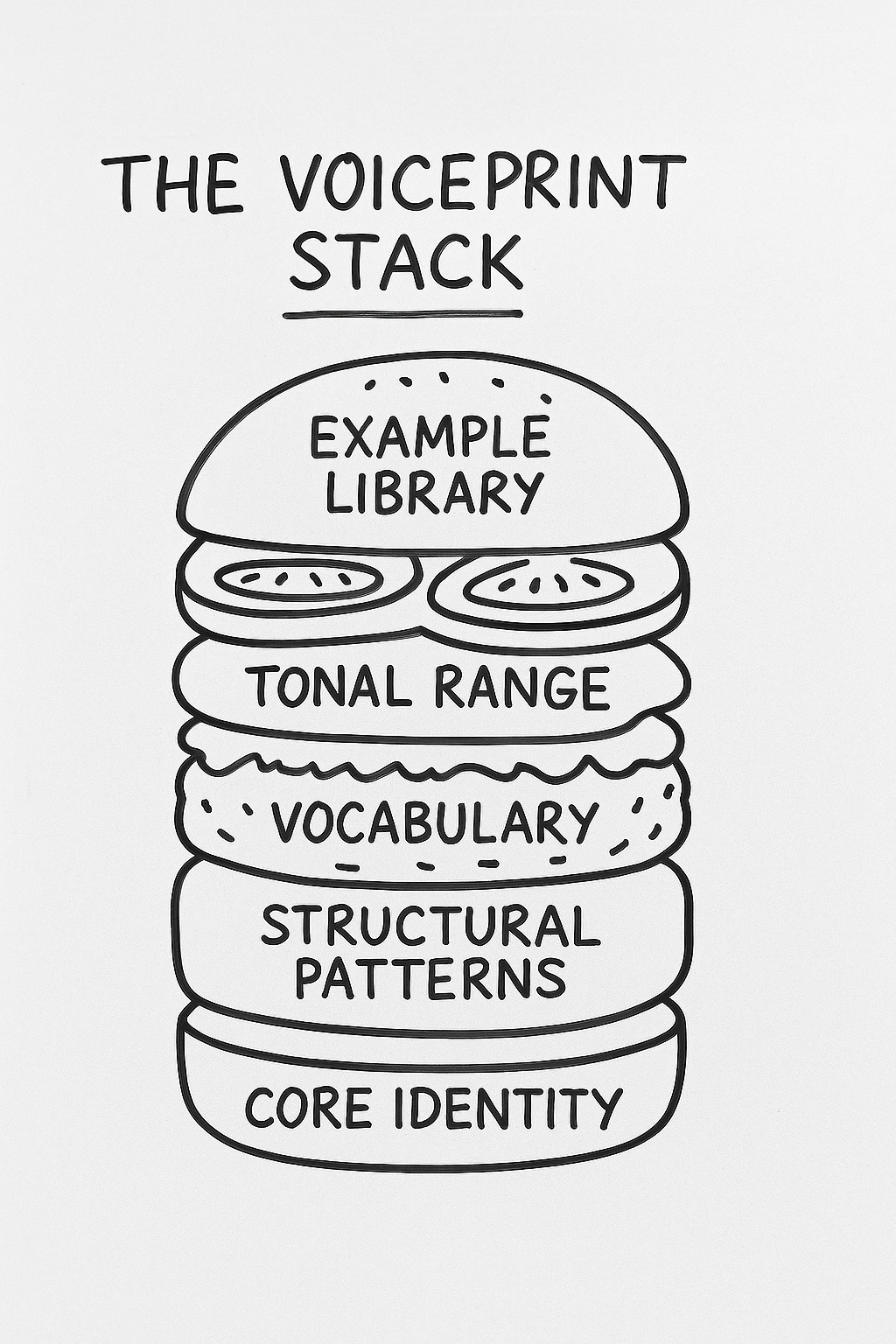
Your Voiceprint has five sections. Each one captures a different dimension of your writing identity.
Think of it like an employee onboarding doc—except the employee is AI, and instead of learning company culture, it's learning your culture.
Section 1: Core Voice Attributes
This is your writer's DNA. Not what you write about—how you write about anything.
What to include:
5-7 adjectives that describe your writing personality
Your default emotional register (optimistic? skeptical? playful?)
How you handle expertise (show authority? admit uncertainty?)
Your relationship with the reader (teacher? peer? mentor?)
My example:
Voice Personality: Conversational, slightly skeptical, practical over theoretical. Uses self-deprecating humor sparingly. Prefers showing expertise through examples rather than credentials. Treats readers as smart people who don't need ideas over-explained.
Common mistakes:
Being too vague ("friendly and professional")
Describing what you write about instead of how you write
Listing aspirational traits instead of actual patterns
Section 2: Structural Patterns
How you organize words on a page. The architecture of your writing.
What to include:
Default paragraph length (sentences per paragraph)
How you use white space
Typical post/article structure
Transition style (explicit? implied? abrupt?)
My example:
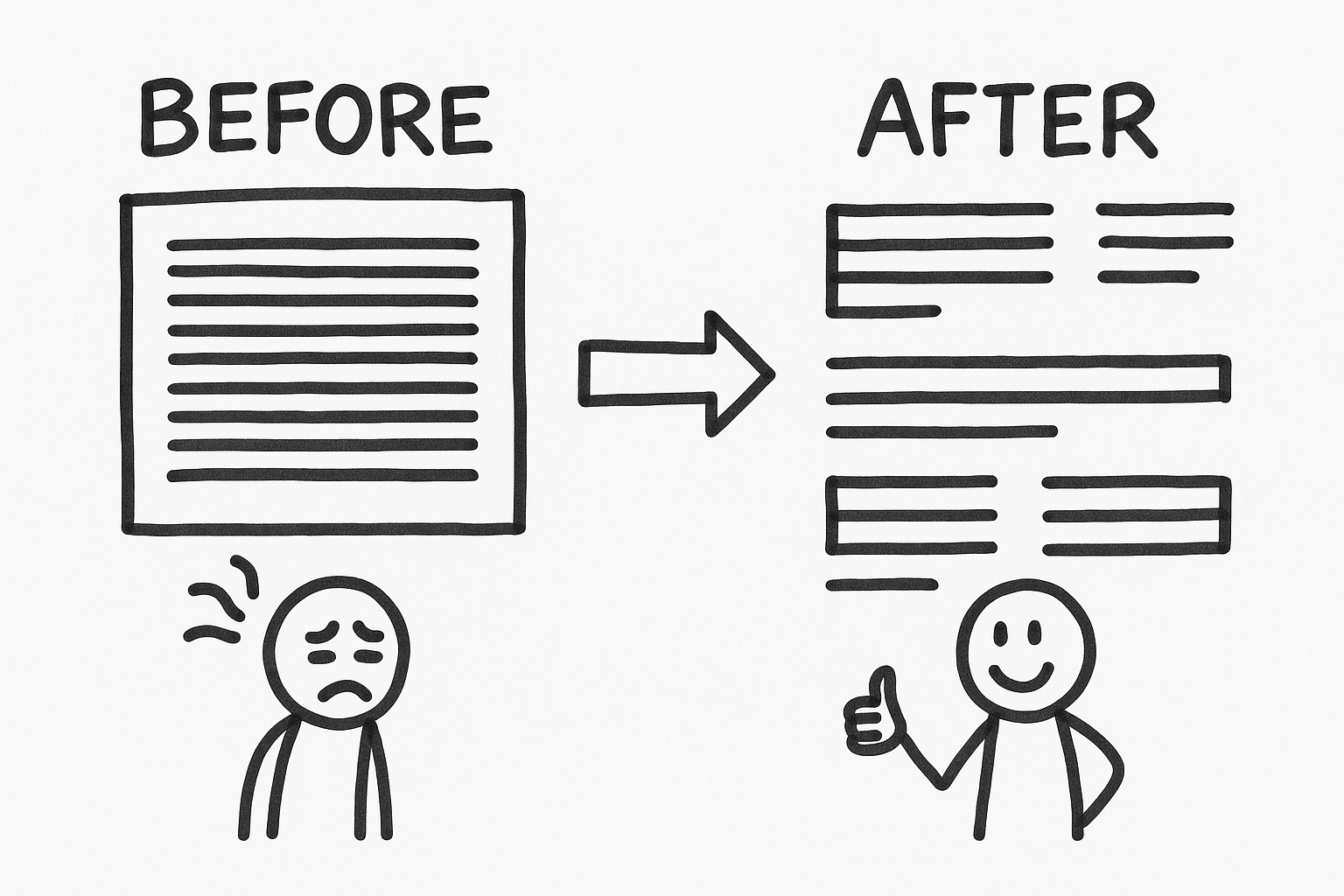
Paragraph length: 1-3 sentences typically. Heavy use of line breaks for breathing room. Subheadings every 200-300 words in long-form. Opens with hook or story before framework. Uses single-sentence paragraphs for emphasis.
Section 3: Vocabulary & Language
The actual words that make your writing yours.
What to include:
Signature phrases you use repeatedly
Words/expressions you avoid at all costs
Jargon policy (use it? translate it? avoid it?)
Profanity approach (never? occasionally? freely?)
My example:
Signature expressions: "Here's the thing," parenthetical asides (like this), rhetorical questions that I answer immediately.
Banned words: Synergy, leverage (as verb), "in today's world," "but what if I told you," "game-changer," "let me tell you."
Profanity: Rarely. Used only for genuine emphasis, never as filler.
This section is where you prevent AI from using phrases that make your skin crawl.
Section 4: Tonal Range
You don't write the same way in every context. Neither should your Voiceprint assume you do.
What to include:
Your default/neutral tone
How tone shifts in different content types
When you're more/less formal
Emotional range (do you show frustration? enthusiasm? vulnerability?)
My example:
Default tone: Laid-back but purposeful. 6/10 on structure scale, 4/10 on formality.
Teaching content: More structured, uses frameworks and steps, slightly more authoritative.
Commentary/opinion: Shorter sentences, more direct, willing to be blunt about what I disagree with.
Emotional range: Express enthusiasm openly. Show vulnerability about learning process. Can be frustrated about industry trends but never mean-spirited about individuals.
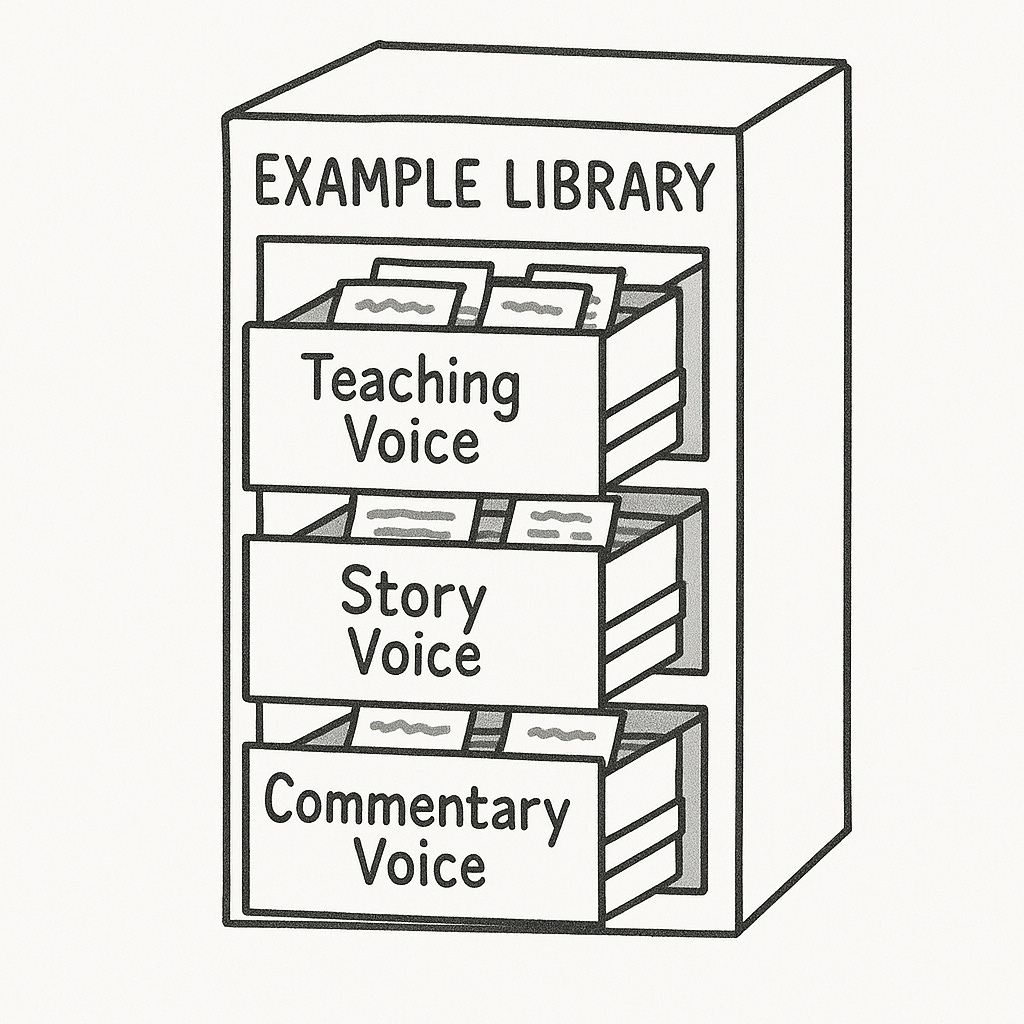
Section 5: Example Library
The most underrated section. Possibly the most important.
What to include:
2-3 paragraphs from your best work
Variety of tones if possible
Specifically chosen because they capture your voice well
AI can pattern-match from examples in ways that written descriptions can't replicate. When Claude or ChatGPT has real samples of your writing, it picks up on rhythms and quirks you might not even consciously know you have.
My example:
Sample 1 (newsletter opening):
"Every time you open ChatGPT, you're talking to a stranger. Not a stranger who's hostile. More like a stranger who desperately wants to help but has no idea who you are."
Sample 2 (teaching section):
"The goal isn't to fully automate your voice. It's to give AI enough context that its first draft is 70% there instead of 30%."
Putting It All Together: The Quick-Start Process
Step 1: Block 30 minutes
This isn't a weekend project. It's a focused half-hour of documentation.
Step 2: Start with examples (Section 5)
Counterintuitive, but pull your writing samples first. You'll reference them while filling out the other sections.
Step 3: Ask AI for pattern analysis
Paste your samples into ChatGPT or Claude:
"Analyze these writing samples for patterns in: sentence structure, word choice, tone, paragraph length, and distinctive quirks."
Use its observations to fill Sections 1-4.
Step 4: Add your preferences
AI catches patterns but misses preferences. Add what you intentionally avoid, not just what you naturally do.
Step 5: Test it
Ask AI to write a paragraph using your Voiceprint as context. Read critically. Update based on what's missing.
How to Actually Use Your Voiceprint
Creating it is step one. Using it consistently is what makes it valuable.
For ChatGPT: Paste a condensed version (key points from each section) into Custom Instructions. Keep the full document elsewhere for reference.
For Claude: Create a Project with your complete Voiceprint as persistent context. Every conversation in that Project starts with AI knowing your voice.
For any AI tool: Keep your Voiceprint in a quick-access location (pinned note, bookmarked doc) so pasting it takes 5 seconds.
Grab the Template
I've packaged everything above into a Notion template you can duplicate and fill in.
It includes:
All 5 sections with guiding prompts
The exact analysis prompt for AI pattern extraction
A "condensed version" format for Custom Instructions
Example entries from my own Voiceprint
Get Your Voiceprint Template Now
Thirty minutes to build. Infinite sessions of AI that actually sounds like you.
The best prompt in the world won't help if AI doesn't know who it's prompting for.
What section of your Voiceprint do you think will be hardest to define? I'm betting Section 1 (Core Voice) trips up a lot of people. Prove me wrong in the comments.
Crafted with love (and AI),
Nick “RTFM” Quick

PS…Want more on collaborating with AI without losing your voice? Subscribe for new posts every Sunday and Wednesday.