
Everything You Know About Engagement Is Making You Forgettable
What actually builds loyal readers in a world of infinite content.

The UX industry’s most famous rule is “Don’t Make Me Think.”
Great advice for checkout flows. Genuinely catastrophic for publishing.
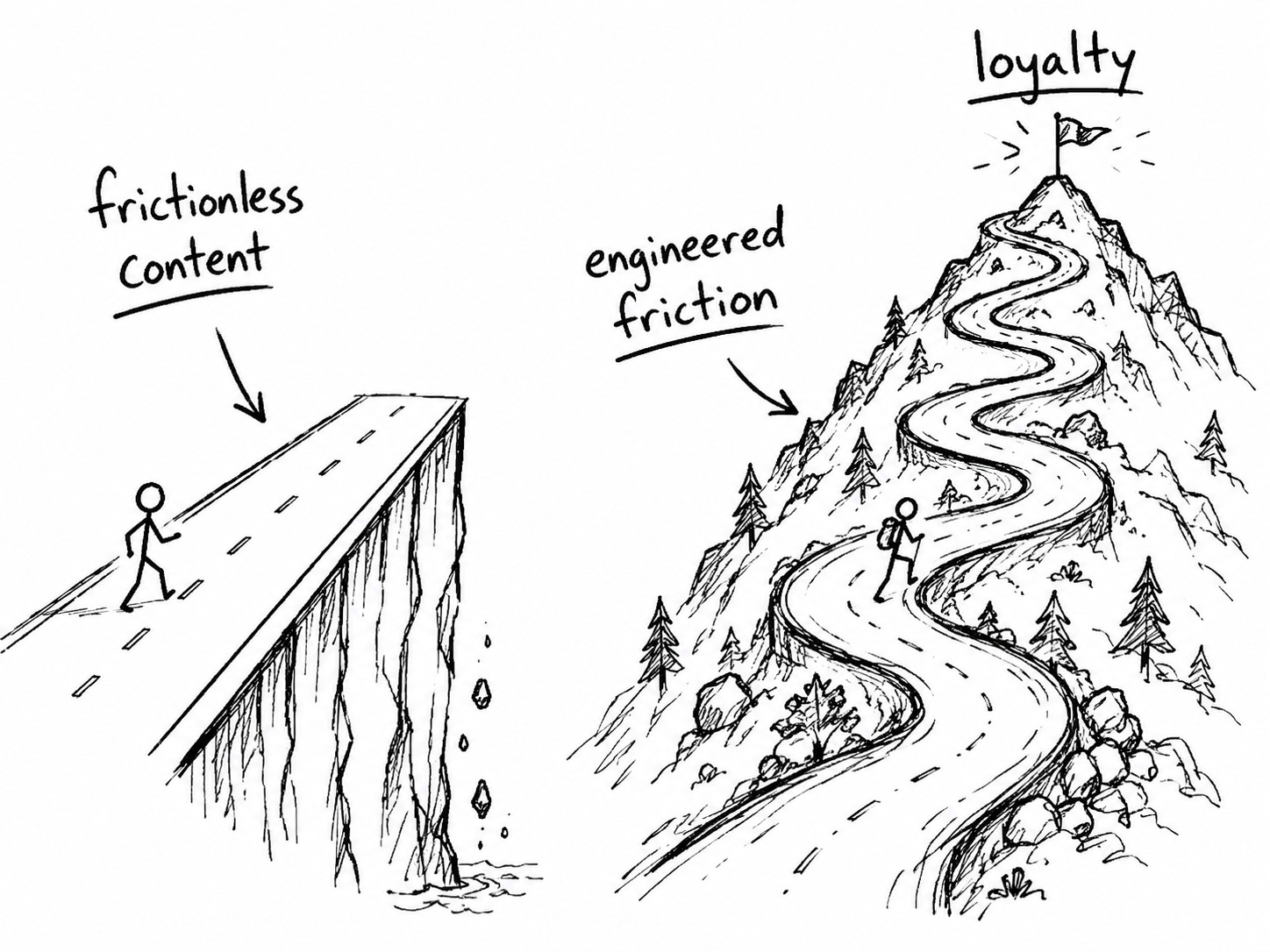
There’s a whole optimization playbook built around friction removal. Short paragraphs. Scannable bullets. The pre-chewed “key takeaway” callout that deposits the insight directly into the prefrontal cortex without asking it to do anything. Carousels that sequence your argument so you can receive it while thinking about something else entirely. (The optimization industry calls this “reducing cognitive load.” I call it ambient content.)
Scrolled. Nodded at. Filed under “vaguely interesting, can’t recall it later this evening.” The reader is unchanged.
Slop factories run on zero friction. They need content that’s easy to consume because their model requires volume, and volume requires interchangeability. Anything that makes a reader pause, actually wrestle with an idea, or exert their mental faculties for three seconds is overhead in their system.
For us, that pause is the product.
Attention Doesn’t Compound
There’s a spectrum to what publishing can actually do to a reader.
At one end: they stopped. Saw the thing. Maybe nodded. That’s attention. Measurable, farmable, worth approximately as much as a door being open. Something might walk through it. Usually doesn’t.
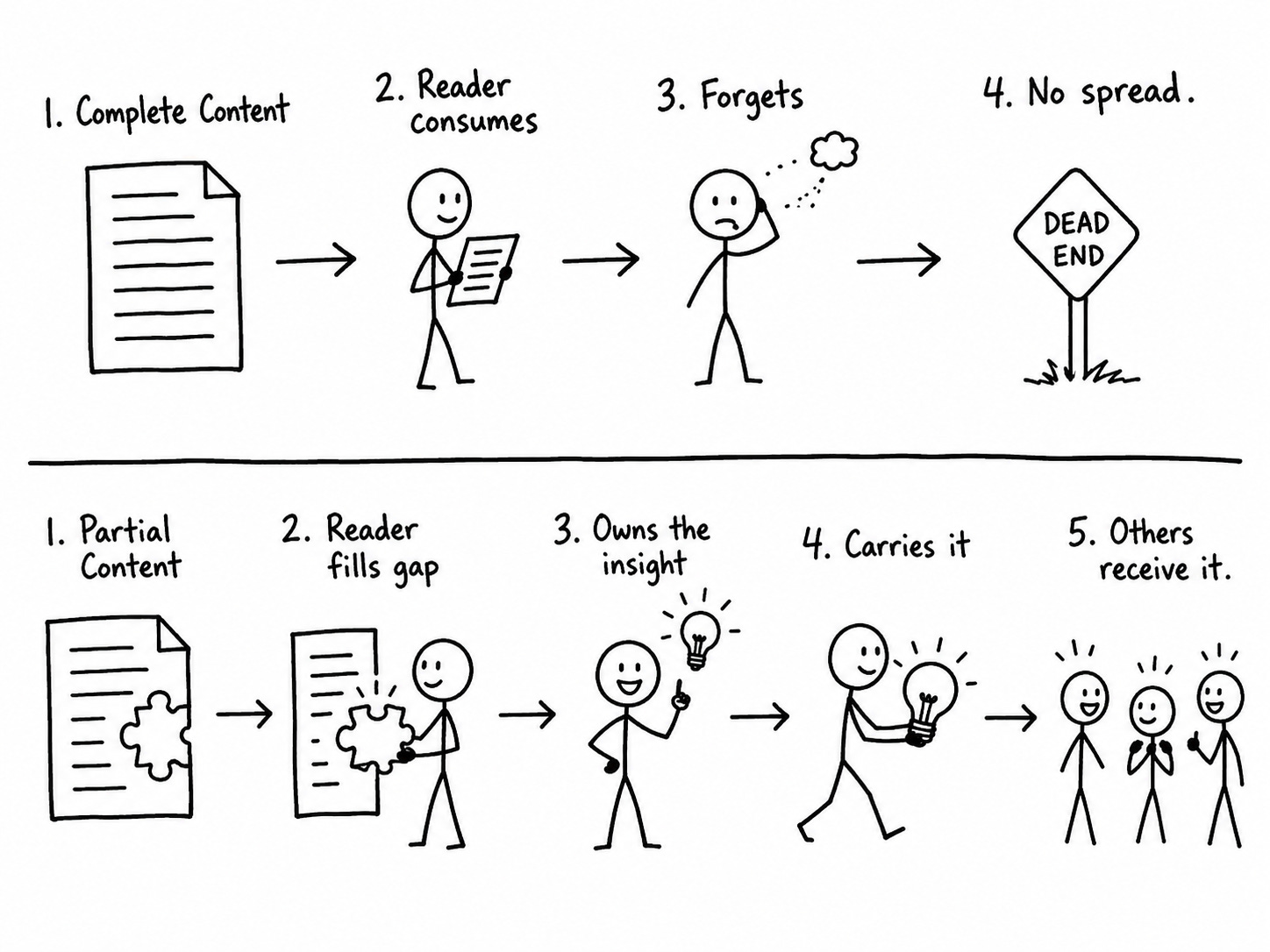
At the other end: the idea travels. Your reader explains your concept to someone who’s never heard of you, in their own words, in a conversation you weren’t part of. That’s not attention. That’s what attention was supposed to be a door to.
You can’t optimize your way there.
Ideas only travel when readers carry them. And readers only carry ideas they earned. Ideas they had to piece together. Ideas that felt, in some partial way, like their own discovery. (There’s actual research on this, which is satisfying because it means I’m not just being contrarian for aesthetic reasons. I’m being contrarian for aesthetic reasons that also happen to be correct.)
Handed insight is forgotten insight. Earned insight gets carried.
That’s the mechanism. And it points directly at a strategy most creators are too worried about open rates to run: making your content slightly harder to consume.
Not confusing. Not opaque. Just requiring a little assembly.
Assembly Required
Research on the IKEA Effect shows people consistently value things they assembled themselves more than identical pre-assembled versions. They invested effort. The thing is partly theirs.
Content works identically.
When you give readers the principles and context behind a complex idea, then leave the final synthesis for them to close, something shifts. They feel the “a-ha” as their own discovery. They remember it differently. They explain it to other people in their own words, not yours. In a conversation you weren’t part of, to someone who’s never heard of you.
Samin Nosrat did this with an entire book. Salt Fat Acid Heat doesn’t give you recipes. It gives you the four principles that generate any recipe. Once you understand what salt enhances, what fat carries, what acid brightens, what heat transforms, you don’t need her instructions anymore. You can figure it out yourself. (That’s the point. That’s always been the point. The book sold millions of copies because it made readers feel like cooks, not like people following directions.)
She gave up the recipe and kept the kitchen. Most creators won’t do that. Giving readers the principles means accepting they might not need the next post. (Turns out readers who don’t need your instructions come back for your judgment. Which is the better thing to be selling anyway.)
Four Things to Leave Out
Not all friction is intentional. Some of it is just bad writing.
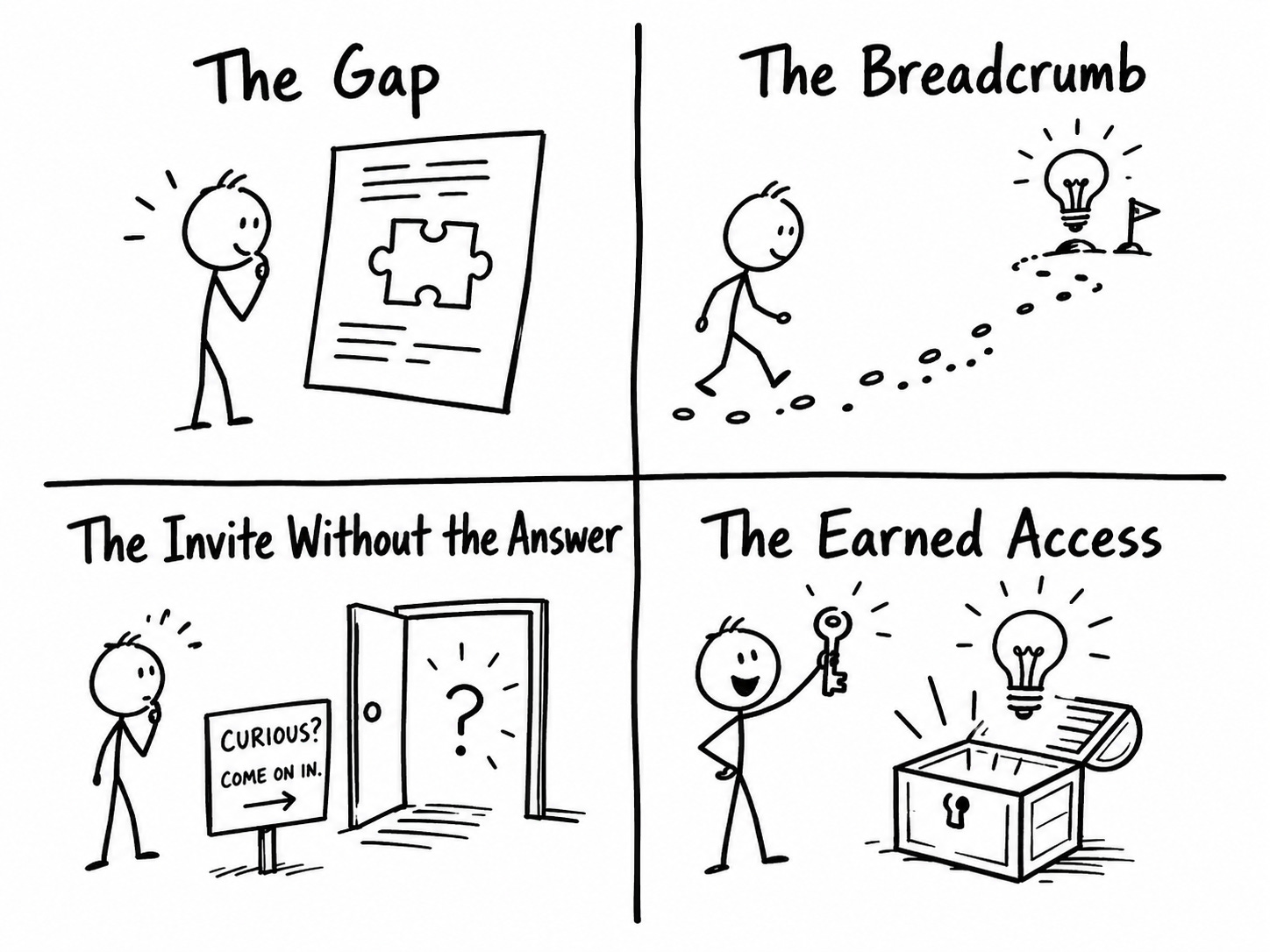
Four places to stop short. The reader takes it from there.
The Gap. Lay out the context, the principles, the evidence. Then trust the reader to make the leap. Don’t explain every implication. Creators who walk you through every consequence of every idea are treating you like you need protecting from your own cognition. Readers feel that condescension. They just don’t often name it out loud.
The Breadcrumb. Reference something significant without the full context. Call it “The Tuesday Anomaly” and let the curious go looking. You’ve just created a binge loop, a reason to read backward through the archive, and a quiet act of self-selection. The readers who go looking are the ones who care. (Those are your actual readers. The ones who don’t go looking are also fine. They just aren’t who this is for.)
The Invite Without the Answer. Leave a real question hanging. Not rhetorical. Not performative. “I don’t know how to resolve this yet. What would you do?” isn’t weakness. It’s a gap the reader steps into. Comments become generative instead of decorative.
The Earned Access. Put your most useful resource one deliberate step away from obvious. Not a treasure hunt. One intentional action. When they find it, they value it differently. The effort is the signal. It also quietly filters out the people who won’t use it anyway, which is its own kind of service.
The Filter Is the Feature
Friction isn’t just an engagement strategy. It’s an audience quality filter.
Optimize for zero friction and you’re optimizing for anyone. Which sounds like growth. Until you realize “anyone” includes every reader who’ll never buy, never refer, never reply, never come back unless the algorithm taps them on the shoulder and says “hey, remember this guy?”
The slop factories need everyone. They’re running volume.
You need the readers who'll take your framework to a party you weren't invited to. The ones who absorb something you wrote so completely it dissolves into how they think. No citation required. The idea doesn't travel as a quote. It travels as a new instinct.
Friction self-selects for those readers. Not through difficulty for its own sake. Through the implicit signal that this publication respects your intelligence enough to leave some of the work to you.
Slop factories have perfected the frictionless experience. You can’t beat them there. You shouldn’t try. Their model runs on volume, and volume can’t afford to slow anyone down. You can.
Crafted with love (and AI),
Nick “Licensed Friction Inspector” Quick

PS... You used to write like you. Now you write like ChatGPT writing like you. Engineered friction only works if there’s something underneath worth earning. Voice Sync documents what that is before AI finishes averaging it out. Four prompts. Twenty minutes. Free:
PPS... If this earned it: like, restack, forward it to the creator who’s been optimizing themselves into ambient content. If it didn’t, the comments exist for a reason.