
Four Ways to Grease Their Eyeballs Down the Page
Four moves that make the middle hit harder than the hook.

You know how to hook a reader. You were never taught how to keep one.
That’s not a character flaw. It’s a curriculum gap. The writing advice ecosystem spent the last decade obsessing over the first sentence and mostly ignored everything after it. The throughline (the architecture that carries a reader from hook to close and back out into their day still thinking about what they read) got treated as the natural result of writing well, not as a set of decisions you could learn to make deliberately.
It isn’t natural. It’s constructed. And once you can see the construction, you can build it on purpose instead of hoping it shows up.
Part 2 named the trust ledger. The throughline is how you make deposits. Four techniques, all proactive, all decided before the post goes live.
What a Compelling Throughline Feels Like
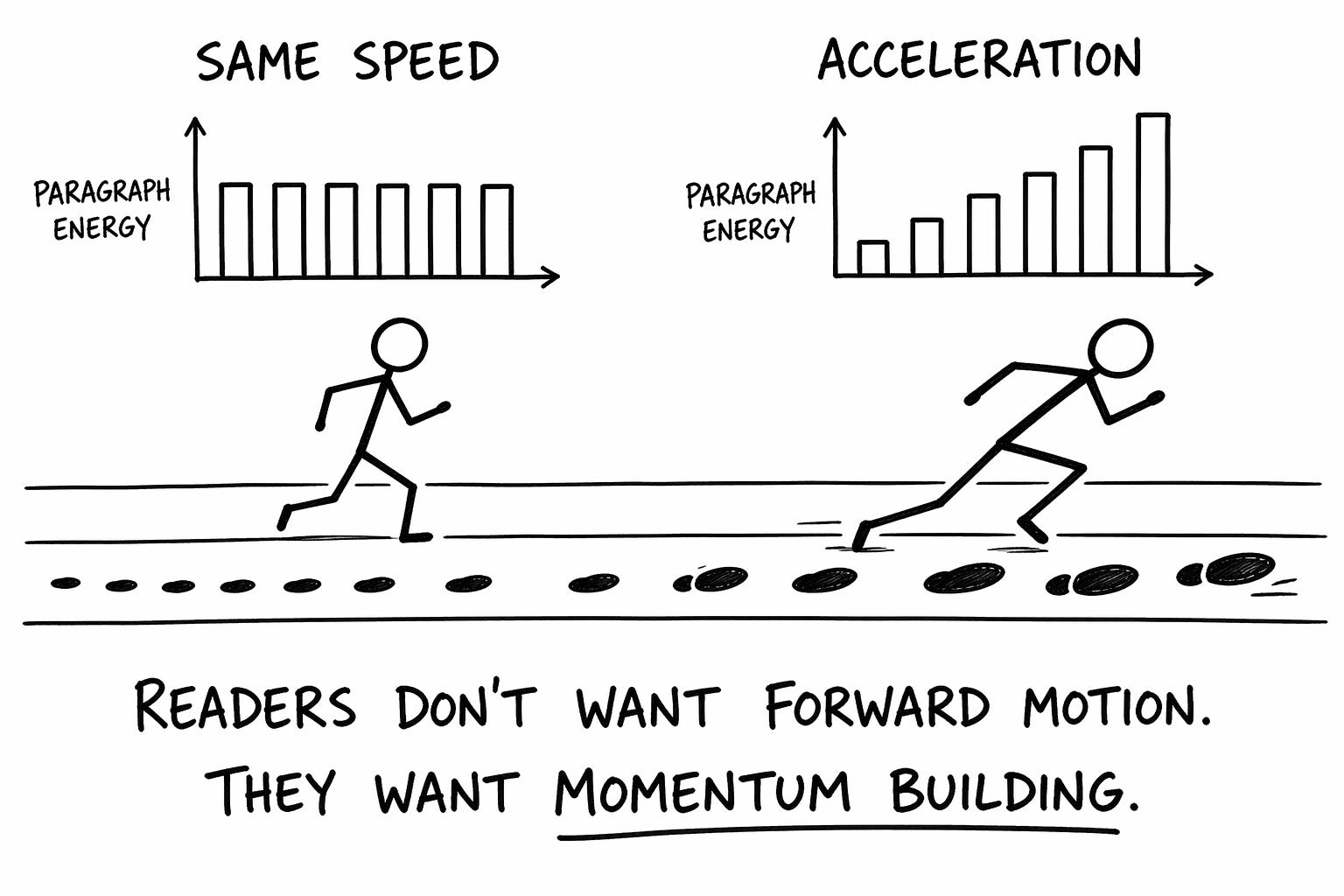
It’s acceleration.
Not speed. Acceleration. The reader is moving faster in paragraph eight than they were in paragraph three. Not because the writing got faster. Because each paragraph is heavier, more specific, more costly than the last. The argument is closing in on something and the reader can feel it getting closer without being able to name what it is. That pull (the sensation of arriving at something real) is what keeps them in the seat.
Most throughlines feel like forward motion at the same energy, paragraph after paragraph. Fast or slow, no direction. The reader drifts. They stop and start. They find natural exit points that a throughline with real momentum never offers.
The four techniques below are about building that acceleration deliberately. Not after the article is published. Before.
Technique 1: The Open Loop
Ideally, every section should end on a heavier problem than it started with.
Not a cliffhanger (cheap). Not a question (obvious). Heavier.
A cliffhanger withholds resolution. An open loop delivers something real and then hands you the weight of it. The reader finishes the section holding more than they came in with. That weight pulls them forward because they need somewhere to put it.
Clean completions do the opposite. A section that ties off neatly gives the reader a moment of satisfaction, and satisfaction is a natural stopping point. Complete. Closeable. They had a good time and they can leave now.
(What IS it with completion. Writers treat a tidy closing sentence like they just talked a jumper off a ledge. They didn’t. They ended a paragraph. Ending is the minimum deliverable of the paragraph as a format. Receiving a standing ovation for remembering to close the refrigerator would be more embarrassing than flattering. The fridge was going to close regardless. We are all already here. Please sit down.)
The prescription: after drafting each section, ask what it leaves unresolved. If the answer is nothing, you tied it off too neatly. Crack it back open. The close of every section should add weight, not relieve it.
Technique 2: The Specificity Accelerator
Each paragraph should be more specific than the one before it.
Abstraction is a brake pedal. Specificity is an accelerator. The reader keeps moving because they’re zooming in, getting closer to something concrete and named and real. When the prose moves from concept to example to specific named thing to specific cost in a specific body, the reader has the physical sensation of getting somewhere.
When it moves the other direction (from concrete observation to general principle to abstract takeaway) the reader has the physical sensation of floating slightly above the earth with no destination and a growing awareness that they could be doing laundry instead.
(Writing workshops exist to teach writers. They mostly teach writers to write for other writers in writing workshops. This has been going on since 1936 and nobody is stopping it.)
The common failure: the hook is the most concrete thing in the post. Everything after it dilutes. The sharpest claim is in the first paragraph and the rest of the throughline softens it toward the mean. This is the spike economy problem applied to prose. The hook is the best thing in it. Everything after is a longer and longer way of not being the hook.
The prescription: read the draft vertically. Each paragraph should zoom in, not out. If paragraph seven is more abstract than paragraph three, you’re braking. Find the concrete version of what you just abstracted and put it there instead.
Technique 3: Plant, Raise, Detonate
This is the architecture you decide before you draft.
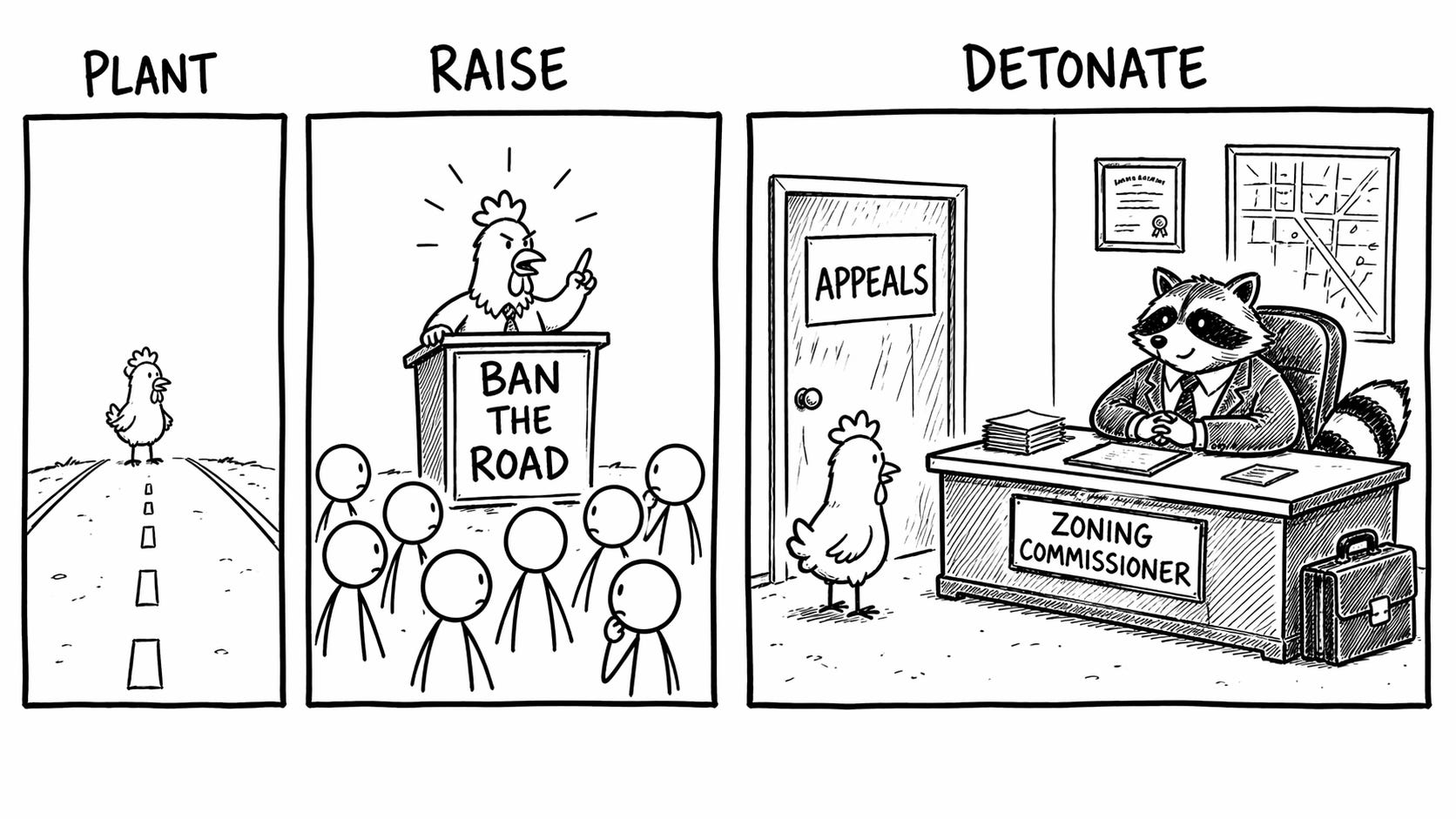
One element gets planted in the first third. An image. A character. A specific claim. Something concrete that the reader absorbs without registering it as load-bearing. It reappears in the throughline, raised (weirder, more specific, higher stakes than the original). It detonates at the close, recontextualized. The reader didn’t know the opening was a setup until the close revealed what it was setting up.
That’s the boom. The structural shock that makes a reader scroll back to the top to read the opening with the ending already in their head.
Comedy writers know this move. They call it heighten. Every return to a setup has to be bigger, weirder, or more specific than the last. Same energy twice and the audience is already done with you. Prose writers mostly don’t know it by name. They know something went flat. They go back and tinker with the sentences. The sentences were fine. The escalation was the problem.
Plant: The chicken crossed the road.
Raise: The chicken, having crossed the road, is running for city council on a platform of anti-driver populism.
Detonate: The chicken lost. The raccoon with the PAC won. The raccoon is now the zoning commissioner. The road is being renamed. The chicken is in appeals. The appeals court is three foxes and a dog with a conflict of interest. The road is still there. Nothing was learned.
(The raise escalates the chicken into something weirder and more specific. The raccoon arriving in the detonation retroactively makes the chicken funnier. The appeals court makes the raccoon funnier. The reader wants to scroll back and watch sentence one become the setup for all of it. In miniature. On a joke about poultry. The mechanism works identically whether the subject is a chicken or a trust ledger.)
You cannot retrofit this cleanly. The seed has to be in the ground before the post exists. Decide what you’re planting. Decide how it raises. Decide what the detonation changes about what the reader thought they knew when they read the first line.
Map this before you write. Then write toward the detonation.
Technique 4: The Stakes Ladder
Each claim should cost more than the one before it.
Not more extreme. More specifically costly. Abstract stakes create intellectual agreement. Specific stakes (the kind where the reader can feel the cost landing in their chest rather than processing it in their head) create the sensation that something actually happened to them inside this post. That sensation is what they forward. Not the learning. The landing.
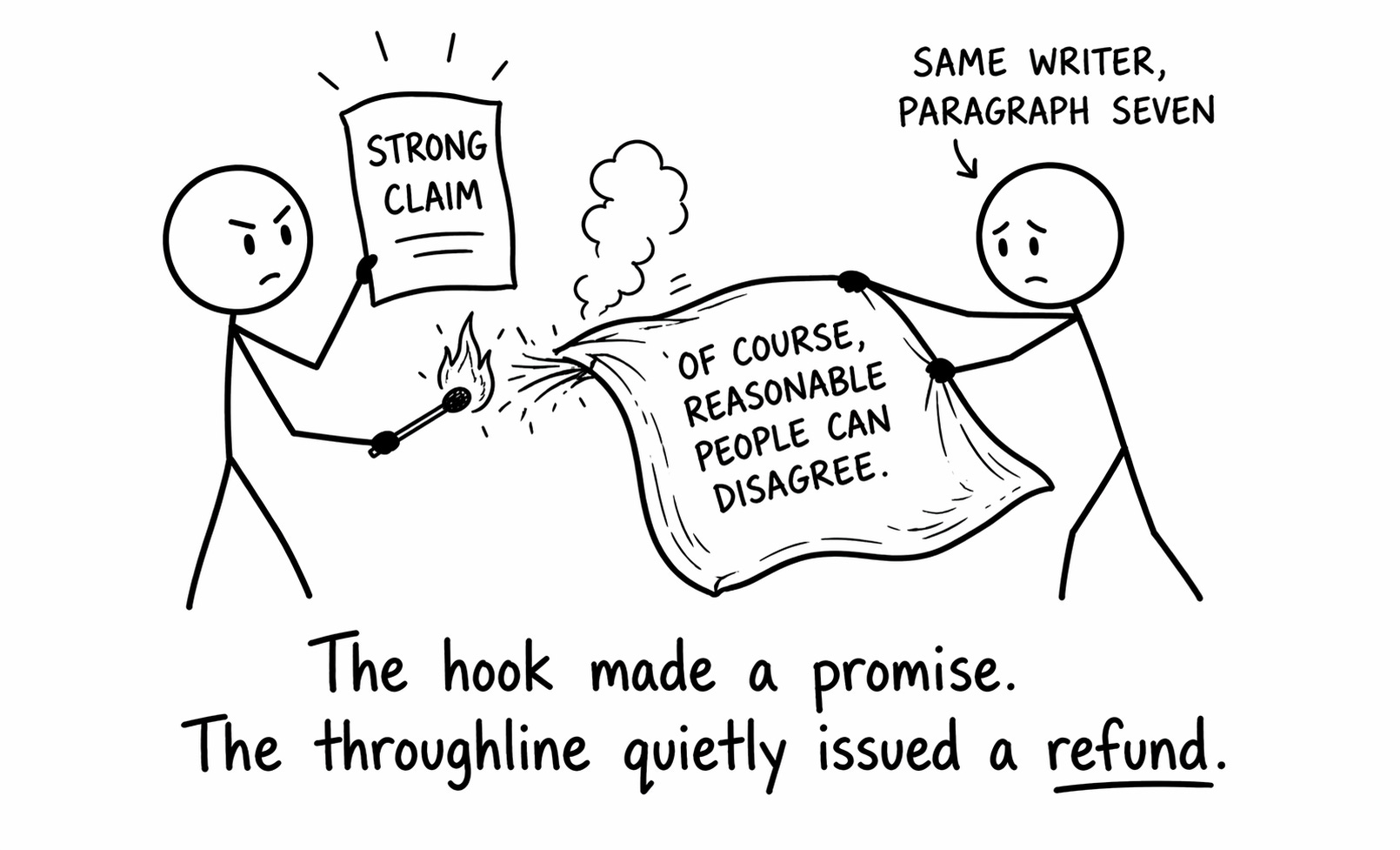
What actually happens in most throughlines: the writer quietly smothers the fire. Not with water, which would at least be decisive. With little wet blankets. One at a time.
Blanket one: “Of course, reasonable people can disagree.” A preemptive refund policy on the claim before it has a chance to land. The reader correctly registers it as negotiable and stops caring about it.
Blanket two: “There’s something to be said for the other side.” Presented as generosity. Received as capitulation. The hook promised a point of view. The throughline delivered a panel discussion nobody signed up for.
Blanket three: “But what do I know. I’m just figuring this out like everyone else.” Manufactured humility that un-establishes the authority the hook spent three paragraphs building. The reader is now entitled to a reasonable question: if you’re figuring it out like everyone else, why aren’t they just going to figure it out themselves?
Blanket four: “At the end of the day, we’re all just trying to do our best.” A lullaby dressed as a conclusion. The reader agrees vaguely, feels soothed, closes the tab, and never thinks about the post again. That is the entire function of that phrase. It exists so writers can end something without having said anything.
(Stakes decay is the single most common reason a reader drifts mid-throughline. Not bad writing. Not weak ideas. A claim that started with conviction and got incrementally un-sharpened by a writer who confused reasonable with compelling. They are not the same thing. Reasonable is what you say at a homeowners’ association meeting. Compelling is what makes someone forward a link to a group chat at eleven on a Tuesday night.)
The prescription: for every claim in the throughline, ask what it costs the specific person reading it. If the answer is abstract, make it concrete. Move the cost closer.
The Quality Check
After applying all four techniques, read the throughline paragraph by paragraph from bottom to top.
Top-down, your brain is rooting for the piece. You remember the setup. You rescue weak transitions out of loyalty to the argument getting home safe. Top-down, you are an enabler.
Bottom-up, you are a stranger. Each paragraph arrives cold. Claims have to stand alone.
Which matters because readers came in on your side. They clicked. They opened. They are rooting for this to be good. Affection is not the question. The question is whether any paragraph in the throughline quietly hands them a reason to leave. The bottom-up read finds those paragraphs before the reader does.
The coasting phrases announce themselves cold:
“As I mentioned earlier.” (The phrase of a writer who didn’t trust the first mention to land. They were right.)
“Building on that idea.” (Zero voltage. Sounds like the name of an architectural firm specializing in preschool playground equipment.)
“Here’s where it gets interesting.” (Interesting things never announce themselves. One more sighting of this phrase and I’m moving to eastern Montana and not telling anyone where I went.)
“To wrap things up.” (Said by writers who are demonstrably not wrapping anything up, and who will continue not wrapping anything up for at least three more paragraphs.)
“It’s worth noting that.” (Then note it. We’re all already here. The preamble is a waste of everybody’s airtime.)
These are the phrases a paragraph reaches for when it has run out of things to say and is waiting for the next one to start without it. The bottom-up read finds them before the reader does.
Everything Above This Line Was the Setup
At the top of this post I said the throughline is constructed, not natural. That once you can see the construction, you can build it on purpose.
Here’s what the construction looks like from inside a post that used it.
This post planted something in the opening: the claim that the throughline is a set of learnable decisions, not a mysterious quality some writers have and others don’t. Technique 3 raised it with a chicken who lost a local election to a raccoon with a PAC. This close is the detonation. The four techniques aren’t just described here. They’re demonstrated. The opening planted the seed. The throughline raised the stakes one technique at a time. The close is recontextualizing the opening. The thing you were told at the start means something different now that you’ve seen it operate.
(That’s the feeling you’re building toward. Not likes. Not restacks. That specific sensation in a specific reader at the moment the post reveals its structure. You can build it on purpose. You have the map now.)
Part 4 is about what this architecture looks like across a body of work. Not one deposit. The compounding of a hundred of them into something no dashboard has ever learned to count.
The raccoon, for the record, has retained counsel.
🧉 Which of the four techniques is the one you've been skipping? First instinct only.
The hook writes the check. The throughline is whether it clears.
Crafted with love (and AI),
Nick “Never Ties It Off Too Neatly” Quick

PS... The throughline only compounds as hard as the voice carrying it. If your AI is smoothing out the acceleration because it has no map of how you actually write, the Voiceprint Quick-Start Guide is where that gets fixed.
PPS... Like it. Restack it. Subscribe. Comment something. Send it to a writer friend. Send it to a writer enemy. Print it out and leave it on a coworker’s desk with no explanation. Read it aloud to your houseplants. The houseplants won’t restack it but they will absorb the carbon dioxide from your reading and convert it into oxygen so technically they’re doing more than most people who liked the hook and closed the tab.