
Congratulations, You Can Stop a Scroll. Now What?
Why readers scan and leave

You know that movie where, if you’ve seen the trailer, you’ve already seen the film?
Suicide Squad. Two and a half minutes of Bohemian Rhapsody, perfect cuts, Will Smith looking cool, Margot Robbie smashing things, Jared Leto doing... whatever that was. The actual movie? Two hours of filler connecting the scenes you’d already watched in the trailer. (The studio literally re-edited the film to match the trailer. It made everything worse.)
Prometheus. Ridley Scott returning to the universe he created. Michael Fassbender, Charlize Theron, cosmic dread, swelling music. The trailer was Alien reborn. The movie was two hours of scientists making bafflingly stupid decisions while someone monologued about creation.
Baywatch. The Rock and Zac Efron in a self-aware beach comedy. The trailer had perfect comedic timing. The movie had the same six jokes. For 116 minutes.
You’re making that movie.
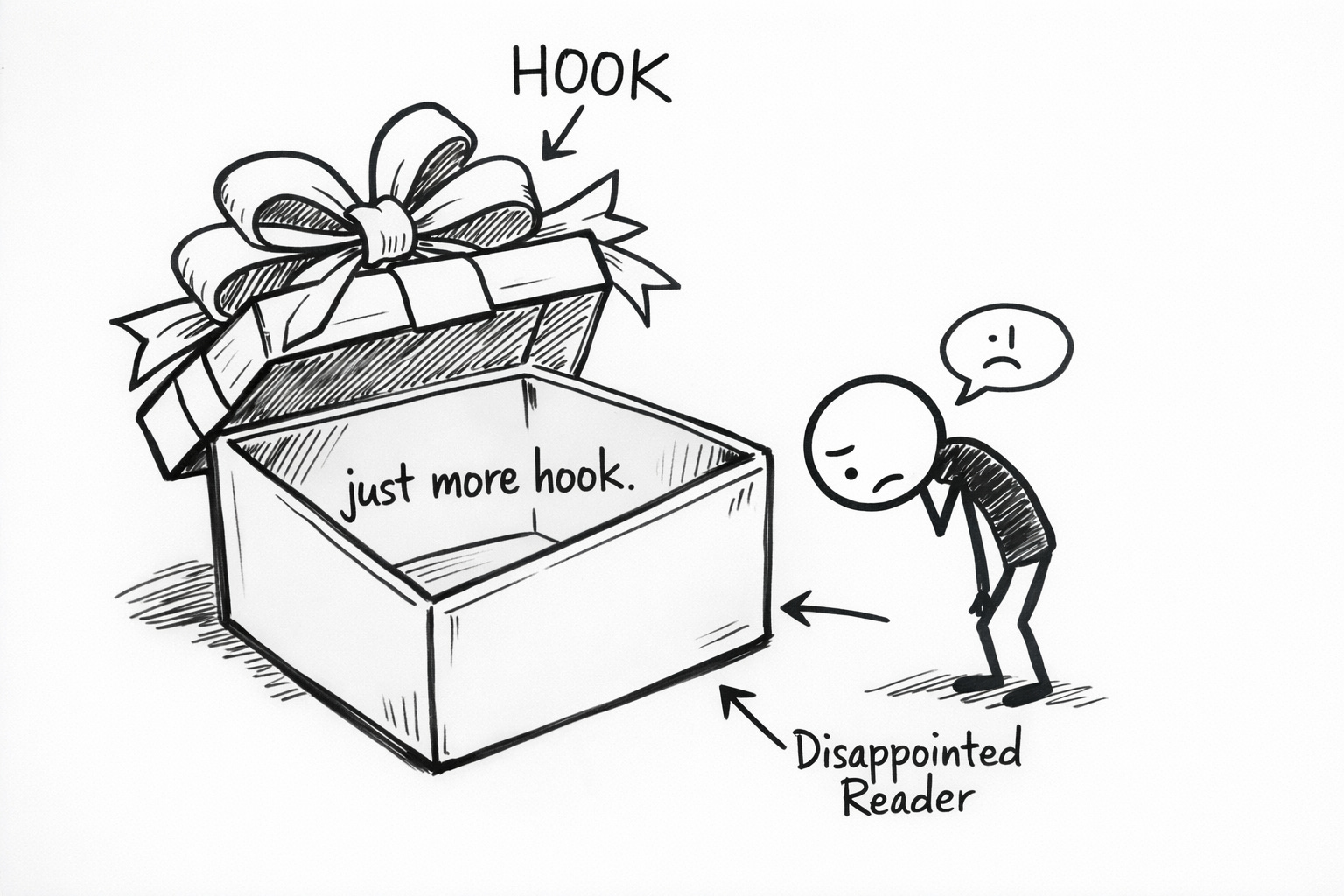
Your hook is the trailer. Everything after is the film. Readers have figured out that if they’ve seen your trailer, they’ve seen your movie. Nothing held back. No third-act surprise. Just filler between the moments they already watched.
So they do what any reasonable person does. They watch your trailer. They nod. They leave.
How You Got Here
The engagement economy taught you to hook. It forgot to mention you’d need something to say afterward.
Every course. Every guru. Every “how I went viral” thread. They optimized for the click. First five words. Pattern interrupts. Curiosity gaps. Scroll-stopping techniques.
And you learned it. Because you had to. The algorithm punishes slow starts silently and completely.
So you got brilliant at compressing insights into hooks.
The problem? That became the whole job. Find an insight. Compress it. Ship it. The hook was the thinking. Everything after was just hitting word count.
You used to have second ideas. Third ideas. Then you learned what gets rewarded. Hooks get clicks. Depth gets ignored. The algorithm trained you to stop building after the first floor.
So you learned to write content where the hook does 100% of the intellectual work. And everything else? Intellectual sawdust. Examples that illustrate but don’t advance. Paragraphs that explain what you already said instead of going somewhere new.
The advice wasn’t wrong. It was catastrophically incomplete. You got great at the click. What happens after the click? Apparently not your problem.
Now you’re a chef who makes the greatest amuse-bouche anyone’s ever tasted. One perfect bite. Diners are already texting friends. Then the next course arrives. And it’s the same bite. Slightly larger. Then again. By the entrée, they’re asking for the check.
Why It’s Getting Worse
Here’s where this gets darker.
AI didn’t create hook-hollowing. But it poured gasoline on it and handed everyone a match.
Not because AI writes hooks. (It does. Good ones, if you know what you’re doing. That’s a separate crisis.) Because AI made content infinite. Literally infinite. Anyone can produce unlimited content now. A teenager with ChatGPT can flood a platform with more posts in an afternoon than you’ll write in a year.
When content becomes infinite, attention becomes ruthless.
Readers don’t have time anymore. They never really did, but now they definitely don’t. The scroll is endless. The options are unlimited. Every piece of content is competing against an infinite supply of other pieces, all with hooks engineered to stop thumbs.
So readers adapted. They became scanners. Speed-readers. Hook-extractors.
Three seconds. That’s what you get. Three seconds for a reader to determine if there’s anything here worth staying for. They’re not being rude. They’re being rational. There’s an ocean of content and they’re drowning in it. They have to scan. They have to strip-mine for value and leave.
And creators adapted right back. Everyone optimized for those three seconds. Hook training went into overdrive. First five words. First three words. First one word. The compression arms race accelerated.
Meanwhile, the stuff that comes after the hook? Nobody optimized for that. Why would they? The click already happened. The metric already logged. Whether the reader stayed for paragraph six or bounced at paragraph two, the analytics look the same.
AI made content infinite. Infinite content made readers ruthless. Ruthless readers made creators optimize for the scan. And optimizing for the scan meant abandoning everything after the hook.
This isn’t a writing problem anymore. It’s an ecosystem problem. You’re not just fighting your own habits. You’re fighting an entire environment that’s been re-engineered around the three-second verdict.
(Fun, right? Really makes you want to keep publishing.)
The good news, if you can call it that: most creators won’t fix this. They’ll keep producing vapor because vapor is what the system rewards. Which means the few who do build substance will stand out like a pulse in a morgue.
The bar is underground. Step over it.
Famous to the Algorithm, Invisible to Humans
Here’s what your dashboard doesn’t show you: nobody remembers your post.
They liked it. They saved it. They have absolutely no idea who wrote it. Your name didn’t register. Your thinking didn’t stick. You were a hook that floated past, indistinguishable from the forty other hooks they saw that hour.
You’re not building authority. You’re not building trust. You’re not building an audience that comes back for you. You’re building a number that resets to zero every 24 hours.
Likes don’t convert to loyalty. Saves don’t convert to sales. Clicks don’t convert to “I need to read everything this person writes.”
And here’s the part that should terrify you: if your entire value is the hook, you’re replaceable. By the next person with a good hook. By AI, which can generate infinite hooks at zero cost. By anyone willing to play the same game slightly faster.
Hooks make you visible. Depth makes you irreplaceable.
The creators who build beyond the hook—who have second ideas, third ideas, implications that change how readers think—those are the ones who develop audiences instead of analytics. Readers come back to them. Not because of the algorithm. Because they remember being given something worth staying for.
Your call.
The Diagnostic
You can’t fix what you can’t see.
Three questions. Two minutes. Uncomfortable clarity guaranteed.
Question One: The Summary Test
Summarize your piece in one sentence without mentioning your hook.
Can you do it? Is there a different idea in there somewhere? Or does every summary just circle back to the opening lines?
If you can’t describe what the piece adds beyond the hook, the hook was the only idea.
Question Two: The Deletion Test
Delete your first paragraph entirely.
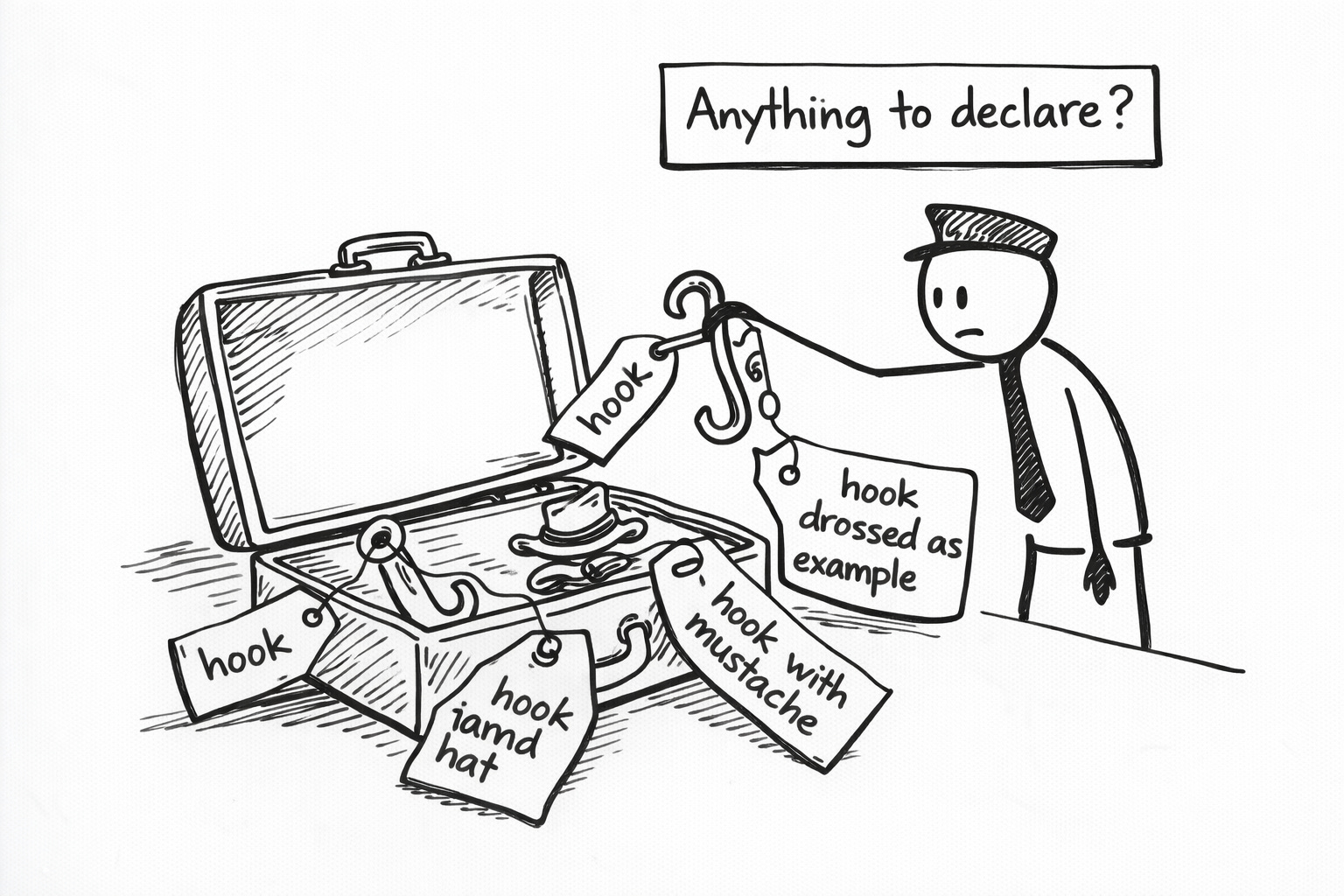
Read what remains. Is there anything new in there? Any insight that wasn’t already implied by the hook? Or is it all explanation, examples, and restatement?
If removing the hook leaves nothing but support staff, you built a palace for a single thought.
Question Three: The “What Did They Learn” Test
A reader absorbs your hook perfectly. Gets it completely from that first line.
What do they gain from reading the rest?
If the answer is “more detail about the hook” or “examples of the hook” or “confidence that the hook is true,” that’s not enough. That’s one idea waterboarded until it confessed to being an article. They didn’t learn anything new. They just had one idea repeated until it felt like content.
The quick version: If a reader only read your hook and skipped everything else, what would they miss? If the answer is “not much,” you’re hook-hollowed.
Building the Second Floor
This is where I give you the hard news.
Hook-Hollowing isn’t a craft problem. It’s a thinking problem. You can’t fix it with better transitions or stronger paragraphs. You fix it by having more than one idea.
Three moves. Each one is harder than a writing tip. Sorry.
Move One: The Idea Inventory
Before you write, list the distinct insights in your piece. Not examples. Not explanations. Insights. Things the reader will know after that they didn’t know before.
If your list has one item, you have a tweet. Not an article.
A real piece needs at least three ideas:
The hook insight (what gets them in the door)
The deepening insight (what they didn’t expect)
The implication insight (what changes because of this)
If you can’t name three separate things the reader will learn, you don’t have enough to write yet. Go think more. The hook can wait.
Move Two: The Progression Audit
Every section must ADD, not SUPPORT.
Go through your piece. For each section after the hook, ask: “What new thing does the reader know now?”
If the answer is “they understand the hook better,” that’s not new. That’s support. Cut it or replace it with actual progression.
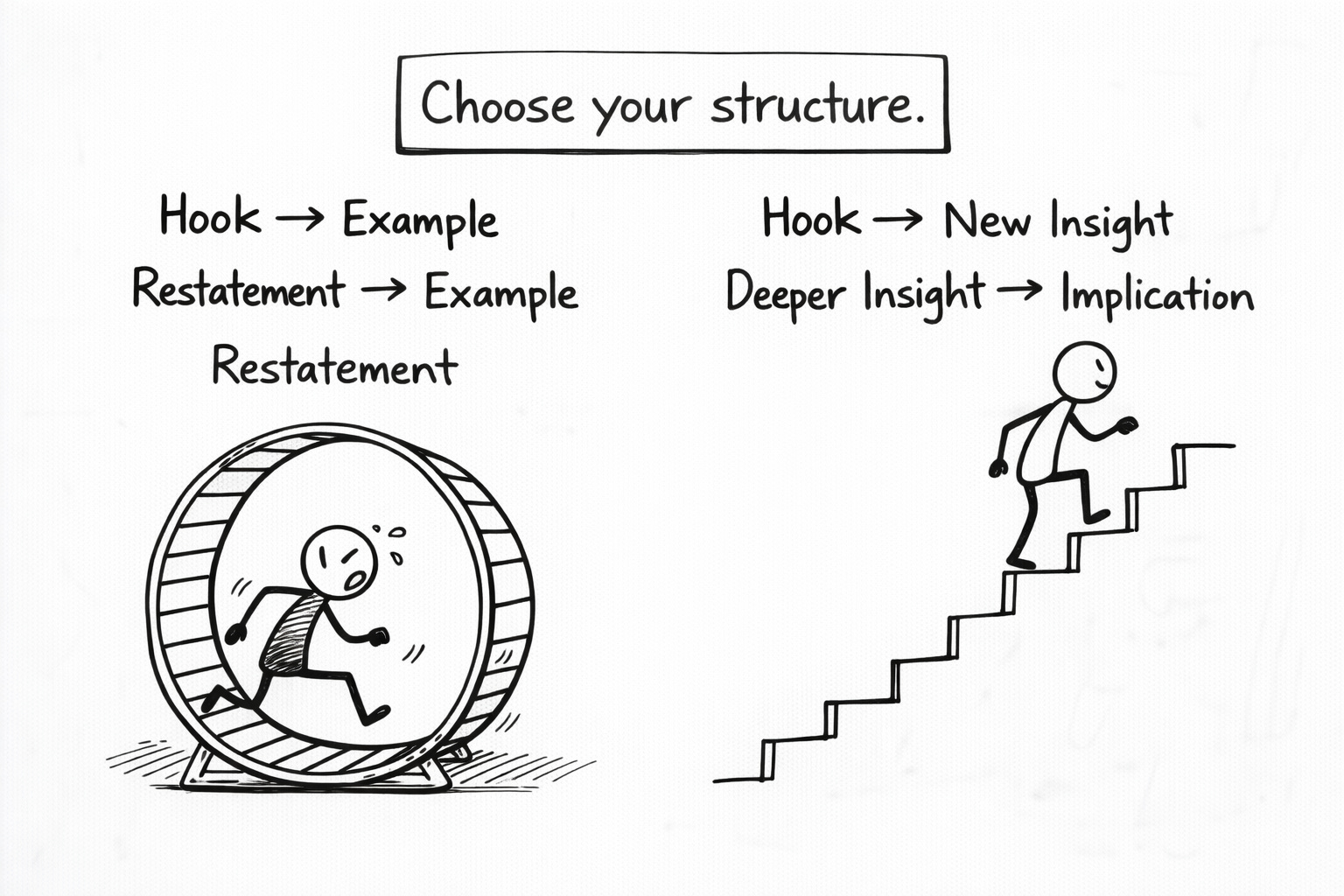
Support (vapor): “For example, here’s how this plays out...” (illustrates the hook)
Progression (substance): “But this creates a second problem...” (goes somewhere new)
Your piece should be a staircase, not a treadmill. Each section one step higher. Not the same step, repeated.
Move Three: The “And Then What” Test
Your hook makes a claim. Interesting. Now ask: and then what?
What follows from this insight? What does it bump into? What problem does it create? What door does it open?
The hook is the beginning of a thought, not the whole thought. Your job is to think past it. To go where the hook points but doesn’t reach.
Hook alone: “Most writers have great hooks and nothing after.”
Hook + “and then what”: “Most writers have great hooks and nothing after. Which means they’ve trained themselves to compress insights but never to extend them. The skill that made them clickable made them shallow. And the only fix is learning to think past the tweet.”
That second version has somewhere to go. The first is a bumper sticker.
The 15-Minute Pre-Publish Protocol
Run this before anything goes live:
Minutes 1-3: Idea Inventory. List the distinct insights. If there’s only one, stop. Go think.
Minutes 4-10: Progression Audit. Mark each section ADD or SUPPORT. Kill or replace the supports.
Minutes 11-15: “And Then What” pass. Push every idea one step further than it wants to go.
If you can’t find three ideas after fifteen minutes, you don’t have a piece yet. You have a hook looking for a home.
The world is full of beautiful doors that open onto empty rooms.
Don’t be another one.
A hook is not a piece. It’s an invitation to one. Time to RSVP with actual substance.
🧉 What’s a hook format that’s basically an admission there’s nothing after? I’ll start: “Unpopular opinion:”
Crafted with love (and AI),
Nick “More Than One Idea” Quick

PS… Daily newsletter. Anti-slop philosophy. Occasional profanity. Consistent attempt to have actual thoughts, not just hooks dressed up as thoughts. Subscribe and we’ll figure this out together.
Nick, I have made so many Claude Project Instruction tweaks since subbing to you... now about to make another.
The opening made me laugh, because that is exactly it. When we start watching a trailer for movie that actually looks decent, there is a mad "yup, looks good, quick!!!" as the remote control is madly stabbed at to turn it off before the entire plot is ruined. Why do they do this to trailers?!
Brilliant breakdown of how content compression became the entire skillset. The progression audit idea is gold becuase most of us dont even realize we're just restating the hook in different clothes. I've caught myself doing this exact thing where I think Im adding depth but really just circling the original point with examples. Time to actully build those stairs instead of running in place.