

Forbes dropped a stat this week that should make every small business owner put down their coffee and stare at the wall for a while.
58% of American small businesses now use generative AI. The vast, staggering, almost mathematically elegant majority of them are getting nothing out of it. No measurable ROI. No competitive advantage. Just a subscription fee and a growing pile of content that reads like it was written by a committee that never met, doesn’t know what the company does, and has strong opinions about synergy.
(So... most committees, actually.)
The Forbes diagnosis is correct. These businesses are feeding AI absolutely nothing about who they are, what they sound like, or why anyone should care. No brand foundation. No voice documentation. No map. Just a blinking cursor and a prayer. AI receives no information and returns the favor.
The recommended fix: something they’re calling a “Master Context File.” A document that captures your brand’s positioning, voice, and values so AI has a basis for its output beyond “generate something professional.”
I’ve spent a year obsessing over this exact problem. Built a methodology for it. Named the framework. (Yes, I named it. I’m that guy now.) The document is real. It matters. But a document without calibration, without a feedback loop, without someone checking whether the output actually matches, is a gym membership. Technically you have it. Technically it’s doing nothing.
They’re right about step one. Forbes just discovered step one and presented it like the whole staircase.
And I can already see, with the grim clarity of someone watching a piano fall from a building in slow motion, exactly how this goes wrong.
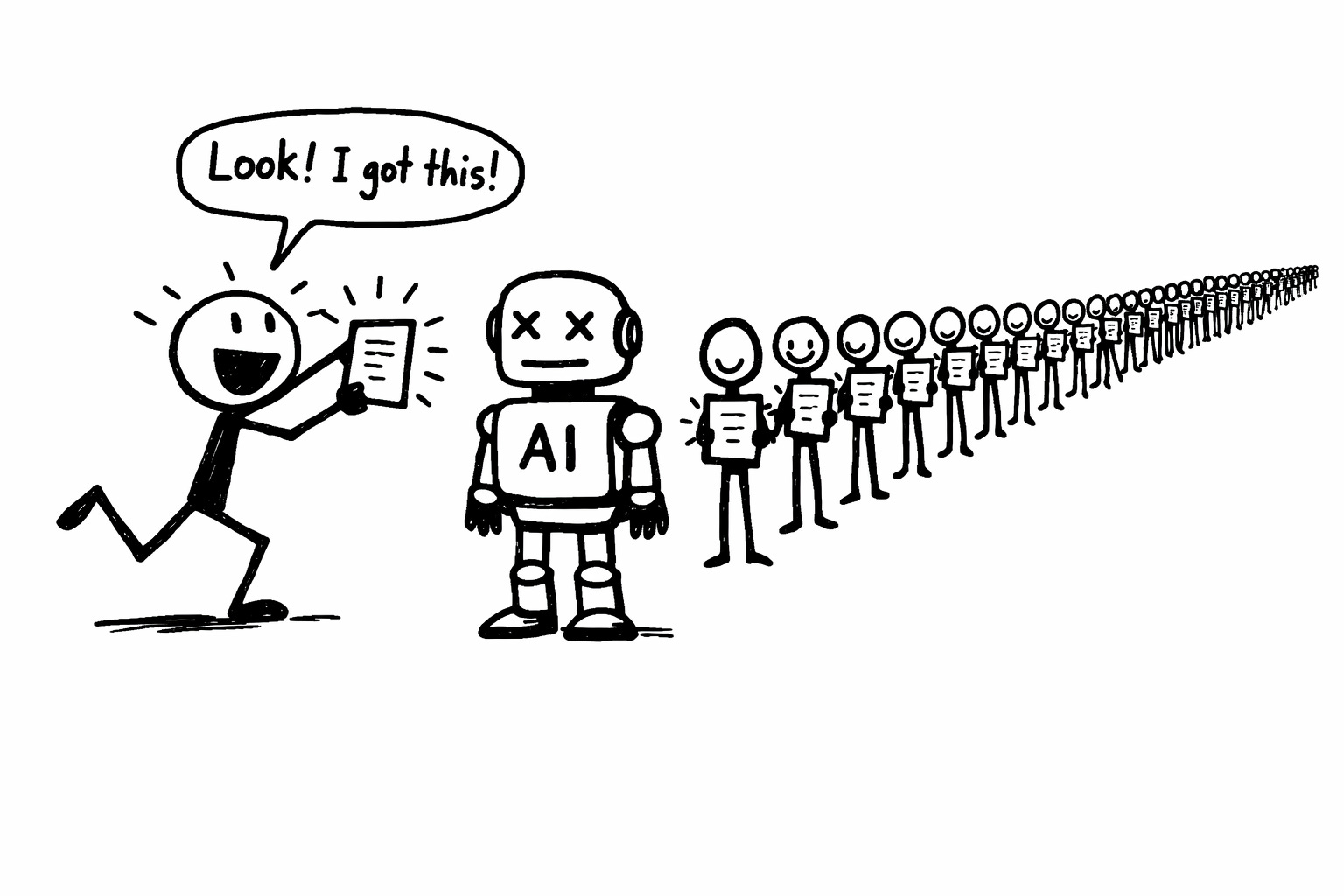
The idea is already loose. “Brand voice document” is becoming the new “content strategy” (something every LinkedIn consultant will add to their bio by summer, something every template marketplace will sell a $97 kit for, something millions of businesses that couldn’t articulate their voice when it was free will pay someone $97 to help them not articulate faster).
(I refuse to be surprised by this. Being surprised by the internet monetizing bad advice is like being surprised that a pyramid scheme has levels. At some point, the shock is your fault.)
The slop doesn’t stop. It gets a filing system.
Here are the five most popular ways this is about to go spectacularly, predictably, almost beautifully wrong. I’m documenting them now so I can point back to this post in six months and experience the specific flavor of satisfaction reserved for people who predicted a disaster nobody wanted to hear about.
The Adjective Trap
The template will have a field labeled “Brand Voice.” A marketing manager somewhere in Ohio will stare at it for eleven minutes, then type “friendly, professional, and approachable.”
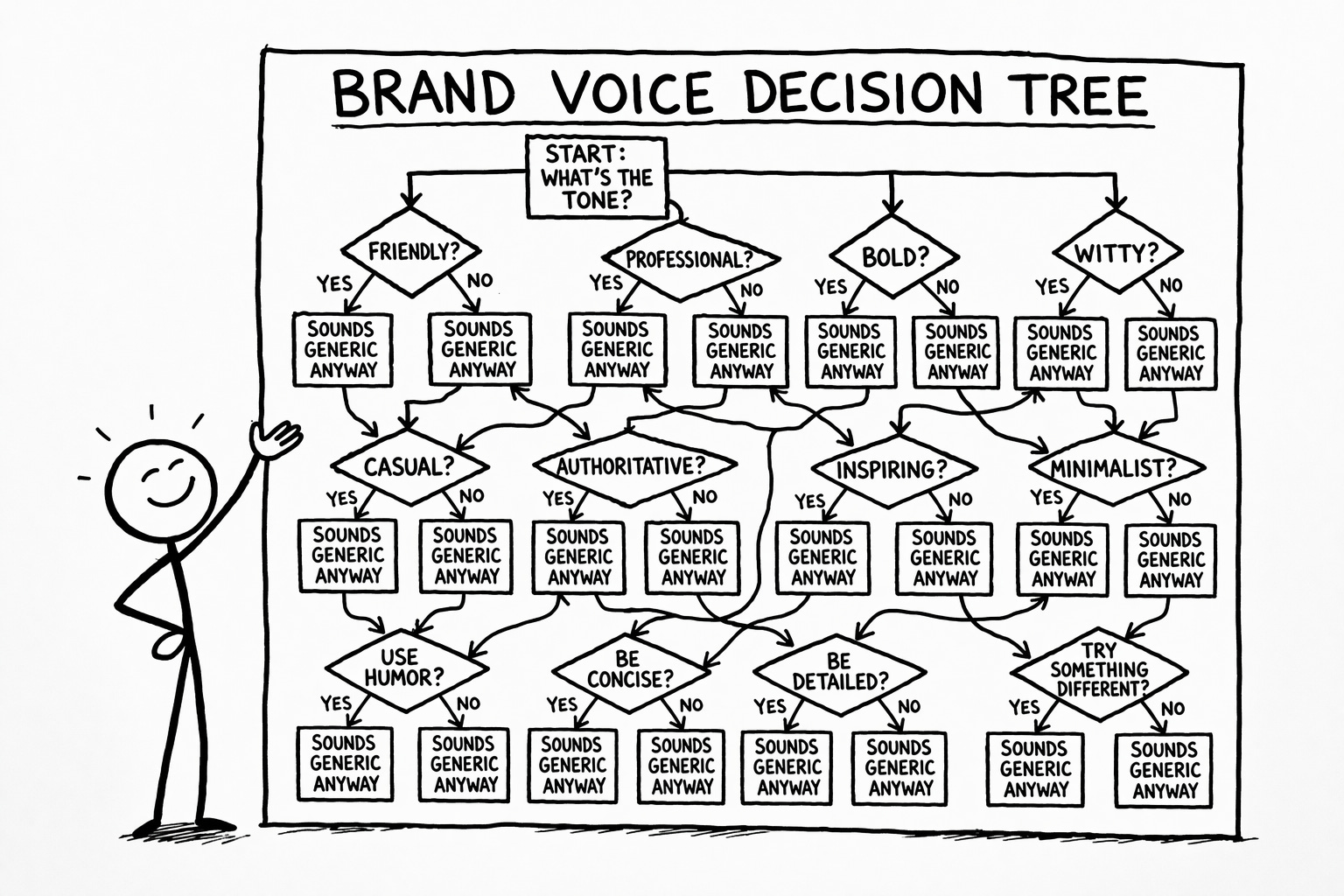
This is a horoscope. This describes every company that has ever existed and several that haven’t. Dental offices. Insurance agencies. The guy at the farmers market selling aggressive amounts of lavender-scented soap. All friendly. All professional. All approachable. All identical.
(If your brand voice description could double as a Hinge profile bio, it’s not a brand voice description. It's a tattoo that says "unique.”)
AI can’t perform “friendly” any more than a session musician can perform “make it sound blue.” Give it notation and it’ll play. Give it a feeling and it’ll guess. And AI’s guesses all sound the same. (I spent an entire post explaining why vague voice instructions produce vague output. Forbes is about to prove the thesis at national scale.) It’s like handing a portrait artist a paint-by-numbers kit and wondering why the result looks like it came from a paint-by-numbers kit.
The $97 Template Problem
This template already exists in fourteen versions on Gumroad. A gorgeous Google Doc with 15 fields. Company name. Mission statement. Three adjectives. Target audience. “Words we never use.” Drop your answers in, paste the output into ChatGPT, collect your branded content.
Thousands of businesses will complete the same template. With slightly different words. In exactly the same structure. Producing content that is slightly different in precisely the same way.
(The $97 template will be $147 by June. It’ll include a “bonus module” that is the same template but this time in Notion. Somebody will make a course about the course about the template. The ouroboros turns. The machine doesn’t care.)
A template that standardizes how everyone documents their voice standardizes the output. That is the mathematical, inevitable, thermodynamic certainty of what templates do. They converge. This is ensloppification wearing a blazer and charging a licensing fee.
The Aspirational Self-Portrait
A founder will sit down, full of caffeine and ambition, and document a brand voice that belongs to the company they’re building in their imagination. Bold. Irreverent. Category-defining. The kind of voice that makes people say “I need to follow this company” at cocktail parties. (Nobody has ever said this at a cocktail party. But the fantasy persists.)
The actual company sounds like mid-2010s content marketing with a Canva logo and a blog post titled “5 Tips For Better Customer Engagement.”
AI doesn’t know you’re fantasizing. It reads the document, takes it at face value, and produces content for a brand that doesn’t exist. The audience reads it and feels the gap without being able to name it. Something’s off. The voice doesn’t match the experience. It’s the uncanny valley of brand communication: technically coherent, fundamentally dishonest.
The document captured their ambition. Nobody asked it to capture their reality. (There’s a reason I tell people to train AI on their sweatpants, not their Sunday best. The polished version of you is a costume. AI needs to learn the human underneath it.)
The Document as Finish Line
This one will burn the most money the most quietly.
They create the document. It feels productive. Maybe even transformative. They paste it into their AI tool of choice. Content comes out. It’s... better? Probably? Hard to tell. They call it done and move on to the next crisis.
No one reads the output and asks “does this actually sound like us, or does it just sound less obviously terrible than before?” No feedback loop. No correction cycle. No one catches when the AI quietly drifts back toward generic over six weeks of unchecked output. (AI drifts the way relationships drift. Slowly, then all at once, and by the time you notice, the damage is structural.)
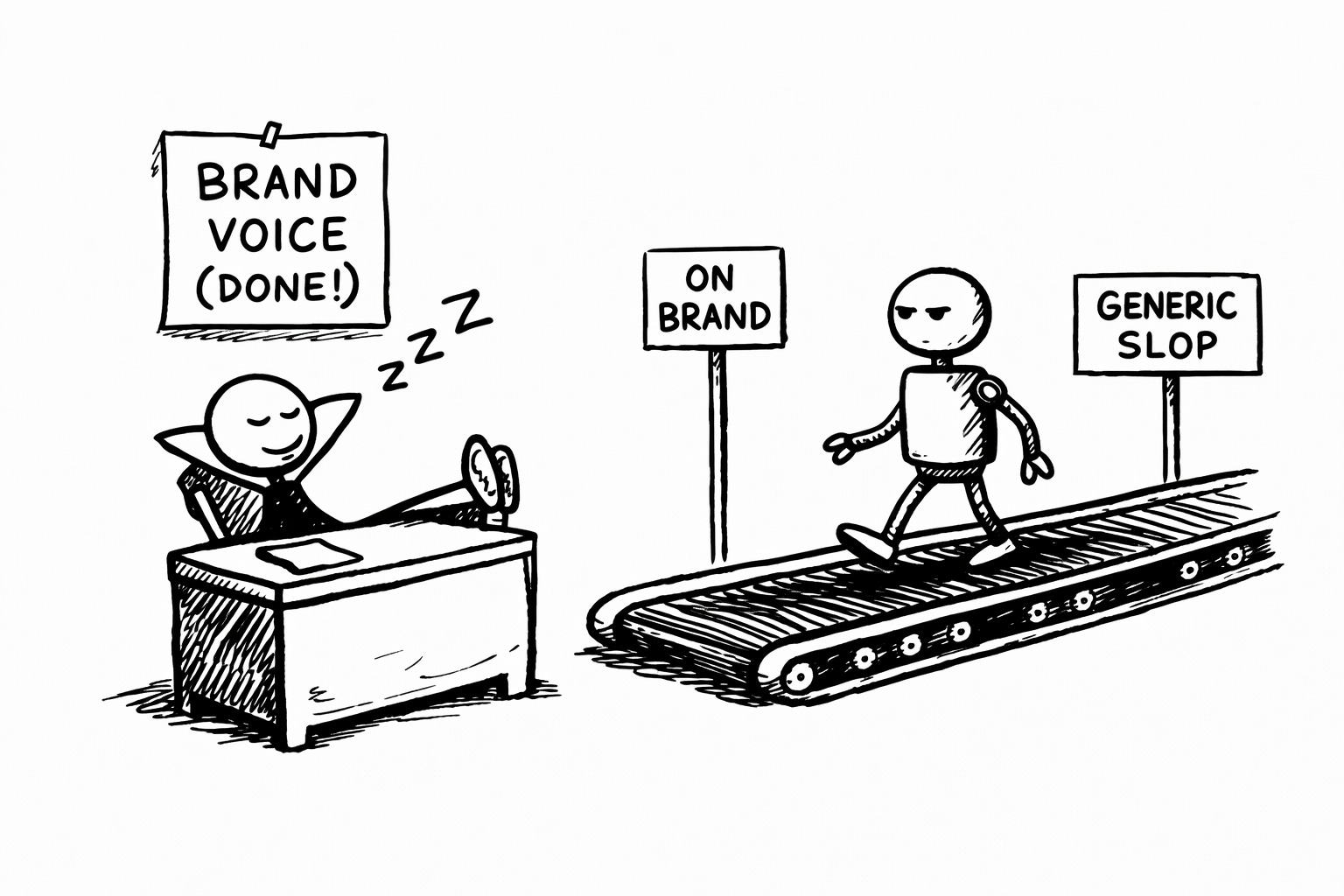
The document sits in a Google Drive folder between a logo guidelines PDF from 2019 and a brand deck nobody opens. The AI drifts. The content quietly converges back toward wallpaper. But everyone believes the problem is solved because there is a document, somewhere, with their name on it.
(This is the most expensive failure on the list because it masquerades as success until the quarterly review, at which point everyone agrees the content “could be stronger” and nobody mentions the document again.)
The 63-Page Bible
And then there are the overachievers. Bless them. They mean well. They also can’t be stopped.
Sixty-three pages. Brand archetypes with spirit animals. Tone matrices cross-referencing audience segment by content type by time of day by emotional state by phase of the moon. (I’m barely exaggerating. I’ve seen a real one that included “voice adjustments for Mercury retrograde.” The client was a SaaS company. They sold invoicing software.)
Audience persona cards with fictional names and stock photos. “Meet Decisional Diana, 34, a mid-level marketing manager who values authenticity and drinks oat milk.” Diana isn’t real. Diana will never be real. Diana is a $300/hour consultant’s imaginary friend being used to justify a document that AI will ignore past page three because AI, like every human who has ever received a 63-page brief, stops paying attention after the first thousand words.
When everything is a rule, nothing is a pattern. The voice document becomes a compliance manual. And content produced under a compliance manual reads exactly like you’d expect content produced under a compliance manual to read.
Which is to say: content that passes through your brain the way a goldfish passes through its own life story. Constantly experiencing it for the first time.
What Forbes Left on the Table
The diagnosis was right. The prescription was “here’s a scalpel, good luck with your surgery.”
Writing the document is the easy part. Reading what AI produces with it, marking what’s wrong, feeding corrections back, and doing that every single week forever is the actual work. Nobody’s selling a template for that. It doesn’t fit in 15 fields.
So. Set your watches. Count the templates. Watch LinkedIn. I’ll be here in six months, pointing at this post, experiencing that particular brand of joyless vindication that comes from being right about something nobody wanted to hear.
The slop factories just got a Forbes endorsement. They’ll be the last ones to realize it.
🧉 What’s the worst piece of AI-generated content you’ve seen from a business that should know better? Names optional. Screenshots encouraged.
Crafted with love (and AI),
Nick “Forbes’ Uninvited Fact-Checker” Quick

PS... If Forbes convinced you that you need a brand voice document (and they’re right, you do), the free Voiceprint Quick-Start Guide walks you through building one that captures actual patterns, not horoscope adjectives:
PPS... Like, share, subscribe, all the things. Especially share. Someone in your network is about to spend $97 on a Google Doc with 15 fields and call it a strategy. You can save them. Or at least get to say “I told you so” later. Both are valid.
The Forbes article that inspired this post (paywalled, but the stat alone is worth the click):
https://www.forbes.com/sites/terdawn-deboe/2026/03/31/small-businesses-are-drowning-in-ai-slop-one-document-stops-it/
this cracks me up. thank you for this!