
AI Came for the Cheap Half of Know, Like, Trust
The framework still holds. But the easy path to each leg is automated now, and the only road left runs straight through your taste.

Know, like, trust gets quoted like a law of nature, and for once the cliché holds up. The sucker works. People really do buy from people they know, like, and trust. That part was never the problem, and AI didn’t break it.
Here’s what it actually did.
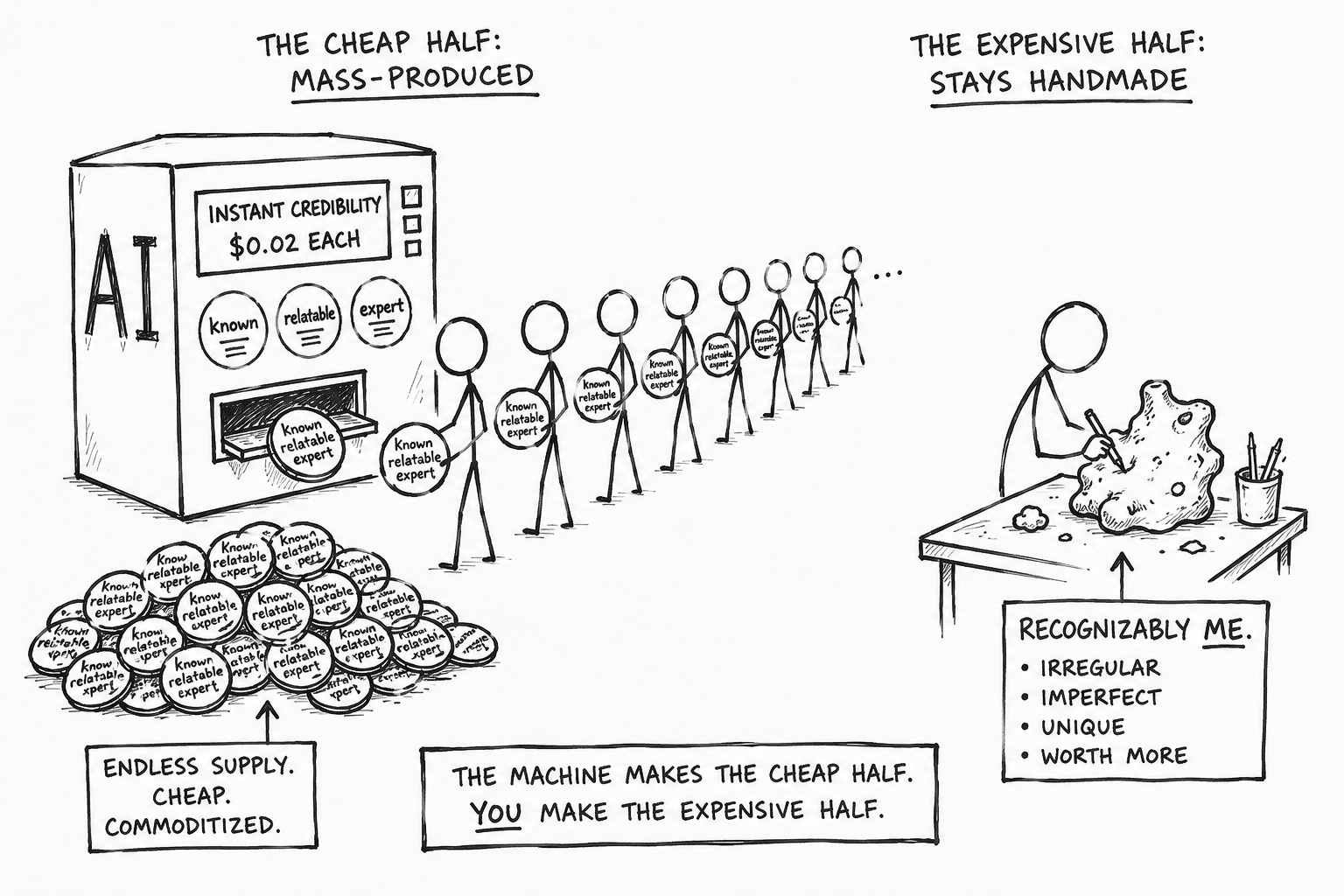
Every one of those three legs has two halves. A cheap one and an expensive one. For years you could lean on the cheap half of each and mostly get away with it. Then the machine showed up, looked at the cheap half, and said “oh, I can do that,” the way it says it about everything, with the serene confidence of a guy who has never been in a fight explaining, in detail, how he’d win one, having just, last week, seen his first Steven Seagal movie.
So the framework still stands. The ground under it turned into a chocolate vanilla swirl pudding pack.
Let me introduce you to Brennan.
Brennan posts six times a day. He has a streak counter he’s mentioned in eleven of those posts, most recently to note that the streak is “a non-negotiable.” His bio says “AI-powered storyteller,” which is doing a lot of work for a guy whose last three posts were a Monday motivation, a repackaged thread about compounding, and a photo of his desk with the caption “environment is everything” (the desk has a Ring light, a $40 succulent, and a book he has not opened facing outward for the cover). His pinned post is about his morning routine, which involves single-origin Slovenian spring water served at precisely 13 degrees in a copper cup he refers to exclusively as “the vessel,” a $68 leather journal he photographs more than he writes in, and a sentence attributed to Marcus Aurelius, which Brennan read on a LinkedIn carousel eight months ago and has since come to believe he thought of himself.
Brennan is doing everything the advice told him to do. He’s also about to get quietly taken apart by all three legs of his own favorite framework, because Brennan mastered the cheap half of each one, and the machines just made the cheap half free.
Here we go. One at a time.
Know
“Know” used to be the leg that hurt. Getting found was the whole bottleneck, so it earned a permanent seat at the strategy table and everybody treated it with the reverence of an unwritten rule traced back to a Vine nobody can find from an account nobody can remember since the app left the Play store in 2017.
Now a faceless account churning out AI grannies reacting to 90s hip-hop gets known. Bots get known. (Awareness used to be a moat. Now it’s a bouncer who stopped checking wristbands.)
Every modern version of this advice quietly walked “know” out of the strategy room, patted it on the head, and reassigned it to logistics. Post more. Hit your quadrants. Six videos a day, one per topic, repeat until something sticks or you do.
Brennan is winning this leg, by the way. Brennan is extremely known. If you mute him he finds you in a different app.
There are two things hiding in “know.” Getting known means a stranger registers you exist. Getting recognized means a reader clicks on name alone. AI buried the first one. It can’t touch the second.
Like
“Like” is where it gets interesting, because this is the leg most people chop off themselves, proudly, with a hacksaw, a LinkedIn post about why they did it, and a follow-up thread three days later about the freedom they felt afterward.
Your gym selfies were never a business. Everyone gets that part. (Brennan’s gym selfies are also not a business, but there are nine of them this week, each captioned with a Stoic insight Brennan is fairly certain he arrived at independently, having no memory of the podcast it came from or the macro-planning session it soundtracked.)
But “like” was never only the selfie. There are two versions hiding under one word. One is relatability theater. The other is sensibility: the specific texture of how one particular brain runs at the world. The second one is the entire reason an idea gets repeated in a room you will never be let into.
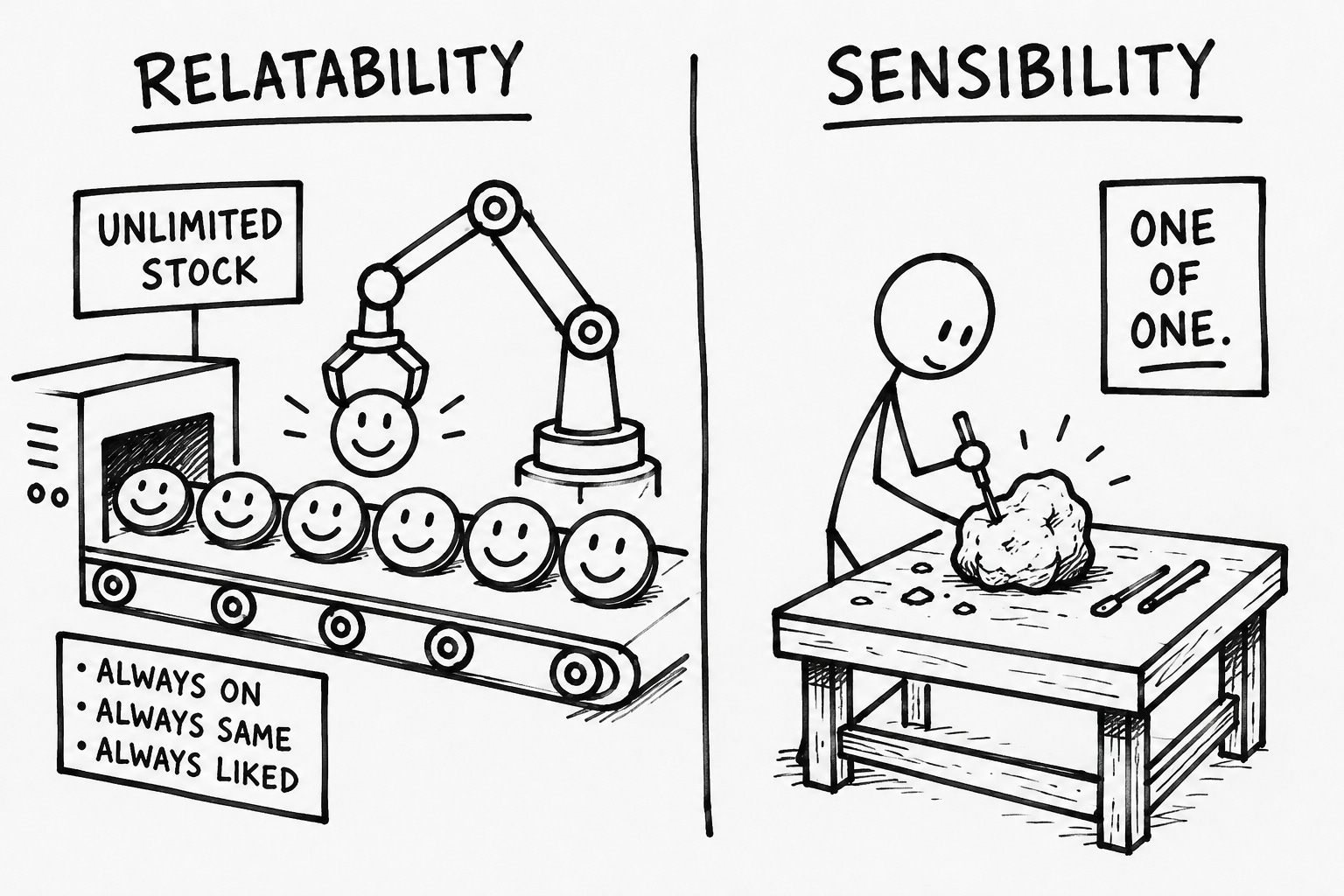
And here’s the part that should land harder than it does. The machine is exceptional at theater. It’ll hand you a relatable morning-routine post, a tender little origin story, a “real talk, I almost walked away from all this last year” confession, on demand, in bulk, faster than you can feel an actual feeling about your own actual life. The relatable half of “like” is free now. What it can’t fake is the sensibility, because sensibility isn’t a content type. It’s a person. You can’t prompt your way to that any more than you can prompt your way to a childhood.
Trust
“Trust” is the leg everyone’s amplifying right now, and almost everyone is amplifying the version that’s quietly being discontinued.
The pitch: become the expert, know the most things, trust follows. Solid plan in 2019. The clankers know more things than you now. Instantly, drafting up think pieces with footnotes, at three in the damn morning, while you’re asleep dreaming of puppy dogs and rainbows. Expertise-trust is finished.
Brennan has Top Voice energy and a slide deck and a way of saying “let’s unpack that” that makes you want to repack it and GTFO. None of it survives ten seconds against a chatbot that’ll unpack the identical thing for free and won’t make you sit through the part where he relates it back to the three weeks he spent living abroad at an all-inclusive resort in Cancun.
The trust that survives isn’t expertise. The machine has expertise. It isn’t relatability either. The machine has that on tap. What it doesn’t have is scar tissue. Decisions made under real conditions, with something actually on the line. Not what you know. What you’ve bled to figure out.
Now stand back and look at all three legs together. The same thing happened to each one.
Two halves apiece. Known and recognized. Relatable and singular. Credentialed and scarred. For years the cheap half of each was a workable shortcut, and most people, Brennan very much included, took it, because it was right there and it didn’t require the inconvenience of having a self.
Then the machine showed up and did the cheap half for free. It gets you known. It does relatable on command. It out-credentials you before breakfast, with footnotes, (again with the goddamn footnotes!) Every easy path to every leg, automated, handed to anyone with a pulse and a password, worth precisely nothing now for exactly that reason: everyone has access.
What’s left standing in all three is the same thing. The judgment call nobody else would have made the same way. The machine can’t supply it because the machine has no stakes. It has never once been wrong in a way that cost it anything.
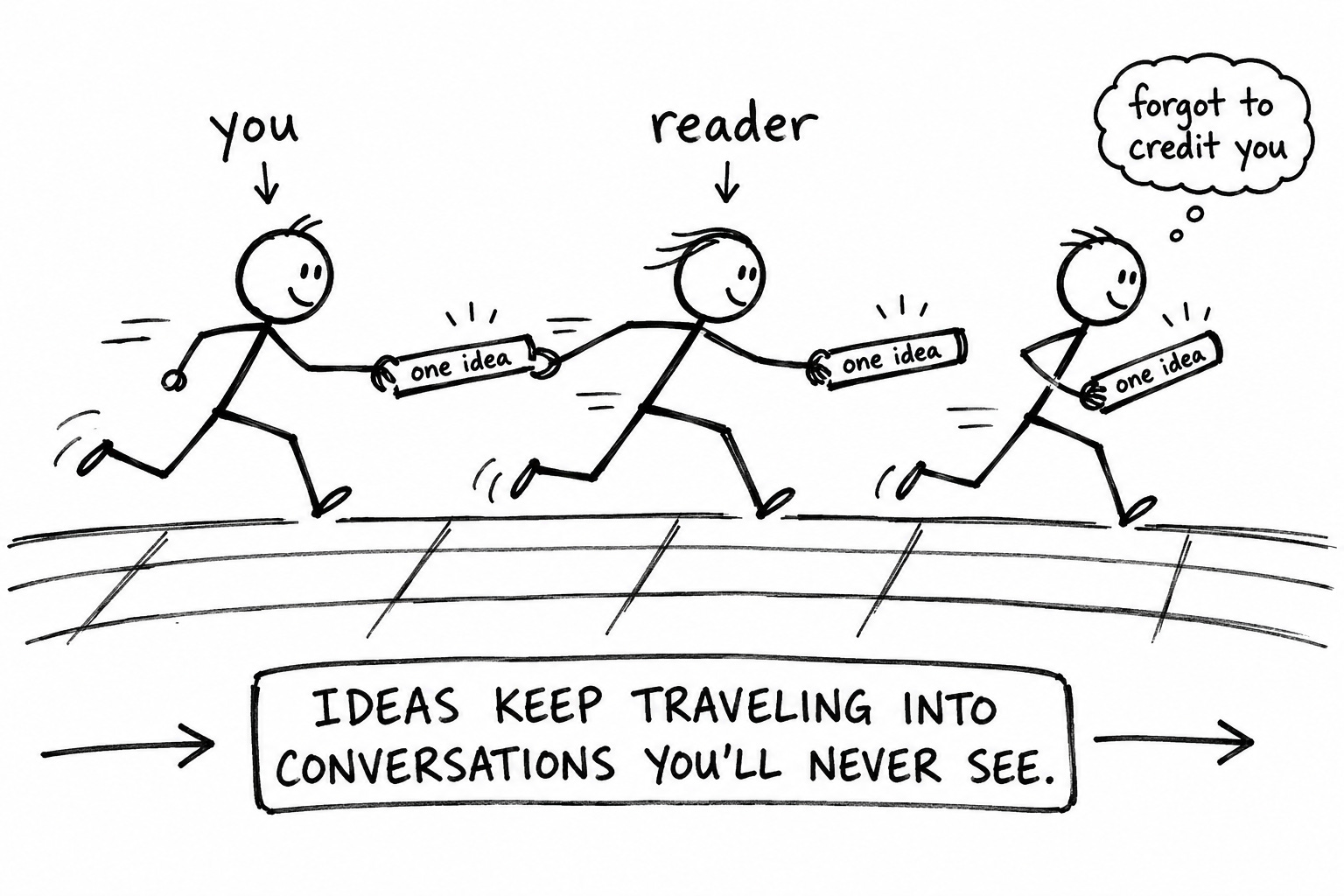
A line. A frame. A way of seeing the thing they can’t un-see now.
If they carry nothing, you wrote the cheap half, the one the machine hands out at the door like a flyer for a gym that already closed. If they carry one sentence and repeat it to a friend three weeks later and forget it came from you, that’s the expensive half doing its job. That’s recognition. That’s the part no model ships, and the part Brennan, six posts a day and climbing, has never once produced by accident or otherwise.
Know, like, and trust still work. AI just automated the cheap way to earn all three, which leaves exactly one currency the machine can’t print, can’t fake, and can’t borrow from you: your taste.
Crafted with love (and AI).
Nick “The Expensive Half” Quick
PS… I publish here regularly. If this landed, subscribe, restack the line that hit, and forward it to the Brennan in your life who needs to read it. Then:
Grab the Voice Sync Framework free
Because the expensive half doesn’t survive on instinct. It survives because you documented it before AI had a chance to sand it down to something everyone would approve of. Brennan doesn’t have one. That’s not a coincidence.
PPS… Brennan read this far. Brennan is nodding. Brennan is already opening a fresh post titled “Why Taste Is the Real Moat in the Age of AI,” which he will publish in forty minutes, schedule across four platforms, and never once suspect was about him.