
You Ran the Reverse Prompt. Now You’re Staring at a Wall of Text.
The triage system for turning reverse prompting results into actual changes

Yesterday I handed you a loaded weapon.
The reverse prompting framework. Feed AI what you have, let it work backwards, watch it diagnose problems you didn’t know existed. Five ready-to-use prompts for content calendars, landing pages, email sequences, top performer analysis, and workflow audits. (Missed it? Start here.)
Some of you ran them immediately. (I see you. Respect.) And now you’re sitting there with a wall of analysis, a vague sense that AI just called your content mid, and absolutely no idea what to do next.
This is where most people fumble the bag.
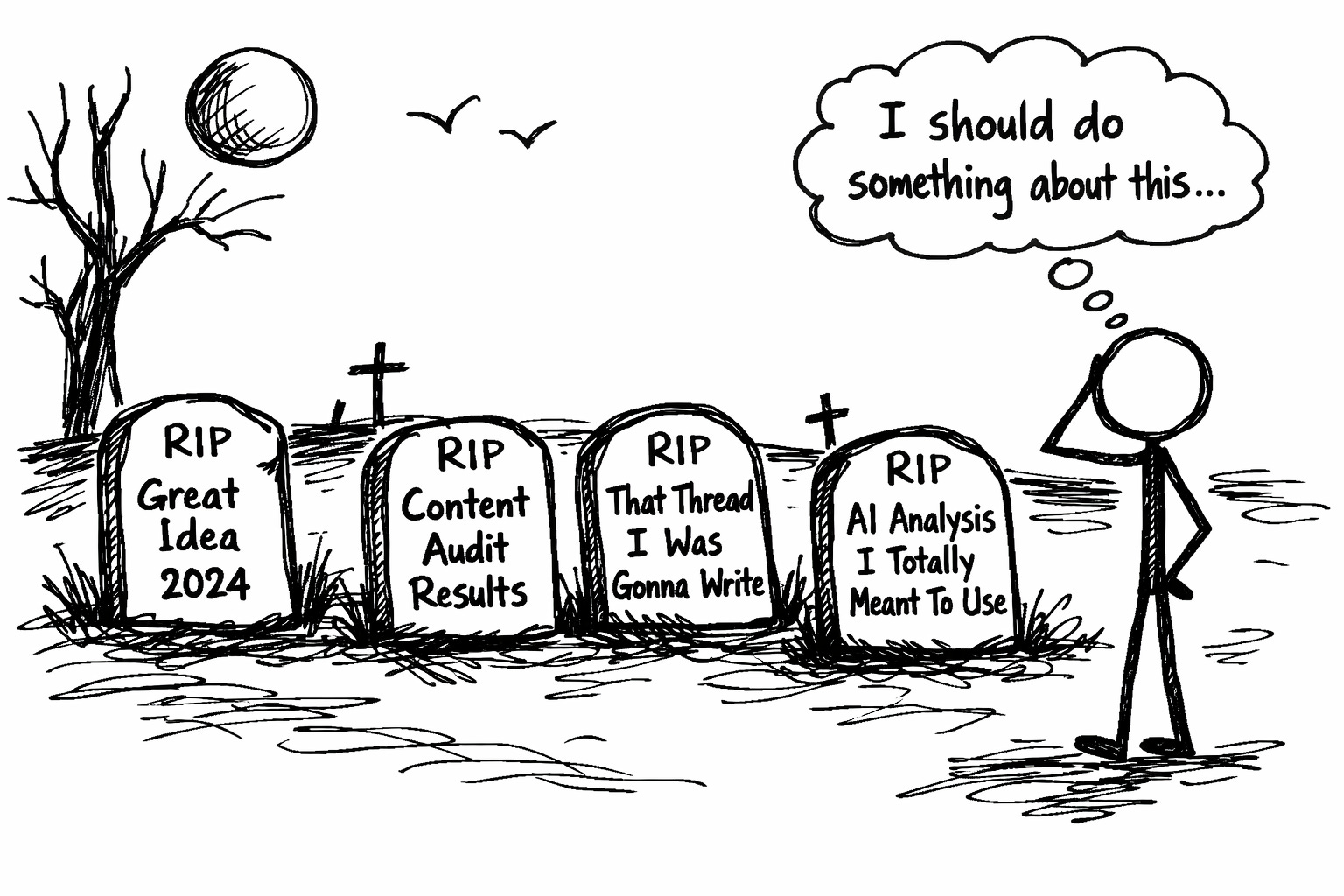
They screenshot the output. Maybe paste it into a note somewhere. Tell themselves they’ll “review it later.” Later becomes never. The insight dies alone in a forgotten Google Doc, surrounded by other abandoned revelations that never made it past the dopamine hit of discovery.
(I’ve done this. Multiple times. I have a graveyard of AI analyses that could’ve changed everything if I’d bothered to act on them. It’s genuinely embarrassing. Like finding old gym memberships you paid for monthly and used twice.)
Today we fix that.
AI Gave You 99 Opinions. Here’s How to Ignore Most of Them.
The output you’re staring at? Some of it is gold. Some of it is interesting but irrelevant. Some of it is just wrong.
AI doesn’t know your business. It doesn’t know your audience’s weird preferences. It doesn’t know that you tried that thing it’s suggesting and it flopped spectacularly. It’s diagnosing from patterns, not context.
Your job is triage. Sort the findings into four buckets:
Bucket 1: Fix This Today
High impact. Low effort. The stuff that’s so obvious once someone points it out that you feel slightly stupid for missing it. These are the quick wins hiding in plain sight.
(Example: AI tells you your CTA is buried under four paragraphs of throat-clearing. You read it back. AI is right. This takes ten minutes to fix and probably doubles your conversion. Do it now. Close this tab if you have to. I’ll still be here when you get back.)
Bucket 2: Fix This Week
High impact. Requires real work. The structural stuff that matters but can’t be knocked out between meetings. Block time and your calendar. Actually do it.
(Example: AI identifies that your last twelve posts all open the same way. Fixing this means rethinking your hook strategy. Important. Not a ten-minute job.)
Bucket 3: Interesting But Not Urgent
Real pattern. Valid observation. Acting on it now would be a distraction from the stuff that actually moves numbers. File it. Revisit in 30 days.
(Example: AI notices your sentence length variance has decreased over time. True. Interesting. Not the reason your newsletter isn’t growing. Put it on the list, not the calendar.)
Bucket 4: AI Is Wrong About This
Because sometimes it is. That’s why your name’s in the the byline, not the robot’s.
(Example: AI suggests your writing is “too casual” for your audience. But you know your audience subscribed because of the casual tone. AI is pattern-matching against some imagined professional standard that doesn’t apply to your weird little corner of the interwebz. Ignore it. Trust the people who actually read you over the robot that’s never met them.)
The triage isn’t optional. Without it, you’ll either drown in low-priority tweaks or freeze because everything seems equally important. Busy or paralyzed. Pick your poison.
The “AI Said It, Now Prove It” Step
AI sounds like an expert even when it’s pulling patterns out of its b-hole. That’s a feature, not a bug. For the AI companies, anyway.
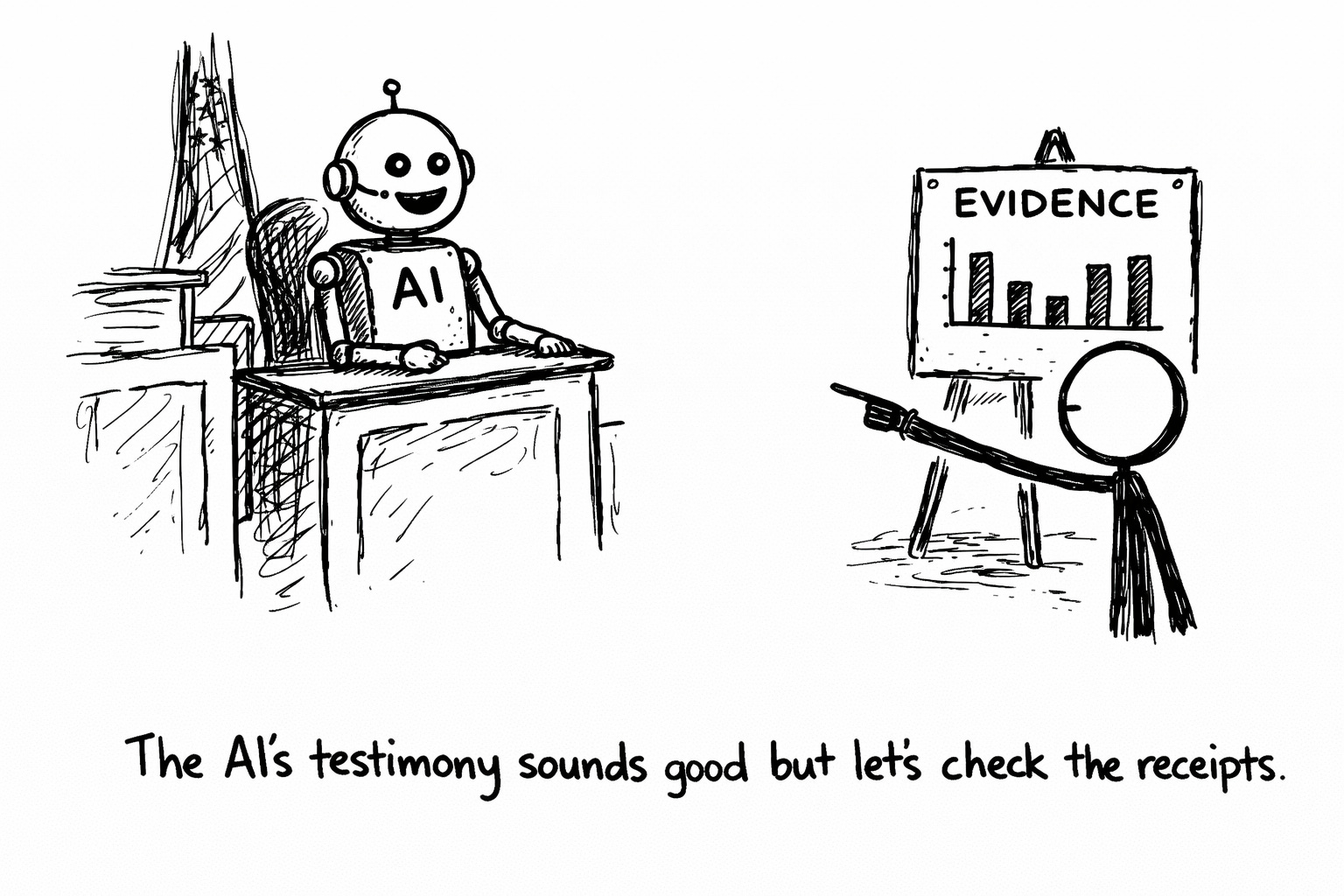
AI will tell you your open rates are probably suffering because of your subject lines. Sounds authoritative. Might even be true. But “probably” is doing a lot of heavy lifting in that sentence.
Before you reorganize your entire content strategy around AI’s diagnosis, cross-reference it against actual data.
AI says your hooks are weak? Pull your top 10 performing posts. Look at the hooks. Are they actually different from your underperformers, or is AI just saying things?
AI says you’re posting at the wrong times? Check your analytics. Is there actually a pattern, or is AI regurgitating generic best practices that don’t apply to your audience’s time zone and habits?
AI says your email sequence has a “cold” tone? Re-read it yourself. Ask two people you trust. Is AI picking up on something real, or is it just allergic to your personality?
(I once had AI tell me my newsletter was “lacking clear value proposition.” I checked the data. 44% click-through rate. Turns out AI and my audience had different definitions of value. The robot was confidently wrong. This happens more than you’d think.)
Trust but verify. Use AI output as hypotheses, not verdicts. The diagnosis is a starting point for investigation, not a conclusion.
Turning Findings Into Prompts (The Meta Move)
Here’s where it gets fun.
The diagnosis you just got from reverse prompting? It becomes the input for your next prompt. The output of one step feeds directly into the next. You’re not starting from scratch. You’re building momentum.
(This is bass ackwards thinking applied recursively. Yesterday’s technique pointed at itself. Stay with me.)
Let’s say AI identified that your landing page buries the transformation under feature lists. Cool. Now take that specific diagnosis and feed it right back:
You previously analyzed my landing page and identified this problem:
[Paste the specific finding]

Now I want you to help me fix it.

Write 3 alternative versions of my hero section that:
- Lead with the transformation, not the features
- Get to the "what changes for them" in the first two sentences
- Maintain my voice (here are my voice patterns: [brief description or paste your Voiceprint])

Here's my current hero section:
[Paste current version]
Or let’s say AI found that your email sequence drops engagement after email 3. The diagnosis becomes the brief:
You analyzed my email sequence and identified that engagement drops significantly after email 3.

Looking at emails 1-3 vs emails 4-6, I want you to:
1. Identify what's different about the structure, tone, or content
2. Hypothesize why the later emails lose people
3. Suggest specific changes to emails 4-6 that reintroduce whatever worked in 1-3

Here's the full sequence:
[Paste all emails]
One more. Let’s say AI noticed your top-performing content shares patterns your recent stuff doesn’t. Turn that into a template extraction:
You previously identified that my top 5 posts share these patterns:
[Paste the patterns AI found]

My recent posts don't follow these patterns. I want to fix that without just copying myself.

Take this draft and revise it to incorporate the successful patterns while keeping the new content and angle intact:

[Paste draft]

Show me what changes you'd make and explain why each change aligns with the patterns that work.
The output becomes the input. Each cycle gets more specific. More targeted. More useful. This is how you squeeze actual value out of AI instead of just generating analyses that make you feel productive without changing anything.
The 72-Hour Rule
Insights have a half-life. And it’s shorter than you think.
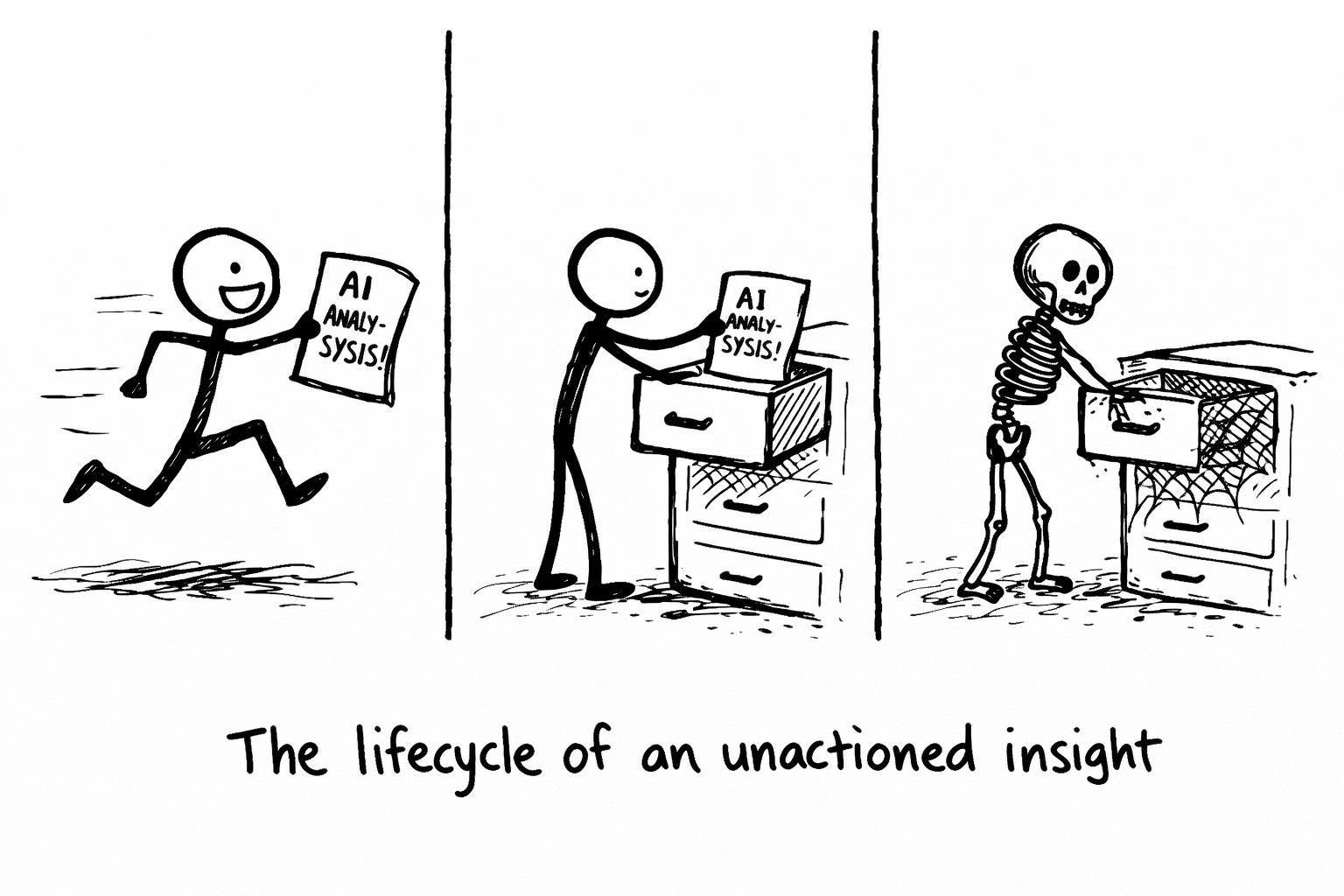
If you don’t act on a reverse prompting finding within 72 hours, it dies. Not officially. Not dramatically. It just... fades. The urgency bleeds out. Other priorities stack on top. The finding becomes “something I should get to” which becomes “I remember there was something” which becomes nothing.
(This isn't hustle porn. I’ve ghosted my own best ideas more times than I'd like to admit. Three days. That's your window before your brain starts gaslighting you that the insight wasn't that good anyway.)
So here’s the protocol:
Immediately after running a reverse prompt:
Triage into the four buckets (5 minutes)
Pick your top 3 findings from Buckets 1 and 2 (2 minutes)
Block time in your calendar to act on them (2 minutes)
Ignore everything else until those three are done
Not five. Not “all the good ones.” Three.
Three is a number you’ll actually do. Five is a number you’ll feel guilty about not finishing. One is too easy to dismiss. Three is the sweet spot between momentum and overwhelm.
The rest goes in a “Reverse Prompting Findings” doc for your weekly review. (You do have a weekly review, right? No? That’s fine. That’s a problem for another post. For now: just do the three.)
The Bridge to Calibration
Reverse prompting tells you what’s broken.
But knowing what’s broken and knowing how to fix it in your voice are different skills.
This is where most AI collaboration goes sideways. You get a solid diagnosis. You ask AI to help implement the fix. And the output comes back sounding like... someone else. Professional. Plausible. Generic. The AI equivalent of a stock photo handshake.
(You know the voice. It's the one that would describe a sandwich as "a protein-forward lunch solution." The voice that thinks "synergy" is still a word people respect. That voice.)
Better prompts won’t fix this. Calibration will.
If you want AI to help you implement fixes that actually sound like you, it needs to know how you write. Not “be conversational” or “match my tone.” Your actual patterns. Your vocabulary. Your rhythm. The specific weird things that make your writing yours.
That’s what Ink Sync is for.
The Direct → Reflect → Correct loop. You feed AI your patterns, review what it produces, correct specifically where it drifts, and repeat until the output reads like a rough draft you’d actually write. Three rounds and you’re locked in. (Usually. Some of us are complicated. It’s a whole thing.)
I built a free workshop that walks through the entire system: Ink Sync: Stop Fixing AI Output. Start Calibrating It.
Reverse prompting finds the problems. Ink Sync makes sure the solutions sound like you.
Tomorrow: how to turn this from a one-time trick into an operating system. The weekly reverse prompting habit that compounds.
Option F: 🧉 What’s AI been right about that you’re still annoyed by? (Or wildly wrong about? Both count.)
Sound off in the comments.
Crafted with love (and AI),
Nick “72-Hour Enforcer” Quick

PS… The Ink Sync Workshop is free while the link is live. If you’re running reverse prompts but the fixes keep coming back sounding generic, this is why. Grab it here.
PPS… If this was useful, hit the like button. Leave a comment so the algorithm knows this isn’t spam. Subscribe if you haven’t. Share with someone who needs to stop letting insights rot in Google Docs. The usual. You know how this works.
📚 The Reverse Prompting Trilogy
Part 1: Stop Writing Prompts. Reverse-Engineer Them. — The backwards technique that teaches AI your patterns in minutes instead of months
Part 2: You Ran the Reverse Prompt. Now What? — How to turn AI’s diagnosis into action before the insight dies of neglect ← You Are Here.
Part 3: One Reverse Prompt Is a Trick. A Weekly One Is an Operating System. — The weekly habit that compounds (Coming Soon!)