
Stop Writing Prompts. Reverse-Engineer Them.
The backwards technique that teaches AI your patterns in minutes instead of months

I sat down to write this post this morning with absolutely nothing.
Almost 100 articles into my daily streak. Brain empty. Calendar full. The kind of day where you stare at a blank screen and the blank screen wins. I had the time to write (barely) but zero ideas worth writing about. Streaks are binary. You either post or you don’t. There’s no partial credit.
So I did what I always do when I’m stuck. I worked backwards.
I opened a chat where AI already knows everything about my newsletter (I set this up months ago, and if you haven’t done the same, that’s your homework after you finish this article) and asked: what should I write about next?
And AI said, essentially: teach them this. Teach them the thing you’re literally doing right now. Show them how to reverse-engineer their next move instead of staring at a blank page hoping inspiration shows up. (Inspiration, for the record, has never once shown up on time. Inspiration is that friend who says “leaving now!” while still in the shower.)
So here we are. The post you’re reading exists because of the technique the post is about.
Which is either beautifully meta or proof that I need a vacation. Probably both.
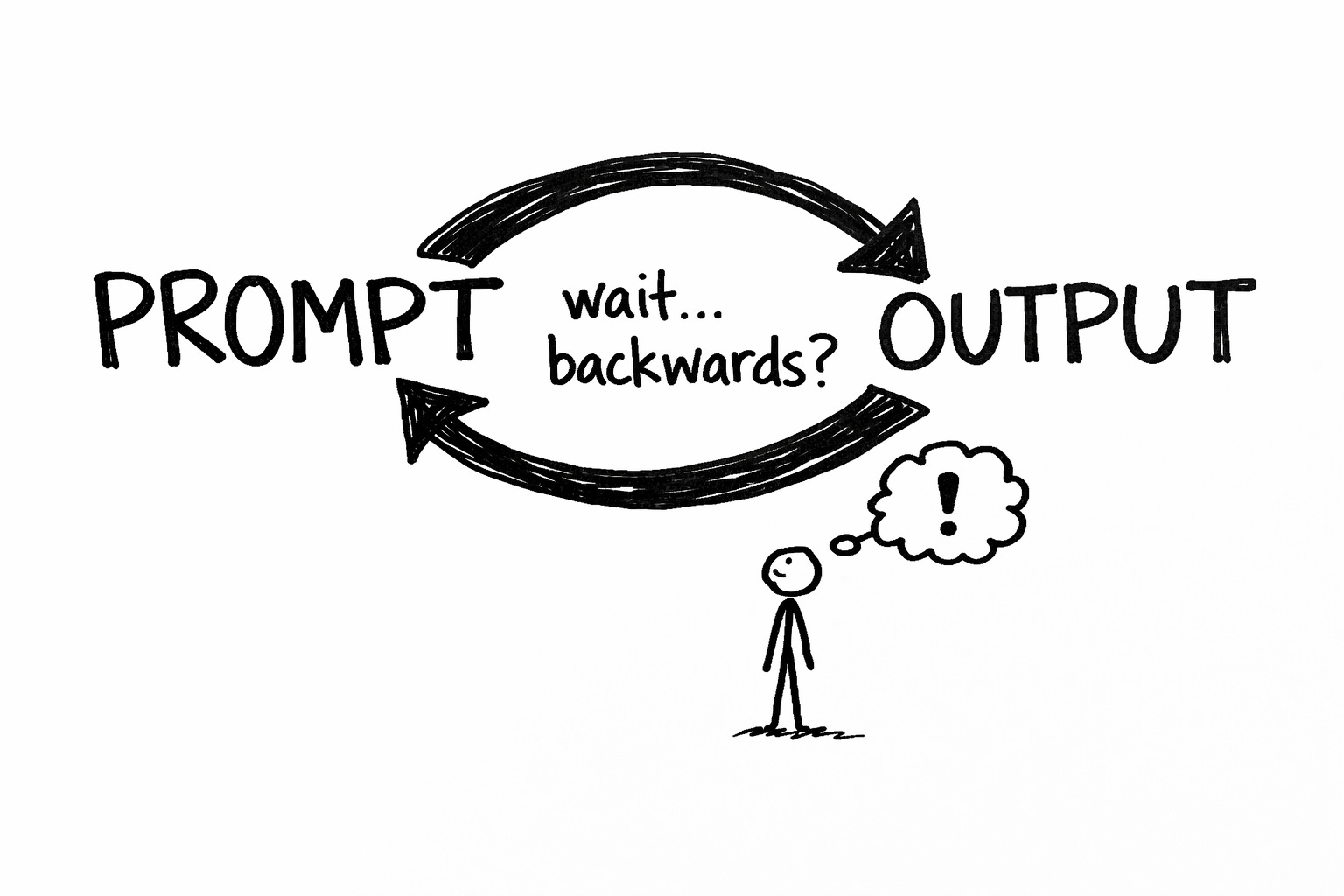
The Technique That Wrote This Post (And Can Unstick Almost Anything)
Most people prompt AI the way a sleep-deprived detective interrogates a suspect with no evidence. “TELL ME WHAT I NEED TO KNOW.” And AI, being pathologically cooperative, just... confesses to everything. It’ll give you content ideas. It’ll give you a marketing strategy. It’ll give you a twelve-step plan for something you didn’t ask about. None of it is connected to your actual life. But the confidence is immaculate.
Reverse prompting inverts the whole relationship. Instead of staring forward into the void trying to figure out what to create, fix, or decide, you work backwards from what already exists. You feed AI what you already have and ask it to analyze, diagnose, or extract the answer from the raw material.
This works because AI is significantly better at analyzing what exists than it is at imagining what you want from a vague description. When you say “give me content ideas,” you’re asking a machine to guess. When you say “here’s everything I’ve published, here’s my audience, here’s what’s working, what’s the obvious gap?” you’re asking it to do math.
And AI is really, really good at math. (Terrible at comedy. Worse at flirting. But math? Absolutely disgusting at math.)
The key insight: you almost always have more raw material than you think. Old posts, failed drafts, analytics screenshots, customer emails, competitor pages, your own damn 2AM ramblings on your notes app. All of it is fuel for reverse prompting. You’re not starting from zero. You’re starting from everything you’ve already built and asking AI to find the pattern you can’t see because you’re standing too close.
Five Ways to Use This Today (Not Someday, Today)
Five things I've reverse-prompted in the last week. Some of them saved me hours. One of them made me realize my landing page had been politely escorting people to the exit since last November.
1. Unstick Your Content Calendar
This one you already watched happen in real-time. But the prompt I used wasn’t “give me ideas.” It was closer to:
Here's my newsletter context:

- Topic: [what your newsletter is about]
- Audience: [who reads it, their skill level, what keeps them up at night]
- Recent posts: [paste your last 5-10 post titles or brief descriptions]
- Top performers: [which posts got the most engagement and what you think resonated]
- Underperformers: [which posts flopped and your best guess why]

Now work backwards:
1. What obvious content gap exists that I haven't addressed?
2. What question is my audience almost certainly asking that I've skipped?
3. What natural next post follows from what I've already published?
4. What topic am I avoiding that I probably shouldn't be?
AI can’t read your readers’ minds. But it can cross-reference what you’ve published against what your stated audience would logically need. The gaps light up like a neon sign once you give AI enough context to do the comparison.
I've been doing this for months now. I've pulled some of my best post ideas from this exact process. Not because AI is creative or insightful or has any taste whatsoever. (AI has the aesthetic sensibility of an airport Chili's.) But brute-force pattern recognition beats inspiration every single morning I've tried it.
2. Diagnose a Landing Page That’s Leaking
Got a page that gets traffic but doesn’t convert? Stop tweaking headlines at random. Paste the entire page into AI and ask:
You're a potential customer landing on this page for the first time. You know nothing about me or my product except what's on this page.

Walk me through your experience sentence by sentence:

- Where do you get confused?
- Where do you lose interest?
- Where does the copy make promises it doesn't back up?
- Where would you leave without buying, and why?
- What questions do you have that the page never answers?
- What's the first thing you'd change if your job depended on this page converting?

Be brutally specific. Quote the exact sentences that fail and tell me why they fail. No compliments. I'm not here for encouragement. I'm here for a diagnosis.

Here's the page:

[paste your full landing page copy here]
AI can simulate the reader journey through your copy in a way that’s harder to do yourself because you already know what you meant. AI doesn’t know what you meant. It only knows what you wrote. Which is exactly the perspective you need.
3. Figure Out Why Your Emails Aren’t Landing
Paste your last 5-10 emails (the ones with underwhelming open rates or dead click-throughs) into AI and ask it to find the patterns:
Here are my last 10 emails. I've split them into two groups.

GROUP A - Top performers (highest open rates and click-throughs):
[paste 3-5 emails that performed well]

GROUP B - Underperformers (low opens, dead clicks, or both):
[paste 3-5 emails that flopped]

Analyze both groups across these dimensions:
- Subject lines: length, structure, emotional trigger, specificity
- Opening sentences: how quickly they hook, what technique they use
- Overall length: word count, paragraph count, density
- CTA placement: where it appears, how many times, how it's framed
- Tone: formal vs casual, confident vs tentative, teaching vs selling
- Structure: how the email flows from hook to close

Now work backwards:
1. What patterns are consistent across Group A that are missing from Group B?
2. What patterns are consistent across Group B that don't appear in Group A?
3. What's the single biggest difference between the two groups that I should fix first?
4. What am I doing in my worst emails that I've probably convinced myself is working?

Be mechanical. Quote specific lines. No vague praise, no soft suggestions. I want a forensic report, not a pep talk.
You’re not asking AI to write better emails. You’re asking it to autopsy the ones that were DOA. Different skill entirely. And far more useful, because once you know why something isn’t working, the fix usually becomes obvious.
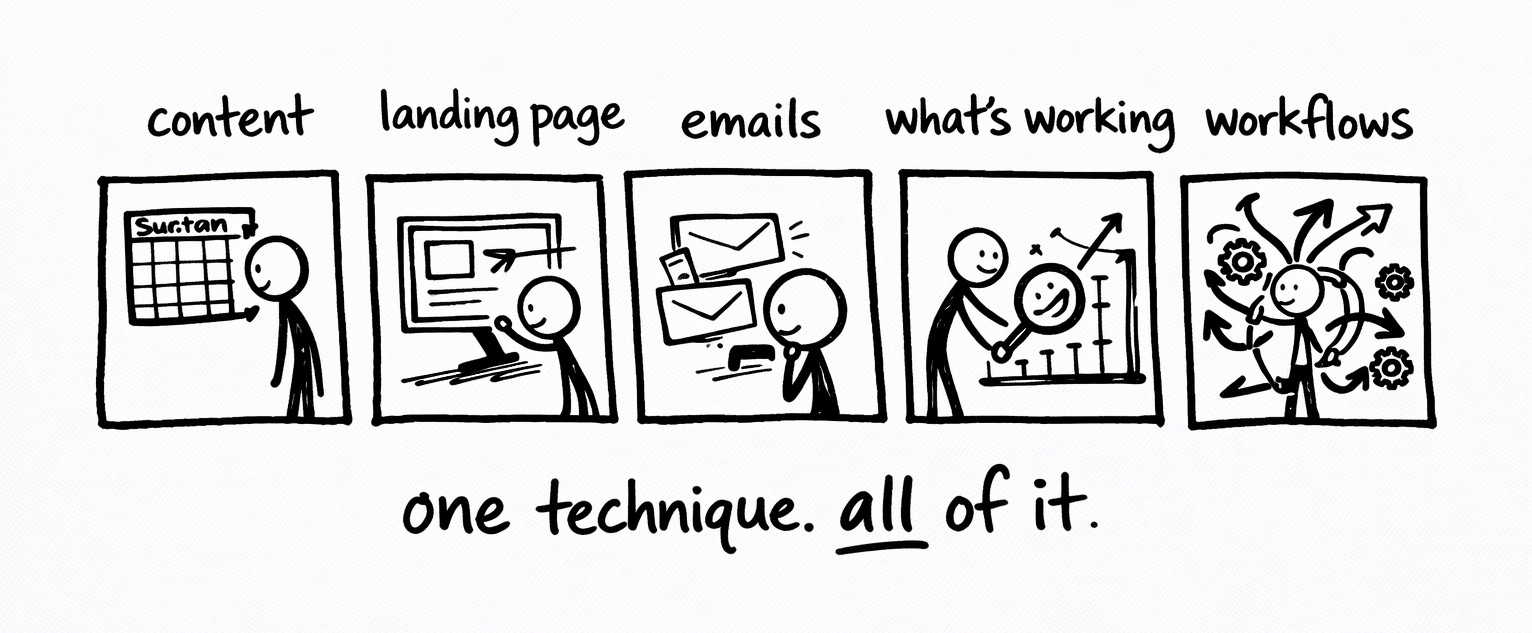
4. Reverse-Engineer What’s Working (So You Can Do More of It)
This one’s criminally underused. Take your 5 best-performing pieces (highest engagement, most shares, best conversion) and ask:
Here are two groups of my content.

GROUP A - My best performers:
[paste 5 posts/pieces that got the most engagement, shares, or conversions]

GROUP B - My average performers:
[paste 5 posts/pieces that did fine but nobody talked about]

Analyze both groups across these dimensions:
- Hook style: what technique opens the piece, how many words before the reader is locked in
- Structure: how the argument builds, section length, pacing, where it accelerates and where it breathes
- Topic framing: how the subject is positioned, what angle makes it feel fresh or urgent
- Emotional tone: what the reader feels at the open, middle, and close
- Specificity: how concrete vs abstract, how much example vs theory
- CTA approach: where it lands, how it's framed, hard ask vs soft invitation
- Length: word count, paragraph count, ratio of setup to payoff

Now work backwards:
1. What patterns show up in every single Group A piece that are absent from Group B?
2. What patterns show up in Group B that are actively dragging those pieces down?
3. What is Group A doing in the first 3 sentences that Group B isn't?
4. What is Group A doing in the last 3 sentences that Group B isn't?
5. If I could only change one thing about how I write my average content to make it perform like my best content, what would it be and why?

No generalities. Quote specific lines from both groups to support every claim. I want to see the evidence, not just the verdict.
Most creators know what works. They can point to the post that blew up. But they can’t tell you why it worked versus the one they published the day before that died in silence. Reverse prompting makes the invisible mechanics visible. And once you can see them, you can repeat them on purpose instead of by accident.
5. Audit Your Entire Workflow for Bottlenecks
This goes beyond content. Paste in a description of your current process for anything (content creation, client onboarding, product launches, weekly planning) and ask AI to find the friction:
Here's my current workflow for [what you're trying to do]:

STEP BY STEP PROCESS:
[Walk through every step from start to finish. Include the ugly parts.
The parts you know are inefficient but haven't fixed yet.
The parts you do "because that's how I've always done it."
All of it. The messier the better.]

For each step, I've noted:
- Approximate time spent: [how long each step takes]
- Tools used: [what software, platforms, apps]
- Done manually vs automated: [be honest]
- How I feel doing it: [energized, neutral, soul-crushing, etc.]

Now tear this apart:
1. Where are the obvious bottlenecks I've gone blind to?
2. Where am I doing manually what could be systematized or templated?
3. Where am I spending 80% of the time for 20% of the results?
4. Where am I doing steps out of order that create unnecessary rework?
5. What steps could be eliminated entirely without affecting the output?
6. What would this workflow look like if someone ruthlessly efficient rebuilt it from scratch?

Don't be polite. I've been living inside this process too long to see it clearly. That's why I'm asking you. Assume everything is up for questioning.
I ran this on my own publishing workflow two months ago and discovered I was spending 40 minutes per post on formatting that could’ve been templated in 5. (Forty minutes. Per post. For months. I’d rather not calculate the total. Some math is better left undone.)
Skipped Everything Above? Fine. Here's the Cheat Sheet.
Every example above follows the same basic structure:
1. Feed AI what already exists (your content, your data, your process, your copy)
2. Ask AI to analyze backwards (find patterns, diagnose gaps, identify what’s working or broken)
3. Refine the output with your judgment (because AI finds the patterns, but you decide what they mean)
That’s the whole framework. Three steps. Works for content, strategy, copy, workflows, product decisions, email sequences, pricing pages, onboarding flows... basically anything where you have existing material and a nagging feeling that something’s off but you can’t articulate what.
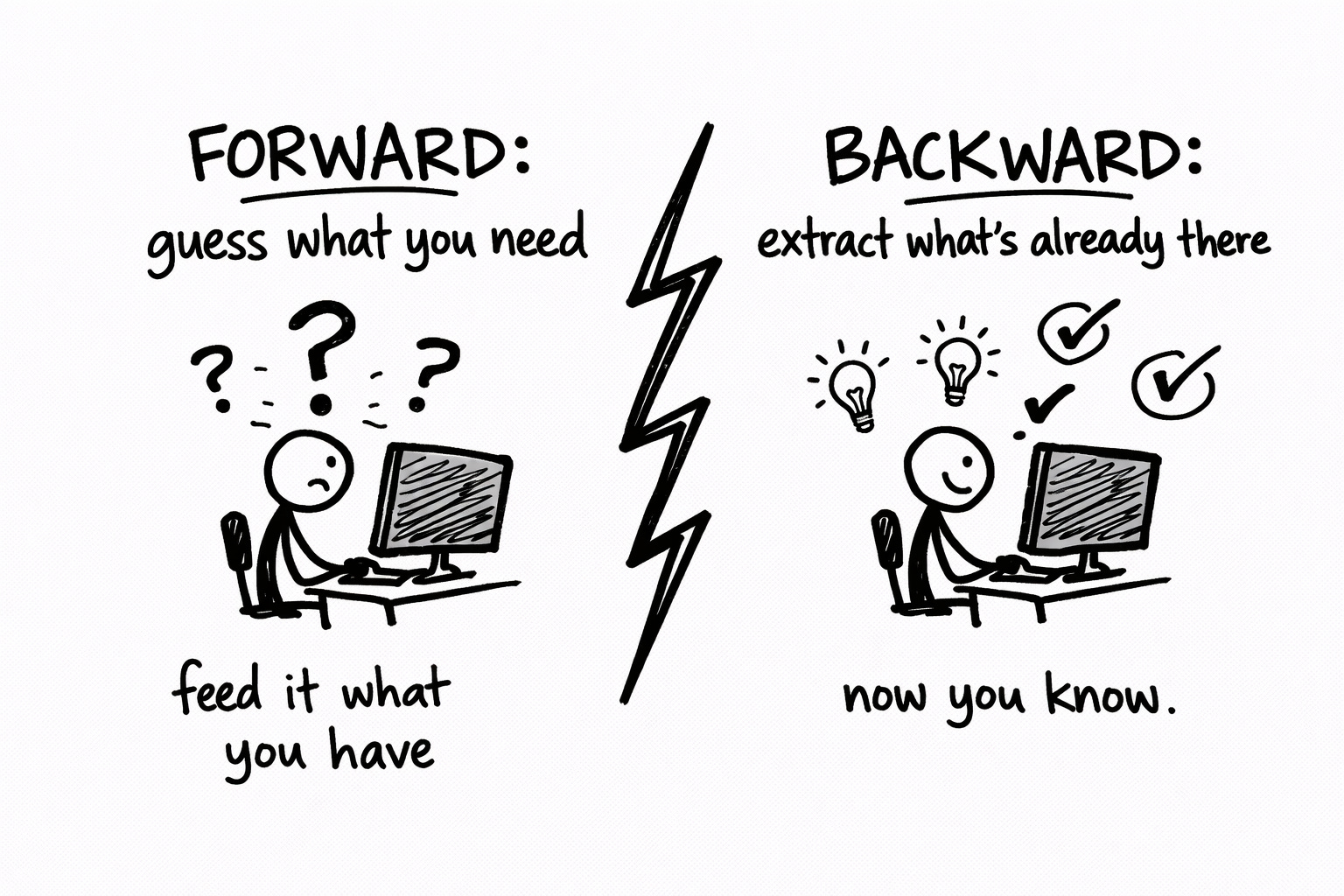
The power isn’t in the prompt. The power is in the direction. Forward prompting asks AI to guess what you need. Reverse prompting asks AI to extract what’s already there.
Stop guessing forward. Start engineering backward.
Almost Forgot: This Is Also How You Stop Sounding Like ChatGPT
Quick sidebar (because this is a newsletter about AI collaboration, after all): one of the most potent applications of reverse prompting is extracting your own writing patterns so AI can actually replicate them.
Same principle. Feed AI your best writing. Ask it to analyze the mechanical patterns (sentence rhythm, vocabulary, structure, punctuation habits). Refine the output into a working blueprint. Now AI has actual instructions instead of “be conversational and authentic.” (Which is like walking into a tattoo parlor and saying “surprise me.” Technically you gave instructions. Technically you deserve what happens next.)
I built an entire methodology around this. If you want the full process for building your own voice blueprint, the Quick-Start Guide walks you through it step by step:
Where This All Falls Apart (For Some of You)
Reverse prompting has one requirement: you need raw material worth analyzing.
If your content calendar is empty, your emails are sparse, and your processes live entirely in your head, AI has nothing to work backwards from. You can’t reverse-engineer a blank page. (You can reverse-engineer a bad page. That’s actually the sweet spot. Bad material with clear patterns is far more useful than no material at all.)
The creators who get the most from this technique aren’t the ones with perfect systems. They’re the ones who’ve been in the trenches long enough to have a messy, imperfect body of work that AI can actually chew on.
If you don’t have that yet? Start building it. Write badly. Ship imperfectly. Create the raw material that future-you will feed into AI and say “find the patterns.”
Everything else is just rearranging deck chairs.
Fifteen Minutes. Right Now. Before You Close This Tab.
Pick one thing that’s bugging you. Your content calendar. An email that flopped. A workflow that feels like wading through concrete. A landing page that gets clicks but not conversions.
Feed it to AI. Ask it to work backwards. Read what comes back.
You’ll either get a diagnosis that saves you weeks of guessing, or you’ll discover you need more raw material before the technique has something to grab. Either way, you’ll know something you didn’t know fifteen minutes ago.
This post exists because I stopped guessing. Sat down with nothing, worked backwards, and AI handed me the idea you just finished reading. The technique is the proof.
Your turn.
🧉 What's been bugging you for weeks that you haven't been able to figure out? Landing page that leaks? Email sequence that flatlines? Workflow that makes you want to fake your own death?
Drop it below. I might reverse-prompt a few of them live in a future post.
Crafted with love (and AI),
Nick “Bass Ackwards” Quick

PS... Everything in this post is the appetizer version of what I teach in the Voiceprint Quick-Start Guide. Same backwards principle, except pointed directly at your writing voice until AI stops guessing and starts following your blueprint. If reverse prompting clicked for you, this is the deep end.
PPS... You know someone who needs to read this. The friend who complains that AI “doesn’t get their voice.” The one still typing “be authentic and engaging” into ChatGPT and wondering why everything comes back sounding like a hotel checkout email. Send them this. Save them months of prompt-tweaking that was never going to work. And if you haven’t already, subscribe so you don’t miss what’s coming next. It gets weirder from here. 👇
.📚 The Reverse Prompting Trilogy
Part 1: Stop Writing Prompts. Reverse-Engineer Them. — The backwards technique that teaches AI your patterns in minutes instead of months ← You are here
Part 2: You Ran the Reverse Prompt. Now What? — How to turn AI’s diagnosis into action before the insight dies of neglect
Part 3: One Reverse Prompt Is a Trick. A Weekly One Is an Operating System. — The weekly habit that compounds
Working backwards from a good result is way easier than guessing the perfect prompt.
You end up with a clear template you can reuse, so the output stays steady and you waste less time.
I love these Nick.
Nowadays I feel stuck, because I have several ideas but find it hard to prioritize which one to go with next. I am curious to see how your audience need matching prompt could work.
Another great idea is analyzing the average performer posts along with the good performers. I never thought about adding the average performers, but I see how it could add really valuable, tangible feedback on some patterns. Thank you for sharing!🩷🦩