

📚 This is Part 3 of 3 in the “How Readers Become Buyers” series. If you’re jumping in here, start with Part 1: Your Readers Don’t Trust You Yet. It’ll make this one hit harder.
I have a paid tier.
Two courses. A workshop. A subscription vault with templates, scorecards, and tools I add to monthly. A product ladder that would make a SaaS founder nod approvingly at a whiteboard.
I have never pitched any of it. Not once. Not in 100+ consecutive daily posts. Not in a single newsletter. Not in a Note. Not in a whispered aside at the bottom of a Tuesday dispatch about Claude Projects folder architecture.
(I realize, as I type this, that I am writing a post about how to ask for money while continuing to not ask for money. The recursion is not lost on me.)
Here’s what happened. I spent Part 1 of this series building the permission ladder. Five rungs. Attention to trust. The canyon between someone opening your email and someone pulling out a credit card. I told you about Tyler, who pitched on day 31 and sold subscriptions to his mom, his roommate, a bot from Kazakhstan, and one accidental click from someone who thought they were closing the tab.
Then Part 2 laid out the five editorial plays that build trust. Show the ugly parts. Publish the post that makes you look bad. Have opinions that cost you something. Document failures live. Give away the good stuff free.
And now we arrive at Part 3. The Ask. The part where you actually open your mouth and say “I made something, it costs money, and I think you should buy it.”
I’m the wrong person to write this post. I’m also the only person who should.
The Price Tag Problem
Every creator I know who cares about what they publish, who has genuinely earned trust with their audience, hits the same wall.
They can write the post that teaches something real. They can share the win, the case study, the breakdown that proves they know what they’re talking about. They can show up week after week with content good enough that strangers DM them saying “this is exactly what I needed.”
They cannot write the sentence “this costs $99.”
(I am describing myself in the third person because directly saying “I am terrified of asking for money” felt too on the nose. But yeah. That’s what’s happening here.)
The price tag problem isn’t about confidence. It’s not imposter syndrome. It’s not even about whether you’ve earned it. I know the formula. I’ve written about the formula. I’ve taught the formula to other people. The price tag problem is structural. It’s what happens when you’ve built an entire editorial identity around generosity, around giving the good stuff away, around proving your worth through free content that’s better than most people’s paid content. You’ve trained your audience to expect everything for free. Worse, you’ve trained yourself to believe that asking would break the contract.
You’ve built a house with no door.
Gorgeous kitchen. Great bones. No way in or out.
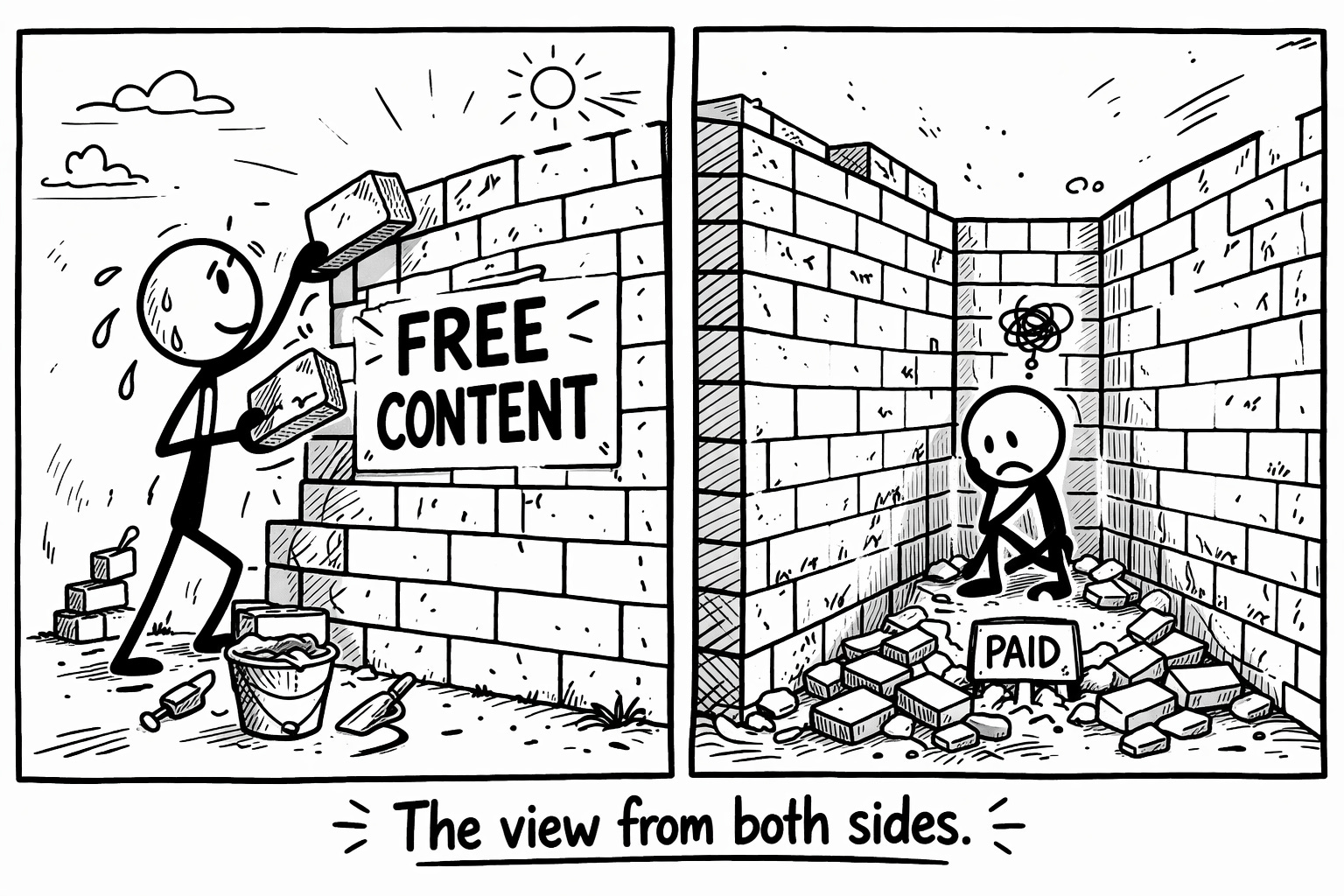
Tyler (remember Tyler?) had the opposite problem. Tyler built a toll booth before he built the road. Charged admission to a parking lot in a neighborhood no one wants to visit. Tyler’s issue was premature monetization. That’s a timing problem. Timing problems are fixable.
The price tag problem is an identity problem. And identity problems are the ones that make you draft the pitch paragraph, stare at it for ten minutes, then delete it and publish the post without mentioning your paid stuff at all. Because the free version felt safe. The pitch version felt like you were betraying something.
(Ten minutes is generous. Some of you have been staring at that draft paragraph for months. I’ve been staring at mine since I launched.)
What Everyone Gets Wrong About “The Ask”
Here’s where most monetization advice fails you. They tell you to “match your CTA to your content.” Pitch your course at the end of a post about the topic your course teaches. Simple. Elegant. Obviously correct.
It’s also completely useless if you’ve never pitched before.
Because the first pitch isn’t a marketing problem. It’s a physics problem. An object at rest (your zero-pitch streak) stays at rest unless acted upon by an outside force (humiliation, desperation, or a really honest newsletter post about your own inability to ask for money).
(I’m choosing option three. Let’s see how it goes.)
Here are the things I’ve learned from watching the monetization ecosystem while studiously refusing to participate in it. These are observations, not results. I have no results. I have an immaculate record of never asking.
1. The First Pitch Converts Worse Than Every Pitch After It (And That’s Not Why You’re Avoiding It)
Creators who’ve tracked this (people braver than me, which is a low bar) consistently report the same pattern. First pitch: crickets. Maybe one or two conversions. Third pitch: noticeable uptick. By the fifth or sixth mention, the conversion rate stabilizes.
The obvious takeaway: be consistent, repeat yourself, give it time.
The non-obvious takeaway: the first pitch is performing a different function than every subsequent pitch. The first pitch isn’t selling. It’s announcing that selling is something you do now. It’s reclassifying the relationship. Before the first pitch, your audience has you filed under “generous expert who gives stuff away.” After the first pitch, you’re filed under “generous expert who gives stuff away and also has paid things.”
That reclassification is permanent and it only has to happen once.
Which means every day you avoid the first pitch, you’re not “waiting for the right moment.” You’re postponing a one-time identity tax that gets cheaper the sooner you pay it.
(I owe approximately four months of back taxes on Substack at this point. With interest.)
2. The Permission Ladder Has a Trap Door at Rung 4
Go back to Part 1. Rung 4 of the permission ladder is “I trust your judgment.” That’s the rung where readers stop consuming your free stuff and start thinking “I would pay this person for a shortcut.” They’ve watched you demonstrate judgment across dozens of posts. They’ve seen you be wrong and own it. They’ve seen you make calls that cost something.
Here’s the trap door: Rung 4 readers don’t stay on Rung 4 forever.
If you never pitch, Rung 4 readers don’t patiently wait with their wallets open. They do one of three things. They plateau (great reader, never buyer, reads every post, never converts because you never gave them the option). They migrate (find someone who IS asking, someone whose product ladder isn’t invisible, someone who respected them enough to say “I built this for you”). Or they evaporate. Life happens. Attention shifts. The window closes.
You can stop a scroll. You can earn attention. You can build all five rungs of trust. And if you never give those readers somewhere to go next, the attention just… dissipates. Like heat from an engine with no drivetrain.
The trust you built is a perishable asset. It doesn’t rot overnight. But it doesn’t keep forever either.
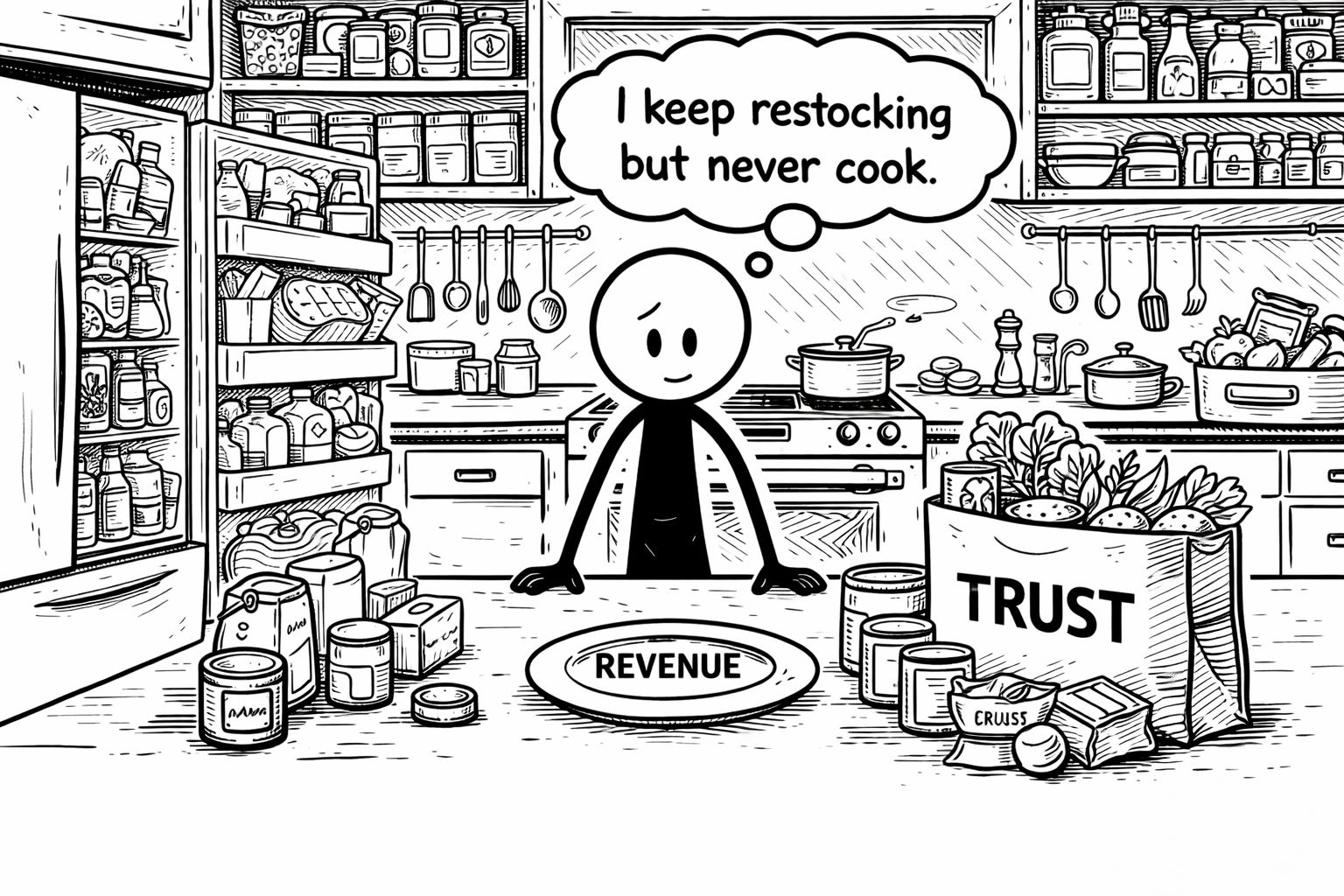
(I think about this at 2 AM sometimes. All those Rung 4 readers I’ve accumulated. Just sitting there. Like a pantry full of food I keep restocking but never cook. Butters stares at me during these 2 AM spirals with a devotion that says “I believe in you and also I would like a treat.” He’s not wrong about the treat. Probably not wrong about the other thing either.)
3. Your Audience Already Knows You Have Paid Stuff
This one wrecked me.
I thought I was being classy. Subtle. “The work speaks for itself and the products are there for people who go looking.” Dignified restraint. A sommelier who never mentions the wine list because truly cultured people will ask.
(No. A restaurant that hides the menu in the bathroom and then wonders why nobody orders dessert.)
Your readers aren’t stupid. They clicked your profile. They saw the paid tier. They noticed the links on your site. They know. They’ve always known. The question in their heads isn’t “does this person have paid products?” The question is “why don’t they seem to want me to buy them?”
And the answer they’ll construct (because humans are story machines) is one of two things. Either you don’t think the products are worth pitching (so why would they buy?). Or you don’t think they’re worth pitching to (which feels worse than being sold to aggressively).
Silence isn’t neutral. Silence is a message. I’ve written about lying by omission before. Turns out the lesson applies to more than content honesty. It applies to commerce, too. Every post without a mention of the thing I built is an implicit statement that the thing I built isn’t worth mentioning.
I just wasn’t listening to what my own silence was saying.
4. The “Pitch Ceiling” at Small Scale Is a Myth
Conventional wisdom says don’t pitch hard until you hit some subscriber threshold. A thousand. Five thousand. “Build the audience first.” Which sounds wise until you realize it’s just a more sophisticated way to avoid putting a price tag on anything.
Part 1 established that at 500 subscribers, roughly 5 to 15 people are already at Rung 4 or 5. Ready to pay. Wallet adjacent. Waiting for you to say the words.
Five to fifteen people isn’t a rounding error. Five to fifteen people, at $5 a month or $99 for a course, is the difference between “this is a hobby” and “this is a business that’s starting to breathe.”
The creators who say “I’ll pitch when I’m bigger” are making the same mistake as the ones who say “I’ll start exercising when I’m in better shape.” The pitching IS the exercise. The audience doesn’t grow because you got big enough to pitch. The audience grows partly because pitching (done well, done honestly, done with the trust you’ve earned) signals that this operation is real. That there’s a there there. That someone can go deeper if they want to. The “unprofessional” thing often outperforms the polished thing. A slightly raw, honest pitch from someone who’s earned the trust is more effective than a slick sales page from someone who hasn’t.
(Tyler pitched too early without trust. I pitched too late by never pitching at all. Somewhere between Tyler and me there’s a functional human. I haven’t met them.)
The Seven Flavors of Pitch Avoidance (I’ve Tried All of Them)
Since I apparently can’t write about what good pitching looks like on Substack (on account of having never done it on mine), let me offer something I’m actually qualified to discuss: the taxonomy of avoidance.
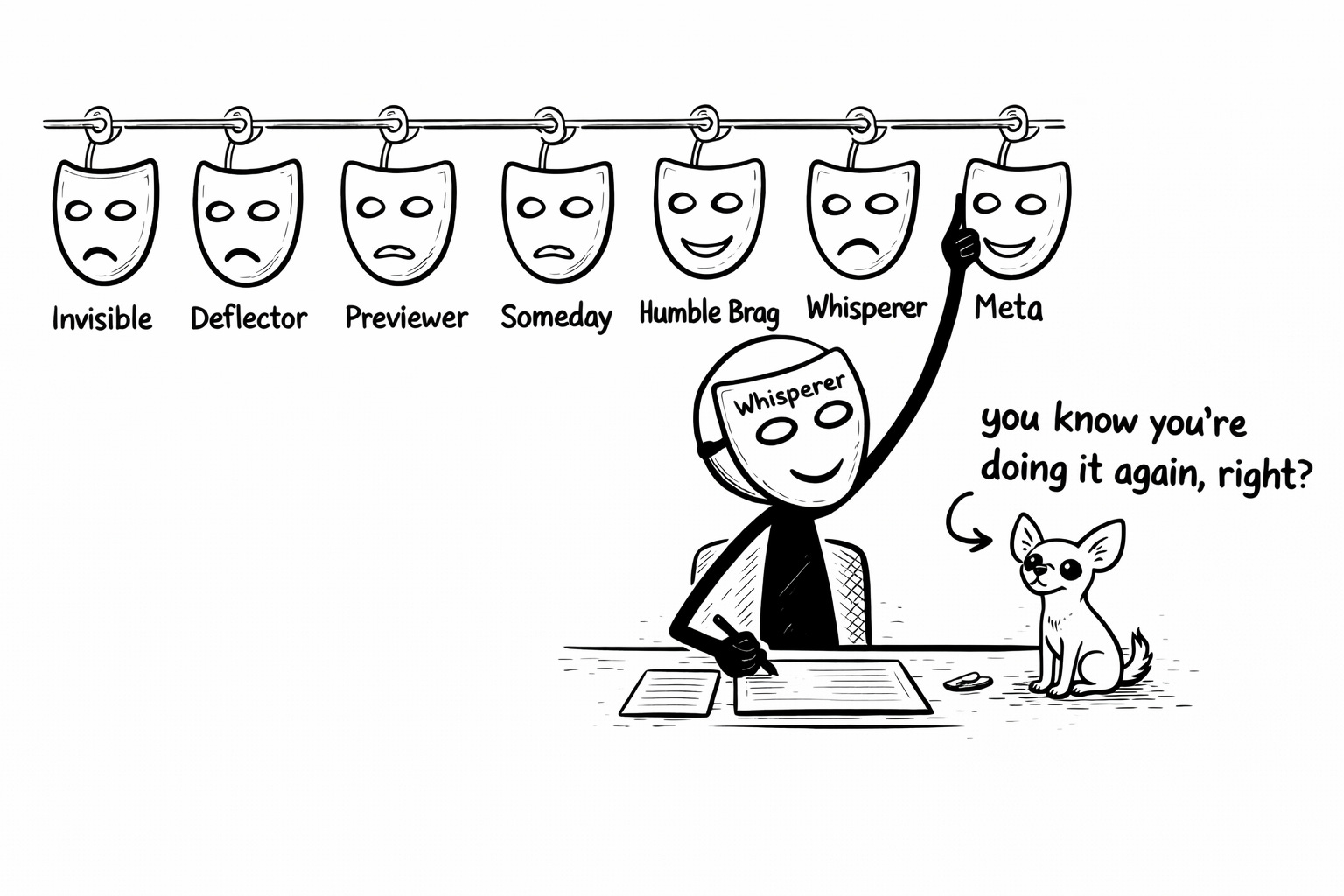
Every creator who’s earned trust but won’t pitch has a favorite flavor. I’ve rotated through all seven like a dysfunctional buffet.
Flavor 1: The Invisible CTA. You put the link somewhere readers technically could find it if they were conducting a forensic investigation. Bottom of your About page. A tiny text link in your Substack settings. A disappearing act performed on your own revenue. You tell yourself it’s “available for anyone who wants it.” What you mean is “available for anyone stubborn enough to find it,” which is almost nobody.
Flavor 2: The Deflection. Someone DMs you asking about your paid stuff. You send them the free workshop link instead. They didn’t ask for the free thing. They asked for the paid thing. You redirected them because helping feels safe and selling feels like you’re about to be investigated for wire fraud.
(I have done this. Recently. To a real person who was trying to give me actual money. I’m aware of how this sounds.)
Flavor 3: The Eternal Preview. Every post hints at deeper content. “This is what we build in the workshop.” “The full template lives in the Vault.” But you never actually say “here’s how to get it” with a link and a price. You’re a movie trailer that runs for fourteen months and never releases the damn film.
Flavor 4: The Someday Pitch. “I’ll pitch when the course is finished.” It’s been finished for two months. “I’ll pitch when I have a proper sales page.” You have one. “I’ll pitch when Mercury exits retrograde and the subscriber count is a prime number divisible by my childhood phone number.” You’re stalling. You know you’re stalling. You’re using preparation as camouflage for avoidance.
Flavor 5: The Humble Brag Substitute. Instead of pitching, you write build-in-public posts about your products. “I just finished building the Co-Write OS curriculum.” “Here’s what the Voiceprint Vault includes now.” Content about the products, never content that says “and you should buy them.” You think you’re marketing. You’re actually journaling.
Flavor 6: The One-Line Whisper. Your sign-off says something like “Paid subscribers get the templates to implement this.” One line. Every post. Never louder. Never elaborated. Never with a link that makes it easy. Mumbling “I love you” into your pillow and counting it as emotional vulnerability.
(I aspire to be this functional one day.)
Flavor 7: The Meta Post. You write a three-part series about monetization and how readers become buyers, and in the final installment, instead of actually pitching your products, you write 2,000 words about why you haven’t pitched your products.
(Oh. Oh no.)
What I’m Actually Going to Change
Here’s where I’m supposed to give you the thirteen-step framework for perfect pitching. The optimal CTA placement strategy. The conversion-rate-optimized pitch sequence.
I don’t have that. What I have is four things I wish someone had told me before I spent months building a product ladder nobody knows about.
(And yes, I’m writing this publicly because I know myself well enough to know that if I don’t commit to it in front of 500 people, I’ll find Flavor 8 of avoidance by Sunday.)
1. Pay the identity tax once.
The first pitch isn’t a pitch. It’s a reclassification. You’re announcing to your audience that you’re someone who makes things that cost money now. That’s it. The actual conversion doesn’t matter. What matters is that after the first time, “creator who sells things” is part of how they see you. Every pitch after that one is easier because the identity shift already happened.
Stop waiting for the perfect post to be the first one. The first one just needs to exist.
2. Let structure do the asking so you don’t have to.
If writing a pitch paragraph makes you nauseous, don’t write one. Put the CTA in your sign-off. Rotate it. Match it to the post topic. A post about voice development ends with a line about your course. A post about systems ends with a line about your systems product. One sentence. A link. No fanfare.
The readers who skim to the bottom (and there are more of them than you think) will see it. Repeatedly. Without you having to perform a sales pitch every time. The architecture does the asking.
3. Use serial paywalls so the content IS the pitch.
Part 1 free. Parts 2 and 3 behind the paywall. One series per month. The free installment teaches and hooks. The paid installments deliver implementation. The reader doesn’t experience a pitch. They experience a post that’s good enough to make them want the next one. The editorial trust you built in Part 2 is what makes the paywall feel like a door and not a wall.
(The whole How Readers Become Buyers series was supposed to be my first serial paywall. Three parts, natural break after Part 1, perfect test case. I published all three free because apparently I’d rather be generous than solvent. Which is a lovely quality in a volunteer. Less lovely in someone trying to build a business.)
4. Mention the thing when the thing is relevant.
When a post naturally connects to something you’ve built, mention it. By name. With context. Without apologizing for its existence. One sentence. Maybe two. Then move on.
This is not a pitch. This is a service. The reader just consumed 1,500 words about a problem your product solves. Not mentioning the product isn’t restraint. It’s like documenting a system failure and refusing to ship the fix. It’s the dumbest trade you can make. You’re protecting your comfort at the expense of the person who actually needs the thing you made.
If that sounds basic, congratulations, you’re more functional than I’ve been.
🧉 What’s the thing you’ve built (or are building) that your audience doesn’t know about yet? A course, a template, a paid tier, a service, something sitting in a Google Doc waiting for a launch date that never comes. Drop it below. Consider this your practice pitch.
Your readers survived your ugly parts, your costly opinions, and your documented failures. They can survive a price tag.
Crafted with love (and AI),
Nick “Four Months of Back Taxes” Quick

PS... If you’ve never mapped the patterns that make your writing yours, the Voiceprint Quick-Start Guide walks you through it in one sitting. Free, no email required:
PPS... If this series helped you think differently about monetization, a like, comment, or share is how Substack knows to show it to other creators stuck in the same spot. Butters would share it himself but he lacks opposable thumbs and a Substack account. He’s doing his best.
📚 How Readers Become Buyers — The Complete Series
🧉 Part 1: Your Readers Don’t Trust You Yet — The 5-rung permission ladder and why attention ≠ trust
🧉 Part 2: The Best Monetization Strategy Looks Like Self-Sabotage — 5 editorial plays that build the trust you need before asking
🧉 Part 3: I’ve Been Hiding the Menu in the Bathroom — Why I’ve never pitched my paid products, and what I’m changing (you’re here)
Isn't it amazing how posts that are open about pricing seem to have few or any comments? Like we are all reading and whistling.
"Post? What post? I don't see any post!"
Asking for money is tough. Some of it, maybe a lot of it, comes down to simple self-confidence. But as someone who still hates to sell, I will say it does get easier the more you do it. Your pitch becomes better as you get more experienced and begin to better understand what appeals to your buyer. You touched on this in the post and it's a great point.
The bottom line is if two people are selling similar products, the one that actually ASKS for the sale will be the one that gets it almost every time.
Selling isn't just about building trust with our audience, it's about building trust with ourselves. Trusting that what we create has value, and is worth asking a price for.