
This Post Was Co-Written With AI. Here’s Every Step.
The full workflow behind an AI-assisted newsletter post. From blank screen to published. Before-and-after receipts included. Steal what’s useful.

The post you’re reading was co-written with AI.
So was yesterday’s. And the one before that. And the hundred-something before that. I co-write everything. Have for months. Every single post that has landed in your inbox with my name on it was produced in collaboration with a machine that, left unsupervised, writes like a thermostat wrote a memoir. Functional. Room temperature. Absolutely convinced it has a story to tell.
And yet. (Allegedly.) These posts sound like a human wrote them. A specific human. One with opinions and a documented inability to stop using parenthetical asides. (Case in point.)
Yesterday I made the case that 54% of readers preferred AI writing in a blind test, and that this is actually good news for solo creators who give a shit. The thesis: your taste can become infrastructure. Your fingerprints can be engineered into the production process itself, not painted on at the end like a coat of “authenticity” over a prefab wall.
Lovely thesis. Very stirring. The kind of idea that makes you nod thoughtfully and then do absolutely nothing because nobody showed you how.
This is the how.
Every step. The full workflow, from blank screen to the published post you’re reading right now. Including the moments where Claude produced something that made me want to throw my laptop into a river. (I live in Paraguay. We have rivers. Massive rivers. The temptation is real and geographically convenient.)
Step 1: Before You Open Your AI (The Part Everyone Skips and Then Wonders Why Everything Sucks)
Most people open ChatGPT the way a drunk person opens a bag of chips. Immediately. Without thinking. With the kind of reckless confidence that historically precedes both great fortunes and federal investigations.
They type “write me a blog post about AI writing” and then sit there, appalled, as the machine produces something that reads like it was written by a sentient HR manual that recently discovered it had feelings and decided, on reflection, to keep them all to itself.
The problem isn’t the AI. The problem is you asked a stranger to impersonate you based on no information whatsoever. (Imagine calling a voice actor and saying “sound like me” and then hanging up. That’s what “write in my voice” means to an AI without documentation. It guesses. It guesses wrong. It guesses confidently wrong, which is worse, because now you have to figure out what’s off about something that looks almost right.)
Before I open Claude, two things are already loaded into the conversation:
A voice document. I call it a Voiceprint. It documents my writing patterns across four layers I call the VAST framework: Vocabulary (what words I use and which ones are banned on pain of deletion), Architecture (how I structure arguments and where I put the punchline), Stance (how I position myself relative to readers, which is somewhere between “experienced guide” and “guy at the bar who’s had three Jaeger Bombs and reflexively started yammering”), and Tempo (sentence rhythm, paragraph length, the staccato-then-release pattern that makes my writing sound like my writing and Not like the back of a cereal box that somehow scored a book deal).
You don’t need a full Voiceprint to start. You need something. A single page. A scrappy, half-drunk set of notes that answers questions like: What words do I overuse on purpose? What words make me physically cringe when I see them in my own writing? (”Utilize.” “Facilitate.” If I ever write “facilitate” sincerely, assume I’ve been kidnapped and this is my cry for help.) How long are my sentences when I’m writing well versus when I’m writing on autopilot? Do I swear? (Yes.) How often? (More than I ought.) Do I use parenthetical asides? (I do, and at a frequency that my future editor will describe as “clinically significant.”)
Write that down. Even the crappy version. Even the notes-app-at-2am version. Load it into your AI conversations. The output will change immediately. Not perfectly. But measurably. And “measurably better” is a starting point you can actually work with, which is more than most people have when they’re staring at a wall of generic AI prose wondering where their personality went.
Context about this specific piece. What am I writing? Why today? What did I publish yesterday and what’s the reader walking in expecting? For this post, my context was simple: “The 54% post was the thesis. This is the proof. Walk them through every step. Make it useful enough to steal. If someone reads this and can’t replicate the process by tomorrow, you’ve failed.”
(No pressure.)
Step 2: The First Prompt Is Not “Write Me a Post”
If your first prompt to AI is “write me a 2,000-word blog post about [topic],” you deserve every lifeless paragraph you receive. (I’m kidding.) (I’m mostly kidding.) (I’m 37% kidding. The other 63% has read what that prompt produces and feels strongly about it.)
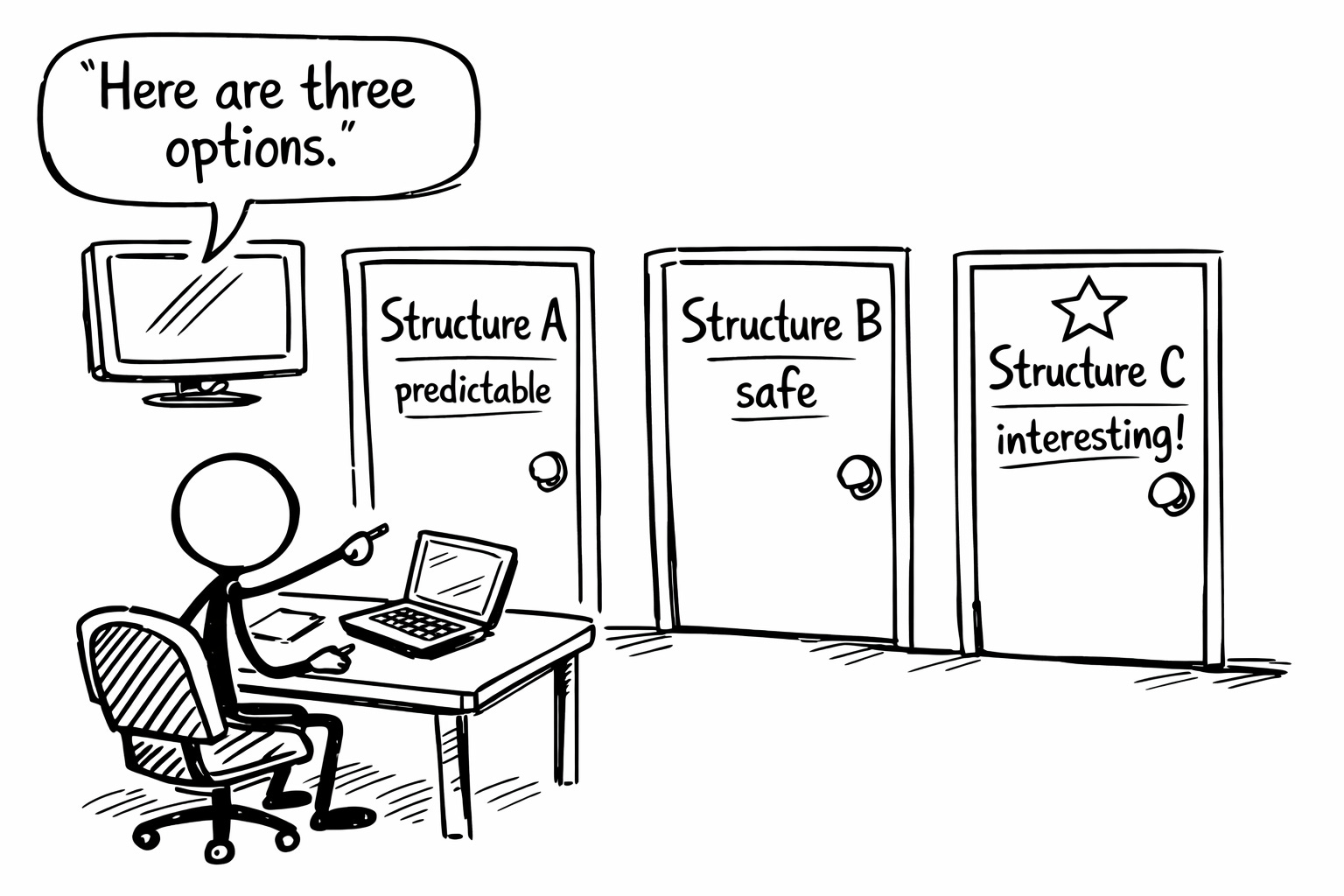
My first prompt is structural. I ask for options.
Something like: “Here’s the concept, here’s the context from yesterday’s post, here’s where the reader’s head is at. Give me three structural approaches for this piece. A paragraph each (opening move, how the middle builds, where the reader ends up). I’m choosing based on feel, not a pitch.”
Three. Not one. Because the first structure AI suggests is always the most convergent one. The template. The five-paragraph content marketing essay that’s been published nine million times and read to completion approximately fourteen. By asking for three, you push past the default into territory where something with an actual heartbeat might appear.
For this post, Claude offered three structures.
The first was chronological. Walk through the process step by step, from opening the AI to hitting publish. Linear. Clean. The reader follows the same path I follow every day. Risk: it reads like a tutorial, which is useful but not memorable. The punchline lands at the end, which means you’re asking people to trust that the payoff is coming for 2,000 words.
The second was thematic. Group everything by principle instead of sequence. One section on voice documentation, one on structural prompting, one on editing, one on quality control. Risk: it fragments the narrative. The reader learns the concepts but never feels the flow of actually doing this. It teaches the recipe without ever cooking the meal.
The third was meta. The post demonstrates the process it describes. You’re reading a post about AI co-writing that was itself co-written with AI, and the before-and-after corrections from its own production get woven into the walkthrough as proof. The post is the receipt.
I picked the meta option. Obviously. Because it’s the most interesting one, and because “interesting” is a competitive advantage that zero slop factories have access to. They’re producing at volume. Volume does not produce interesting. Volume produces wallpaper. (Nice wallpaper, sometimes. Tasteful even. But when’s the last time you told a friend about wallpaper?)
The AI proposed. I chose. This is what collaboration looks like. If you’re nodding along thinking “but I just want it to write the thing for me,” you’re not looking for a co-writer. You’re looking for a first-time ghostwriter you don’t have to pay. And the output will read exactly like what it is: work nobody claimed because nobody wanted to.
Step 3: The Draft (Where AI Does the Fast Part)
Now I ask for the draft. But the prompt isn’t just “go.” It’s specific. It references the structure we agreed on, points to the voice document already loaded, and includes a note I’ve found disturbingly necessary: “First draft. Don’t over-polish. I want rough and alive, not smooth and dead.”
Telling AI to stay rough is like telling a golden retriever not to bring you the ball. It goes against every instinct the thing has. But the rough draft gives me something with bones. Something I can grab and reshape. The polished draft gives me something that looks finished but collapses the moment I press on it.
Claude produces the draft in about thirty seconds.
I need you to sit with that number for a second. Thirty seconds. A draft that’s structurally sound, tonally in the neighborhood, and roughly 2,000 words. It took you longer to read this paragraph than it took Claude to write the first version of this entire post.
That speed is the point. It’s also the trap.
The draft is not the product. The draft is raw material. A starting point that’s in the right zip code because the Voiceprint got it there, but hasn’t found the specific house yet. Hasn’t met the neighbors. Doesn’t know which drawer the good knives are in. (The good knives are always in a weird drawer. This is universal.)
If you publish this draft as-is (and millions of people do, every day, across every platform), nobody will tell you it’s bad. That’s the trap. It’s not bad. It’s thirty seconds of work that looks like three hours of work, and your brain does the math and says “take the deal.”
(Your brain is not your editor. Your brain is a middle manager trying to close the ticket.)
Step 4: The Voice Pass (Where You Earn Your Byline)
This is the part the automation crowd pretends doesn’t exist and the quality crowd pretends can’t be systematized. Both are wrong.
I use a calibration loop I call Ink Sync. Three steps. Direct (give AI your voice document, structure, and task). Reflect (read the output like a surgeon examining an X-ray, looking for what’s broken). Correct (fix what drifted, and document why it drifted so the next draft starts closer).
Something always drifts.
Always. In a hundred-plus posts, I have never once received a first draft from Claude that I published without changes. Not because Claude is bad at this. Claude is remarkable at this. But “remarkable” and “indistinguishable from me” are different planets in different solar systems in different galaxies, and the space between them is where my entire business model lives.
I want to show you three moments from this post’s actual production where the AI went one direction and I dragged it somewhere else. These aren’t theoretical. These are real corrections. You’re reading the results.
Correction 1: Killing the Smooth
What Claude wrote:
The fundamental challenge with AI-assisted content creation is that AI produces output lacking the specific, documented patterns that make your writing recognizably yours.
What I published:
The problem isn’t the AI. The problem is you asked a stranger to impersonate you based on no information whatsoever.
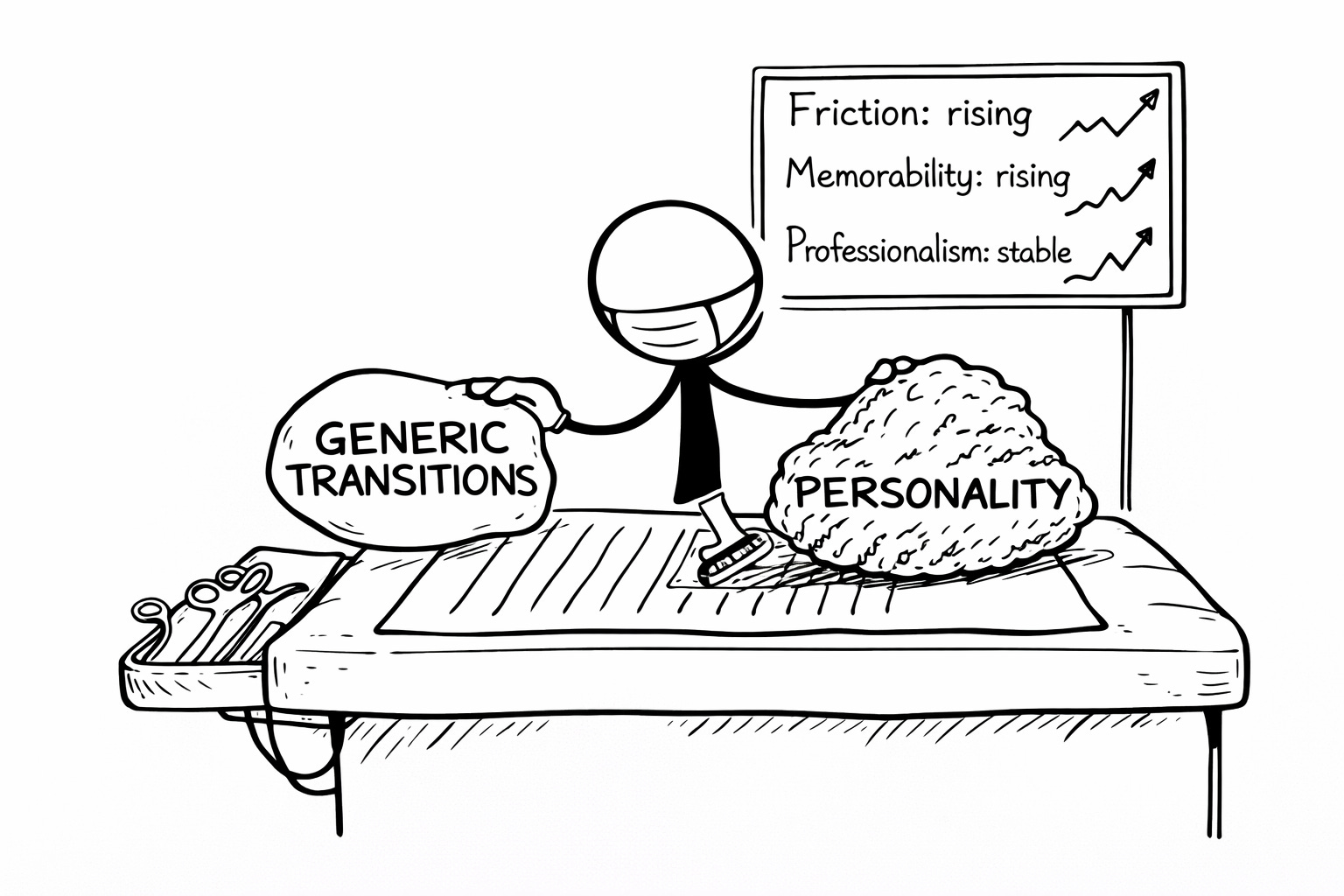
Claude’s version is accurate. I want to emphasize that. Every word in Claude’s version is factually, mechanically correct. It’s also the kind of sentence that enters your brain through one ear, finds nothing to grab onto, slides across the entire cerebral cortex without friction, and exits the other ear having contributed nothing except a vague sense that you’ve been educated. (I’m told this is also the experience of attending a two-day corporate strategy offsite. Catering may vary.)
My version is shorter. Blunter. It puts “you” in the sentence, which creates a half-second of “wait, me?” before the explanation arrives. That half-second is everything. Attention doesn’t live in smooth sentences. Attention lives in friction. In the tiny snag where the reader’s brain catches on something unexpected and has to slow down.
Smooth writing is fast to read and impossible to remember. Rough writing takes a beat longer and sticks.
Correction 2: Specificity Over Abstraction
What Claude wrote:
Even a basic set of documented writing patterns provides significantly more useful context to AI than providing no voice guidance at all.
What I published:
A scrappy, half-drunk set of notes that answers questions like: What words do I overuse on purpose? What words make me physically cringe when I see them in my own writing?
Claude told you what to do. I showed you what it looks like. Those questions aren’t abstract advice. They’re things you can picture yourself answering right now, tonight, in a notes app, possibly (ideally) after a drink that loosens the inner critic enough to let you write something real about yourself.
The words “basic” and “significantly” are load-bearing members of the Generic Sentence Construction Union. They’ve been working that job for decades. They’re tired. Let them retire. (They won’t, of course. They’ll show up in every AI draft from now until the heat death of the universe. Your job is to spot them and replace them with something that has a pulse.)
Correction 3: The Self-Deprecating Undercut
What Claude wrote:
This systematic approach represents the practical application of the taste-as-infrastructure thesis presented in the previous post.
What I published:
Lovely thesis. Very stirring. The kind of idea that makes you nod thoughtfully and then do absolutely nothing because nobody showed you how.
Claude wrote a transition sentence. Functional. Correct. The connective tissue between “yesterday’s post” and “today’s post.” Technically doing its job.
My version does the same thing but also takes a shot at my own previous post in the process, which accomplishes something Claude’s version can’t: it earns trust by acknowledging what the reader might already be thinking. “Yeah, yesterday was philosophical. Where’s the actual help?” If you name the reader’s skepticism before they feel it, you’ve got them. If you let them accumulate it silently, you’ve lost them and they don’t even know why.
(The difference between a magician who says “pick a card” and a magician who says “I know, I know, card tricks, just humor me for ten seconds” is enormous. The second one acknowledges the eye-roll and then wins you over anyway. The first one doesn’t know the eye-roll is happening, which means he’s performing for himself.)
Step 5: Read It Out Loud (The Test That Exposes Everything Your Eyes Forgive)
After the voice pass, I read the entire post out loud. Start to finish. Every word.
Your eyes are liars. (Kind, well-meaning liars. The sort of liars who tell you that outfit looks great when you’re already in the car. But liars nonetheless.) Your eyes will skim a six-line paragraph and report back that everything’s fine. Your mouth will trip on line three because the rhythm fell apart and your tongue noticed even though your brain didn’t.
What I’m listening for: Does this sound like me explaining something to someone I respect, or does it sound like a document being presented? There’s a difference. The first one has pauses and personality and the occasional profanity. The second one has “furthermore” and “it’s worth noting that” and a cadence that suggests the author is standing at a podium they didn’t ask to be behind.
If any section sounds like presenting, I rewrite until it sounds like talking.
Takes ten minutes. Catches more shit than every checklist, rubric, and second-pass prompt I’ve ever used combined. (I have a quality checklist. Eleven items. Voice patterns, rhythm, humor, structure, the whole audit. The read-aloud catches things the checklist doesn’t even have categories for. Some problems aren’t checklistable. They’re felt. And your mouth is a better feeling instrument than your eyes.)
I’m not sharing mine. (It’s calibrated to patterns that are specific to my writing, and borrowing someone else’s checklist is like borrowing their prescription glasses.) But I did build something better: the Anti-Slop Checklist Builder. Twelve questions. Your answers become your checklist. Thirty minutes to build, two minutes to run, yours forever. Free.
Step 6: Metadata, Publish, Move On With Your Life
Five to ten minutes. Mechanical. Custom URL slug with the primary keyword. SEO title under 60 characters. Meta description under 160. Primary keyword in the first hundred words. Internal links to two or three related posts.
Substack auto-generates most of this. I overwrite all of it. Substack’s defaults are built for Substack. My metadata is built for Google, Medium imports, and the person searching “how to co-write with AI” at midnight who hasn’t found me yet. (That person exists. I’d like to make it easy for them.)
Then I hit publish.
The post goes live on Substack. I pull a couple of Notes from the sharpest lines (discovery fuel). If it’s a long post, I’ll import it to Medium for search visibility. Social micro-posts get queued for the week.
But that’s distribution. That’s plumbing. That’s the 80% of the operation that can be automated (and increasingly is). The work that mattered happened in Steps 1 through 5. The taste decisions. The structural choices. The fingerprints.
Everything else is moving boxes after the art is made.
What This Looks Like on a Clock
Let me put numbers on this because “it’s fast” is useless and I hate vague claims.
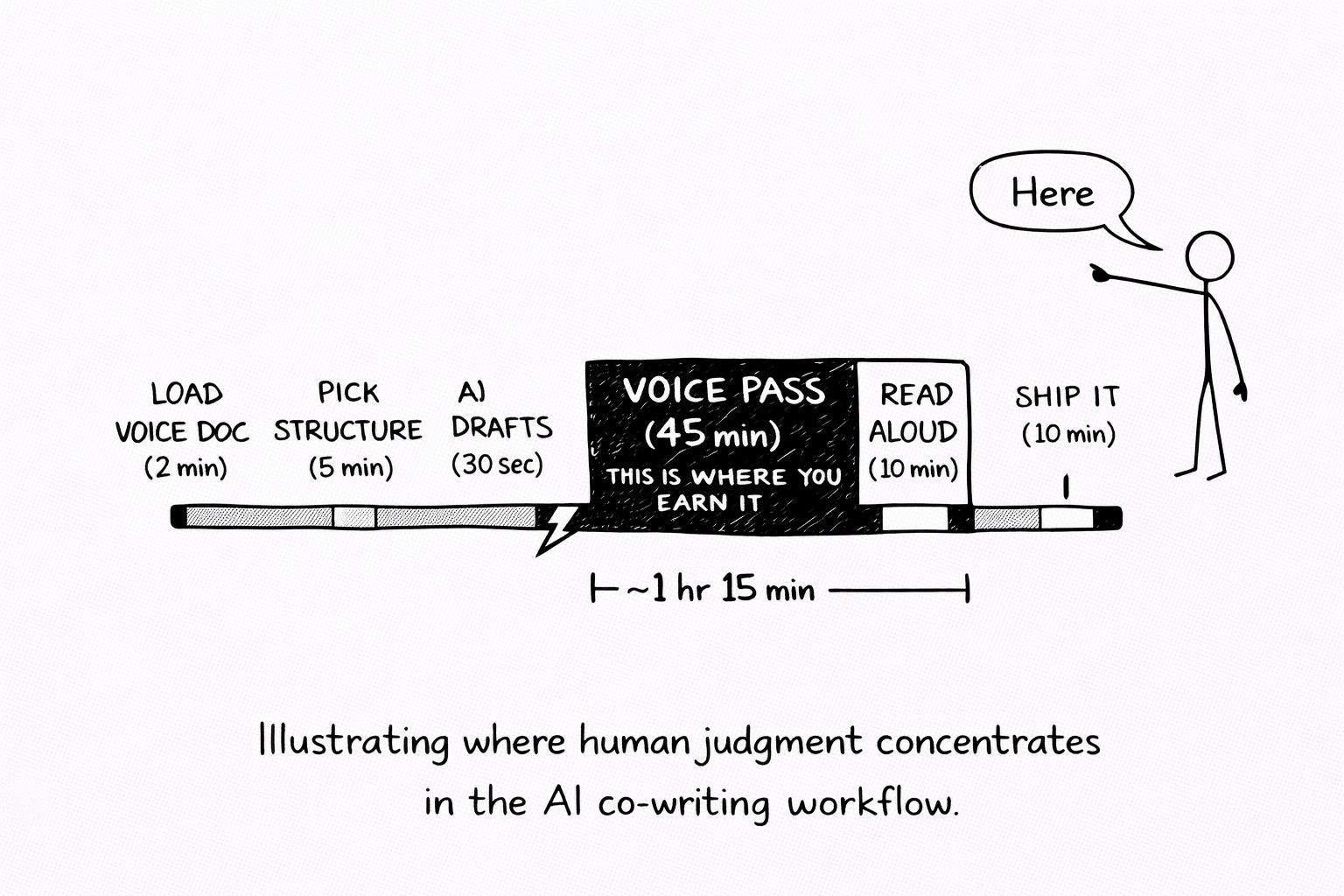
Voice document and context are pre-loaded (I use Claude Projects, but pasting them into a conversation works fine): 2 minutes. Structural prompt, read three options, pick one: 5 minutes. Claude produces the draft: literally 30 seconds. (I have feelings about how fast this is. They are complicated. Like watching someone play a piano piece in ten seconds that took you six months to learn, except the machine’s version has no emotion and you could play it better if anyone would just let you start.) Voice pass (Ink Sync loop, corrections, adding parenthetical asides, killing every sentence that sounds like it was written by someone who owns a blazer): 45 minutes. Read out loud, final edits: 10 minutes. Metadata and publish: 5 to 10 minutes.
Total: roughly an hour and fifteen minutes.
Without AI, this post takes three to four hours. With AI but without a voice document, it takes closer to two hours because I spend half the session arguing with the output instead of refining it. With AI and my documented patterns loaded, I start from a draft that’s already in the neighborhood.
That time difference is the entire argument for doing the work of documenting your patterns. Not because AI writes faster (it does, but speed is the least interesting benefit). Because your starting point moves. You stop starting from “generic” and start starting from “approximately me.” And the distance between “approximately me” and “actually me” is a voice pass, not a demolition project.
What You Can Do Today (Not Next Quarter. Not Tomorrow. Today.)
You don’t need my tool stack. You don’t need an automation platform. You don’t need a self-hosted server running custom AI agents in a country where the electricity occasionally has opinions about reliability. (That last one is very specific to my situation.)
You need three things:
An AI you can talk to. Claude, ChatGPT, Gemini, whatever you already have open in a tab. The specific tool matters less than you think. The process you wrap around it matters more than anyone’s telling you. (Most AI education is “use this tool.” The tool is maybe 20% of the outcome. The other 80% is what you do before and after the tool runs. But “here’s a workflow that requires judgment and effort” is a harder sell than “here’s a magic prompt.” Guess which one the slop factories teach.)
A voice document of any size. One page. Scrappy. Imperfect. A list of your patterns. What words you love. What words you’d rather eat glass than publish. How you start things. How you end things. Whether you use parenthetical asides at a rate that could be classified as a behavioral addiction. (I am not seeking treatment at this time.)
The Voiceprint Quick-Start Guide walks you through the full VAST framework if you want the detailed version. But the crappy version is infinitely better than nothing. A voice document that exists beats a Voiceprint that’s “on your to-do list” every single time. Start ugly. Refine later.
A willingness to treat AI output as raw material, not finished product. This is the whole thing. The whole shift. If you’re publishing what AI gives you, you’re running a content factory. If you’re using what AI gives you as the starting clay for something you then shape, correct, and leave your fingerprints all over, you’re co-writing.
One of those scales beautifully and means nothing. The other scales slightly less beautifully and compounds trust over time. Pick your path. (I’ve picked mine. If the parenthetical asides didn’t make that obvious.)
The Proof Is the Thing You Just Read
Here’s what I find genuinely interesting about this post’s structure (and you can tell me if this is vanity dressed up as insight, because it might be): the post is the proof.
You just read approximately 2,500 words that were co-written with AI. If they felt like they were written by a specific person with specific opinions and a specific relationship to parentheses, then the workflow works. The process I described produced the result you experienced. Closed loop. Receipt provided.
And if something felt off. If a paragraph went smooth and lifeless. If you caught a moment where the machine got past me and left something that tasted like it came from a can. Tell me. Seriously. Drop it in the comments. Point at the sentence. I learn more from the misses than the hits, and I’d rather know where my fingerprints slipped than publish another hundred posts assuming they didn’t.
The deal with building in public is you show everything. The good drafts. The bad corrections. The before-and-after where the “before” is a little embarrassing and the “after” is only slightly less so.
That’s what trust looks like when you’re a one-person operation co-writing with a machine that doesn’t understand trust. You show the seams. You admit the imperfections. You let readers decide for themselves whether the fingerprints are real.
Slop factories can’t do this. They can’t invite scrutiny because scrutiny requires a human on the other end who cares about the answer. A human who’ll read the comments and think “damn, they’re right, that paragraph was wallpaper” and then fix the process so it doesn’t happen again.
That’s the moat. Not the tools. Not the automation. Not the Voiceprint document itself.
The moat is giving a shit. At scale. Consistently. With receipts.
🧉 What’s the one word or phrase you kill on sight in every AI draft? Drop it in the comments. One word. No explanation needed.
Your fingerprints don’t land by accident. They land because you decided, sentence by sentence, that “good enough” wasn’t.
Crafted with love (and AI),
Nick "Forty-Five Minutes of Earned It" Quick

PS... The voice document is the foundation of everything I described today. Want the full framework? The Voiceprint Quick-Start Guide walks you through VAST and gives you the scaffolding to build your own. Free. No email gauntlet. (Fine. A very polite email gate. It asks nicely. It has manners.)
PPS... If this was useful, hit the like. If you want more of this, subscribe. Both are free. Both take less time than reading this sentence took. (And yet somehow most people don’t. Which is why I’m asking. Shamelessly. In a postscript.)
I instinctively smack away any instance of "Not A. Not B. Just C." I see in practically every AI model's output. It's the new "delve."
Not today, AI, not today.
Hey Nick! I always find your posts entertaining and informative, btw.
And, about your question, word that I kill in AI drafts is crucial.