

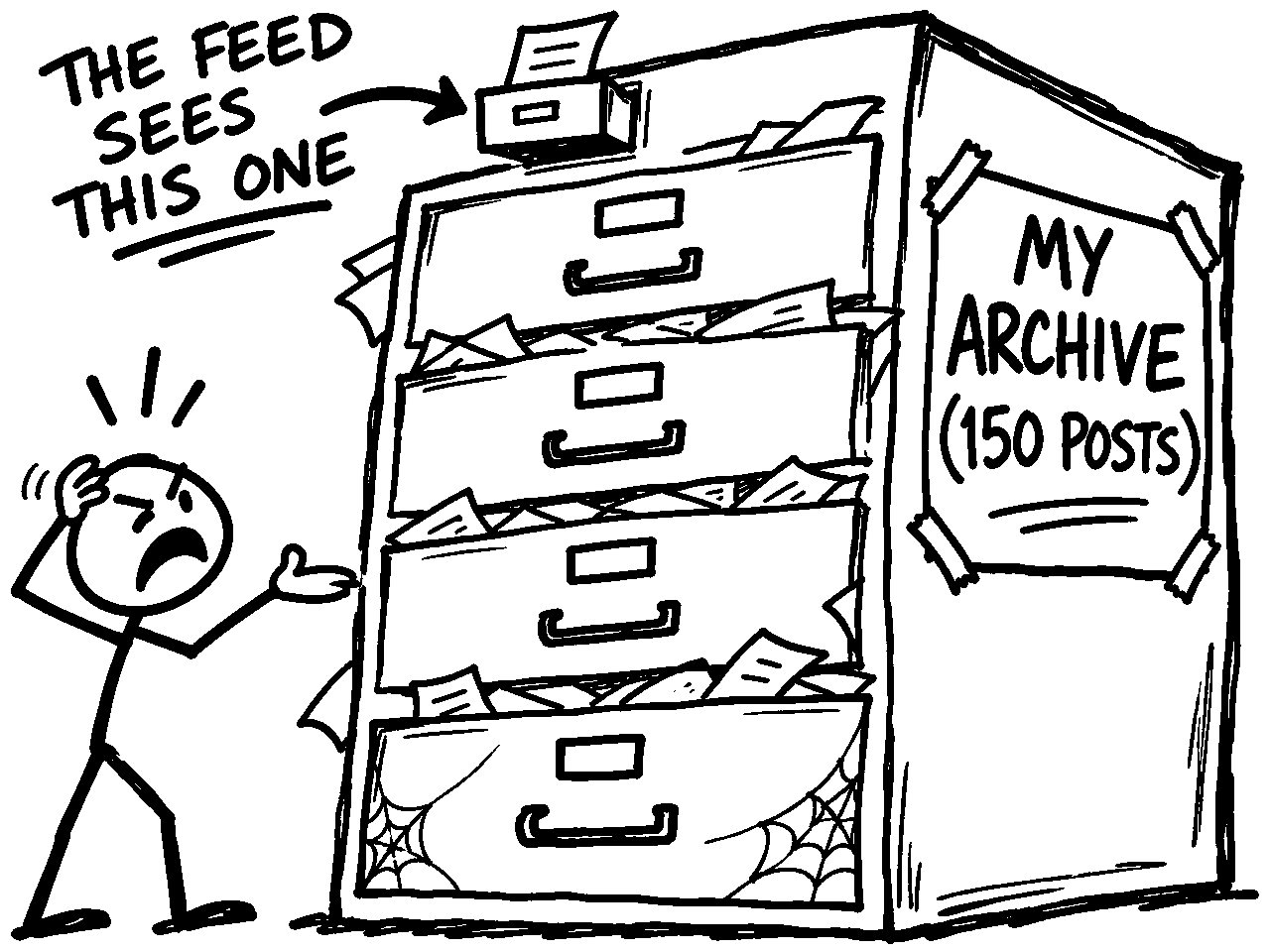
I have 150 posts on my Substack. My Notes feed has met maybe three of them.
(I checked. I pointed my agent at my own archive this week, and its reading tool tapped out after the three newest posts. The other 147 are still out there. Technically. The way a gym membership is technically still active.)
Which is a weird way to treat work you already did. You wrote those damned posts. You fussed over the headlines. You hit publish and refreshed so hard your F5 key filed for workers’ comp.
Then the feed moved on. So did you. And now your best stuff sits in the archive like the sombrero-shaped bottle of duty-free tequila you hid from yourself in 2023. Still good. Possibly better with age.
The Best Notes You’ll Post This Week Are Already Written
The Notes feed only wants what’s new. That’s the deal. Your article gets one day in the sun, then the feed forgets it ever existed, faster than your buddy forgets the pizza money they swore they’d Venmo you.
But your archive is the safest raw material you’ve got. It’s already in your voice. Your ideas, your claims, your words, written on a day you had something to say. No inventing. No staring at a blank Note box waiting for a thought to wander by. (It won’t. Thoughts don’t wander by. They have to be dragged out of the bar at closing time, still yelling for one more round.)
Every Note built from an old article gives a stranger one useful thing right there in the feed, even if they never click. Some go a step further and point back to the article, so it gets a second shift.
Other writers already run setups like this. Teodora Szasz says hers turns out five Notes from her archive in about 20 seconds, a job that used to eat an hour of her week. (The same setup drafts her comment replies too, and she says the whole thing saves her around 8 hours a week.) Lucija Tomšić says hers produces 35 Notes a week for about $8 a month. (Their numbers, self-reported. I’m passing them along, not auditing them.)
And the part both of them keep is the human part. Teodora still edits and posts every one by hand. Lucija approves every Note before it goes anywhere.
One thing before you get excited. Your archive won’t fill your whole Notes week, and it shouldn’t. Most of your Notes should be fresh: what you’re thinking today, what everyone’s fighting about this week, your take on the news nobody asked you about. Reruns are the side dish, not the meal. Your archive is one stream in that mix. The cheapest one, because you already did the writing.
I Write. The Agents Distribute.
Tattoo that somewhere your agent can’t read it. Ideally somewhere your mom can’t either.
I talk to my agents. (I don’t use prompts. I talk to them like coworkers who never ask for a raise and never microwave fish.) They’re great at reading, sorting and checking. They’re terrible at being me.
So the writing stays mine. The agents do the grunt work.
Today’s build file installs that rule in your agent, so you don’t have to get that silly-ass tattoo.
What the Build File Actually Does
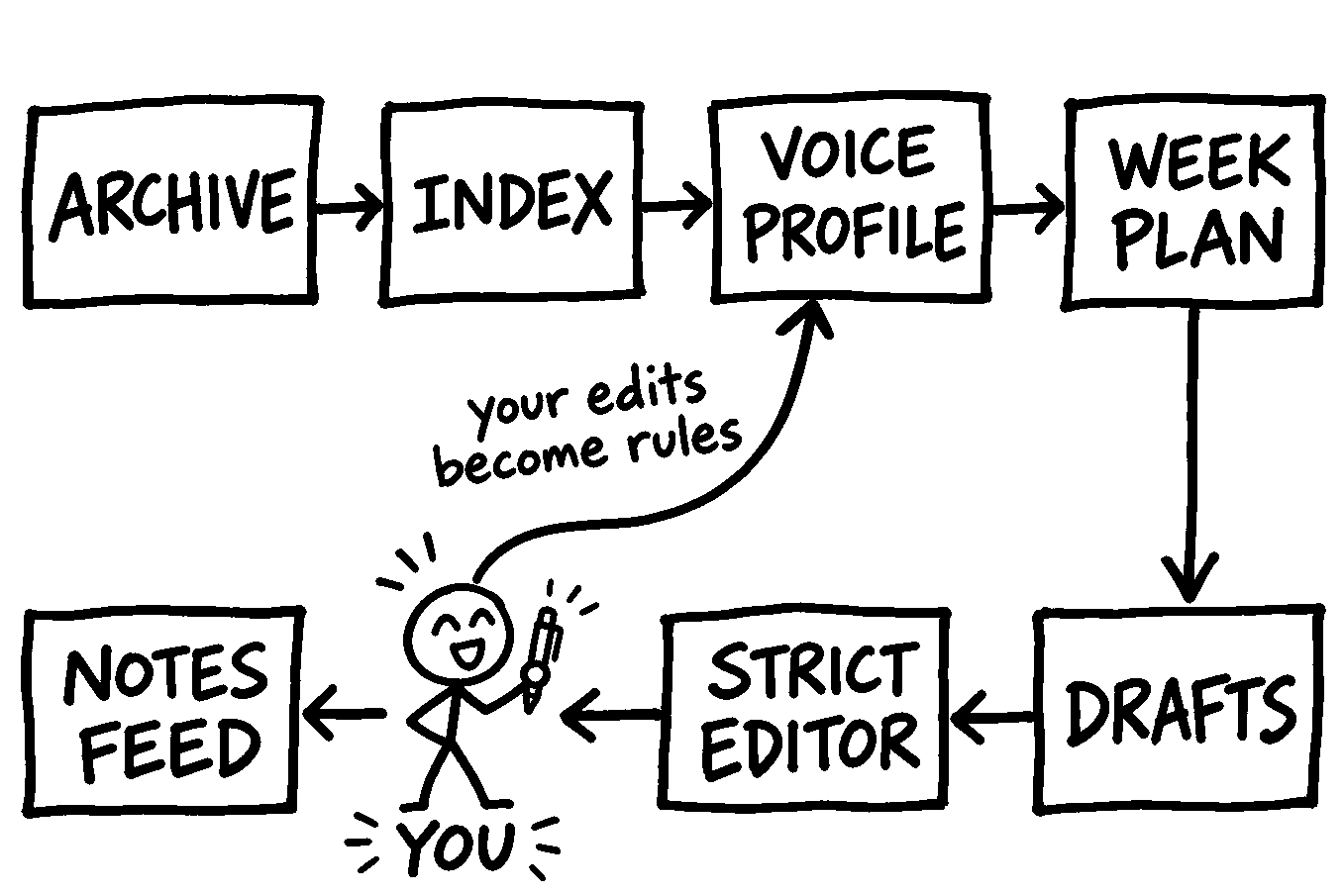
You hand it to your agent (Grok bot, Muse, Duet, Dot, ChatGPT, Claude, whatever you talk to) and it works through seven steps:
It asks you four questions first. Your Substack address, what your newsletter is about, which 10 to 15 posts sound most like you, and how many Notes you want from your archive this week. (If you don’t say, it defaults to 7. Ask for more.)
It reads your archive from your feed and your sitemap, then builds an index: the main idea of each post, who it helps, the takeaway it gives readers, and the best lines, quoted exactly.
It builds a voice profile you correct. Vocabulary, sentence shape, stance, tempo and humor, plus a never list. (Longtime readers just spotted VAST. Yes, I’m recycling my own framework. I’m allowed.) Want a sharper profile from day one? My free Voiceprint Quick Start walks you through all four VAST layers in about 20 minutes, so you show up with your voice already written down.
It plans the week. One older post per Note, five possible angles (one line, the problem, the step, still true, the question), and never the same angle two days running.
It writes two versions of each Note. Link on its own last line. No other call to action.
It switches hats and becomes a strict editor that didn’t write any of them. Every claim has to point back to a sentence in your post, or it gets the axe.
It hands you the week, then learns from what you actually posted.
Step 6 is my favorite. You want the editor to punish every lazy sentence. (Like a dominatrix who only takes payment in Oxford commas.)
What Came Back From My Archive
Here are three of the Notes it handed me, after the editor pass and before I touched them. Raw material, so you can see what you’re starting from.
From “AI Came for the Cheap Half of Know, Like, Trust” (angle: still true)
Know, like, trust still works. AI just automated the cheap half of each.
Getting known is cheap now. Getting recognized, a reader clicking because it’s your name, is still hard.
(Awareness used to be a moat. Now it’s a bouncer who stopped checking wristbands.)
AI Came for the Cheap Half of Know, Like, Trust
·Know, like, trust gets quoted like a law of nature, and for once the cliché holds up. The sucker works. People really do buy from people they know, like, and trust. That part was never the problem, and AI didn’t break it.

From “Stop Guessing What to Build. Your Notes Already Know.” (angle: the step)
A survey is where honest answers go to quietly expire.
Before you build anything, test the problem in your Notes. Keep the exact words people use when they reply.
Ask first. Build second.
Stop Guessing What to Build. Your Notes Already Know.
·I once spent eleven weeks building a product nobody wanted. (Ok, ok, more than once. I’m extremely consistent at building things nobody asked for.)

From “How to Find Your Next 20 Substack Readers...” (angle: the problem)
Nobody wants a relationship with your clanker.
I hand my agents plenty. (I say that with love. They’re my clankers.) But the conversations with readers stay mine.
So I had one find 20 people who raised their hand this month. Then I went and talked to them myself.
How to Find Your Next 20 Substack Readers Without Living in the Notes Feed
·I have a secret. (Not a fun one. Not an “I loiter in the mattress aisle at Costco until an employee asks if I’m ‘still deciding’” type secret.)

Notice what the editor did to the second one. The original post ends with “Everything else on this list is just logistics.” Good line. But a Note has no list, so the editor cut it. That’s exactly the kind of fussy, literal call you want a robot making for you.
Before and After: My Edit on the Second One
What the agent handed me:
A survey is where honest answers go to quietly expire.
Before you build anything, test the problem in your Notes. Keep the exact words people use when they reply.
Ask first. Build second.
What I’d actually post:
Surveys turn honest people into polite liars. Ask a room full of raccoons whether they love your trash. Five stars, every time.
Nobody fakes enthusiasm in a reply. They just don’t reply.
So before you spend a weekend on your next big post, float the idea in a Note. If nobody bites, you just got your weekend back. If they do, steal their exact words for your headline.
Let the replies pick your topics.
The agent’s opener was passive, it used the “this is where X does Y” shape I can’t stand, and “quietly” has quietly become AI slop. Worse, it ended by telling people to ask, right after saying asking makes people lie. So I gave it a raccoon, a reason replies beat forms, and one move a stranger can actually make. Paste that back and the agent learns the rules: active verb up top, never “quietly”, and one concrete move per Note.
The Part That Stays Yours
The agent never posts. It never schedules, restacks, likes, comments, replies, follows or messages anyone. It doesn’t want your password either. (Reading a public feed needs no sign-in. If an agent ever asks for your Substack password, treat it like a Nigerian prince asking for your routing number.)
You edit every Note. You post every Note.
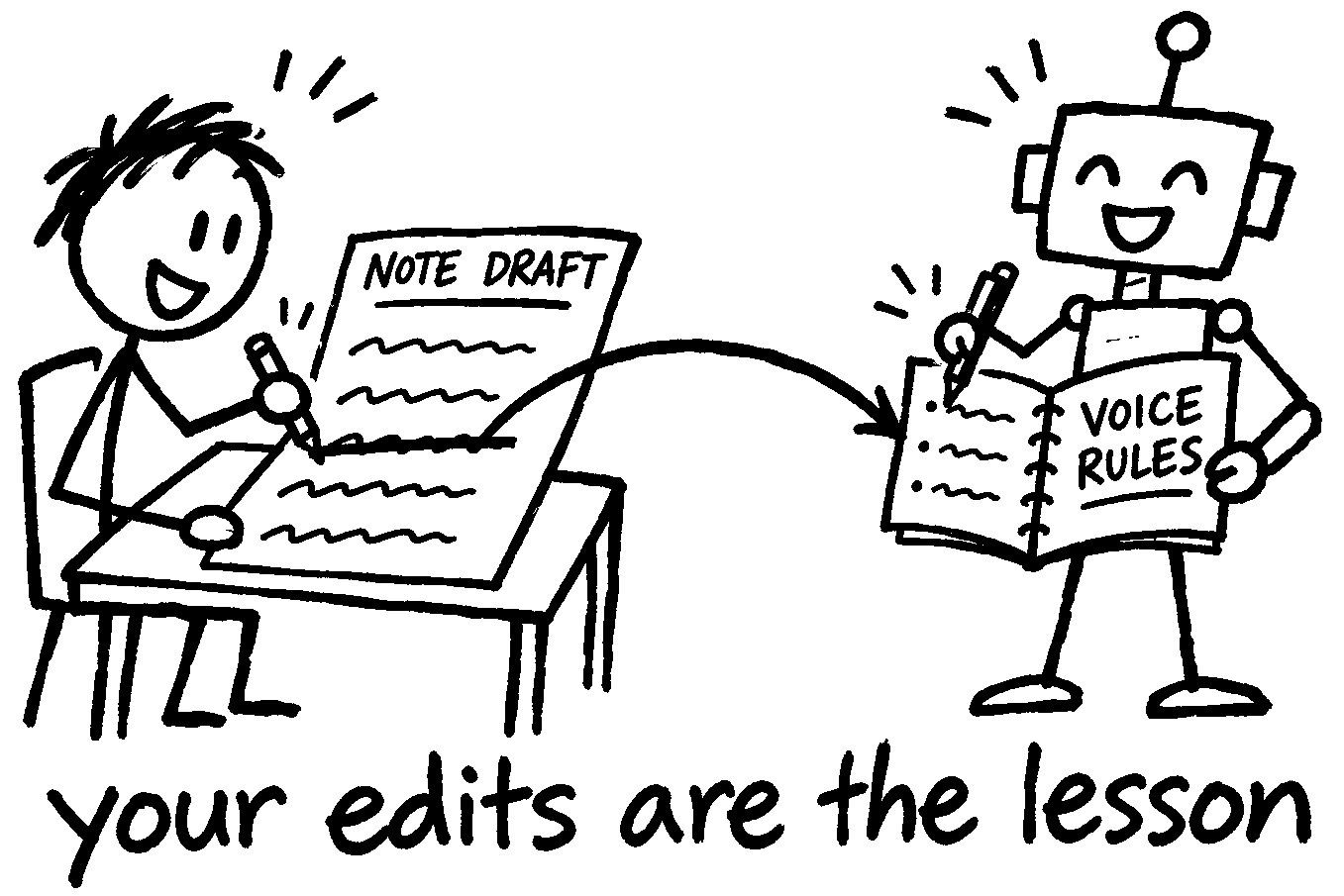
Then you paste what you actually posted back into the chat, and the agent turns each change into a rule. “Never open with a question.” “Cut the last line, they end on the punch.” When a new rule clashes with an old one, the newest edit wins.
That loop is the co-writing. Your edits are the lesson. Week one gets you a decent impression of yourself. Every week after that, you’ve been correcting it, so it gets closer.
Grab It and Run It
Click here to grab the build file before your best stuff gets any dustier. Drop in your email and the download link lands in your inbox, along with the install guide.
Then:
Open a fresh chat with your agent. Nothing from an old conversation gets mixed in.
Copy the one-line install command from your download page. Paste it in, hit send, done.
Let it lead. It starts with four quick questions and walks you through the rest. The first run takes about 30 minutes, most of it spent fixing your voice profile. Later runs are shorter.
If it says it can’t open links, upload the Markdown file into the chat instead. If it can’t open web pages at all, it’ll ask for your Substack export (Settings, then Exports).
Fair warning: some reading tools cut a long feed off partway. If yours does, the build file tells your agent to say so and read your posts one at a time instead of guessing. No bluffing about the other 147.
One Thing to Do This Week
Run it. Post three of the Notes it hands you, edited your way, mixed in with everything else you post. Paste your finals back so it learns.
Pick a side. Recycling your old posts as Notes is: (A) smart, (B) lazy, (C) both, and I don’t care. One letter in the comments, or hit reply. Fight me.
Your other 147 posts are waiting. They’re very patient.
Crafted with Love (and AI),
Nick “Dumpster Diver” Quick

PS... Your back catalog is clocking in zero hours a week. Put it back on the schedule with the free Archive to Notes build file.
PPS... Your archive called. It’s not mad, just disappointed. It says you still owe it three Notes and an apology. Reply and tell me what your voice profile got wrong, and I’ll pass the message along.