

Yesterday I gave you a system that tears your drafts apart. A dedicated AI red team. A damage report. Five categories of problems most of us can’t see in our own writing because our brains helpfully autocomplete what we meant to say instead of what’s actually on the page.
(If you missed Part 1, go read “You Need An Enemy” first. This post assumes you’ve already built the red team and received your first damage report. If you haven’t, this is going to feel like showing up to an Easter egg hunt and realizing everyone else started twenty minutes ago.)
Several of you DM’d me after yesterday’s post with some version of the same question: “Okay, I ran it. The report is brutal. Now what?”
Now we fix it. Without burning the whole draft down.
The Instinct You Need to Fight
The first time you get a damage report, the temptation is to nuke everything. Rewrite from scratch. Start over. Throw the whole draft in the trash like it personally offended you.
Don’t.
The red team found specific problems. The fix should be equally specific. You’re a surgeon, not an arsonist. (Though some days the arsonist approach is tempting. I’ve had drafts where “select all, delete” felt like the only compassionate option.)
The Fix Workflow (Three Passes, 15 Minutes)
Here’s the exact process I run after every damage report. Three passes. Each one has a single job. You don’t combine them. You don’t skip ahead. You don’t try to do everything at once because that’s how you end up rewriting the whole damn piece and losing the thing that made it yours in the first place.
Pass 1: The Structural Pass (5 minutes)
This fixes two things from the damage report: buried ledes and dead weight.
Open the damage report. Find every structural flag. Then do exactly this:
Look at this damage report for my draft:

[paste the damage report]

Here is the original draft:

[paste your draft]

Identify ONLY the structural issues (buried ledes and dead weight).

For buried ledes: Show me the sentence or paragraph that
should be leading the piece, and where it currently sits.

For dead weight: List each paragraph flagged and tell me
what the piece looks like without it — does anything break?
If nothing breaks, it's dead. Cut it.

Do not rewrite anything. Do not touch the voice. Just show
me the structural map.
You’ll get back a map. Not a rewrite. A map. “Your actual thesis is in paragraph 4. Paragraphs 2 and 3 are throat-clearing. Paragraph 7 restates paragraph 5.”
Now you do the surgery. Move the lede up. Cut the dead weight. Read what’s left. Does it still flow? Good. Move on.
(The reason you do this yourself instead of letting AI restructure is that AI will "smooth" the transitions, and that smoothing is a lobotomy with better bedside manners. Your weird, slightly janky transitions are part of your texture. Protect them like they owe you money.)
Pass 2: The Argument Pass (5 minutes)
This fixes weak arguments and missing receipts.
Here are the weak arguments and missing receipts from
my damage report:

[paste only those sections from the report]

For each one:
- Tell me specifically what claim needs support
- Tell me what TYPE of support would work (personal
  example, data point, specific detail, or logical step)

Do not write the support for me. Just tell me what's
missing and what shape the fix should take.
This is where your expertise matters. AI can tell you a claim is unsupported. It can tell you the fix needs a specific example. But the actual example has to come from your brain, your experience, your receipts. If you let AI generate the supporting evidence, you’ve just filled a you-shaped hole with AI-shaped filler.
(This is the whole collaboration-not-delegation thing in action. AI identifies the gap. You fill it with something only you could provide. The result has your fingerprints on it because the substance came from you.)
Write the supporting sentences yourself. Drop them in. Move on.
Pass 3: The Voice Pass (5 minutes)
This fixes voice drift. And it’s the one most people get wrong because they hand it back to AI.
Don’t.
Pull up the voice drift flags from the damage report. Read each one. Then ask yourself one question: Would I say this out loud to a friend?
If yes, it stays.
If no, rewrite it yourself. In your voice. Out loud if you have to. (I mutter at my screen like a lunatic during this pass. Butters watches from the couch with deep concern and total support, which is exactly the energy I need from at least one member of my editorial team.)
The voice pass is the only pass you do entirely by hand. No AI. No prompts. Just you and your instincts. This is the quality control layer that keeps the whole system from becoming an elaborate slop machine with extra steps.
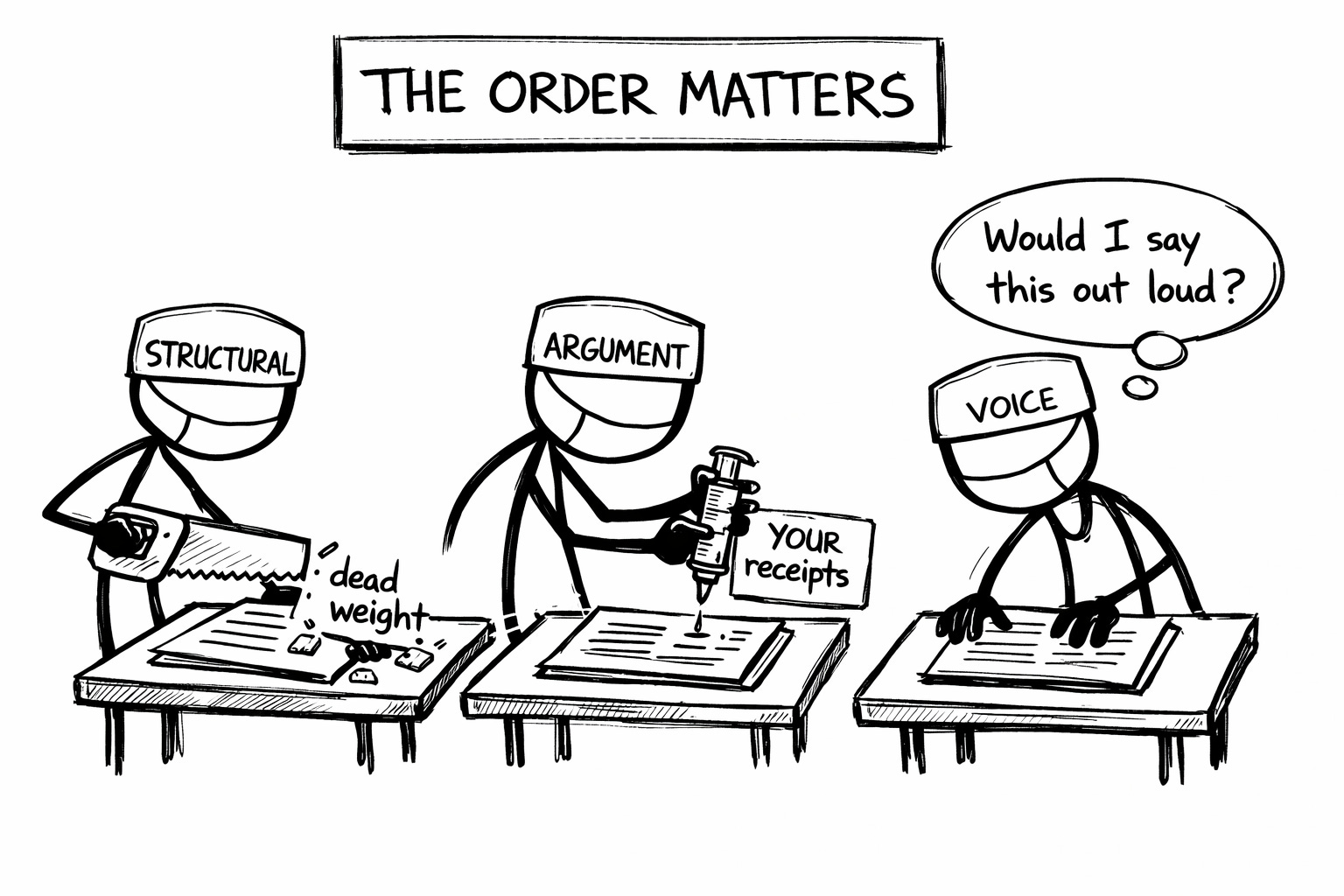
The Order Matters
Structure first. Arguments second. Voice last.
If you fix voice before structure, you’ll polish sentences that get cut. If you fix arguments before structure, you’ll add evidence to sections that move. Work from the macro to the micro. Build the house before you pick the paint.
(If you’ve ever assembled an entire piece of IKEA furniture only to realize the back panel goes on before the shelves, you understand this principle viscerally. I haven’t done this. I’m speculating. I’m also lying. There are still leftover screws in my kitchen drawer. Two apartments ago.)
The Whole System in 20 Minutes
Here’s what the full red team workflow looks like end to end:
Write your draft (your normal process)
Paste into Red Team project (separate from your writing project)
Read the damage report (resist the urge to argue)
Pass 1: Structural fixes (move the lede, cut the dead weight)
Pass 2: Argument fixes (add YOUR evidence to weak claims)
Pass 3: Voice pass (by hand, no AI, would-you-say-this-out-loud test)
Publish
Five minutes for the red team. Fifteen for the fixes. Twenty minutes total between “draft done” and “draft actually ready.”
That’s it. That’s the system.
What Changes After a Month
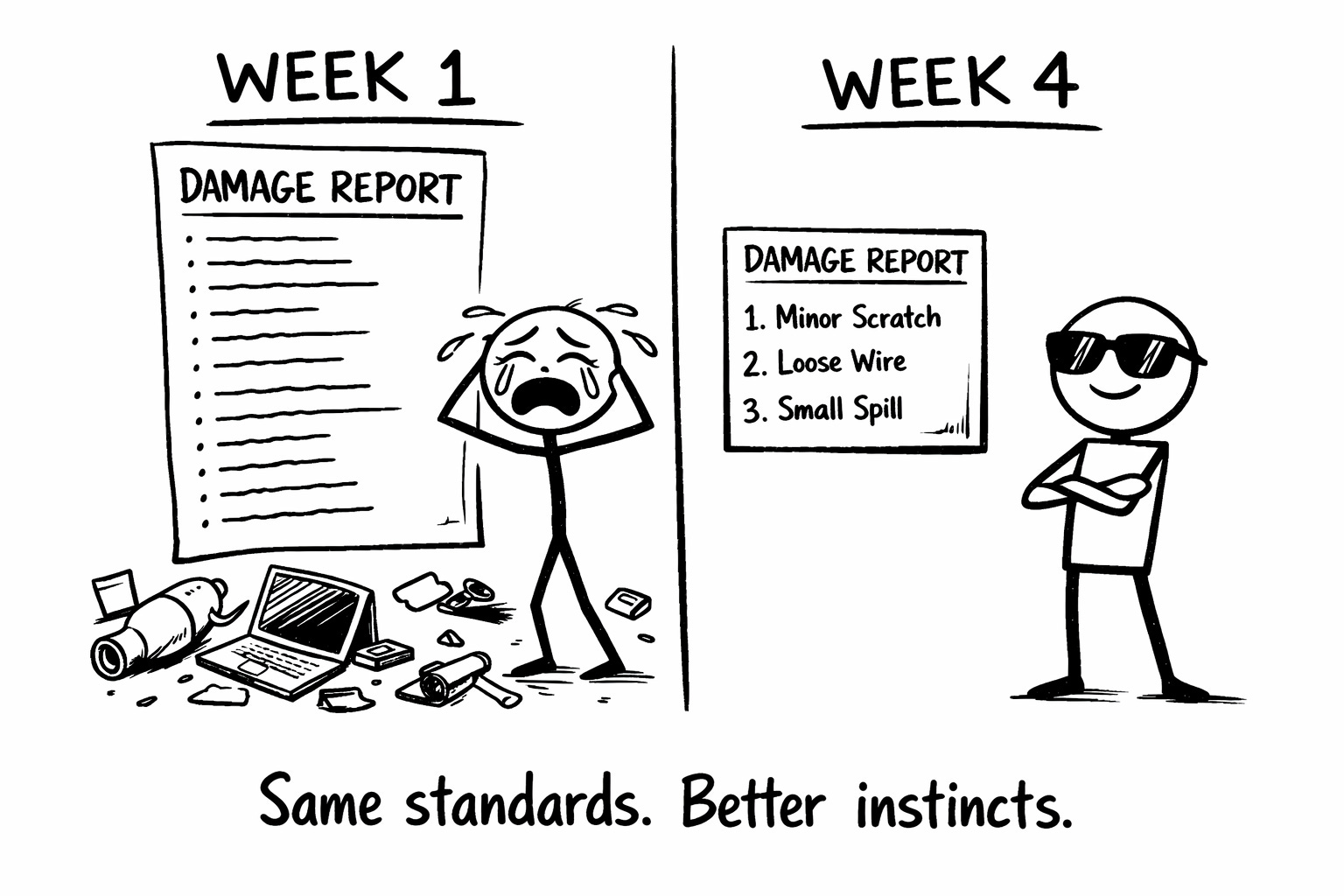
After about three weeks of running this, something shifts. You start catching the problems while you’re writing. You catch yourself burying the lede in paragraph 4 and move it up before the red team ever sees it. You notice the wallpaper phrase creeping in and kill it mid-sentence. You feel the dead weight accumulating and cut it in real time.
The red team trains your instincts. The damage reports become shorter. Not because you lowered your standards. Because you internalized them.
(The red team doesn’t become unnecessary. It becomes faster. My damage reports used to be a full page. Now they’re usually 3-4 items. The system is working. My ego is bruised but my drafts are better. Fair trade.)
🧉 Quick poll: does your editing process have actual steps, or is it just “read it, feel okay about it, publish”? No judgment. (That was my entire system until 27 days ago. I am in no position to judge.)
Your red team doesn’t make you a worse writer. It makes you an honest one. Which, as it turns out, is the same thing as being a better one.
Crafted with love (and AI),
Nick “Post-Op Recovery Specialist” Quick

PS... Want to build your own AI collaboration system from scratch? Start with the free Ink Sync Workshop:
PPS... If you’re reading this on Easter instead of hunting eggs, you’re my kind of person. Like, comment, and share this with someone whose drafts need an enemy.
It usually depends, my editing process. If it's just for me (i.e. personal or no client involvement), I read, "feel okay about it", and publish. But, if it's for a client, I follow steps (or at least, read and reread it and polish it) and publish. What's your editing process?