
Your Hot Takes Are Worthless Now
Proof of work is the new SEO

I read 63 LinkedIn posts about “authenticity in the age of AI” last week.
Sixty-three people. Same topic. Same three talking points with fake mustaches and borrowed accents.
I remember zero of them.
Not a single goddamn one.
So here’s the part that should terrify you: most of those posts were fine. Well-written, even. Coherent arguments. Proper paragraph breaks. The kind of content that would’ve gotten a B- in any business writing course.
Which is exactly why they vanished from my brain like morning fog. Like they’d never existed at all. Like the universe had simply decided those words didn’t need to keep existing, and who were we to argue?
The Funeral Was Last Year. You Missed It.
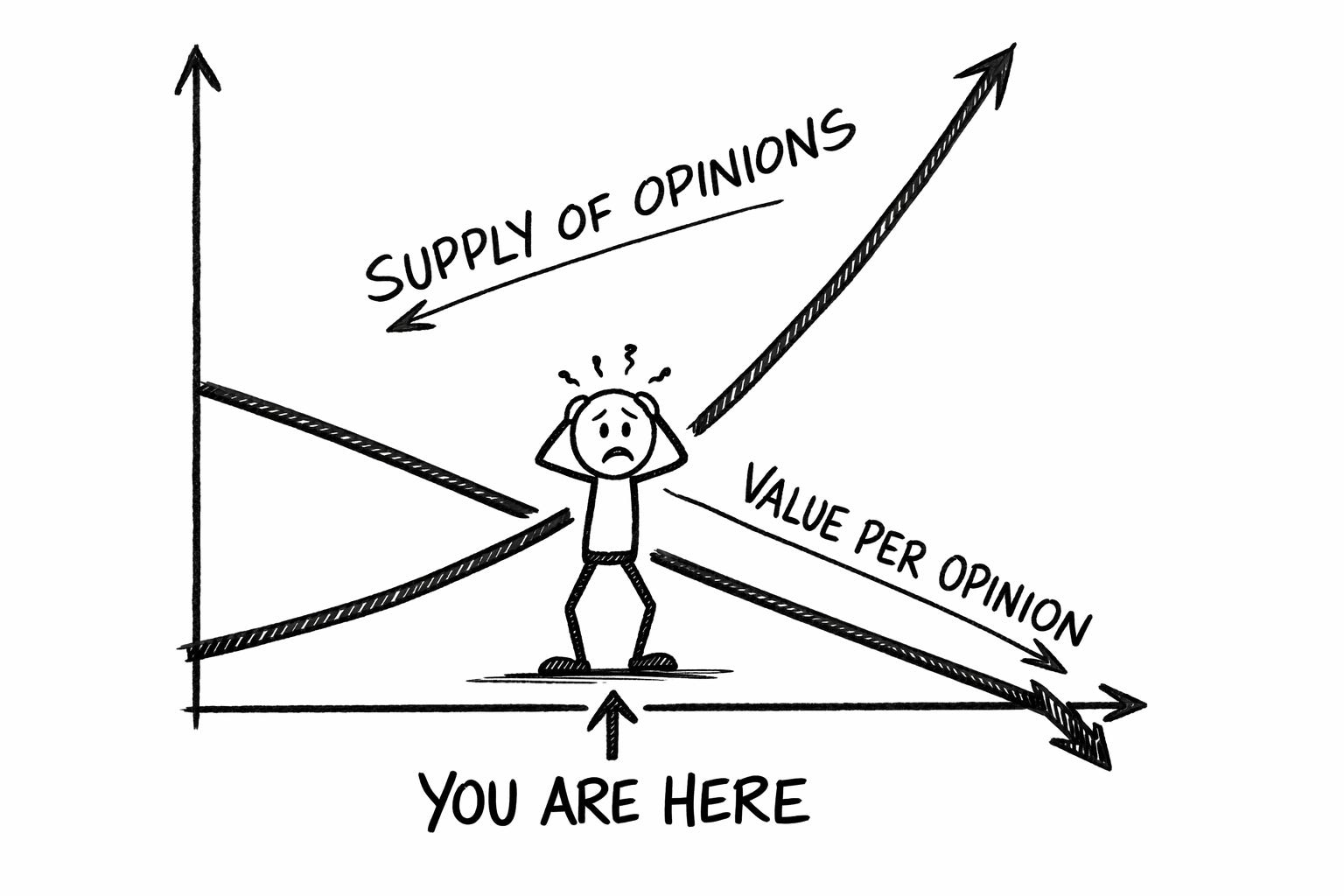
The opinion economy is dead. You just haven’t gotten the memo yet because you’re too busy penning your next hot take about (*checks notes) the importance of authentic connection in digital spaces.
AI didn’t kill it, exactly. AI just showed up at the wake and started handing out business cards. The opinions were already worthless. AI just made it impossible to pretend otherwise.
See, when anyone can produce “good enough” writing in 30 seconds, “good enough” becomes approximately as valuable as the air you’re breathing right now. Which is to say: essential for survival, but ain’t nobody gonna pay for it.
Your “unique perspective”?
ChatGPT has 63 of those too. All coherent. All B-.
Receipts or It Didn't Happen
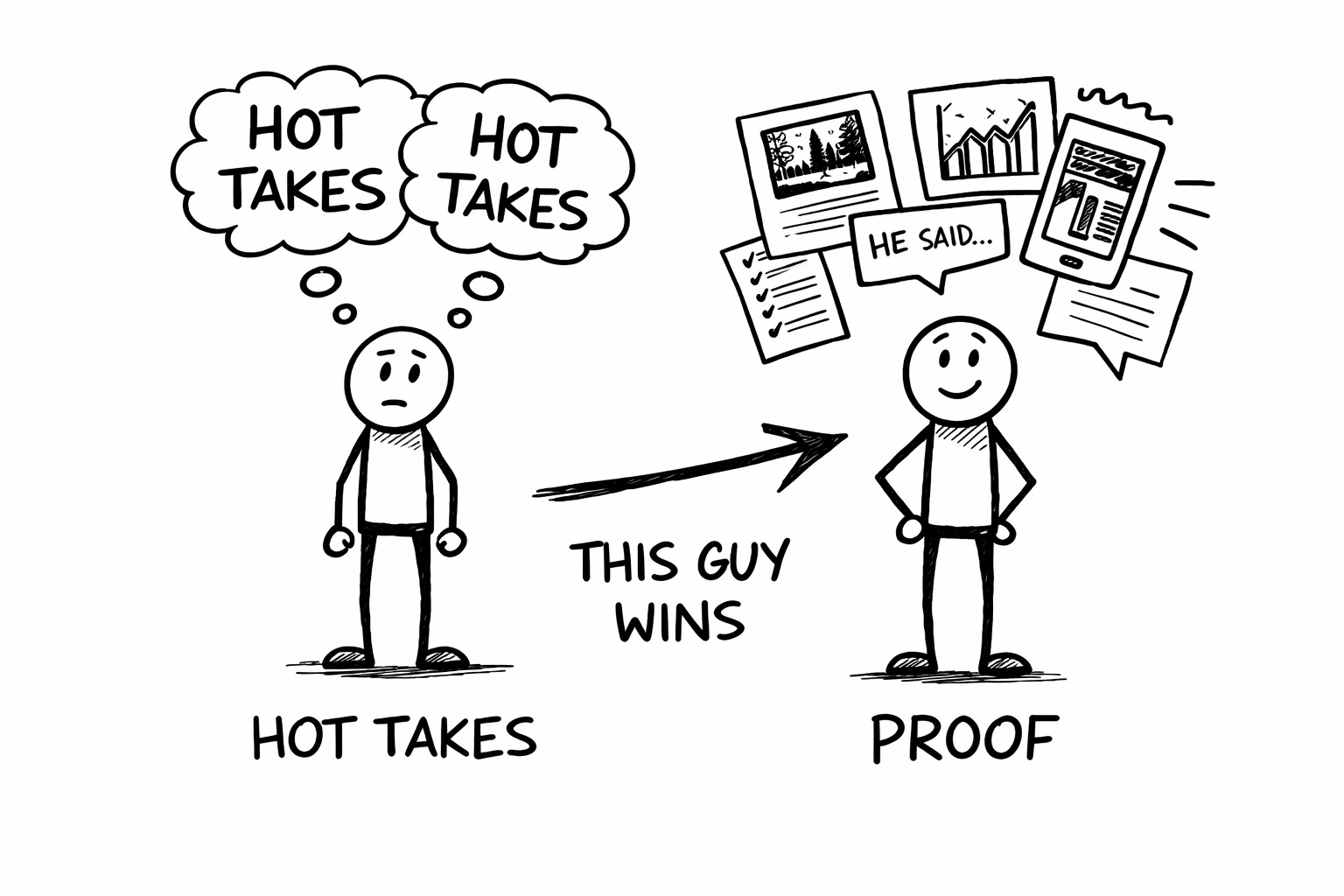
Here’s what I saw instead. One post. Buried in that avalanche of authenticity hot takes.
Someone had cracked open their drafts folder like a crime scene. Showed us the bodies. Fourteen failed attempts at the same damn idea, each one killed for a different reason. This one was too clever. This one was trying too hard. This one was actually good but felt too vulnerable, so it got buried in a folder called “maybe later” (which is where ideas go to die).
The timestamps told the real story. Four months from first draft to publish. The mess was the proof.
That one I bookmarked. That one I shared. That one I remember two weeks later while 63 “thought leaders” have dissolved into the same gooey paste of professional-sounding bleh.
The difference?
Receipts.
Evidence.
Proof that someone actually did something instead of laundering other people's ideas through their own keyboard.
The One Useful Thing Crypto Ever Did
Cryptocurrency gave us one useful idea. (One.) They call it “proof of work.” The computational effort required to validate anything. No effort, no validity. Even the blockchain has standards.
Your audience is developing the same standards. Faster than you'd think.
No visible effort? No attention. No saves. No shares. No subs. The algorithm doesn’t reject you (that would be merciful). It just lets you scream into an empty room while everyone walks past to see what the person who actually did something is showing.
Must be nice to have opinions for a living, you’re thinking.
It was. Past tense. RIP.
The reports of thinking’s death have not been greatly exaggerated.
All these “writers” getting paid to have thoughts about things, and suddenly a machine can have the same thoughts in 30 seconds flat. The entire profession of “person with opinions” exposed as a bubble that was always going to pop. We just didn’t know when.
Now we know when. It was last year. We’re living in the aftermath.
Modern creators can resist anything except the temptation to share their thoughts on every trending topic. To weigh in. To be part of the conversation. To contribute their “unique perspective” to the discourse. (Perspective here meaning whatever Claude regurgitated after breakfast, lightly edited for tone.)
The discourse doesn’t need your perspective. The discourse is drowning in perspectives. The discourse is begging someone, anyone, to please just go do something and report back for chissakes.
What the Market Actually Pays For
So what actually has value now?
Glad you asked. (You didn’t ask. I’m telling you anyway. That’s the whole relationship here.)
Original research. You surveyed 500 people. You analyzed 10,000 data points. You spent three months collecting information that didn’t exist before you collected it. AI can’t fake original data. (Well, it can. But you’ll get caught. And the reputational napalm that follows is... chef’s kiss. Career-ending.)
Documented experiments. “I tried X for 30 days.” “I built Y and here’s what happened.” “I spent Z hours doing this thing so you don’t have to.” The messiness is the proof. The failures are the proof. The screenshots of the thing not working the first twelve times are the proof.
Real interviews with real humans. You talked to someone. You quoted them. You captured something that only exists because you showed up and asked questions. AI can summarize existing interviews. It cannot conduct new ones. (It has no mouth, and yet it must scream into the void anyway.)
Unique access documentation. You went somewhere. You saw something. You experienced something others couldn’t. Geographic uniqueness. Temporal uniqueness. “I was there and here’s what it was actually like” uniqueness.
Notice what’s missing from this list?
Your thoughts.
Your take.
Your unique perspective on [trending topic].
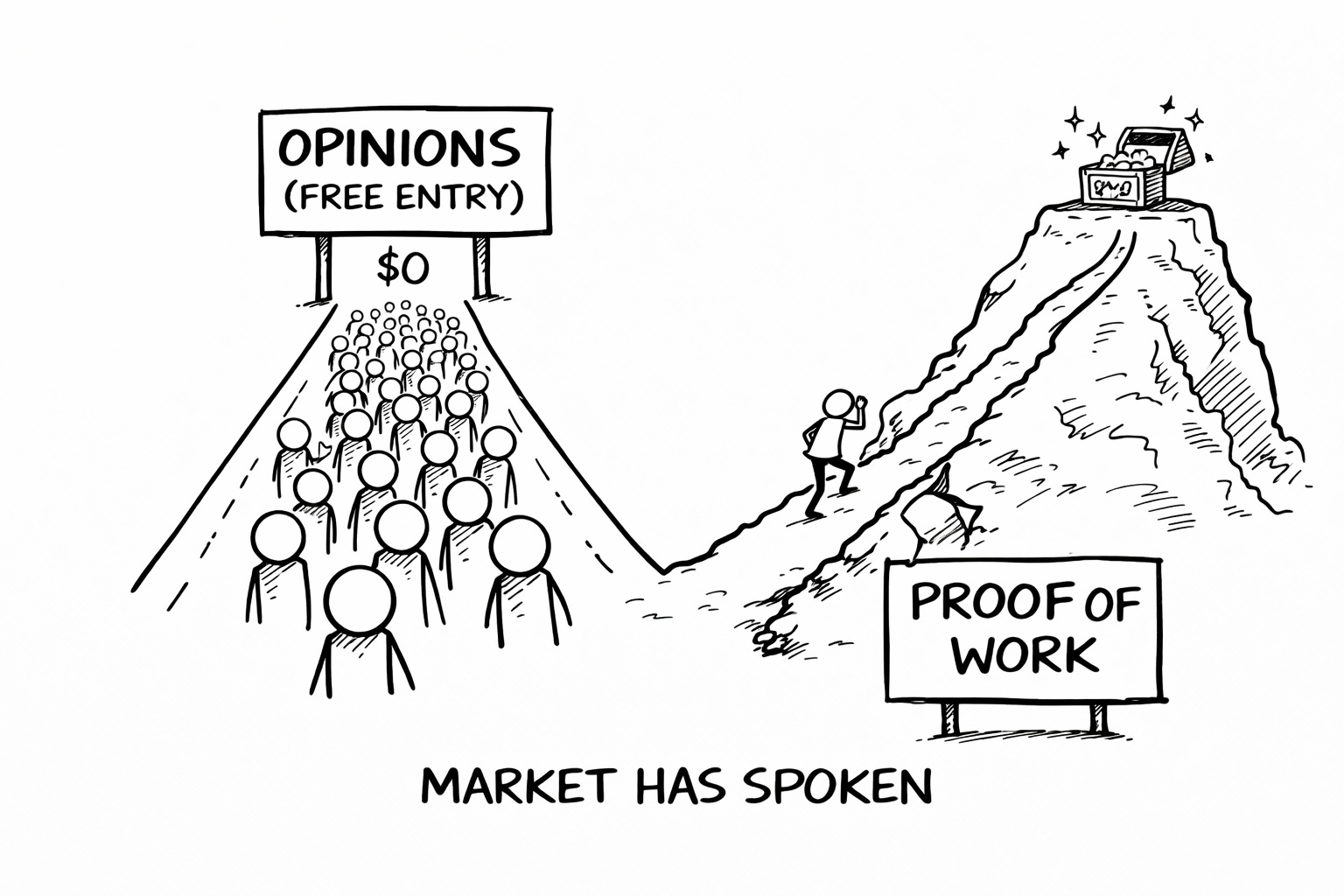
Those are commodities now. Infinitely supplied. Worth approximately nothing.
Two Questions. No Mercy.
Here’s a test for everything you publish. A brutal one. I use it on myself. (Which is how I know it’s brutal. I fail constantly.)
Part one: Could an AI have written this if given the same topic?
Part two: Could an AI have done what this piece is based on?
The first question is about the words. The second is about the work underneath them. Most content fails at question two. There’s no work underneath. Nothing that required you to actually do something, see something, experience something, collect something. Just thoughts. Just opinions. Just words arranged competently.
That’s a commodity.
Commodities compete on volume.
You will never beat AI at volume.
You’re challenging a Xerox to an originality contest.
The Part Where You Get Mad at Me
Someone reading this is getting defensive right now. (I would be. I was, when I first figured this out.)
“But I don’t have time for original research! I just want to share my perspective! I’ve earned my perspective through years of experience!”
Cool.
The attention economy doesn’t give a shit.
I don’t say that to be a dick. (Okay, maybe a little.) I say it because pretending otherwise is going to waste the next three years of your life. You’ll keep publishing hot takes. They’ll keep evaporating. You’ll wonder why growth stalled in 2025 and never recovered.
The hand-knit sweater isn’t valuable because the knitter has good taste. It’s valuable because you can see the 40 hours embedded in every stitch. The slight irregularities that prove human hands touched this thing. The imperfections that are, paradoxically, the whole point.
Your content needs visible stitches. Proof that a human cared enough to do work that machines can’t replicate.
Otherwise?
You’re competing with everyone who has internet access and 15 minutes.
That’s a lot of people. A lot of AI. A lot of hot takes about authenticity in the age of AI.
15 Minutes vs. 40 Hours
Here's some light arithmetic to ruin your afternoon:
Time to write an opinion piece with AI: 15 minutes.
Time to conduct original research: 40+ hours.
Market value of the opinion piece: approaching zero.
Market value of the research: potentially unlimited.
That ratio is only getting more extreme. Every Tuesday, some lab releases a model that’s 15% better at having opinions than last week’s model. Nobody’s releasing a model that goes outside and does things.
Your moat isn’t your thoughts.
Your moat is your willingness to do work that machines can’t do.
Everything else is just noise. Expensive noise, if you count your time. (You should count your time. It’s the only non-renewable resource you’ve got.)
I’ve restructured my entire content approach around this. Not because I’m noble. Because I’m terrified. (Passion needs a podcast and a journaling practice. Fear just needs a deadline.)
More documented experiments. More data only I have. More “I tried this thing and here’s exactly what happened, including the embarrassing parts.”
Less “here’s my take on the discourse.”
The discourse has enough takes. The discourse is made of takes. If the discourse were a physical structure, it would be a landfill. A massive, stinking monument to everyone’s unique perspectives, piled high enough to blot out the sun.
I’m trying to build something outside the landfill now.
Slower. Harder. That’s the point.
Good News: Your Competition Won't Read This Far
Most people won’t do this.
That’s not me being pessimistic. That’s me being observant. Most creators are going to keep publishing opinions. Keep optimizing for the algorithm. Keep wondering why engagement dropped and never came back.
Good.
(I know how that sounds. I’m past caring.)
Every person who chooses the opinion factory is one less person competing for the attention that goes to actual work. The bar is higher than “have good ideas.” But the runway is also clearer than it’s been in years.
If you’re willing to do the work that AI can’t replicate (if you’re willing to invest hours instead of minutes, if you’re willing to show the fuckups and the failures along with the process), you have an advantage that compounds.
The slop factories will keep churning. Let them.
They’re racing to zero.
You can build something else entirely.
🧉Discussion Thread: The opinion economy died. We just haven’t finished burying it yet. The proof economy is what comes next. Pick your side.
What’s one experiment you could run this month? One piece of research you could do? One thing you could actually do and document instead of just thinking about? Drop it below. I want to see what you’re building.
Crafted with love (and AI),
Nick “Do the Work” Quick

PS… I publish every day now. (Yes, I know what I said about volume. I contain multitudes.) Subscribe if you want more on co-writing with AI without losing your fingerprints.
This is your official notice that I've now absorbed "chissakes" into my daily vernacular.
Your analysis is spot-on. I've tried several approaches here with mixed results, and your approach gives me a clear path forward. This is going into my playbook immediately.